Who Makes New Zealand's Food Now?
Over 20 years, New Zealand food and drink factories closed, moved or were sold overseas, from Cadbury and Tui to Alliance and Anchor. Here's what changed, who owns what's left, and why it matters when the ships stop coming.
William Gregg started selling coffee and spices in Dunedin in 1862.
In October 2017, Japan's Suntory sold the Cerebos Gregg's factory to Kraft Heinz, along with brands like Fountain, Gravox and Bisto.
A Kraft Heinz spokesman said at the time: "We do not anticipate closure of any factories."
In March 2026, Heinz Wattie's told the Dunedin staff the Gregg's factory would close, with more than 30 jobs going.
Gregg's coffee is being discontinued.
That's one factory. Over the last 20 years, the same pattern has played out across beer, chocolate, frozen vegetables, fish, dairy and eggs. I went back through two decades of closures and sales to see what it adds up to.
Here's what I found.
What left the country
Some factories closed and the work went overseas.
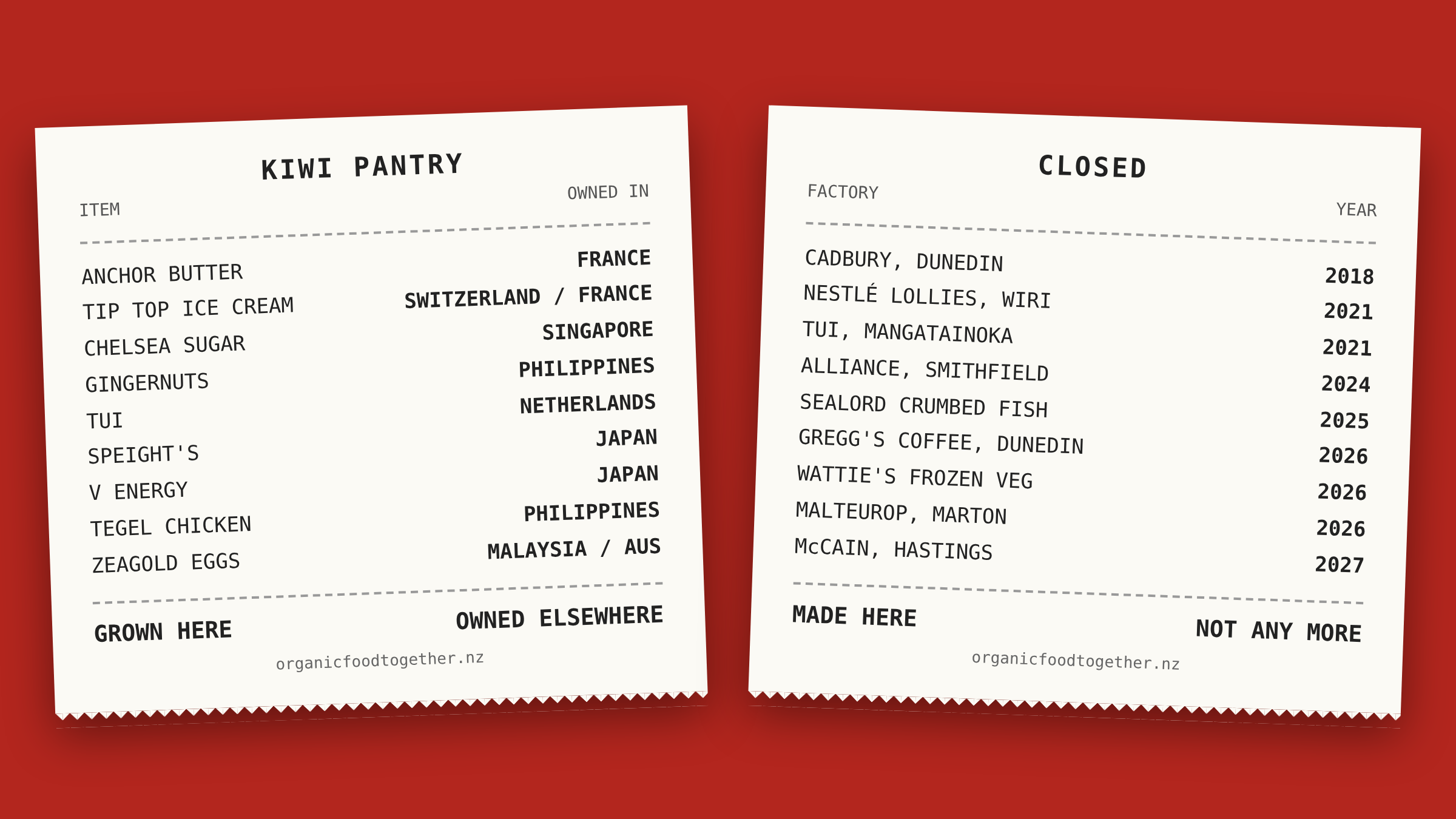
Cadbury, Dunedin. Mondelēz announced the closure in February 2017, and the factory shut in early 2018. Around 350 people were affected.
More than 70% of the plant's production capacity was exported, mainly to Australia. Mondelēz's Amanda Banfield said the factory's distance from its main market, low volume and complex product range "make it an expensive place to manufacture our products".
Mondelēz looked for a New Zealand company to keep making the local confectionery and got one formal response. It said the "unique requirements" of the marshmallow products meant "it simply wasn't possible", so production went to Australia.
Dunedin had already absorbed one closure. When Cadbury announced in 2007 that it would close Pascall's Avondale factory in Auckland, production was to go to Dunedin. So the lollies moved south, and then the south closed too.
Nestlé, Wiri. In March 2021 Nestlé stopped making lollies at Wiri, with 45 jobs gone and production moved to a bigger plant in Victoria. Maggi production stayed.
Sealord, Nelson. In October 2025 Sealord confirmed it would close its coated-fish factory, with 79 jobs going. Coated products will be processed and packed overseas, likely in Vietnam, using Sealord-caught fish. So the fish is caught here and crumbed in Vietnam.
Malteurop, Marton. New Zealand's largest malthouse, supplying about 70% of the malt sold here, was due to close at the end of September 2026. The big buyers are expected to move to Malteurop's plant in Geelong. Malteurop itself belongs to Vivescia, a co-operative of French farmers.
McCain, Hastings. McCain is closing its Hastings plant by the end of January 2027, citing "a shift in how McCain will supply its vegetable portfolio".
Heinz Wattie's. I covered the Wattie's and McCain closures in more detail in Can New Zealand Feed Itself? In March 2026 Heinz Wattie's confirmed it was closing sites in Christchurch, Dunedin and Auckland, plus the frozen packing lines in Hastings, with about 300 Wattie's jobs going. It is exiting frozen vegetables, Gregg's coffee and dips, including the Mediterranean, Just Hummus and Good Taste Company brands. Its New Zealand company lost $187.9 million in 2024, after a write-down of more than $210 million.
Wattie's didn't move those products offshore. It stopped making them. None of the articles I read say what will fill the freezer space instead.
What shrank with the farms
Some plants closed because the animals stopped coming.
Alliance closed its Smithfield plant in Timaru at the end of 2024, with around 600 jobs at peak. It blamed "declining sheep processing numbers because of land-use change."
Silver Fern Farms closed its Fairton sheep plant near Ashburton in 2017 after a fall in regional sheep numbers.
This is a different story from Cadbury. The farm changed first, and the plant followed.
What moved into fewer, bigger sites
Beer shows this most clearly, and it runs the full 20 years.
In 2009 Japan's Kirin offered to buy the 53% of Lion Nathan it didn't already own, valuing the company at A$6.5 billion. Lion Nathan owned Speight's and Steinlager.
In 2011 Japan's Asahi agreed to buy Independent Liquor for NZ$1.5 billion. The Papakura company made Woodstock, Vodka Cruiser and Boundary Road beer.
In 2012 Heineken, from the Netherlands, took over Asia Pacific Breweries, which had owned 90% of DB Breweries since 2004.
So by 2012, all three of New Zealand's big drinks makers answered to Tokyo or Amsterdam.
Then they bought the craft brewers.
Lion bought Emerson's in Dunedin in 2012, paying $8 million. Its New Zealand boss said it "would be nonsensical to buy a brand like Emerson's and make any changes to it."
Lion took over Panhead from July 2016.
DB bought Tuatara in 2017. Its founder said: "We're changing the shareholding, we're not changing the recipe."
Lion bought Harrington's in Christchurch in 2018, and said the brewery "will stay in Christchurch".
Then the brewing moved.
Lion's Canterbury Brewery was damaged in the 2011 earthquakes. Lion didn't rebuild it, and moved production to Speight's in Dunedin and The Pride in East Tamaki.
The Fermentist, the Christchurch brewery Lion built in 2017 to replace it, closed in September 2021.
In 2021, less than three years after "will stay in Christchurch", Lion proposed closing Harrington's brewery. By 2024, Lion was brewing one Harrington's beer at The Pride in Auckland and another at Emerson's in Dunedin.
In 2020 DB proposed moving commercial brewing out of Monteith's in Greymouth, saying it was "no longer commercially viable, given the relatively small volumes". The gastropub and brewery experience were to stay. The man who led the fight against DB's 2001 attempt to close it asked: "How can they not brew in Greymouth, but continue to trade on all of the West Coast history?"
Tui stopped brewing at Mangatainoka in 2021, with production moved to DB's Timaru and Auckland breweries. In 2024 a DB spokesman said: "We are currently in the process of redeploying the brewing equipment to our other sites across the country."
The brands still trade on Greymouth, Mangatainoka and Christchurch. The beer comes from somewhere else.
Beer isn't the only example of production moving into fewer sites:
- Talley's closed its Westport fish factory in May 2026, with 92 staff offered work elsewhere, to "consolidate its fish processing operations".
- Goodman Fielder proposed closing its Irvines and Hot Plate bakeries in Auckland in 2017, with 147 staff affected and production moving to Palmerston North.
- In 2025, Griffin's proposed closing the Proper Crisps factory in Nelson and moving savoury snacks to Wiri from late 2027, with up to 82 roles affected.
- Fonterra closed older plants at Brightwater (2023), Te Rapa and Waitoa (2024) and the Canpac packing plant in Hamilton (2025).
The food still gets made in New Zealand. It's made in fewer places, further from the small producers who need somewhere to put their volumes through.
Who owns it now
This is the part that surprised me most. Over 20 years, a long list of New Zealand food and drink businesses were sold to overseas companies or investment funds.
| Year | Business | Known for | Bought by |
|---|---|---|---|
| 2009 | Frucor | V, Just Juice, Fresh Up | Suntory (Japan), from Danone, for €600m |
| 2009 | Lion Nathan | Speight's, Steinlager | Kirin (Japan) |
| 2010 | Synlait (51%) | Infant formula, including a2 Platinum | Bright Dairy (China) |
| 2010 | Chelsea Sugar Refinery, via its parent Sucrogen | Chelsea sugar | Wilmar (Singapore) |
| 2010 | Tegel | Chicken | Affinity Equity Partners, a private equity fund |
| 2011 | Independent Liquor | Woodstock, Vodka Cruiser, Boundary Road | Asahi (Japan), from private equity owners PEP and Unitas |
| 2012 | Turners & Growers (T&G) | Jazz and Envy apples | BayWa (Germany), controlling stake |
| 2012 | DB Breweries, via Asia Pacific Breweries | Tui, DB Export, Monteith's | Heineken (Netherlands) |
| 2013 | Oceania Dairy, Glenavy | Infant formula | Yili (China) |
| 2014 | Griffin's | Gingernuts, MallowPuffs, Eta | Universal Robina (Philippines), from PEP, for NZ$700m |
| 2015 | Goodman Fielder | Meadow Fresh, Irvines | Wilmar (Singapore) and First Pacific (Hong Kong) |
| 2016–17 | Silver Fern Farms (50%) | Red meat | Shanghai Maling (China), for NZ$261m |
| 2017 | Mainland Poultry | Zeagold eggs, MainFeeds | Navis Capital (Malaysia), nearly NZ$300m |
| 2017–18 | Cerebos Gregg's | Gregg's, Fountain, Gravox, Bisto, Raro | Kraft Heinz (US), from Suntory |
| 2018 | Tegel | Chicken | Bounty Fresh (Philippines) |
| 2019 | Tip Top ice cream | Ice cream | Froneri (Nestlé and PAI Partners), from Fonterra, for $380m |
| 2019 | Westland Milk Products | Westgold butter | Yili (China), for $588m |
| 2024 | Bostock Brothers | Organic chicken | Inghams (Australia), for $35.5m |
| 2025 | Synlait's North Island assets, including Pōkeno | Nutrition products | Abbott (US), about NZ$307m |
| 2025 | Alliance Group (65%) | Pure South lamb and beef | Dawn Meats (Ireland) |
| 2026 | Fonterra's consumer business | Anchor, Mainland, Kāpiti | Lactalis (France) |
| 2026 | Mainland Poultry | Zeagold eggs | Navis with PEP Gateway (Sydney) |
A few things stand out.
Three of New Zealand's big farmer-owned co-operatives went partly or wholly into overseas ownership. Westland's 400 farmer shareholders sold to Yili and the co-op ended. Silver Fern Farms went half to Shanghai Maling. Alliance's farmers kept 35%, and Dawn Meats completed its 65% stake on 1 December 2025.
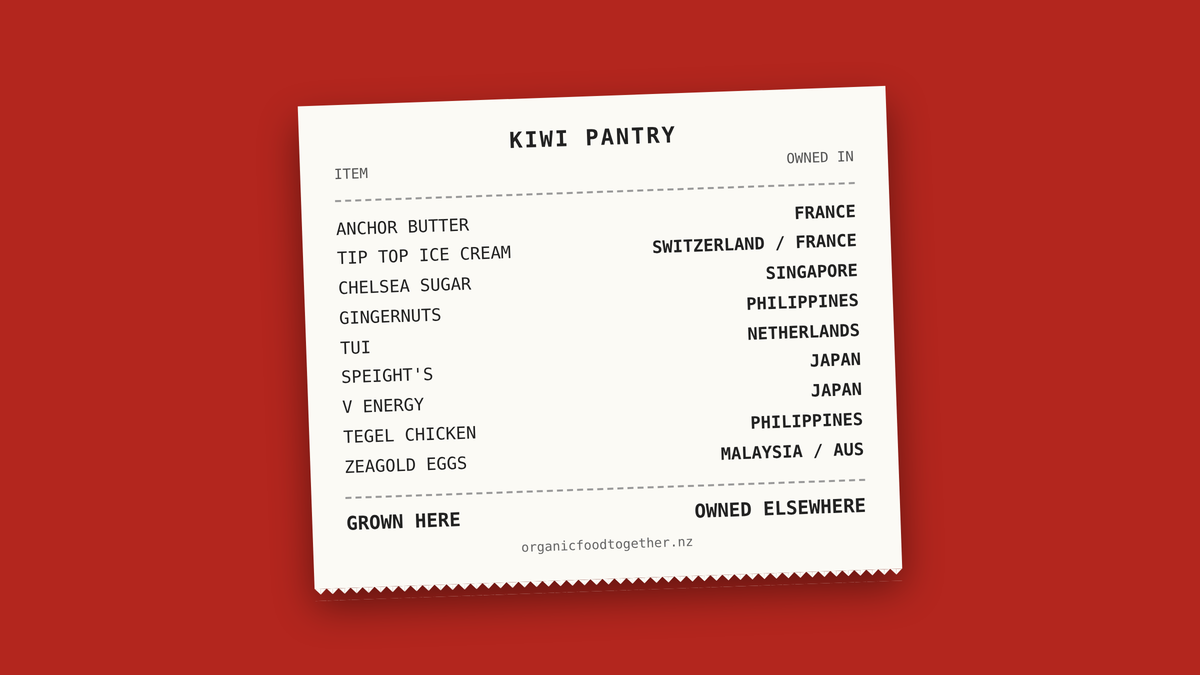
Fonterra sold Tip Top ice cream in 2019 and its consumer brands in 2026. It now supplies Lactalis with raw milk for at least ten years. The milk still comes from New Zealand cows. The company that owns the Anchor wrapper is French.
Investment funds turn up again and again. Frucor started in 1962 as a New Zealand Apple and Pear Board company, and Pacific Equity Partners owned it from 1998 until it sold to Danone in 2002. PEP also owned Tegel from 2005 until it sold to Affinity in 2010. It owned Griffin's for about eight years before selling to Universal Robina, and sold Independent Liquor to Asahi. A PEP affiliate bought into Mainland Poultry in 2026. For a fund, a food company is an asset held for a few years and then sold.
New Zealand's largest poultry processor was sold to a Philippine company in 2018. Its largest egg supplier was sold to Malaysian and Australian investors in 2026. The egg aisle is more concentrated than it looks.
And sometimes the brand goes without the factory. Bürgen bread "was invented in Auckland in 1987 by a master baker called Doug Leighton." Australia's George Weston Foods has owned it since the early 1990s. In August 2026 the company said Bürgen was no longer being produced, after retailers dropped it for "lower shopper demand and increasing pressure on shelf space". As The Spinoff put it, the most German thing about Bürgen was the punctuation.
What's filling the shelf
While the domestic plants closed, imports of ultra-processed food climbed.
A study led by University of Auckland researcher Kelly Garton found ultra-processed foods rose from 8.7% of New Zealand's food and drink imports by volume in 1990 to 21.8% in 2023. Per person, that's 15.7kg rising to 103.8kg. She is careful to say that "correlation does not imply causality".
The rules haven't changed much of this. Since 2022, fresh fruit, vegetables, meat and fish have to state where they come from, but mixed and most processed foods are exempt. So the shopper can see which country a steak came from, but not where the peas in a bag of mixed frozen vegetables were grown.
When the ships stop
New Zealand has been here before.
In 1938, a balance-of-payments crisis led the government to restrict imports and make them subject to licensing. Licences were easier to get for raw materials and machinery than for finished goods, which gave local manufacturers a protected home market. "When coupled with the restrictions caused by the Second World War, the result was a manufacturing boom." Fisher & Paykel started making washing machines and fridges in 1939, after its supply of imported ones dried up.
The war showed what depending on ships means. The government feared "disruption to shipping would block supplies of 'motor spirits'". By 1942, a private motorist could buy 2 gallons of petrol a month, and petrol rationing didn't end until May 1950.
Food went the other way. Butter was rationed from October 1943 and meat from March 1944, and "keeping the people of Britain fed, with dairy and meat exports, was the impetus for a further round of rationing". Butter rationing lasted until June 1950. In 1943 the Dig for Victory campaign had people growing vegetables at home. So the country made its own goods because the ships couldn't be relied on, and rationed its own butter so the ships could carry it to Britain.
After the war, the government "helped industry rebuild and then develop". Protection had costs: even in the 1970s, most manufacturers kept producing for the protected home market rather than exporting. From 1984 a controlled economy "was dismantled in favour of a market-led economy", and in 1988 the government announced import licensing would be phased out completely by 1992.
The point isn't to bring back import licences, which had real costs. It's that New Zealand once treated making its own essentials as a matter of national security, and then stopped thinking about it that way.
Marsden Point
I wrote about Marsden Point in April. It was built after the war to fix exactly this weakness, and it closed in 2022. Since then, refined fuel has been 100% imported. When the government looked at reopening it in 2024, the site operator's chief executive said: "There is no part of the former refinery that can be restarted."
MBIE's own words: a significant, sustained fuel disruption "would cripple industry and cause significant hardship to New Zealanders." Since 1 January 2025, fuel importers have had to hold minimum stocks by law.
So fuel now has a safety net written into law. It took losing the refinery to get one.
Covid
Covid was a reminder of how far away we are.
In the last three months of 2020, 430 container ships visited New Zealand ports, 34% fewer than a year earlier. Shipping lines moved ships to more profitable routes and dropped some routes altogether. In November 2020, ships were waiting six to nine days to berth in Auckland, against a normal turnaround of 24 hours or less, and retailers were already short of stock ahead of Christmas.
That was a disruption, not a breakdown. The ships kept coming, just fewer and later.
The staples we don't make
Two official reports have pointed at the gap.
In 2020, Manaaki Whenua Landcare Research found New Zealand produces a food surplus overall but depends on imports for sugar, cereals and coffee, "staple or popular foods that are not readily substitutable". It found 95% of dairy and 74% of beef and lamb was exported in 2018, and that the push towards premium products for the global market had left domestic food security out of most agricultural strategies.
In 2024, the Public Health Advisory Committee warned that "any disruption in trade flows or production in those countries will severely affect Aotearoa New Zealand's food security". It also found that "no agency has overall responsibility for both food security and sustainable food systems."
Sugar, cereals and coffee. Since that 2020 report, the country's largest malthouse and the Gregg's coffee factory have both been set to close in 2026. Chelsea's parent company has been Singapore-owned since 2010.
Going the other way
It isn't all one direction.
T&G has agreed to sell its New Zealand fresh produce business to J & P Turner, a Turner family company, subject to Commerce Commission clearance. The name went to Germany in 2012 and is coming back to the family it started with.
In 2025 Talley's-owned Open Country signed a conditional agreement to buy the Mataura Valley Milk plant near Gore. a2 Milk had bought 75% of it from China Animal Husbandry Group in 2021, and expected to lose about $130 million on the sale.
Small operators have built what the big plants wouldn't do for them. When the Ruakura abattoir was sold, the Andrews family, who run the Wholly Cow butchery in Cambridge, built their own micro-abattoir on the farm. When Wholegrain Organics closed in Palmerston North, Organic Flour Mills bought its mills and kept the same flour going.
New crops are filling some of the gap. Kiwi Quinoa has 17 contract growers and an export deal with a Canadian partner. RNZ's story about it opens with the McCain and Wattie's closures, which affected about 220 growers in Canterbury and 100 in Hawke's Bay.
New overseas money is still arriving, too. Singapore's ofi opened a dairy plant in Tokoroa in 2023, built to supply "South-East Asia, China, the Middle East, and Africa."
The case for all of this
There is a fair argument that none of this is a problem.
Each of these decisions made sense to the company making it. The Cadbury plant was small and far from its main market. The meat plants lost their sheep. Fonterra was paying down debt; the Tip Top sale was part of a plan to cut it by $800 million.
Overseas owners also bring money. Yili put $236 million into Glenavy, and planned another $400 million. Lion planned $2 million of upgrades at Harrington's. Dawn Meats' money cut Alliance's short-term debt by about $188 million.
The argument also goes that shoppers got cheaper choices. Some products, like Jaffas, went because people stopped buying them.
And the import figures are a correlation. Nobody has shown that a closed factory in Dunedin put a particular product on a shelf in Auckland.
So what's the verdict?
Most of these decisions were made somewhere else. Once a New Zealand factory belongs to a bigger group, it competes against that group's bigger factories. Mondelēz, Nestlé, McCain and Malteurop all chose the bigger one.
New Zealand still processes plenty of food. Most of it is milk powder, meat and fish for export, made in big plants, increasingly by companies headquartered somewhere else.
What's going is the everyday processing that fed New Zealanders: the frozen peas, the coffee, the lollies, the crumbed fish, the beer from the town on the label. Imported processed food is taking its place on the shelf.
Food security usually means whether a household can afford to eat. This is the other half of it: whether the country can still feed itself when the supply chain breaks. Food sovereignty, a country's ability to decide how its own food is produced, depends on both.
For fuel, the government now sets minimum stock levels in law. I couldn't find anything equivalent for food processing, and the Public Health Advisory Committee found that no agency has overall responsibility for both food security and sustainable food systems. That should concern the government, and it should concern anyone who buys food here.
The organic gaps are the same story at a smaller scale. A certified organic batch is exactly the kind of small, awkward volume that a consolidated plant doesn't want. Organic Dairy Hub, the farmer-owned organic milk co-op, folded in 2023. Brendan Hoare said it "got caught in the middle; they were too small to be a boutique and not big enough to compete with the big players."
In April I asked what would happen to the McCain equipment, in Can New Zealand Feed Itself?
In May, a group of Hawke's Bay growers started looking at buying the Hastings plant themselves. One of them, pea grower Hugh Ritchie, had supplied McCain for more than 30 years.
The government put $50,000 towards "the first stage of a feasibility study". The growers had estimated the full study at about $450,000.
On 29 July they withdrew. Their bid depended on the equipment staying in the plant, and it was "no longer available". "The growers liked the condition of the plant," said Central Hawke's Bay mayor Will Foley. They're now looking at a smaller site.
Heartland shows it can be done the hard way. When Bluebird closed its Washdyke crisping plant in 2009, the Bowan family, its main potato supplier, bought the building without the old equipment. They spent "the retirement money" on it and on a new production line from the Netherlands, and their first chips reached the shelves about two years later.
Hawke's Bay only wanted help finding out whether it could keep what it already had.
Before you go
If this was useful, sign up free to get the next one, or leave a one-off tip to help keep this going.