Organics Is Where Craft Beer Was in 2011
For ten years the number of small breweries in New Zealand barely moved. Then it doubled in four. I think organic food is sitting in the flat bit right now, and the big players have started to notice.
I started brewing in January 1997. In a couple of months that will be 30 years. For a long stretch after I started, the small end of New Zealand beer went almost nowhere. Beer writer Martin Craig reported in 2017 that the number of small independent breweries sat at about 60 from 2001 to 2011. Then it roughly doubled, to 130 by 2016. In the same piece, their combined output went from 7.5 million litres in 2012 to 17 million litres in 2016.
I founded Epic in 2005, right in the middle of the flat bit. Being early feels a lot like being wrong, right up until it doesn't.
I keep coming back to that graph, because I think organic food in New Zealand is sitting where craft beer sat around 2011. Most people know it exists. Plenty of people buy some. The price puts others off. And underneath, the pressure is building.
Why craft happened in the first place
America got there first, and the reason it happened matters more than the dates. Through the 20th century, the big US brewers kept buying each other up and chasing scale. By 1980, according to a Federal Reserve Bank of Richmond history of the industry, just 101 firms were making all of America's beer. Homebrewing was made legal in October 1978, and states began legalising brewpubs soon after. In the early 1980s there were only eight craft brewers in the country. By 1994 there were just over 500, and by 2000 the count of breweries had nearly tripled to 1,509. In 2024 the US had 9,922 breweries, according to the Brewers Association, almost all of them craft.
The law opened the door, but people walked through it because they wanted something the big brewers had stopped making. The same Richmond Fed piece points to changing consumer tastes as a key driver: craft drinkers cared about the style of beer more than the brand on it. Fewer companies had meant less choice and less flavour, and a lot of people noticed at roughly the same time.
New Zealand followed the same path, just later. Here too, decades of consolidation had left almost all of our beer in the hands of two companies, Lion and DB, and Emma McCashin, writing for Nelson's local history site The Prow, describes what they made as bland production-line beer. Then in 1981, former All Black Terry McCashin and his wife Bev opened a brewery in Nelson. Beer writer Geoff Griggs called it New Zealand's first new independent brewery for half a century, the one that broke the stranglehold of the two big brewers. It had been so long since anyone had applied for a brewing licence that, as The Prow tells it, nobody even knew where the forms were kept.
From there, small breweries opened slowly around the country for three decades, and then from 2012, more than 15 years after the American boom, it all went at once. I'll declare an interest here, because some of the beers that drove that explosion were mine. Epic Pale Ale won Supreme Champion Beer of New Zealand in 2006, and beer writer Neil Miller wrote in 2018 that it "really introduced New Zealand to the joys of US hops." Armageddon IPA won the first Malthouse West Coast IPA Challenge in 2008, and Michael Donaldson wrote in 2020 that it shaped how New Zealand breweries made IPA for the next five to eight years, and that it's still one of the country's most-awarded beers. In the same piece he credited Hop Zombie as New Zealand's first bottled double IPA. All three are still being sold today. I'd call them iconic, though of course I would.
When the boom came, it came hard. By 2019, a report for the Brewers Association of New Zealand counted 218 breweries, or 4.56 for every 100,000 people, against 3.04 in the UK, 2.10 in Australia and 1.96 in the US. The Herald, reporting the same figures, called it more breweries per head than anywhere else in the world.
That's the part that looks familiar to me. Craft beer was a reaction to a handful of companies deciding what everyone drank. What I see coming in food is the same reaction, only bigger: people worrying about what's actually in their food, about ultra-processed food, about getting sick, about a few big companies owning too much of what we eat, and about not knowing where any of it comes from.
The brewer was the brand
Craft beer drinkers didn't only love the flavour. They knew who their brewer was. In a lot of cases they could go to the brewery, meet the person who made the beer, and have one with them. The brewer was the personality behind the brand, and that mattered as much as what was in the glass.
I think that's exactly what people are starting to look for in their food. Who's the farmer? Where's the soil it grew in? Who decided what went on it?
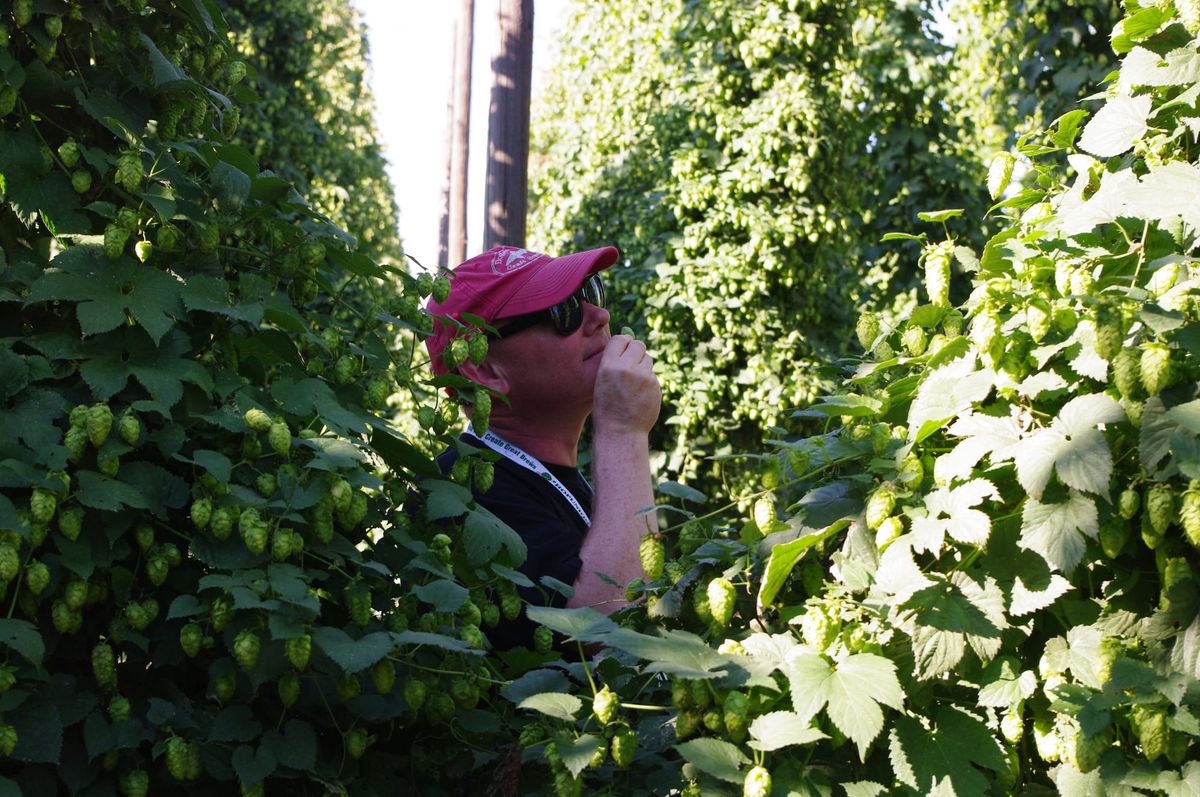
I've spent most of 30 years asking those questions about beer. I've been to the fields where my hops and barley were grown. I've chosen my hops at harvest in Yakima, picked the same farm's hops blind three years running, and then gone to see where they grew. I've met the growers and their families and eaten dinner at their tables. I've walked their fields in the tough years and felt it with them. You don't look at a bag of malt the same way afterwards.
Craft beer drinkers want to know where their beer comes from and where it's made. The next wave is people wanting to know that about their food.
The price argument
Craft beer costs more than mainstream lager, and you can taste why. Put a hoppy IPA next to a standard lager and nobody needs a judging sheet to tell them apart.
Organic food has a taste case too. In my experience you can often taste it, especially in things like meat, butter and fruit. But I'll be honest, it isn't IPA versus lager. A good organic carrot is a better carrot. It is still a carrot.
If flavour were the whole argument, the premium would be a harder sell than it was for beer. It isn't the whole argument. With organic you're also paying for what isn't sprayed on the food, and for what isn't going into the soil and the water while it grows. Beer never had to make that case. Once you add those up, I think the premium is justified, and I think more people will come to the same conclusion one fact at a time.
The big players are already moving
The clearest sign a tipping point is coming is when the big, careful companies start spending money on it before the public catches up. That's happening.
Fonterra has run an organic programme since 2002, and as of April 2026 more than 100 farms were part of it. According to Fonterra's farmer site, its Organic Milk Price has averaged $2.07 per kilogram of milksolids above the conventional farmgate price since 2016/17. From 1 June 2026, Fonterra lifted the extra it pays farmers who are converting to organic from 45 cents to 70 cents per kgMS. Conversion typically takes around three years, so that is money paid out well before a single litre can be sold as organic. In May 2026, Fonterra confirmed it would expand organics into the South Island, with organic milk processed there from the 2028/29 season. Big co-operatives don't build three-year supply pipelines on a hunch.
Zespri is the other one. In September 2026, Zespri's first full forecast for the season put Organic SunGold at $15.67 a tray, against $11.50 a tray for conventional SunGold. In the United States, Zespri's North American president said in July 2026 that retail dollar sales of organic kiwifruit were up more than 30 percent in the past year.
Globally, retail sales of organic food and drink reached a record €145.0 billion in 2024, according to the annual FiBL and IFOAM survey. The Swiss spent the most per person, at €481 each, which is roughly what I'd expect from a country that also takes its chocolate seriously.
And New Zealand is slow again
At home, the numbers are growing but small. The 2025 Organic Market Report from OANZ, the sector's industry body, put the sector at $1.18 billion in 2024, up from $723 million in 2020. That 2024 figure is the first to include foodservice, and without it the growth since 2020 was 37 percent. Exports were worth $606.7 million, and New Zealanders spent $572 million on organic food here, $190 million of it through cafes, restaurants and other foodservice. The same report says only 0.6 percent of New Zealand farmland is certified organic, and it says plainly that the sector "lags behind the rest of the world due to outdated policies and lack of investment." I went through what else is in that report back in April.
So here's the honest version. Fonterra and Zespri are moving because buyers overseas want organic and will pay for it. New Zealand shoppers haven't caught up yet. That's exactly how it looked with craft beer: the rest of the world went first, and we followed later, and then all at once.
Yes, craft beer is having a hard time
Anyone in the beer industry reading this will be thinking the same thing. Craft boomed, and now it's busting.
It is. In June 2026, RNZ ran through the list of what New Zealand's small brewers are up against: excise tax going up every year, delivery costs swinging with the fuel crisis, a shortage of food-grade CO2, a keg crisis, and a younger generation that doesn't head to the pub the way their parents did. Brian Watson, co-founder of Good George, told RNZ the tide was going out, and added: "It will come back again, it's just a case of when." In the United States, 481 craft breweries closed in 2025 and only 300 opened, according to the Brewers Association.
But look at what's left standing. The same Brewers Association figures put American craft at 13.4 percent of all beer sold by volume in 2025, and 24.8 percent by value. Even after two years of more closures than openings, there were still 9,578 craft breweries operating in America at the end of 2025. In New Zealand, the 2019 industry report put craft at 10 percent of all beer sales in 2018. Craft isn't going away. It's consolidating and rationalising, it holds a much bigger share than when it started, and it has changed the beer market for good. America already had one of these shakeouts in the late 1990s, and the second boom that followed was more than six times bigger than the first, measured in breweries.
I don't think organics will go through the same bust, and the reasons are the differences between the two. It's coming off a tiny base, 0.6 percent of our farmland, so there's nowhere near the crowding craft beer ran into. People have to eat, and they don't have to drink. And the culture around alcohol is changing right now in a way that has nothing to do with whether craft beer is any good. I can't see people choosing to eat worse for their health. If anything, it's going the other way.
So why am I doing this
For me it started with bread, as I've written before. From August 2023, the government required all non-organic bread-making wheat flour in New Zealand to have folic acid added. I get the reason for it. What I didn't like was having the decision made for me, in a staple everyone eats, so I wanted to opt out. The way out was organic, because organic wheat flour was left exempt, in the government's words, to give consumers a choice.
I've always wanted to control the inputs of my beer, and to know where they came from and who grew them. So after a lot of research, I started making my own bread. That was the opening of Pandora's box. Once I'd asked what was in my bread, I couldn't stop asking about everything else on my plate. I was discovering so much I didn't know. A lot of what I'd taken for granted about food turned out to be wrong. And a lot of what I bought was habit, built up over years, trusting brands that had been changing quietly behind the scenes.
Frozen vegetables are a good example. When Fenton Hazelwood of Thank a Farmer turned the bags over, as I wrote about in October, McCain's corn was packed in New Zealand using corn grown in China, while McCain's mixed bag, corn included, said grown in New Zealand. A Pams bag was packed here from local and imported ingredients, and the Woolworths bag at the same $3.69 said 100% New Zealand grown on the front. Fenton admitted he'd expected it the other way round. Then in March 2026, Heinz Wattie's announced it would discontinue its frozen vegetable business, and McCain said it would close its Hastings vegetable plant by January 2027 and source through supply partners in its wider network instead. RNZ reported that the supermarkets' own house brands already import canned and frozen vegetables from China, South Africa, Thailand and Italy. For years, the name on the bag stayed the same while what was behind it moved.
I've watched one of these curves from the inside once already. Most people don't have the time to chase down what's in their food. They're working, raising kids, getting dinner on the table. This site is me doing for food what I've done for beer for 30 years, and sharing what I find as my curiosity takes me to the next thing. There's no plan and no pattern. It can start with a headline, a conversation, or a "hey, wait a minute, that seems odd."
I don't have all the answers, and I'm not pretending to. I'm learning as I go, out in the open. When I get something wrong, I change it and update it.
The last time I watched a line sit flat for ten years, it turned in 2012. I'd like to be standing in the right place when this one does.
Before you go
If you want more like this in your inbox, sign up free.
If this was useful and you'd like to chip in once, leave a tip.