Why New Zealand Doesn't Eat Its Own Organic Food
The best organic kiwifruit in the world is easier to find in Sacramento than in Tauranga. New Zealand's organic sector just hit $1.18 billion, and most of it leaves the country. Five structural reasons the domestic organic market stalled while the rest of the western world moved on.

The best organic kiwifruit in the world is easier to find in Sacramento than in Tauranga.
This month Zespri is heading to the Organic Produce Summit in Monterey, California, with a press release announcing that US retail sales of organic kiwifruit are up more than 30 percent in a year. Organic SunGold from the 2026 New Zealand harvest is posting double digit dollar growth in American supermarkets. The fruit was grown in the Bay of Plenty. Picked in autumn. Packed, shipped, and celebrated eleven thousand kilometres from the orchard.
Try buying it here. Go on.
You will find some, eventually. A farmers market stall selling export rejects. A box scheme. The occasional organic shop with a tray of Class 2 fruit. What you will not find is the product Zespri is toasting in Monterey, because that product was never intended for you. Under the Kiwifruit Export Regulations, Zespri holds a statutory monopoly on kiwifruit exports to everywhere except Australia, give or take a few million trays of approved collaborative marketing, and the entire certified organic programme is built to feed offshore shelves. The domestic market gets the leftovers of its own harvest.
The fruit is Chinese, incidentally. New Zealand sold it as the Chinese gooseberry until 1959, when Turners & Growers renamed it to move product in Cold War America. This industry has always been brilliant at marketing. Who actually gets to eat the fruit has never been part of the brief.
And inside the export triumph, the organic story has gone backwards. In 2000, organic fruit made up more than 5 percent of the export crop, 3.23 million trays of 63 million, per US Department of Agriculture records. In 2024/25 it was 3.7 percent, 7.2 million trays of 193 million, in Zespri's own annual report. The organic share of the national crop shrank by more than a quarter across the exact 25 years that global organic demand exploded. It shrank while Organic SunGold returned a record $15.20 a tray in 2024/25, the only kiwifruit variety whose per-tray return rose in a down year, and while Zespri's annual report crowned North America its number one organics market, with US organic sales up 52 percent to $57.5 million. The money is there. The conversions aren't. Zespri releases organic growing licences in drips, 250 hectares of Organic SunGold in 2024, against the 750 hectare conventional releases of the boom years.
Kiwifruit is not the exception. Kiwifruit is the system working as designed.
The numbers nobody puts side by side
New Zealand's organic sector is worth $1.18 billion, a record, according to the 2025 OANZ Market Report. Sounds healthy until you split it open. Exports: $606.7 million. Domestic consumption: $572 million, and $190 million of that is foodservice, your flat white with organic milk. Actual organic food bought in New Zealand shops sits somewhere around $380 million.
Total supermarket spend in this country runs north of $25 billion a year. Do the division and organic food holds somewhere between one and two percent of the New Zealand grocery basket on any reasonable calculation. Nobody publishes the precise figure, which tells you something on its own.
Denmark sits at 11.6 percent of its total food market, the highest in the world. Germany's organic market alone is bigger than New Zealand's entire dairy export industry, and its discounters sell organic carrots as a loss leader. Even the United States, home of the 44 ounce soft drink, gets to 6.1 percent of food sales.
And the land tells the same story from the other end. Certified organic farmland in New Zealand: 89,544 hectares, or 0.6 percent of the total. Austria has converted 27.2 percent of its farmland. The EU average is almost 11 percent, with a formal target of 25 percent by 2030.
New Zealand, the country whose entire food brand is a green fern on a white background, farms organically on 0.6 percent of its land and sends most of the output overseas.
The question is why. There are five answers, and they lock together.
1. Clean green did the damage
Europe's organic boom was built on fear that turned out to be justified. Mad cow disease. Dioxin in Belgian eggs. Nitrates in German groundwater. Industrial agriculture visible from every autobahn. When European shoppers reached for the organic label, they were correcting something they could see.
New Zealand never had its food scare. No BSE, no dioxin scandal, no moment where the supermarket became suspect. Instead we got the opposite: a forty year national marketing campaign telling us our conventional food is already the cleanest in the world. Mostly the campaign was aimed at foreign buyers. We absorbed it anyway.
So organic, here, reads as paying twice for something you were told you already have. In Copenhagen the organic label is a correction. In Christchurch it looks like a redundancy. That single perception has suppressed the domestic market more than price ever did, and almost nobody has bothered to test it against what actually gets sprayed here. I have spent six months testing it. The results are elsewhere on this site, filed under honey, chicken, and breakfast cereal.
2. The word meant nothing
The EU has regulated the word organic since 1991. The USDA since 2002. In New Zealand, for the entire modern history of the organic movement, the word was legally undefined. Anyone could print it on a jar. Your only protection was the Fair Trading Act, the same law that stops a used car dealer winding back an odometer.
The Organic Products and Production Act finally passed in 2023 and the domestic standard is still being stood up now, in 2026. Three decades behind Brussels. Thirty years in which certified producers, the ones paying BioGro audit fees and holding buffer zones and keeping records, competed on the same shelf against anyone willing to use the word for free.
That gap destroyed the thing certification is supposed to buy: trust. The OANZ report lists competition from unverified green claims as a live constraint on the sector, in 2025, which is a polite way of describing thirty years of legalised freeloading.
3. Nobody pays for the bridge
Converting a farm to certified organic takes three years. Three years of organic costs at conventional prices, because the certification, and the premium, only arrive at the end. Somebody has to carry that.
In Europe, the public carries it. The Common Agricultural Policy pays farmers to convert and pays them again to stay converted. Germany alone spends over half a billion euros a year on it. Organic is written into EU policy as a public good, like a road. I've laid out the full machinery elsewhere, the per-hectare payment rates, the procurement laws, the national action plans, if you want the detail.
New Zealand removed farm subsidies in 1984 and never built anything in their place for organics. Not a conversion grant, not a certification subsidy, not a cent. Every one of those 89,544 hectares was converted by a farmer betting three years of reduced income against a premium that mostly exists offshore. The wonder is not that the number is 0.6 percent. The wonder is that anyone did it at all.
4. The industry faces the other way
New Zealand agriculture exists to feed other countries. Ninety five percent of our dairy leaves. Most of the kiwifruit crop leaves. The organic sector, small as it is, followed the same gravity, because the premium lives where the demand lives, and the demand lives in markets that spent thirty years building it through regulation and subsidy. Which is to say, not here.
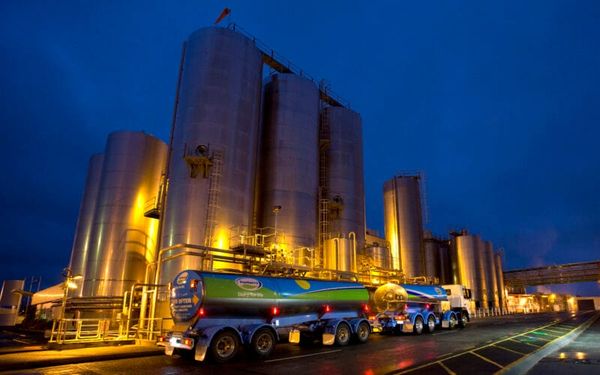
Fruit and vegetables are the top organic export category, up 71 percent since 2020. Fonterra's certified organic milk becomes powder and butter for the American market. Zespri's organic SunGold gets a press release in Monterey. The sector is genuinely successful. It is just not successful for New Zealanders, who function as the landlords of an orchard they cannot shop in.
5. The duopoly has no reason to care
Here is the part that could actually change, and won't.
In Germany, organic went mainstream because Aldi and Lidl decided to sell it cheap, and every other retailer had to follow. In the United States, Costco grew into one of the biggest sellers of organic food on earth. Organic scaled in those countries because retailers used it as a weapon against each other.
New Zealand has two supermarket companies and no discounter. Foodstuffs and Woolworths compete the way two people share a lift. Neither has any strategic reason to make organic affordable, so both run it as a small premium bay at maximum margin, which keeps volumes tiny, which keeps supplier costs high, which justifies the margin. The loop is closed and nobody inside it is motivated to open it.
Organic is expensive in New Zealand partly because it is niche, and it is niche partly because it is expensive. The duopoly did not create that loop, but it profits from every rotation.
The strange moment we're in
Two things are true at once in 2026 and they point in opposite directions.
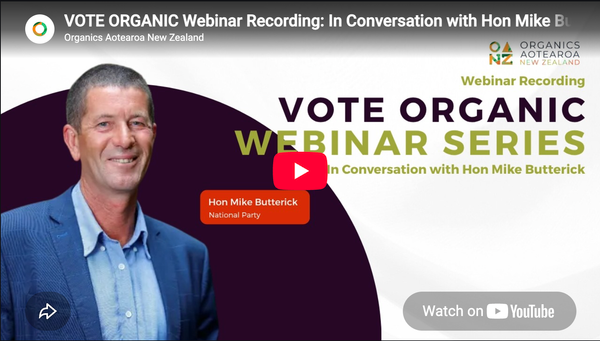
The government has appointed Mike Butterick as Associate Minister of Agriculture for Organics, a dedicated ministerial portfolio for the sector and, as far as OANZ can tell, a world first. New Zealand finally leads the world in something organic: job titles.
At the same time, the Gene Technology Bill proposes allowing outdoor release of genetically modified organisms. The organic export story, the $606.7 million one, the Monterey press release, all of it rests on markets that prohibit GE contamination and on a national GE free status that took fifty years to accumulate and would take one season to lose. An NZIER study cited by the organic sector puts the potential cost to the primary sector at $10 to $20 billion a year if it goes wrong.
So the same government now employs a minister for a sector whose foundation its own legislation is preparing to dig up. Someone in Wellington presumably sees no tension here.
What the 0.6 percent means
None of this is a demand problem. The old OANZ surveys found 80 percent of New Zealanders buying something organic at least fortnightly, even at duopoly prices, even with a label that legally meant nothing. The appetite exists. What never got built is everything around it: the regulation, the conversion support, the retail competition, the domestic supply chain.
Denmark decided organic food was infrastructure and built it. New Zealand decided organic food was a marketing claim and exported it.
Austria converted 27 percent of its farmland. We converted 0.6, grew some of the finest certified organic food on earth on it, and put the fruit on a boat.
Before you go
Organic Food Together is free to read, with no ads and no paywall. If this kind of work is useful to you, there are two ways to support it.
Get it in your inbox, every new post, free.
Or leave a one-off $10 tip to help keep the research going.