Who Makes Woolworths Free Farmed Bacon? The Pack Won't Say.
A reader questioned the Woolworths recommendation in my bacon awards piece. Fair challenge. So I pulled the thread: one farm, a sale almost nobody covered, an anonymous factory, and a cure that burns in the pan. The welfare label is real. It also stops at the farm gate. Here's the rest.
A reader pushed back on my bacon awards piece. Woolworths? Isn't their bacon made with imported pork?
Fair challenge. Here's what I actually wrote: "If you only shop the supermarket, Woolworths' Free Farmed ham is the one higher-welfare medallist on those shelves. Free farmed, born and raised here, a silver. Not the best on this page, but the best of what is easy to reach."
Best of what is easy to reach. That was the whole claim, and I stand by it. But the reader's suspicion deserves a proper answer, because both of us were right about two different products wearing the same name. And pulling that thread took me somewhere worth going: to one farm in North Canterbury, a sale almost nobody covered, and a factory nobody will name.
Two bacons, one brand
Pick up a pack of standard Woolworths bacon and the fine print says the pork was raised in any one or more of Finland, Denmark, Poland, Germany or Spain. Not a farm, not even a single nation, just a pool of possibilities, and the label never has to be more specific than that. That's the default. That's the bacon the reader was rightly suspicious of, produced in countries that aren't required to meet our animal welfare standards, which is precisely why it's cheaper.
The Free Farmed line is a different product. One hundred percent New Zealand pork, born and raised here. Same shelf, same brand, separated by a label and a list of European countries. And to be precise about the medal: the silver went to the Free Farmed boneless champagne half ham, the only Woolworths product to medal in the entire competition, and the only supermarket own-label anywhere on the results sheet. The only way to tell the two bacons apart is the fine print, and if you're new here, I've written about how that fine print trains you not to read it. That's lesson one.
One farm
Lesson two is where the Free Farmed pork comes from. Not a network of suppliers. One farm.
Patoa Farms sits on nearly 900 hectares near Hawarden, on the south bank of the Hurunui River. It is New Zealand's largest free-farmed pig operation and, by its own description, the supplier of Free Farmed pork to Woolworths, nationwide. Five thousand breeding sows, around 100,000 finished pigs a year, two thousand a week. The sows live outdoors with straw shelters for farrowing; the growing pigs are finished in big open barns on deep straw. SPCA Blue Tick, PigCare accredited. As pig farming goes, this is the good end of the commercial spectrum, and I mean that.
The scale is worth sitting with. Patoa grows about 18 percent of all the pork raised in New Zealand. And New Zealand doesn't raise much: around 60 percent of the pork we eat is imported, and over 80 percent of the bacon and ham. The entire local industry is 58 farms, fewer than the country has Pak'nSave stores, and nearly a fifth of everything they produce comes off this one riverbank property. Roughly one mouthful of pork in every fourteen eaten in New Zealand starts in the Hurunui district.
And in December it went up for sale. The quiet fear in the industry was a dairy conversion, which would have erased nearly a fifth of the country's pork supply in one transaction. On 1 July it sold to a local consortium led by the farm's longtime veterinarian and the managing director of Harris Farms, one of its two big customers. The vet and the butcher bought the farm, and it stays pigs. The fate of the traceable half of the bacon shelf came down to whether seven investors in North Canterbury felt like it. They did. This time. You probably didn't see it in the news, because it ran in the rural press and nowhere else.
The label stops at the farm gate
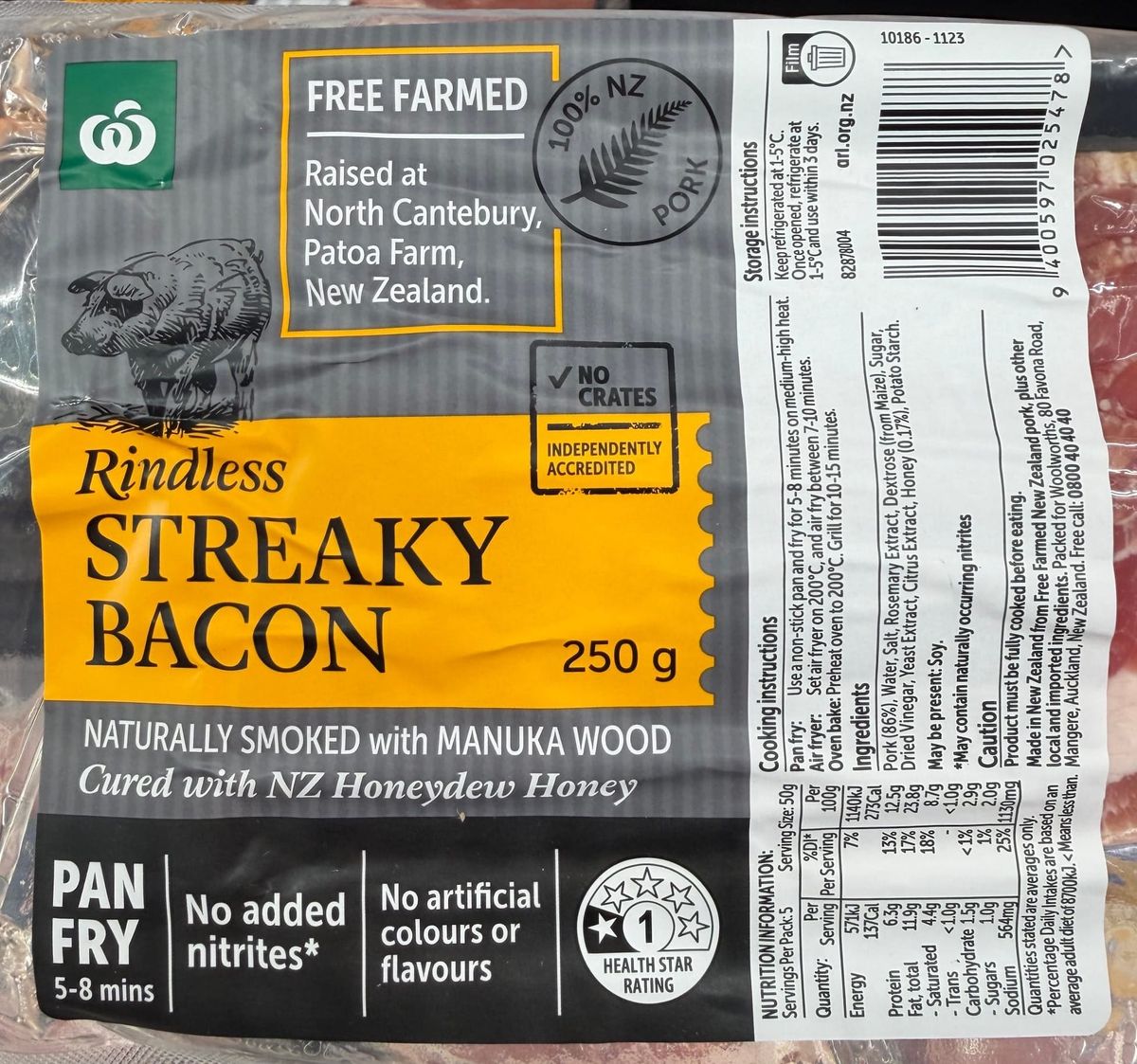
Here's lesson three, and it's the one I care about most. I bought a pack. The label is generous about the pig and silent about everything after it.
The big type is all farm. Free Farmed, no crates, independently accredited, 100% NZ pork, and in a yellow box: Raised at North Cantebury, Patoa Farm, New Zealand. Canterbury is misspelled on the front of a national supermarket product, which tells you how closely anyone was reading. Still, the farm is named on the pack. That's genuinely rare and genuinely good.
Now drop your eyes to the small print on the same sticker. Patoa doesn't make bacon. The pigs leave the farm, go through a slaughter plant, and the pork lands with a smallgoods manufacturer who cures it, smokes it, slices it and packs it. Who? The fine print says Made in New Zealand from Free Farmed New Zealand pork, plus other local and imported ingredients. Packed for Woolworths, 80 Favona Road, Mangere. I looked up the address. It's Woolworths New Zealand's head office. The only physical place named on the pack, other than the farm, is the retailer's own front desk. The farm gets a yellow box in big type. The factory doesn't get a name, and the whole distance between those two facts is about five centimetres of sticker.
Then the ingredients, which is where my frying pan comes in. Pork (86%), water, salt, rosemary extract, dextrose, sugar, dried vinegar, yeast extract, citrus extract, honey, potato starch. No added nitrites, no artificial colours or flavours, naturally smoked with manuka. Credit where due, that's a cleaner cure than most bacon in this country. But look at what's doing the curing: three different sugars. Dextrose, sugar, and the honey from the front of the pack, where Cured with NZ Honeydew Honey is the romantic headline and the fine print declares honey at 0.17 percent. Under half a gram of honey in the whole pack. Meanwhile 14 percent of what you paid bacon price for is water, salt and the rest of that list.
Honeydew honey, in case you're wondering, is real honey with an asterisk of its own. The bees don't make it from flowers. They make it from honeydew, the sugary secretion of scale insects living in the bark of South Island beech trees. Bee-processed bug juice, a genuine New Zealand specialty, harvested in bulk from beech forests, and one of the cheaper honeys the country produces, a long way from manuka money. Which is the pattern, once you see it. The cheapest honey that still earns the words NZ honey on a label. The cheapest pork Europe can land here, in the pack next door. Nothing on this shelf is chosen because it's the best version of itself. It's chosen because it's the cheapest version that can still legally wear the story.
Sugar is why it burns. Follow the pack's own instructions, pan fry five to eight minutes on medium-high, and the water spits out while three sugars caramelise and scorch long before the fat crisps. My last batch went from pink to blackened patches in about four minutes.
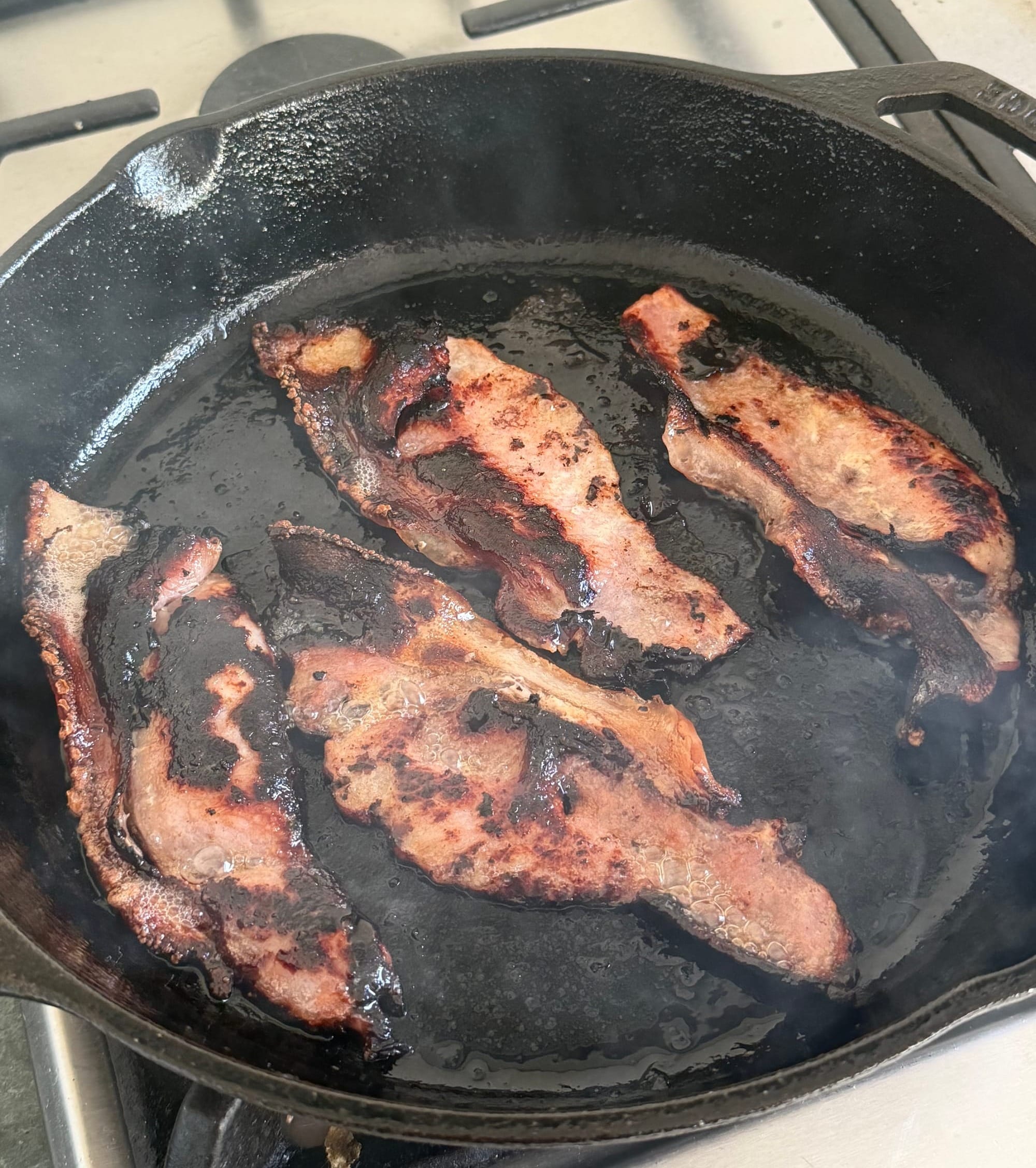
So the pig was raised well, and the bacon is an engineered product with a sweet cure that can't handle the heat its own label recommends, carrying 1130mg of sodium per 100 grams and a 1 star health rating printed in the corner. Every word of this is on the pack. The trick is that nobody reads past the yellow box.
I'd photographed the neighbours on an earlier shop.
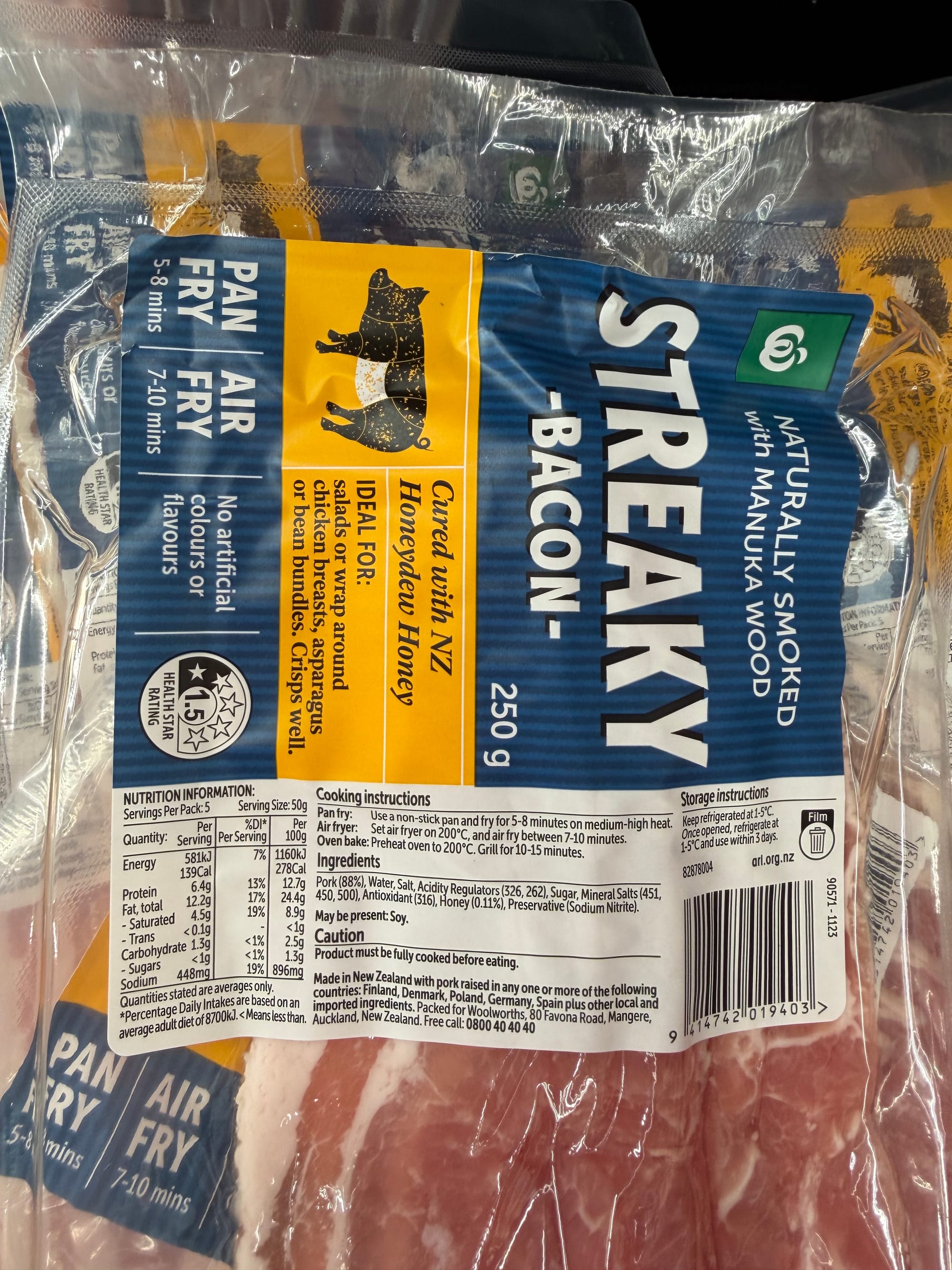
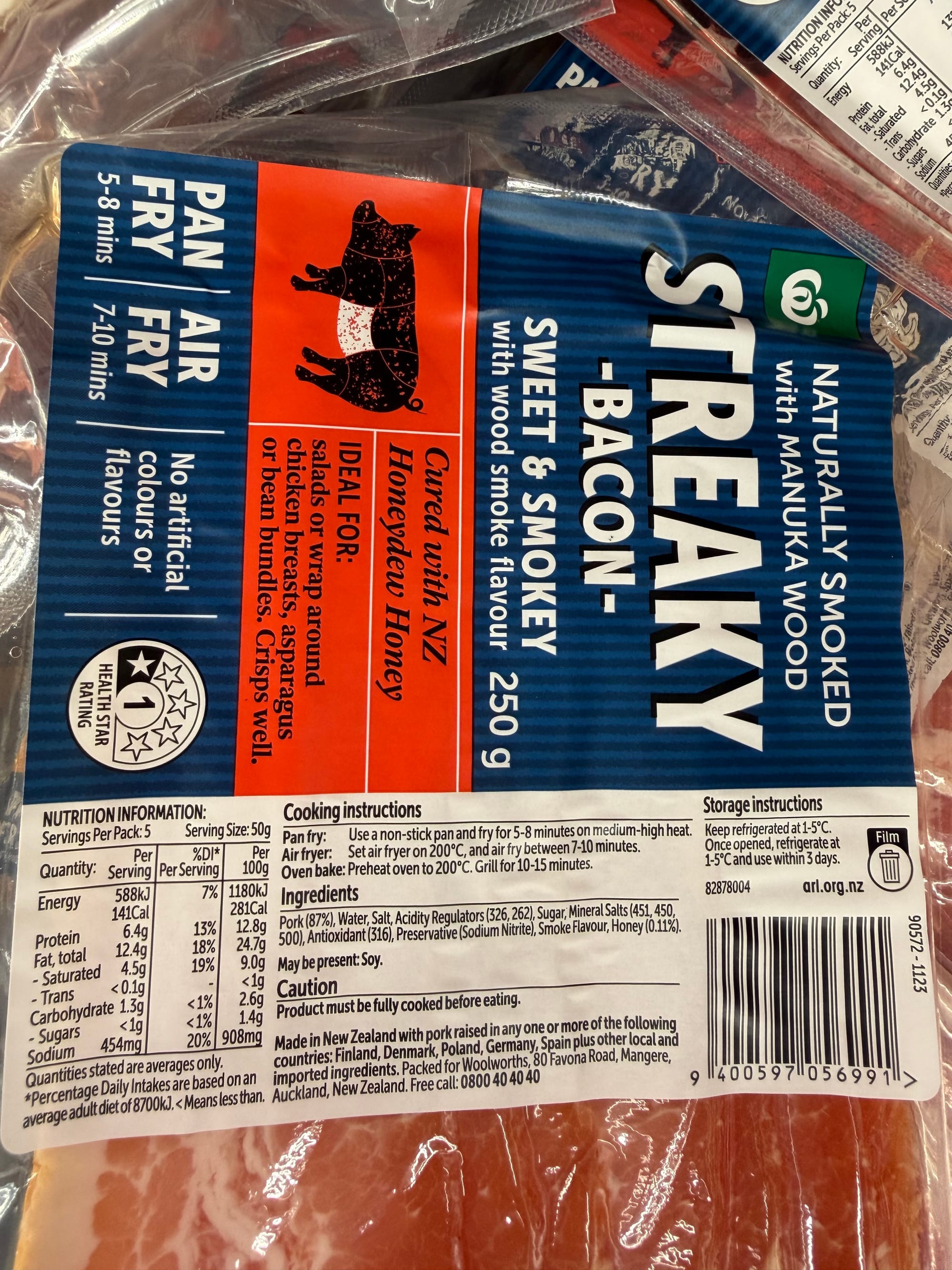
Same honey on the front, sodium nitrite in the fine print, and the pig from any one of five countries.
The standard Woolworths streaky, the one made with imported European pork, carries the identical claim on the front: Cured with NZ Honeydew Honey. A Finnish or Polish or Spanish pig, cured with 0.11 percent New Zealand honey, and the honey is the only ingredient in the pack with a nationality worth advertising. The rest of that cure is the conventional kit the Free Farmed pack avoids: sodium nitrite, phosphates filed under mineral salts 450 and 451, acidity regulators. One detail I genuinely enjoyed: the imported nitrite bacon declares more pork, 87 to 88 percent, and noticeably less sodium than the free farmed one. The cleaner pig comes with the saltier, sweeter, more burnable cure. And every pack on that shelf, New Zealand pig or European, is packed for the same address in Mangere. Three products, three stories in the headline type, one head office in the fine print. And that head office answers to another one, at 1 Woolworths Way, Bella Vista, Sydney. The pig is from Hawarden or Helsinki. The bacon is from nowhere. The decisions are from Australia.
Try finding out
Suppose you wanted to trace it yourself. Here's the trail. The big print names the farm. The small print lists what was added, in descending order, without quantities, except where a marketing claim forces one, which is how we know the honey number. "Packed for Woolworths" is a legal full stop; no rule requires the contract manufacturer to be named, and the only codes on this pack are internal batch numbers, nothing you can match against MPI's public register of licensed processors, assuming you knew that register existed, which almost nobody does. The farm has a website with the family's story on it. The slaughterhouse and the curing factory have nothing. Not a name, not a town. I chased it as far as it goes, which is "somewhere in New Zealand." That's not an accident of paperwork. The system is built so the question dissolves before it reaches anyone who'd have to answer it.
Now run the same questions past a farm that cures its own pigs, or a butcher who names the farm. Who raised it? Them. Who killed and cured it? They can tell you, and they will, because the answer is the product. What's in the cure? Ask, and you get an answer instead of a numbered additive. That's the actual thing you're buying when you buy from someone you know. Not virtue. Not romance. The collapse of an unanswerable supply chain into one person who is accountable for all of it. Peace of mind is just the feeling of questions having answers.
Why the effort matters
So here's where this lands, and it's the same place OFT always lands.
The supermarket option is real. If Woolworths is your only practical shop, the Free Farmed line is meaningfully better than the imported default, and I'll keep saying so. But it's the floor, not the ceiling. It's a well-raised pig handed to an anonymous factory and sold back to you with the story cut off at the farm gate.
The ceiling takes effort. It's the producers who control the whole chain and put their name on every step of it: the farms that raise, butcher and cure their own pigs, the butchers who tell you which farm the pork came from and what's in the cure. I once followed a pack of bacon all the way back to the pig, and the difference was that every question had a person attached to it. They cost more and they're harder to reach, and what you're paying for isn't just the pig's life. It's the right to know what happened after it.
If you want proof the after matters, it's sitting in this year's awards results. Harris Farms of Cheviot, the family butchery that holds Patoa's other supply contract and sells Patoa pork, entered its own free farmed bacon. Category Champion for the dry cured middle. Gold for the dry cured streaky. Quite possibly the same pigs, or near neighbours of them. And here's the endorsement that outranks any medal: two weeks ago, that same family bought into the farm. They win national awards with this pork, and rather than simply renew the supply contract, they put their money into the source of it. Butchers bet their name on their ingredients every day. These ones bet the farm. One supply chain hands the pork to a named family who dry cure it, win championships, and believe in the pig enough to buy the paddock. The other hands it to an unnamed factory that adds water and three sugars, and it scorches in my pan. The pig is not the variable. Everything after the farm gate is.
Cheap food isn't cheap because someone found a clever efficiency. It's cheap because parts of the story have been removed, the country of origin, the welfare standard, the factory, the water content, and you weren't supposed to notice. Every label on the front of a pack is answering a question. The work is figuring out which questions nobody answered.
The pigs behind the Free Farmed label are fine. The bacon is a product. Knowing the difference cost me a morning in the rural press and one burnt breakfast.
Sources
- 100% New Zealand Bacon and Ham Awards 2026 results, Retail Meat New Zealand: https://www.rmnz.co.nz/bacon-and-ham-awards-2026-results
- Patoa Farms, Our Story and Our Pork: https://patoafarms.co.nz/our-story/ and https://patoafarms.co.nz/our-pork/
- NZ Pork, Our Farmers, Holly Sterne: https://www.nzpork.co.nz/our-farmers/holly-sterne
- NZ Herald, "New Zealand's largest free-farmed pig operation Patoa Farms for sale" (December 2025): https://www.nzherald.co.nz/business/new-zealands-largest-free-farmed-pig-operation-patoa-farms-for-sale/2ALDGLR6TFHZLIKYIGJWLG3CSE/
- Farmers Weekly, "New Zealand's largest pig farm to stay in local hands" (1 July 2026): https://www.farmersweekly.co.nz/news/new-zealands-largest-pig-farm-to-stay-in-local-hands/
- Rural News, "Patoa Farms, New Zealand's Largest Pig Farm, Sold to Pork Industry Consortium" (July 2026): https://www.ruralnewsgroup.co.nz/rural-news/rural-agribusiness/patoa-farms-largest-pig-farm-sold-new-zealand
- The Spinoff, "Pigs in New Zealand live a relatively nice life, but chances are your bacon isn't from here" (August 2024): https://thespinoff.co.nz/kai/19-08-2024/pork-animal-welfare
Before you go
Organic Food Together is free to read, with no ads and nothing behind a wall. If you'd like new investigations in your inbox, you can sign up as a free member. And if the work is useful, you can leave a one-off tip to help keep it independent.