Niue Honey and the Last Clean Bees in the Pacific
New Zealand sent Italian bees to Niue in the 1960s. Then varroa arrived here and tore through our hives. On the Rock, 2,400km away, the bees stayed clean. Their honey tastes of caramel and malt, comes certified organic in a rum bottle, and carries Peter Gordon's name.
New Zealand sent bees to Niue in the 1960s. Italian honey bees, shipped north on a boat, well before anyone here had heard of the varroa mite.
Then, in 2000, varroa turned up in Auckland. It moved through the North Island, then the South, and it changed beekeeping in this country for good. Every commercial hive now runs on a treatment cycle, because the alternative is a dead hive.
The bees we exported never got the memo. Niue sits about 2,400 kilometres northeast of Auckland, alone in the Pacific, and varroa never made the crossing. So the descendants of the bees we sent away are now cleaner than the ones we kept. That is the whole story in one sentence, and it is worth sitting with for a moment.
First, the Rock
Niue is a single raised coral island east of Tonga, one of the largest coral islands in the world. Locals call it the Rock. The population sits somewhere around 1,600, which makes it the second least populated country on earth after Vatican City. Far more Niueans live in Auckland than on the island itself.
It is self-governing. It has been since 19 October 1974, when the people voted for self-government in free association with New Zealand rather than independence or staying a territory. The distinction matters. Niue runs its own internal affairs, passes its own laws, and sits at the Pacific Islands Forum in its own right.
So why does New Zealand "look after" it. Because of the terms of that association. Niueans are New Zealand citizens; they carry our passports and can move here freely. New Zealand handles Niue's defence and, when asked, its foreign affairs, and provides the bulk of its budget. It is the island's largest development partner by a wide margin. Niue is one of the three parts of the Realm of New Zealand, alongside the Cook Islands and us.
It is also, for what it is worth, the world's first Dark Sky Nation. No mechanised farming to speak of, forest across most of the interior, almost no industry. Clean air, clean soil, clean water. Keep that in mind, because it ends up in the honey.
The bees nearly died anyway
The man at the centre of this is Andy Cory, known on the island as the Honeyman. In 1999 he spotted a small ad in a New Zealand beekeeping magazine. The Niue Honey Company was for sale. He flew up, got driven into the bush, and found decades-old hives swallowed by vines. Inside them was that isolated Italian bee stock. He took the punt.
Then it almost ended. Cyclone Heta hit in 2004 and stripped the island bare. Waves put salt over everything, the trees went, and with no flowers there was no food. By his own account he was down to a queen and about twenty bees in each surviving hive. He mixed a sugar solution and hand-fed them while the bush grew back. It took roughly fifteen years to bring numbers up to around 3,000 hives.
Those bees are now believed to be the last significantly sized population of disease and parasite-free Italian honey bees left anywhere (Apis mellifera ligustica, the workhorse of global pollination). Cory has worked with the Niuean government on a Pacific Bee Sanctuary, the idea being that clean queen stock from Niue could one day repopulate hives elsewhere. Think Svalbard seed vault, but for bees. Whether that ambition is fully realised yet is unclear, and I would rather say so than pretend otherwise.
How big is the honey, really
Small. That is the honest answer.
The whole industry is one company, a few thousand hives, and two or three local staff. Cory has said that in a good year 3,000 hives can produce a couple of hundred tonnes, "weather permitting, just like fishing." Weather permitting is doing a lot of work in that sentence. This is an island that gets flattened by cyclones.
Exports are boutique by design. Niue honey shows up in gourmet shops in London and in a handful of New Zealand stockists, sold in small bottles at a price that reflects scarcity rather than volume. It won Best International Honey at the UK's National Honey Show in 2016, plus two category golds, which for a product this obscure is a genuine result.
What lifts it above a curiosity is the structure underneath. Landowners whose bush holds the hives get a share of the honey produced on their land. The company has said every resident of Niue gets free honey. It is a small economy doing something unusually fair with a small product.
Where Peter Gordon comes in
Peter Gordon is a New Zealand chef, born in Whanganui in 1963. If you have eaten a flat white or Turkish eggs in a London cafe, you have eaten downstream of him. He is widely credited as the pioneer of fusion cooking, built across The Sugar Club in Wellington and London, and The Providores and Tapa Room in Marylebone, which ran for eighteen years. He holds an ONZM. He has cooked for Barack Obama. He has raised many millions for blood cancer research through his charity dinners.
In 2020 he came home for good and opened Homeland on the Auckland waterfront with his partner Alastair Carruthers, a restaurant he described as a food embassy for New Zealand and Pacific producers. Homeland closed in 2024. These days Gordon consults, writes, and judges; he is head judge of the 2026 Outstanding Food Producer Awards.
His involvement with Niue honey is endorsement, not ownership. Announced back in 2019, the deal put his name behind the product and his weight behind the sanctuary story, with a plan to carry it through his restaurants. He backed it, by every account, for the simple reason that he loves the honey and believes in the cause. For a product this small, a name that size is the marketing budget. So when you see "Peter Gordon" on the label, read it as an ambassador vouching for provenance, not a certification.
The honey itself
Here is where it gets interesting for anyone who tastes for a living.
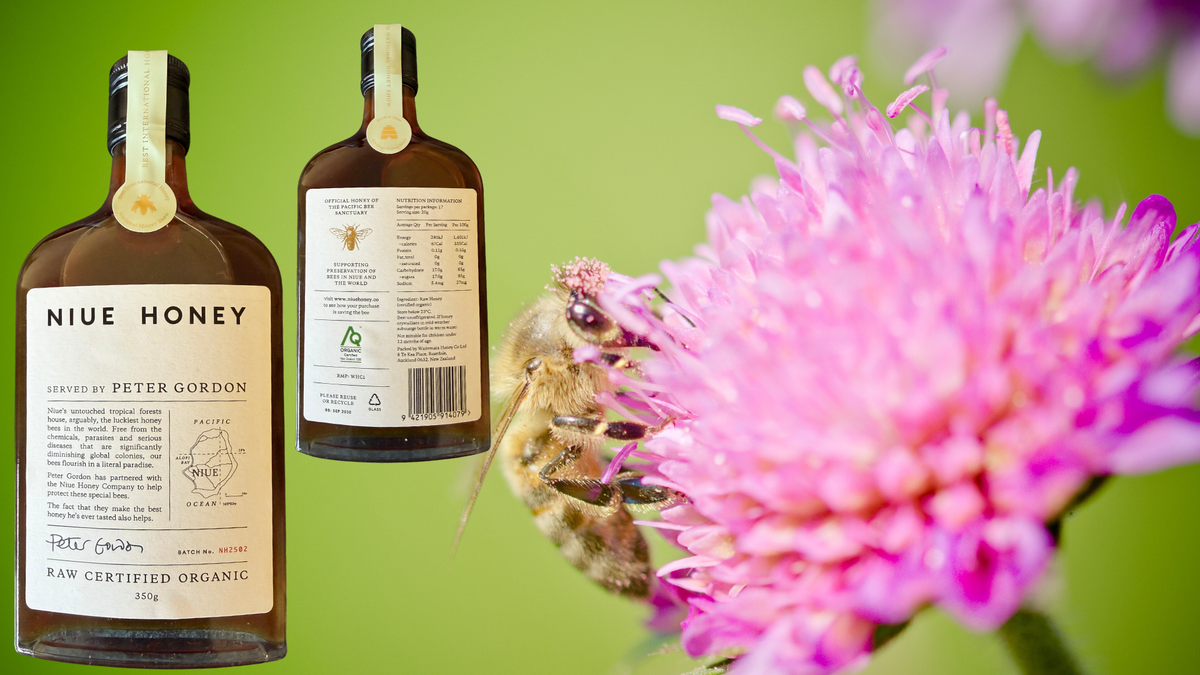
This is not mānuka. It is not anything like mānuka. Niue honey is multifloral, gathered wild from the flowers of coconut palms and jungle trees, with the medicinal shrub nonu in the mix (noni, if you know it by the other name). It pours a medium amber, and the palate is malt and caramel, dark and round, with none of the bitterness or medicinal bite you get at the mānuka end. There is a rum-like note to it, and a delicate hint of smoke underneath. Make of the rum what you will, given the bottle it comes in. Judges at the National Honey Show clearly rated it. It reads more like a dark cane sugar than a floral honey.
It is also certified organic, and the mark on the bottle is worth reading properly. It carries AsureQuality, one of New Zealand's two main organic certifiers, alongside BioGro; it is government-owned and accredited to IFOAM, the global organic body. So the honey is not organic by vibe or by island reputation. It is audited and certified to a recognised standard, the same tier of certification behind organic product on any serious New Zealand shelf.
That certification lands more easily here than almost anywhere. AsureQuality's organic standard covers how the food is produced and processed, and Niue barely has to try. The bees forage wild across an island with no mechanised agriculture and no history of the insecticides, antibiotics or antifungals a mainland operation might reach for. Residue testing has come back very low. The honey took the top international prize as an organic entry at the UK's National Honey Show in 2016. Organic here is less a layer bolted on for marketing and more a description of the default conditions on the Rock.
Then there is the bottle. It comes in glass shaped like a rum flask, and that is deliberate. It is a nod to the sailors and the sea voyages that carried the bees across the Pacific in the first place. The Gordon-era packaging leaned further into it, a hip flask stamped with a map of Niue, the sanctuary logo, and the medals from 2016. Glass also does an unglamorous job well. It does not taint the honey, it does not leach, and it lets the colour do the selling. For a raw, unprocessed honey being sold on purity, plastic would undercut the entire pitch.
How it differs from our honey
New Zealand's honey story is a mānuka story. We grade it by UMF and MGO, we test it in labs for antibacterial activity, we sell it on something close to a medical claim, and we price it accordingly. It is a monofloral product turned into a commodity with a number on the jar.
Niue honey is the opposite on nearly every axis. Multifloral, not monofloral. Sold on flavour and provenance, not a lab score. Tropical, not temperate. And the sales pitch is not what the honey does to you, it is where it comes from and what the bees behind it might be worth to the rest of the world.
Which loops back to the opening. We sent those bees north sixty years ago. We got varroa; they did not. The honey is lovely, the caramel is real, and the awards are earned. But the thing being protected on that island was never really the honey.
Before you go
If Organic Food Together is useful to you, the best way to keep it going is to sign up. It is free, and it means the next investigation lands in your inbox.
If you would like to support the work directly, you can leave a tip here.