Who Is Woody? Following the Bacon Back to the Pig
What got me was the short ingredients list and the words "nitrate free" — then I learned most bacon sold here is imported. So I went looking for Woody, and found a rescue dog, a farm that nearly failed, and a chain of people two ranges away who actually raise the pig.
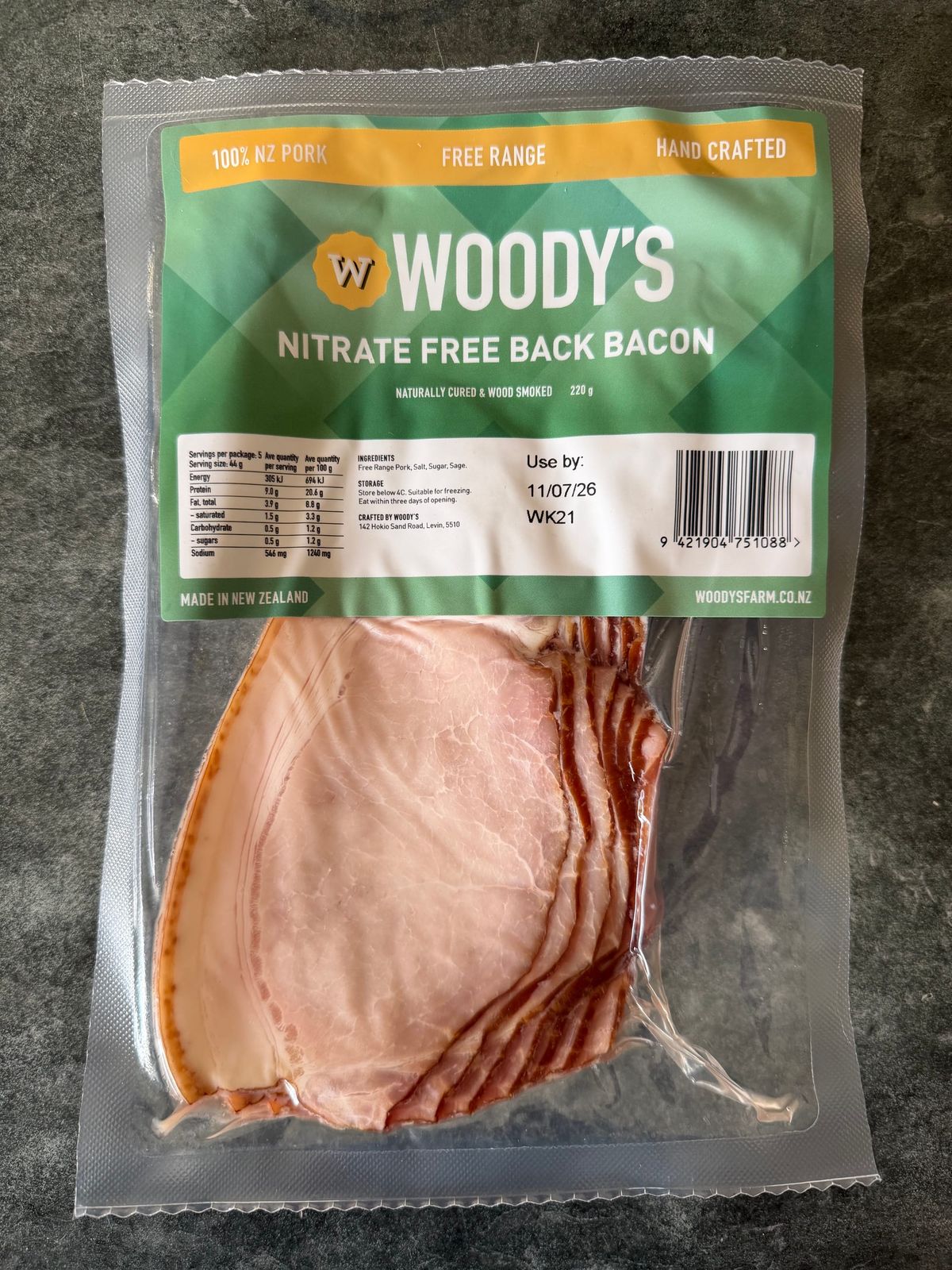
It started with a packet in the fridge. Woody's Free Range back bacon — the brown kind, the sort that cooks down without leaking grey water across the pan. What got me wasn't the branding. It was two small things: nitrate free, and an ingredients list short enough to read in a breath. Pork, sea salt, sugar, sage. After years of turning packets over to find a paragraph of numbers, that simplicity was what put it in my basket.
It was only later I learned the part nobody advertises: most bacon sold here isn't from here. Around 60% of the pork New Zealanders eat is imported, and the share is highest in processed meat — bacon and ham. Most of it arrives frozen and is cured here, which is how a packet says "made in New Zealand" while the pig was raised somewhere else. Read the fine print and you'll see it: one big brand admits its pork is "raised in the USA and/or Canada"; another lists Belgium, Denmark, Germany, Ireland, the Netherlands, Poland or Spain. The reason rarely appears anywhere — imported pork is cheaper largely because those countries allow lower welfare standards than ours.
So a bacon genuinely raised here, on a named farm, by people you could in theory go and meet, is the exception. Which made me curious. I treat the front of a packet as the trailer, not the film — so one morning, cooking it, I asked the obvious question. Who is Woody? And where does this pig actually come from?
The answer ran across two mountain ranges, into a feed silo and a Wellington brewery. None of it is a scandal. All of it is more interesting than the label.
Woody is a dog — and the dog is the whole reason
Woody isn't a butcher or a farmer. Woody was a rescue dog.
A few years before any of this, Daniel Todd — then a managing director who'd run a consumer electronics company in Sydney for seven years — was idly scrolling photos of orphaned dogs, with no intention of getting one. He couldn't say why he was looking. But one dog looked so sad he rang on the spot, and went and picked him up. The dog already had a name: Woody. Not long after, on a flight to Hong Kong, mid-spreadsheet, Daniel wrote his first blog — about wanting to change his life. As he tells it, it was Woody who'd started him "thinking sideways to the business world." When he walked away from corporate life and started the farm, he named it after the dog that nudged him out the door.
The job had gone flat in a specific way: nobody was telling him he was doing anything wrong, no one was showing him what else he could do, so he'd stopped learning. He'd also formed a real objection to how pigs are raised — keeping sentient animals "in dorms" struck him as wrong. A one-day pig course north of Sydney showed him the ethics and the maths. He met Claire, a New Zealander, through internet dating; she wanted to come home, he wanted to keep pigs, and both happened at once. They took on eighty acres at Manakau, in the Horowhenua at the foot of the Tararuas, married on the property, and had their son Fred — a wedding, a baby and two new businesses in roughly a single year. Neither had farmed a day in their lives.
He chose the opposite of the industry default: heritage Large Black and Berkshire pigs, black on purpose. Black-skinned pigs resist the sunburn that troubles pink pigs outdoors, but they grow slowly, which is why the trade abandoned them — that, and shoppers deciding they disliked the faint flecks of black hair left on the skin after processing. Daniel's view is that the flecks were never dirty, just unfashionable, and that the heritage animal gives a denser, meatier pork against the fast white pig whose meat ends up "almost like chicken." His breeding stock are named after chefs — a boar called Gordon, sows called Delia and Hugh. He had to convince New Zealand's rare-breed keepers he was worthy of the pigs, and committed to breeding them, not just keeping them: there's no point owning rare-breed pigs that never have piglets.
If they can't name the farm, it isn't free range"
What makes Woody's worth taking seriously rather than just poking at is that Daniel is himself the provenance evangelist — he says the things I care about, more bluntly than I would.
By his account, only around 1% of New Zealand pig farming is genuinely free-range; roughly 90% is intensive, indoors, fattened fast on less flavour. In between sits the category that catches people out: "free farmed." It uses the word free, and it isn't quite a lie — the piglets really are born outdoors. But at six to eight weeks they're brought inside to clean straw barns where they can't move much, so they bulk up fast and reach the works in four or five months rather than his six or seven. His rule of thumb: if a supplier can't tell you the name of the farm, it isn't free range.
Fair enough. So let's hold Woody's to it. Can I name the farm?
The part the label doesn't tell you
The lyrical version didn't last. When Country Calendar filmed Woody's in 2015, the operation was tiny — nineteen pigs at one trough, five at a time heading to the works. Charming, and financially impossible. By 2016 the farm was close to closing, for the oldest reason in slow farming: on eighty acres, raising slow breeds at that scale, Daniel couldn't grow enough pigs to cover his costs. Close, or invest.
He invested, and it changed what the business is. In 2017 Woody's built a butchery near Levin and became less a farm than a craft butchery and a brand: sourcing whole free-range animals from other farms, then cutting, curing and packing them under the Woody's name (their About page lays the timeline out plainly). By 2021 it was processing more than two tonnes of pork a week; by 2022 it needed more than one farm to keep up; in 2023 it moved into bigger premises again. The single farm with the dog is now a name on meat raised across several farms — and the brand's own line for this is telling: we know our farmers so you don't have to. Which is generous, and also exactly the bit of trust a provenance journal declines to outsource. So who are the farmers?
The answer, as it stands, is mostly one farm, with a second one named on the label that turns out to be a puzzle. The original and main supplier is Longbush, a free-range farm in the Wairarapa, over the ranges to the east. Woody's About page also names a second — Highground, near Timaru — though, as we'll see, that thread knots in an interesting way. The eighty acres with the dog and the chef-named sows still exist, but they're no longer where most of the pork comes from, and nothing on the packet tells you which farm your rasher came off. Who owns these farms — and Longbush has changed hands over the years — is the least useful thing about them. What matters, if you're chasing as-close-to-organic as a supermarket allows, is how the pigs live and what goes into them.
How the pigs are actually farmed
Longbush was built by Naya Brangenberg, an American vet, and her partner Jeremy Wilhelm — and the vet part matters more than the biography, because animal-health decisions get made by someone who actually knows pigs. They run heritage genetics: slow, placid, outdoor-hardy Large Blacks crossed with Duroc and Hampshire for hybrid vigour, a cross they nickname the "Blackroc." These finish at a 75–80kg carcass around 23 weeks, well slower than the roughly 19 weeks an indoor pig takes to a similar weight. The slowness is the point; it's where the flavour and fat live.
The system is what bears on the organic question. As documented from the late 2010s into the early 2020s, Longbush runs a fully pastured, farrow-to-finish operation — pigs born, raised and finished on the same outdoor farm, never shipped to a separate finishing shed — across a rotation of paddocks reseeded into crop once stock move off, to keep the soil alive. Sows farrow outdoors in insulated, straw-bedded huts imported from the UK, fitted with fenders that let the mother roam while keeping her piglets safe — not the crates that pin a sow in place on conventional farms. No sow stalls. They don't ring the pigs' noses, so the animals can root and dig as pigs are built to. They don't tail-dock the piglets. None of it carries a certificate, but all of it is precisely what a certificate checks for.
And there's a logic underneath I found hard to argue with. The Large Black nearly vanished — fewer than ten registered breeders of it remain in New Zealand — and Naya's case is that the way you save a rare breed is, bluntly, to eat it: farm it commercially, keep the numbers up, breed out the inbreeding that finishes off scattered hobby herds. "To save these breeds you have to eat them," she says. "Just not all of them."
What the pigs actually eat
This is the part most free-range stories skip, and it matters most, because a pig is not a cow. Cattle turn grass into meat; a pig can't. Pigs are monogastric — single-stomached, like us — so pasture is wonderful for welfare and gives them something to root in, but it isn't what grows them. Feed is, every single day, and it's the single biggest cost in the business. As Daniel argues, that's why genuine free-range pork should if anything cost more than beef, not less. "Free range" tells you how the animal lived; it tells you almost nothing about what went into it.
On the original Manakau farm the answer was unusually good — spent grain and yeast from Garage Project in Wellington, collected still steaming, plus a custom barley-and-maize mix he formulated with a nutritionist; he flatly refused cheap food scraps as too dirty and unreliable. But the bacon most people buy now comes off Longbush, which feeds a custom formula developed around 2013 with the Wairarapa feed company Sharpes: a range of diets matched to each growth stage, reviewed yearly, eaten ad-lib from hoppers. And the detail that bears on everything I keep writing about chicken and soy — that feed is certified GMO-free. Longbush carries the certification because they supply Farro Fresh and exporters who require it. In a country where most pigs, and nearly all chickens, run on feed built around imported GM soy, a verified GMO-free diet is genuinely not nothing — it's the thing most shoppers assume only "organic" can deliver.
A second farm that knots the thread
Woody's About page names one more supplier: Highground, near Timaru. Chase that thread and it leads somewhere unexpected. Highground is the Cottle family's South Canterbury operation — one of the country's largest free-range pig farms, run with a soil scientist in the family, an organic farming history going back to the 1990s, and a flat no-antibiotics policy. A seriously good farm. But by every account except Woody's, including the farm's own, its pork goes to Harmony, the free-range brand owned by Neat Meat; the industry body describes Highground as Harmony's sole supplier. Whether any of it reaches a Woody's packet today, I can't confirm — and that's its own quiet lesson: even when a brand hands you a list of its farms, following the list can lead you to a different label entirely. Highground deserves a story of its own another day. For practical purposes, the pig in your Woody's bacon is almost certainly a Longbush pig.
How close to organic can you actually get?
This was my real question. Commonsense Organics stocks Woody's, so surely it's basically organic? Not quite — but lay the farming and feed side by side and you can see exactly how close it gets, and where it stops.
A certified-organic standard — BioGro or AsureQuality, the two that matter here — is broadly guaranteeing four things: that the animal lived outdoors free of confinement and routine mutilation; that its feed was clean and GMO-free; that it wasn't run on routine antibiotics or growth promotants; and that an independent auditor signed off on all of it.
Run Longbush against that and most of it is already there, just uncertified. Outdoors its whole life, farrow to finish, on rotated pasture — yes. No sow stalls, no crates, no nose-ringing, no tail-docking — yes, the welfare core, met in practice. GMO-free feed — yes, verified. Heritage breeds living slowly — yes. On what people actually mean by "organic," this pork delivers.
What's missing is narrower than you'd think. Organic requires the feed grain itself to be grown organically, not merely GMO-free — and Longbush's feed, while verified GMO-free, isn't certified organic. It requires an audited ban on routine antibiotics, which I couldn't confirm for Longbush either way. It leans toward later weaning, where Longbush's eight-to-ten weeks sits closer to the mark than a commercial four. And above all it requires the certification and audit trail themselves, which Woody's doesn't carry.
So, the honest placement: Longbush — the pork most likely in your Woody's packet — sits well above commodity pork and a clear step below certified-organic, closer to the organic end than almost anything in a normal chiller without a BioGro or AsureQuality label. If "certified organic" is your hard line, this isn't it; no amount of good farming substitutes for the audit. But if what you care about is a pig that lived its whole life outdoors, rooting in real dirt, on verified GMO-free feed, this is about as close as a supermarket shelf gets, and far closer than "free range" alone would promise.
The small print on curing
The pork comes over the ranges to the Levin factory — large cuts and charcuterie for restaurants, plus the bacon and ham the brand is known for. The back bacon, made from the middle eye loin, is hand-cured, smoked over their own wood-chip blend and hand-sliced; it took Gold at the 2024 NZ Bacon & Ham Awards, the chilli bacon Gold in 2025. The butchery is the real craft here, and it's very good.
But the curing needs reading twice. The headline nitrite-free bacon is cured the old way — just sea salt, brown sugar and sage — which is why it comes out brown, not that uncanny supermarket pink. The catch is that it's one product, not the range: the standard back bacon, and others like the chilli, still list Preservative 250 — sodium nitrite — on the back. Same brand, same chiller, two different stories, separated by a line of small type most people never turn the packet over to read.
What the thread was really about
I went looking for Woody and found a rescue dog, then a man who quit running a company because he'd stopped learning, then a farm that nearly failed, then a heritage-breed farm in the Wairarapa doing most of the actual work, then a second farm named on the label that turned out to belong to someone else's brand, then a feed silo, a brewery's spent grain, and a GMO-free certificate. The bacon got more interesting the further back I followed it.
And the fair conclusion, since Woody's asked to be judged on exactly this: Daniel's test is whether you can name the farm. You can — it's just not the farm on the label, it's behind it, and you have to work to get there, and the trail doesn't always run clean. The pigs really do live outside. The feed, at Longbush, really is GMO-free, which is more than most. It isn't certified organic, and one packet's "nitrite free" doesn't speak for the next one along.
A label is a single still frame from a film that runs for hours. The frame Woody's freezes is the lyrical 2015 one — heritage pigs named after chefs, a dog and a dream. Most of what's in the packet today is a Wairarapa crossbred on certified feed, and that's not a betrayal; it's just the longer, more tangled truth any honest provenance turns out to be. Woody's is more honest about it than most. The pleasure was never in catching anyone out — it's in pulling the thread, and finding a real chain of real people, somewhere, raising the actual animal.
I'll keep buying the bacon. I just know whose pig it is now.