The 20%. Who actually grows the pork in New Zealand.
Sixty percent of pork in New Zealand is imported. Over eighty percent of bacon and ham. So who's growing the rest? The answer is fifty-eight farms — fewer than the country has Pak'nSave stores. Here's who they are, who makes the best bacon and ham from their pork, and where to buy it.

After last week's piece on imported bacon I went looking for the other side of the number. If sixty percent of pork and over eighty percent of bacon and ham in New Zealand is imported, who's growing the rest? I expected the answer to be a long list. It isn't.
There are fifty-eight commercial pig farms in New Zealand. That's the entire industry. Every kilogram of pork that's actually born and raised here comes from one of those farms.
New Zealand has sixty Pak'nSave stores.
There are more Pak'nSave supermarkets in this country than commercial pig farms. I sat with that for a while.
The fifty-eight figure comes from NZPork's own PigCare programme update. As at 1 November 2025, fifty-eight farms were certified, and more than ninety-five percent of commercially produced New Zealand pork carries that label. So those fifty-eight farms are essentially the whole show.
NZPork doesn't publish the names of the fifty-eight. The number is public; the list isn't. What's public are the names of the bigger operations that tell their own stories, the brands they supply, and the processors that handle the pork once it leaves the farm. That's what this piece is built from.
This article will name names. The best farms. The best butchers. The best brands. Where to shop. What to ask for. Who's been quietly doing it right for decades, and who's just starting. It's the best picture I've been able to build from publicly available sources, and there will be things I've missed. If you know any of them, tell me. The Pork Hub updates as I learn.
Two stories at opposite ends
Two operations sit at the edges of what NZ pork can look like in 2026, and they're a good way into the rest. One is a hundred and twelve years old and doesn't farm pigs. The other is ten and does almost nothing except farm them. Between them they cover most of what's possible.
Holly Bacon, Hastings. Carl Vogtherr opened the original shop on Heretaunga Street on the day Britain declared war on Germany in 1914. Carl was a German pork butcher from the south who'd emigrated via Sunderland. There was, his son Ernest later wrote, a crowd that threw stones. The local policeman defended him.
Five generations later, the business is still in the family. Carl's son Ernest took over in 1937. Ernest's son Gordon joined in 1942. Claire Vogtherr, Gordon's daughter, has run it since 1982. Claire's daughters Lydia and Ellen now run the kitchen and the factory respectively. Ellen's daughter Ellie launched New Zealand's first "liquid bacon" — Holly Gold — earlier this year.
Holly Bacon isn't a pig farm. They're a smallgoods maker. They buy from what Claire describes as "smaller, non-industrial farmers who use ethical barn-raising practices." She hasn't named them publicly, and I've respected that. The point is the choice: in a hundred and twelve years they have never used imported pork.
Claire is on the record about why. "The Government regulations allow manufacturers to advertise imported pork that has been further processed here, such as bacon or ham, as 'made in New Zealand', while listing in fine print a list of countries the pork may be sourced from. Countries could include 'New Zealand' even if pork farmed in New Zealand is only a very remote possibility. We believe that's wrong."
That's the same loophole I wrote about last week. Claire has been saying it for years.
The method is its own story. Most commercial bacon in New Zealand is hot-smoked, in a heated cabinet at sixty to sixty-five degrees, for two days. Holly Bacon dry-cures, dry-stacks, air-dries, and cold-smokes in a fifty-year-old block-wall smoker. The whole process takes two weeks. "For us, it's about flavour, not sealing stuff in", Claire says. This is why their bacon goes crisp in the pan instead of releasing water.
They supply Foodstuffs across the North Island — that's New World and Pak'nSave — plus cafes, restaurants, caterers, wholesalers, and their factory shop on Warren Street in Hastings. They sell online direct at hollyfresh.co.nz. The brand identity isn't doing the work the label doesn't have to. The brand identity is the label.
Poaka, Aylesbury, Canterbury. Josh Hill set up Poaka on his parents' unused orchard west of Christchurch in 2016. He'd been a helicopter pilot, an engineer, a carpenter, a welder, a tractor driver. He came home with a plan to raise heritage pigs and make salami the traditional way, with a chestnut-fed diet to enhance the flavour.
The pigs are Berkshire and Wessex Saddleback heritage breeds. Modern commercial breeds like Large White and Landrace have been bred to grow extremely fast — selected for feed conversion, leanness, efficiency. Poaka's heritage pigs can't compete with those growth rates. They take about eight months to finish instead of four. They have to.
The farm is a hundred acres, supplemented by twenty-five acres of sweet chestnut orchard. There are thousands of trees on the property — over a thousand oaks planted in the last two years alone. The pigs are outside their entire lives. They forage. Pheasants, quail, hares, pukeko and rabbits live among them. Poaka mills its own pig feed on the farm from locally sourced ingredients. Since January 2025 they have been processing all of their pigs in their own on-farm micro-abattoir, which is unusual in New Zealand and very unusual in pork.
Poaka won the New Zealand Food Awards Supreme in 2022 for a whole chorizo salami.
Poaka is not certified organic. They have said publicly they are working toward it. The reasons it's hard to get there are the same reasons there's almost no certified organic pork in New Zealand at all, which I'll come to.
These two stories matter because they're both, in different ways, what last week's piece was missing. Last week was a diagnosis: most New Zealand bacon is from somewhere else, and the label is designed not to tell you. This week is the hope side. There are people who have been doing it differently for a hundred years, and there are people who have started doing it differently in the last ten, and both are still here.
What "100% NZ" doesn't tell you
Before going further, a piece of context that matters. The farms below are all 100% NZ. Some of them are also doing genuinely well by their pigs. But "born and raised in New Zealand" tells you nothing about how the pig was raised. The two questions are completely separate, and the system is currently set up to obscure that.
In November 2020 the High Court ruled that farrowing crates and mating stalls breach the Animal Welfare Act. Farrowing crates are metal cages just bigger than the sow herself, used in the days around birth. The sow cannot turn around. Standing, lying down, that's it. The Government agreed a five-year phase-out, ending 18 December 2025.
What actually happened on 18 December 2025 was the opposite. Days before the ban was due to come into effect, the Government amended the Animal Welfare Act under urgency to allow farrowing crates to continue indefinitely.
Around 55% of New Zealand pig farms still use farrowing crates. In November 2025, animal welfare group SAFE released footage from a South Taranaki piggery showing sows in farrowing crates with open wounds, dirty water, and dead piglets piled in rubbish bins. MPI inspectors visited and described "minor welfare issues" being addressed.
The farms in this piece sit outside that system. They are 100% NZ and they are doing it without farrowing crates, or — in the case of the free-farmed operations — using crates for shorter periods inside larger pens. That is part of what makes them worth writing about. The other 100% NZ pork on the supermarket shelf may be from a farm where the sow still can't turn around. The label cannot tell you which.
This is the context for everything below.
The three layers of the supply chain
When I started looking at this it took me a while to see something obvious. There are three different kinds of businesses involved in 100% NZ pork, and they get muddled all the time. Once you can see them separately, the rest of the picture makes sense.
The first layer is the farms. The places that actually raise pigs.
The second layer is the butcheries, processors, and smallgoods makers that buy from those farms and turn the pork into something a shopper recognises — bacon, ham, sausages, salami, fresh cuts.
The third layer is the retail brands. The names on the packets. Some of these are owned by the farms. Some are owned by the processors. Some are independent companies that contract everything out.
Last week's piece was mostly about layer three — Hellers, the brand, the family name, and what the label can and can't tell you about where the pig actually lived. This piece is about all three layers, because the only way to be sure you're buying 100% NZ pork is to know which layer the name on your packet sits at and what it's buying from underneath.
Layer one: the farms
Of the fifty-eight commercial pig farms in New Zealand, only a handful tell their stories publicly. The rest are supplying processors and have no need to be visible to consumers. Here are the ones that are visible, sorted by how the pigs actually live.
Pasture-raised, outdoor for life.
Poaka (Aylesbury, Canterbury). Heritage breeds, chestnut-finished, on-farm milling, on-farm abattoir. The fullest expression of what NZ pasture pork can look like.
Longbush Free Range Pork (Gladstone, Wairarapa). Six to seven hundred pigs grazing pasture, Duroc/Large Black/Hampshire crosses. Their feed is GMO-free certified through Sharpes Stockfeeds — as far as I can find, Longbush is the only commercial NZ pig farm with publicly stated GMO-free feed certification.
Highgrounds Farm (Timaru, South Canterbury). The Cottle family — Hamish and Angela. A 370-hectare property running 280 to 300 sows, producing around 7,000 pigs a year. New Zealand's largest commercial free-range pig farm. No barns, no crates, no concrete floors. The sole pork supplier to Harmony — the brand's product page describes it simply as "free range pork cuts from a single farm in Northern Canterbury".
Crackling Good Farm (Hawke's Bay). Dean Nikora's farm — supplier of the pork behind Wild Game's 2023 double Supreme Award win for both bacon and ham. Doesn't have a public website. Dean attended the awards alongside Jordan Hamilton-Bicknell, was named in every news report, and said the relationship with Wild Game was about "caring for the animal really well and being able to present it to Jordan in the way that he needs it." A small farm doing it the old way, supplying a small butchery doing it the old way, winning national supreme awards. It's the supply chain OFT exists to surface.
Farm Gate Produce. Devon Large Blacks and Berkshires on eighty acres of bush and paddock. Small operation, direct farm-gate sales.
Free-farmed (sows outdoor, finishing in deep-straw eco-barns).
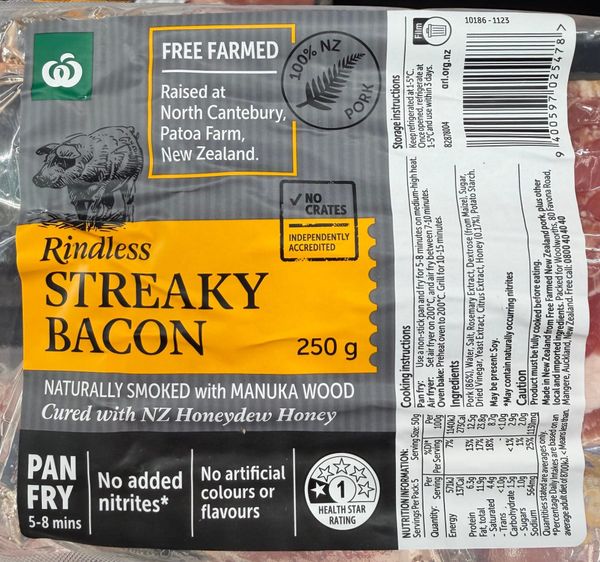
Patoa Farms (Hawarden, North Canterbury). The Sterne family — Steve, Josie and daughter Holly. Around 5,000 sows on 450 hectares producing around 95,000 pigs a year. Around 1,600 to 1,900 pigs go to processors weekly. Sows freely roam, straw-based farrowing shelters, large eco-barns with deep litter straw for finishing. SPCA Blue Tick approved and PigCare certified. Around two-thirds of stock goes to the Ashburton Abattoir and on to Woolworths supermarket shelves; the rest goes to Harris Farms in Cheviot under the "Made in North Canterbury" brand. Patoa won South Island Farmer of the Year in 2014; Steve Sterne won NZPork's Outstanding Contribution Award in 2025.
Apple Tree Farm (Canterbury). Free-farmed, sows and boars outdoors for life with shelter. After weaning, pigs are raised in bedded barns. Supplies Porkcorp.
Freedom Farms (Auckland brand, South Canterbury farms). The brand is honest about not being free-range in the strict sense. Sows in paddocks, piglets to deep-straw shelters. Independently audited by QCONZ to the Five Freedoms standard.
A note about Freedom Farms worth knowing. A substantial portion of the pigs sold under the Freedom Farms brand come from the Christchurch Men's Prison farm. The prison piggery is one of New Zealand's largest free-farmed pig operations — around 8,000 head, 600 breeding sows, supplying 17,000 pigs a year to Freedom Farms under a supply agreement, processed in the Freedom Farms-certified straw barns on the prison farm. The piggery is fully Freedom Farms certified, so the welfare standards are met. The work is done by sixteen to twenty low-security prisoners at a time, as part of Corrections' rehabilitation and training programme, earning NZQA qualifications in primary industry skills. They are paid as little as 20 cents an hour. The arrangement is publicly documented by the Department of Corrections, NZPork, and reporting in Rural News Group, RNZ, and the NZ Herald. It's never mentioned on the Freedom Farms packet. Whether that should be disclosed is a different question to whether the pigs were raised well — but it's the kind of thing readers of last week's piece will want to know.
Ngarara Farm (Greytown, Wairarapa). Bryan Tucker grows half the pigs' barley on the farm. Pigs raised on bedding that's composted as fertiliser. Mixed system. Supplies Cabernet Foods.
Fully indoor.
Moorpork (Aylesbury and Oxford, Canterbury). Ben and Julie Voice. Started outdoor in the mid-90s, then in 2006 chose to build two fully enclosed, modern production systems with strict biosecurity. The argument for indoor pork has a logic I'm not going to dismiss — controlled environment, biosecurity, no effluent reaching waterways. It's also entirely inside. NZ-owned, PigCare certified, 100% NZ.
The remaining roughly forty-eight farms aren't publicly profiled. They're supplying the processors below. Many of them, on the SPCA's numbers, still use farrowing crates.
Layer two: the butcheries and processors
These are the businesses that buy pork from the farms above and turn it into recognisable products. They're not farms themselves. They're the bridge between the paddock and the shelf.
Holly Bacon (Hastings). Sources from small Hawke's Bay farmers — names not publicly disclosed. Dry-cured, cold-smoked. Sells through New World and Pak'nSave across the North Island, plus direct online.
Woody's Free Range (Levin). Sources from Longbush and Highgrounds. All pork outdoor for life. Direct online sales nationwide.
The Neat Meat Company. NZ-owned, operating for over twenty years across Auckland, Queenstown and Christchurch. Wholesale supplier to many of New Zealand's top restaurants and hotels. Owns and operates the Harmony retail brand. Sole wholesale source behind Harrington's Smallgoods. Bigger than they look from the outside, and a key Layer 2 player.
Harrington's Smallgoods. Sources through The Neat Meat Company. "Our pigs don't fly."
Freshpork NZ. Processor and exclusive distributor for the Freedom Farms fresh pork range. Also the company behind the Heartland NZ Fresh Foods retail brand.
Porkcorp NZ. Family-owned wholesaler sourcing from Apple Tree Farm and other Canterbury farms.
Cabernet Foods (Carterton). Processes pork from Ngarara and other Wairarapa farms.
Premier Beehive (Carterton). Smallgoods maker, exclusive licensee for the Freedom Farms smallgoods range. Their own Beehive brand uses imported pork.
The other names on NZPork's processor licensee list — Five Star Pork, Wilson Hellaby, Land Meats, Murellen Pork, Foreman Partnership, Ashburton Wholesale, Kintyre Meats, Harris Meats — are trade-side businesses, mostly without consumer-facing websites. They handle NZ pork only under the PigCare scheme.
Layer three: the retail brands
These are the names on the packets in the supermarket. Some are owned by farms, some by processors, some are standalone brands.
Harmony. Owned by The Neat Meat Company. Pork from Highgrounds only — "free range pork cuts from a single farm in Northern Canterbury." Sold nationally through Foodstuffs and Woolworths, and online via neatmeatstore.com.
Freedom Farms. Auckland-based brand company. Fresh pork processed by Freshpork, smallgoods by Premier Beehive, pigs raised on independently audited South Canterbury farms — including the Christchurch Men's Prison farm.
Heartland NZ Fresh Foods. Freshpork's own retail brand.
Holly Bacon. Their own brand.
Patoa Farms (sold through Woolworths house-brand pork and the "Made in North Canterbury" Harris Farms brand).
If you walk into a supermarket and pick one of these brands off the shelf, you can be confident the pork was raised in New Zealand. None of them is perfect — Freedom Farms' supply chain includes the prison farm; Harmony is owned by an Auckland wholesaler rather than the farmers; Holly Bacon's farms are unnamed. But all of them are clear that the pork is from here, and all of them have to be able to back that up under the PigCare and 100% New Zealand Pork trustmark schemes.
You don't have to take my word for the best
So far this piece has been my research. From here it's the industry's verdict.
The 100% New Zealand Bacon & Ham Awards has been running for over a decade, judged by a panel of working butchers and culinary experts, and every single entry must be made from PigCare-certified 100% New Zealand pork. No imports. No exceptions. Two hundred and fifty submissions in 2025 from forty-four retailers across the country. These are the butcheries and producers consistently making the best bacon and ham in New Zealand, judged by people whose job is knowing what good looks like.
Here are the winners over the last three years.
2025 — Sam's, Wild Game, Peter Timbs
Supreme Bacon: Sam's Butchery, Silverdale, north of Auckland. Naturally Cured Maple Streaky Bacon. The cure took the team about a year to perfect.
Supreme Ham: Wild Game, Camberley, Hastings. Old School Pressed Ham — a traditional pressed shoulder cut you don't see much anymore. Wild Game's second Supreme Ham win in three years.
People's Choice: Peter Timbs Meats, Christchurch. Voted by over 5,400 members of the public. Peter Timbs has thirteen years in the awards, twenty-nine medals, and four Supreme wins across that history.
2024 — Cameron Harrison, Sam's, Aussie Butcher
Supreme Bacon: Cameron Harrison Butchery, Upper Hutt. Honey Cured Streaky Bacon. "I've been doing it the same way for as long as I've been making bacon, which is sixteen years now," owner Rob Cameron told RNZ. "Don't overpump it. Some companies are too focused on making money and put too much water in there."
Supreme Ham: Sam's Butchery, Silverdale. Mini Champagne Ham. Sam's has the trifecta — Supreme Bacon, Supreme Ham, and Supreme Sausage across different years.
People's Choice: The Aussie Butcher New Lynn, Auckland. Over 7,500 public votes. The Aussie Butcher group (multiple Auckland stores, trading since 1984) is explicit: NZ-owned, NZ pork only, PigCare accredited, never imports.
Also worth a mention from 2024: Expleo, Te Awamutu. First time entering — won category champion for dry-cured streaky bacon and sliced ham, plus silver for boneless ham. "Everything we do is done by hand."
2023 — Wild Game (twice), Crackling Good Farm
The 2023 awards is the supply-chain story I want to lift up.
Supreme Bacon AND Supreme Ham: Wild Game, Camberley, Hastings. Jordan and Varnnah Hamilton-Bicknell. First time entering. "My secret is really just keeping it real, creating old school bacon and ham, using good quality New Zealand pork — keeping it simple and doing it well."
And here's the bit that matters. Wild Game's pork was supplied by Dean Nikora of Crackling Good Farm, also in Hawke's Bay. Dean attended the awards dinner in Auckland alongside Jordan. He was quoted in every major news outlet that covered the win. "Supplying someone like Wild Game is critical to us because it helps us to grow, in terms of offering a specialised product, caring for the animal really well and being able to present it to Jordan in the way that he needs it. This allows him to create a superior product."
A farmer and a butcher, both named, both publicly celebrating a national supreme award together. That's the version of the supply chain shoppers should be able to see for every product on every shelf. In a country where most 100% NZ pork brands don't name their farms at all, the Wild Game / Crackling Good Farm pair is the rarest thing — a visible, traceable, transparent chain from paddock to plate. If you want to know what good looks like, that's it.
2022 — Warkworth, Westmere
The 2022 competition was the first after a three-year COVID-related hiatus. Almost 200 entries from around 40 retailers.
Supreme Bacon: Warkworth Butchery, Warkworth. Dry Cured Middle Bacon. The butchery has been part of the local community since 1905. Owners Rob and Renee Lees. Rob was 2020 Pure South Master Butcher of the Year.
Supreme Ham: Westmere Butchery, Auckland. Bone-in Leg Ham. Forty-five years in the business under owner David Rossiter.
What the awards list tells you
Look at who's on this list and who isn't.
The Supreme winners are independent butcheries. Mostly family-run. Mostly outside the supermarket system. The geography is dispersed — Hawke's Bay, Silverdale, Upper Hutt, Christchurch, Warkworth, Westmere Auckland, Te Awamutu. None of them is a national brand. None is owned by Australian private equity. None is owned by JBS or any other global meat conglomerate. None of them shows up in the imported-pork numbers from last week's piece.
The big supermarket processed-pork brands win the occasional category medal — Hellers has won bacon medals over the years for its Middle Eye and Free Farmed lines, going all the way back to 2008. But none of them has ever won Supreme. The Supreme winners are all small-to-medium independent butcheries making bacon and ham the slow way, in small batches, with the kind of attention that comes from doing it yourself.
The pattern is clear. The best bacon and ham in New Zealand is being made by independent butchers buying from smaller farmers, processing it themselves, and putting their own name on the label. If you want the best, you find one of those shops.
Where to actually buy this stuff
The practical bit. Three ways to shop, in order of how good the pork gets.
At a supermarket
If you can only shop at a supermarket — most people, most weeks — these are the safe defaults for 100% NZ pork:
- Holly Bacon at New World and Pak'nSave across the North Island. The best bacon you can buy in a supermarket. 112 years, all NZ pork, two-week dry cure, cold smoked.
- Freedom Farms fresh pork and smallgoods, widely available. Independently audited welfare standards. Now you know the supply chain includes the prison piggery.
- Harmony pork. National. From Highgrounds in Timaru only — no other farm in the supply chain. Free-range for life.
- Harrington's Smallgoods. Widely available. NZ pork only, sourced via Neat Meat.
- Patoa Farms under the Woolworths house brand. Free-farmed.
What to avoid: anything that says "Made in New Zealand from imported and local ingredients." Last week's piece walked through why.
Direct from the maker, online
This is where the best 100% NZ pork lives, and where you'll find what the supermarket shelf can't give you. Most ship nationwide.
- Poaka — heritage breeds, chestnut-fed, on-farm everything. The most artisan pork in New Zealand. Ships from Canterbury.
- Woody's Free Range — bacon, sausages, fresh cuts. Pork from Longbush and Highgrounds. All pigs outdoor for life. Overnight nationwide.
- Holly Bacon — direct via their website, plus the factory shop on Warren Street in Hastings.
- Sam's Butchery — current Supreme Bacon winner. Silverdale and online.
- Wild Game — current Supreme Ham winner, 2023 double Supreme winner. Hastings and online. The Crackling Good Farm pork.
- Peter Timbs Meats — Christchurch. Twenty-nine awards medals over thirteen years. People's Choice 2025.
At an independent butcher
In Auckland specifically:
- The Aussie Butcher (multiple Auckland locations). NZ-owned since 1984, explicit 100% NZ pork policy.
- Grey Lynn Butchers, 531 Great North Road. Won the NZPork Supreme Pork Award in 2017 and has racked up eight Pork, Bacon and Ham Awards medals. Owner Lucia explicitly endorses the NZPork Born and Raised label.
- Westmere Butchery, 131 West End Road. 2022 Supreme Ham winner. Forty-five years in the business.
- Mapari Meats, Stoneridge on Lunn Avenue. Personally sourced from local farms north and south of Auckland.
Across the country: the Supreme winners above plus their gold medallist peers. The full medallist list from each year is on the Retail Meat NZ website. There will be a great butcher within an hour of where you live, win or no win.
The one question to ask
Walk into any butcher and ask: "Which farm is this pork from?"
If they can tell you, you're in the right shop. If they say "New Zealand" without naming a farm, push a little. If they get vague, that's the answer.
The Wild Game / Crackling Good Farm pair gets celebrated at the awards because that level of transparency is genuinely rare. It shouldn't be. Asking the question is how it gets less rare.
Why there's no certified organic NZ pork
A reader of last week's piece asked me the question I'd been avoiding. Where's the Bostock's of pork? The Hawke's Bay-scale, supermarket-distributed, certified-organic option that exists for chicken? The answer is it doesn't exist. Here's why.
The abattoir bottleneck. Organic certification requires the processing facility to also be certified organic. Good Magazine's Good Guide to Pork notes there is at least one New Zealand farm raising Demeter pigs, but to be fully certified requires an abattoir to also be certified — and that hasn't been done. The Organic Farm Butchery in Hawke's Bay describes the same problem for beef and lamb. Their nearest abattoir refuses to get certified because they're too small to make it worthwhile. The economics don't work for an abattoir to certify when the volume of organic meat is tiny.
The feed bottleneck. Pigs aren't ruminants. They need grain. Certified organic pork requires certified organic feed, which at any scale means importing it, which defeats the local sourcing ethic most NZ farmers care about. Freedom Farms put it plainly: to be organic the feed needs to be organic too, and for a larger operation that means importing feed from overseas. They don't like it.
The market signal. Aotea Organics, the most-certified organic livestock operation in the country, has MPI registration to process beef, fish, fowl, lamb, and venison. They've opted to leave pork out of the schedule. The plant is completely halal. Even the operation set up to do organic livestock at scale has decided not to handle pork.
So the closest thing in New Zealand to certified organic pork is Poaka. Heritage breeds, pasture-finished, no synthetic herbicides on the farm, no synthetic drenches on the pigs, on-farm milling, on-farm abattoir. They've publicly said they're working toward certification. The three bottlenecks above explain why it's taking time.
If you want pork raised the way certified-organic pork is raised elsewhere in the world, you buy Poaka and you accept that the certificate isn't there yet.
What I'd buy this week
If you want a concrete answer to the question "what's the single best 100% NZ thing I can put in my trolley":
For bacon: Holly Bacon at the supermarket, or Sam's Butchery, Cameron Harrison, or Wild Game online.
For ham: Wild Game's Old School Pressed Ham online, or Sam's Butchery's Mini Champagne Ham, or Westmere Butchery if you're in Auckland and want to walk in.
For fresh pork: Harmony at the supermarket, Poaka direct online, or Woody's Free Range nationwide.
For salami and charcuterie: Poaka, hands down.
For the freezer: a half pig from Farm Gate Produce, or order a Poaka box, or talk to Wild Game about a direct Crackling Good Farm cut.
For the kids' school lunches: Harrington's, Harmony, or Heartland NZ Fresh Foods at the supermarket. All NZ, all PigCare.
This is what I've found so far
This article is the best picture I've been able to build from publicly available sources. The New Zealand pork industry is small, often privately held, and not everything that's true is online. There will be operations I've missed. There will be supply chains I haven't traced. There will be farms quietly doing it brilliantly that don't have a website.
The OFT Pork Hub is where I'll keep digging. If you know something I've missed, or you want me to look into something specific, tell me. The article is the start of the work, not the end of it.
For now, the practical answer is in front of you. The best bacon and ham in the country is being made by independent butchers buying from named farms. Holly Bacon has done it for 112 years. Wild Game and Crackling Good Farm together are doing it now. Poaka is doing it as well as anyone in the world. The supermarket has safe defaults; the online direct-sellers have the best of the best; the local independent butcher has a story to tell if you ask.
Twenty percent of the pork eaten in New Zealand is born and raised here. None of it has to be a mystery anymore.