The Proprietor: Sam Neill Didn't Just Own an Organic Winery. He Meant It.
The obituaries will give you Jurassic Park. Here's what they'll skip: four certified organic vineyards, a BioGro conversion he pushed because he couldn't stomach the herbicide strip, and a final year spent fighting an open-cast gold mine in his neighbourhood.
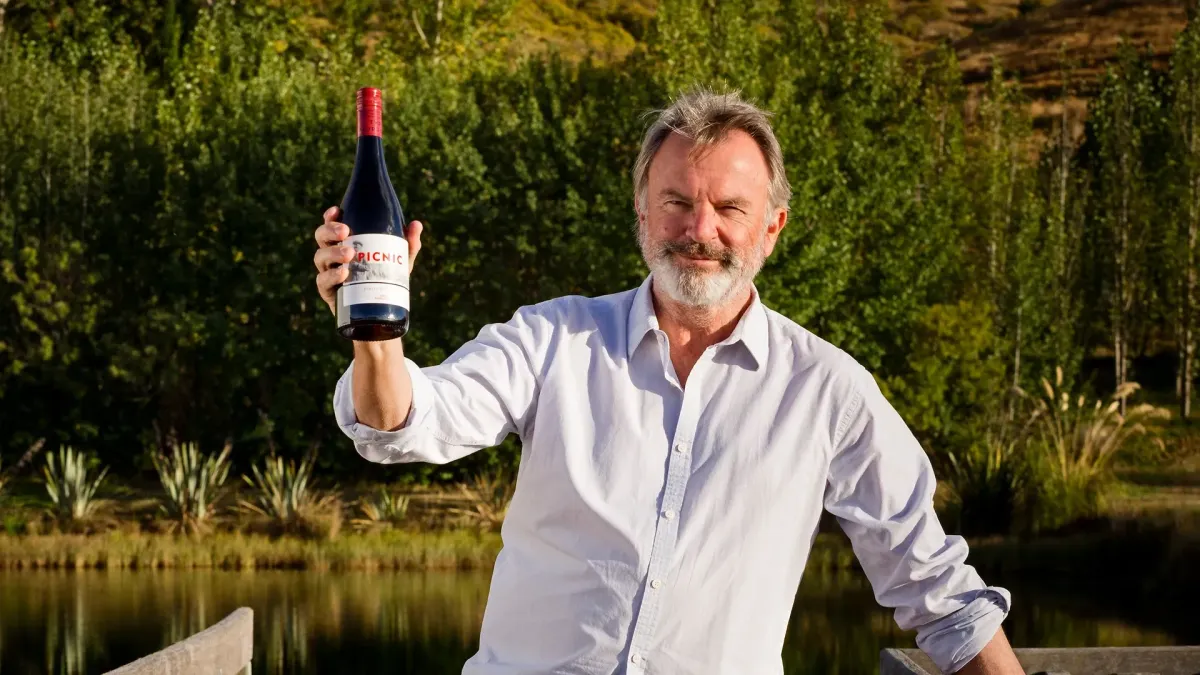
Sam Neill died on Monday in Sydney, suddenly and unexpectedly, at 78. His family said he remained cancer free at the end, which after everything he'd been through feels like its own small mercy.
You'll read plenty this week about Dr Alan Grant and The Piano and the five decades of film. This isn't that piece. This is about the other thing he built — the thing I put on a list three weeks ago without knowing it would soon need to carry his name alone.
The list he was already on
When I wrote about Central Otago organic wine in June, Two Paddocks sat in the fully certified column — every wine from certified organic grapes, alongside Felton Road, Rippon, Quartz Reef. Twelve names. His entry ran to a single line: Two Paddocks, Central Otago, Sam Neill's estate.
He'd have been fine with that. The whole point of Two Paddocks was that it never needed the famous name to hold its place on a list like that. It earned it the same way everyone else did: an auditor walked the rows, checked the records, and signed.
What he actually did
Neill planted two hectares of Pinot Noir in the Gibbston Valley in 1993, at the height of the Hollywood years, and took his first vintage off in 1997. Over three decades that grew into four small vineyards with names that tell you everything about the man: the First Paddock in Gibbston, the Last Chance and Red Bank — the farm headquarters — in the Earnscleugh Valley near Alexandra, and the Fusilier in Bannockburn. Almost all of it Pinot Noir and Riesling, all of it deliberately small. He styled himself "The Proprietor," a joke he committed to for more than three decades — and, like all his best jokes, one with a serious floor under it. He bristled at the celebrity-winemaker tag his whole wine life. Asked about Two Paddocks around the launch of his memoir, he put it in exactly the language this website runs on: "It's always been about provenance and integrity."
The organic conversion was his call, and by his own team's cheerful account he was relentless about it. He hated what he called the scorched earth under conventional vines — the bare herbicide strip I wrote about in June, the glyphosate default now turning up as resistant ryegrass in South Island vineyards. People who worked with him said he couldn't bear driving past conventionally farmed rows once he'd seen what the chemistry did.
And here's the detail I like best, because it's the kind of honesty this website exists for: the conversion wasn't a clean straight line. When Two Paddocks took on new vineyards, conventional weed control was needed to get them into shape, and the estate's organic run was interrupted. The road back took years of conversion work before BioGro certified the wines from the 2017 vintage. No mythology. An interruption, a decision, the slow unglamorous work, an audit, a logo on the bottle. That's how real conversion happens, and he never pretended otherwise.
The certification survives him, because he built it that way. It was never a celebrity promise; he turned it into an audit of the vineyards and their records, renewed on its own schedule, whoever's name is on the gate. That's the difference between lending your fame to a cause and quietly building something that no longer needs it.
And it's worth saying plainly what he gave this movement, because no one else could have. For thirty years the most famous farmer in New Zealand told the world — never preaching, usually joking — that organic is simply how you farm when you give a damn about the ground. Central Otago's organic story has its pioneers and its scientists and its auditors. It had exactly one person who could put a BioGro logo in front of millions of people and make it look like common sense. That mattered, and it will be missed.
More than a wine label
Celebrity farms invite scepticism, and this website usually supplies it. Two Paddocks never needed the benefit of the doubt. Neill described the Red Bank property as close to self-sustaining — vegetables, eggs, lambs, solar power, farm and vine by-products composted back into the soil — alongside lavender, a stand of young native trees above the vines, and a rotating cast of animals named for his colleagues: the kunekune Angelica, who turned out to be a boar, pigs Bryan Brown and Annette Bening among them. In 2024 the work was recognised formally: Two Paddocks was named Sustainable Vineyard of the Year at the Aotearoa New Zealand Organic Wine Awards, an award announced as recognition of the re-wilding of indigenous plants and birdlife at Red Bank as much as the organic farming itself.
He lent his name to strong wool through the Campaign for Wool. And just last week — days before he died — he was named one of five New Zealand Wine Fellows, to be honoured at the New Zealand Wine 2026 Celebration next month. He knew the industry had decided he was the real thing. I'm glad he got to hear it.
The fight he leaves unfinished
There's one more thing, and it matters to anyone who cares about that 30% organic figure Central Otago has spent twenty years building.
Neill spent much of his final year publicly opposing Santana Minerals' Bendigo-Ophir gold project — open-cast pits in the Dunstan Range, the largest around a kilometre long, with a tailings storage facility designed to remain in the landscape in perpetuity, currently moving through the Government's fast-track process with a decision due by late October. He fronted a short documentary, Into the Dunstan Mountains. He took real abuse for it, including threats. He spoke at the Wine not Mine fundraising lunch near the proposed site, an event backed by twelve local wineries. And he was careful about what he was actually arguing. "I'm not against mining. I'm against this mine," he told The Guardian.
Strip out the celebrity and his case was a provenance case — the same one this website makes about bacon and honey and milk. The gold comes out of the ground once. The vineyards, the water, and the land carrying the region's organic certifications have to keep passing their audits every year, indefinitely. Those are two different clocks, and he wanted people to notice which one Central Otago has been winding for fifty years.
That fight now continues without its most famous voice. The decision lands in October. We'll be watching.
What happens to an organic estate when the Proprietor dies
The winery hasn't said anything yet beyond the family's statement, and none is owed this week. But the structure he built points one way. Two Paddocks was never a one-man show: it's a small family company run day to day by a long-standing team — winemaker Dean Shaw, viticulturist Mike Wing, general manager Jacqui Murphy, with Pinot Noir veteran Larry McKenna consulting — and the BioGro certification belongs to the vineyards and their practices, not to the man on the label. Back in 2017 he told an interviewer his ambition was to leave behind "a thing of beauty" that would outlive him.
Still, this is a question I'll keep asking, here and everywhere, because it's the question this website exists to ask: what happens to a provenance promise when the person who made it is gone? We've watched it go badly elsewhere. The difference at Two Paddocks is that Neill spent thirty years making sure the answer wouldn't depend on him.
My honest bet is that Neill built the institutional kind. The proof, as always, will be on the back label — flip the bottle of Two Paddocks, look for the BioGro logo, and raise a glass of Pinot to the Proprietor.