
The Politicians Had Their Turn. Then the Growers Were Asked to Be Prime Minister.
Five MPs had their say in October. On the last Vote Organic webinar, OANZ handed the questions to a market gardener, a dairy farmer, a garden educator and a business owner. One wanted an organic prescription scheme. Another wanted no money spent on organics at all.
Fonterra is forecasting to pay more than half as much again for organic milk as for ordinary milk this season. One of the farmers who supplies it was asked what she'd do as prime minister, and started by saying it's a job she has never wanted.
That was Rachel Short, a dairy farmer and OANZ board member, on the final Vote Organic webinar on 5 November, two days before the election. OANZ had spent October putting seven questions to ACT's Andrew Hoggard, the Greens' Steve Abel, NZ First's Mark Patterson, the Opportunity Party's Daniel Eb and National's Mike Butterick. This time it turned the questions around and asked people who do the work.
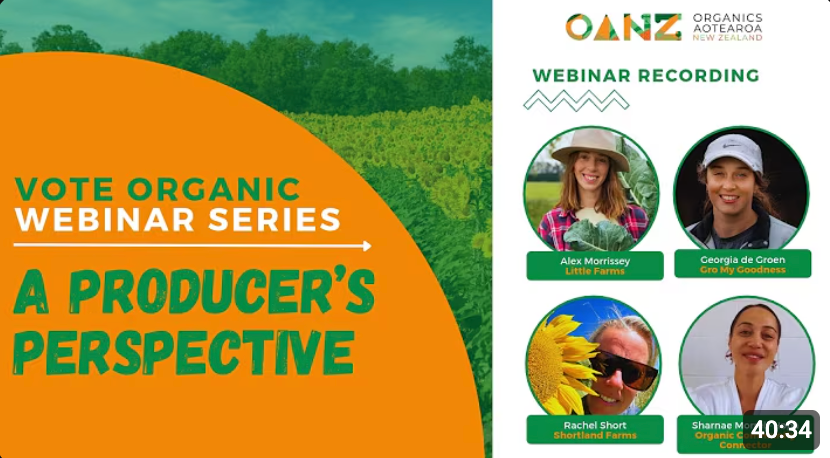
Brendan Hoare hosted again. With Rachel were Georgia from Gro My Goodness Market Garden, Alex Morrissey of Little Farms, who was two days back from a policy conference in China, and Sharnae Morrell-Hopa, who works with schools and community gardens. Hoare noted the panel was all women. It wasn't planned, he said; it's who stepped forward. OANZ has posted the 40-minute recording on its YouTube channel.
VOTE ORGANIC Webinar Recording: A Producer's Perspective
Prime minister for three years
Hoare's opening question was simple. Imagine you're prime minister, and not for a day. For three years.
Georgia said New Zealand's food system has become increasingly centralised and needs a rethink, with organic at the front of it. She'd give farmers incentives to convert and help with the extra costs. Her most original idea was an organic food prescription scheme to help people with health problems get organic food. She also wants organics taught in schools, saying it wasn't something she learned anything about growing up. Her connection then dropped out, which Hoare blamed on someone in the house watching a movie.
Rachel would start by having the government acknowledge the sector and the work already happening in it. Next, a dedicated organics agency, possibly sitting inside MPI, to support the sector as the Organic Products and Production Act comes into force. Third, she said she'd "kill that bloody gene tech bill," which she clarified meant stopping release into the environment. In her view the bill should have been split from the start, with health on one side and primary production on the other. The bill lapsed when Parliament dissolved on 1 October, and the next Parliament can bring it back.
Sharnae's first move would be to hire Georgia and Rachel and copy their homework. Her own list started with time. A ten-year plan isn't long term to her, so she'd make ten years the minimum and aim for 100-year strategies. She wants multi-year funding, because groups that have run community food gardens for years end up exhausting one-year grants that are built for new initiatives. And she'd fund the people as well as the projects, with training, connections and help applying for money.
Alex's plan put no money into organics at all. It would go to other departments and help organics "by default." The Ministry of Health would run campaigns for fresh, local, organic, whole food on buses, TV and social media. Schools would teach preserving in science and cooking in technology. Public procurement would have schools, hospitals and prisons buying organic, which she said is worth hundreds of millions of dollars a year in some countries, particularly in South America. Conversion support would come from the Ministry for the Environment and be justified on climate, water and biodiversity, rather than as a farm subsidy through MPI. An organics minister would run the whole thing.
What they need now
Asked what they need from the next government straight away, the answers got shorter.
Georgia wants the national organic standard finished and rolled out, and she wants it to work for small farms, not only for large exporters. She believes small growers feeding their local area are key to the future food system, and she doesn't want to see them locked out of the new rules. How small is small is still being decided; MPI consulted in August and September on where to set the exemption line.
Rachel repeated the agency, so the Act works for both domestic sellers and exporters. Sharnae asked for real resources, and for government to stop treating food gardens as recreation and start treating them as essential public infrastructure.
Hoare asked her whether the kids she works with are excited about organic. Not at the start, she said. She co-developed a garden game with the council and her nieces and nephews that runs in Roblox and in a real garden. When weeding loses its appeal, she bribes them with food.
Alex asked for something cheaper than any of it: open support. She said a point raised at the China conference was that governments often avoid backing organic because they think conventional farmers will hear it as a snub. The countries that manage it say they support both, and that organic has benefits the market doesn't reward.
What's in the way
Hoare put it bluntly. By his count it has taken 18 years to get from the start of an organic act to finished regulations. So what's stopping the sector just going for it?
Georgia thinks it's perception, among farmers as well as the public. Organic is still seen as a niche, and New Zealand's clean, green reputation isn't matched by the size of its organic food system. The day before the webinar, a visitor to her farm had asked whether organic meant anything more than not being sprayed.
Rachel thinks some of that starts with government. She said MPI's definition of organic is written around what farmers don't use, farming without chemicals and synthetic fertiliser. IFOAM, the international organics federation, defines it around four principles: health, ecology, fairness and care. She wants MPI's wording brought into line.
The milk cheque
A question sent in before the webinar asked about certification costs for medium-sized domestic producers. Alex said the regulations aren't final, so the sector still has a chance to be heard, and that grants for the three-year conversion period would help most. Rachel added that selling locally brings its own layer of rules, separate from organic. Raw milk vendors and paddock-to-plate meat sellers face compliance that she doesn't when her milk goes to Fonterra.
Then she made the case for organic dairy. She said most organic dairy farmers have lower production costs than conventional farmers, and that Fonterra's organic milk price is more than 50% above the conventional price.
The second claim checks out on Fonterra's latest forecast. On 30 October it lifted its 2026/27 forecasts to $15.25 per kilo of milk solids for organic and $9.75 for conventional. That's a gap of $5.50, or 56%. It hasn't always been like that. In January Fonterra said that since 2016/17 the organic price had averaged about $2 above its standard milk price, and more than 100 North Island farms were in its organic programme. Last season's final prices, reported by Rural News, were $14.13 and $9.69, a premium of about 46%. Back in March, Fonterra's record organic forecast was $13.35.
Rachel's own hope for the sector sat right next to that number. She'd like New Zealand organic dairy and meat to be easier to buy here. It's a familiar problem.
Worth more than money
Lou from OANZ read out a question from Carol, who asked how caring for land, people and communities could become a measure of success alongside economic value.
Sharnae said social justice has to come first. When people can barely afford food, organic can look like a privilege. Georgia said customers buying her salad bags tell her every week how long they last, so the dollars go further than a $2 or $3 lettuce from the supermarket. Hoare called himself antagonistic and said organic isn't about buying anything. It's a daily practice at any scale, down to a windowsill.
Alex agreed from experience. Through her social media and workshops, she said, people are much keener to start their own garden than to switch their whole grocery shop to organic. The barrier to growing it is lower than the barrier to buying it.
Asked what gives them hope, Rachel pointed to Fonterra's organic programme going from strength to strength. Georgia and Sharnae both named the young people coming through. Alex said growing food has become cool.
Hoare closed with a story about a grower he'd been remembering at the Biological Husbandry Unit's 50th. The grower's best customers were the ones who had tried to grow a cauliflower themselves. After that, his cauliflowers looked cheap.
Before you go
If you want more like this in your inbox, sign up free. If this was useful and you'd like to chip in once, leave a tip.


