"Not the Best Platform for You": The Opportunity Party on Organics
Daniel Eb finished his Vote Organic interview by telling organic voters his party probably isn't their best option. Here's what the Opportunity Party offers growers anyway, where it stands on GE, and what it said on the scorecard.
"If you guys are voting purely based on organics, I don't believe that we have the best policy platform for you."
That was Daniel Eb's closing pitch. Not many politicians end an election interview by pointing the audience at other parties.
Eb is the Opportunity Party's deputy leader and agriculture spokesperson. He spoke to Brendan Hoare on 5 October, the fourth in Organics Aotearoa New Zealand's Vote Organic webinar series, straight after NZ First's Mark Patterson. Earlier interviews covered ACT's Andrew Hoggard and the Greens' Steve Abel. You can watch the full recording; it runs about 30 minutes.
Eb said his family has a regenerative farm up north, that he founded Open Farms, the national open farm day, and that he was talking from his North Auckland home looking out at his food forest.
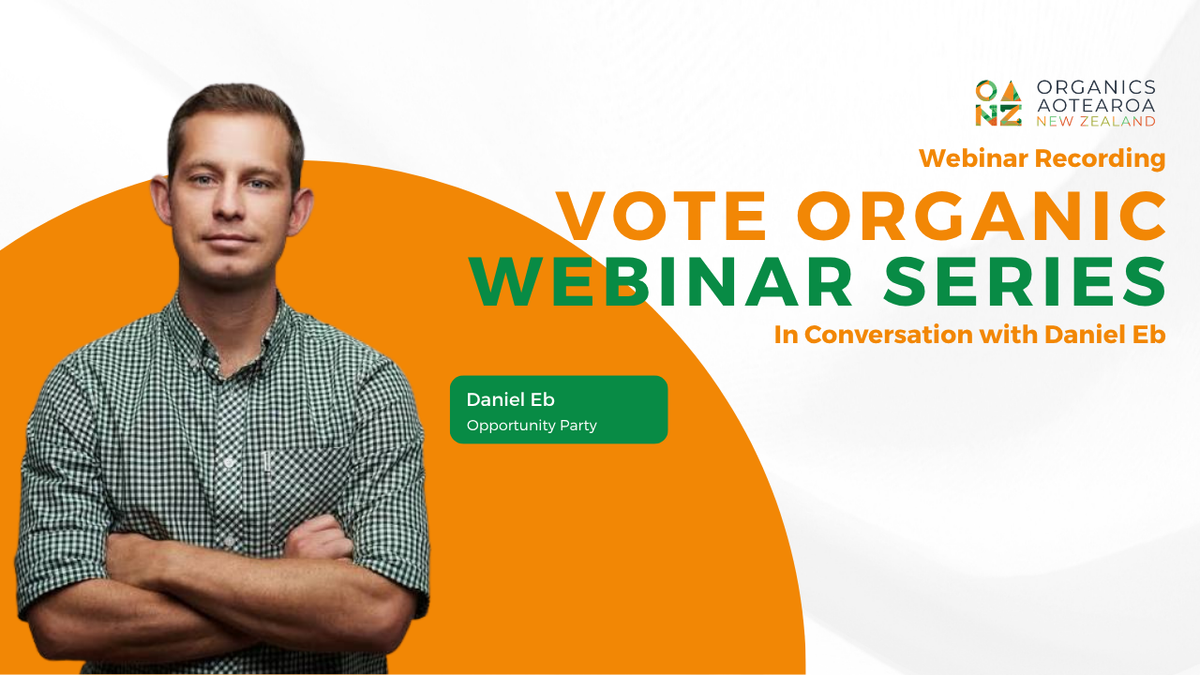
VOTE ORGANIC Webinar Recording: In Conversation with Daniel Eb, Opportunity Party Deputy Leader.
Three ticks, two dashes, two crosses
The Opportunity Party answered five of OANZ's seven questions in writing, according to OANZ's published response tracker. I went through all five parties' answers when the scorecard came out.
It got a yes on finishing the National Organic Standard rollout, on export market access and on protecting GE-free status. Its written answers on the first two say it has no policy of its own but supports the existing MPI-led processes. On GE it gave no written comment and pointed to its gene technology policy.
It got neutral on keeping an Associate Minister for Organics, saying a minor party is unlikely to decide who gets which ministry, and neutral on transition support and public buying.
It said no to investing in the sector's growth architecture, and no to having a specific policy for growing organics.
On the call, Eb didn't argue with any of that.
Right values, no policy
Hoare's first question was the obvious one. The party's pillars are unity, innovation and nature, and organics has been talking about systems for 85 years. It should be a natural fit. So why won't the party just back it?
Eb agreed the values line up. He said his colleagues had been asked the same thing by Creative New Zealand that day: you get us, so where's your arts policy?
His answer was focus. The party has about ten policies this election, he said, aimed at what he called the "big rocks", a phrase he said he doesn't love borrowing from Christopher Luxon, before borrowing it. Tax, climate action, intergenerational infrastructure. Organics isn't one of them.
He was candid about why. A lot of the party's base is urban, he said, and some people in it "still don't quite get it." It doesn't yet have the "policy development muscle", or the confidence, to write policy for smaller sectors.
What growers might get anyway
Eb's case was that general policies would help organic growers more than most, because they're early movers.
The main one is a 25% tax credit for any business investing in new technology. His examples were a new planting method or AI-driven logistics.
The second was a dollar-for-dollar match fund. Instead of the government handing out innovation grants, he said, a sector would come to government with its own research priorities, on emissions or water for example, and the government would match the money. That sounds a lot like the growth investment the party said no to on the scorecard.
He also pointed to a $5 billion climate resilience fund, with $500 million of it set aside for nature-based solutions, and to instructing Treasury to count nature as infrastructure on the national books.
Lobbying and markets
Hoare raised the party's five bottom lines, the policies it says any governing partner must accept. Eb singled out "clean up politics": a register and code of conduct for lobbyists, and a cap on political donations. He said the cap would be $30,000 per individual and that companies couldn't donate at all.
His pitch to the sector was that this levels the field against bigger agricultural lobbies with more money.
When Lou, who ran the audience Q&A, said OANZ had campaigned on organics as climate action, Eb told her to keep lobbying. "As long as you jump on the lobbyist register."
He described the party's reflex as market-based. On methane, it wants a cap-and-trade system so farmers who cut emissions faster can sell their allowance to slower ones. But some lines aren't for markets, he said, and gave the party's bottom line on phasing out bottom trawling as the example.
GE
Asked whether the party would protect New Zealand's GE-free export advantage, Eb said it opposes the current Gene Technology Bill, which he called poorly designed and pushed through without proper consultation.
But he didn't say the advantage needs protecting from GE. "We think there's a world in which we can do both," he said. He admitted that once someone puts a seed in the ground it's hard to control, but said New Zealand's researchers could manage it.
That matches the party's written policy. It wants the bill withdrawn and replaced with a case-by-case, risk-based system, where "no category of gene technology should be pre-approved or pre-excluded", alongside liability rules that respect organic certification. Before any of that, it wants a citizens' assembly on gene technology.
That's a long way from the Greens. Steve Abel told the same audience a week earlier he was "utterly unconvinced" GE and non-GE crops can coexist. The Opportunity Party still got a tick for GE-free protection.
Hoare told Eb the organic sector has been actively excluded from the table on GE. Eb's one firm commitment of the night was that it wouldn't be, with them. "That's just not who we are."
Small growers
A questioner said the new organic regulations could double or triple verification costs for small growers. Would the party commit to a realistic exemption threshold?
"I don't know if that's the job of politicians," Eb said. He said he was six weeks into the agriculture role and his knowledge was too limited to give a solid answer, and asked what the sector needs from government to make verification work.
For the record, it's been through consultation already. MPI asked whether to keep the exemption at $10,000, or raise it to $12,700 or $30,000. Submissions closed on 22 September.
"Lucky for New Zealand First"
Asked what he'd say to an organic farmer worried about the next three years, Eb started with something he said he never thought he'd say: "lucky for New Zealand First." The gene tech bill has hit an impasse, he said, and from the outside he can't see it continuing.
The rest of his answer was about long-term resilience, and the party's climate and land policies.
Food, health and rural New Zealand
Asked whether the party sees food as one of the big systems, Eb said yes. It backs calls for a national food security strategy, and its health policy includes reviewing nutrition guidelines, prevention, and healthy school lunches, which he said pay back many times over.
He said he "banged the drum" for food inside the party and would have liked more of it in the platform.
On treating farm policy as public health policy, he said he'd written a whole Nuffield scholarship arguing food and farming should be treated as a public good, so his answer was yes. He added that it was his personal view.
Asked what the party would do for rural New Zealand, he said there's no specific agriculture policy, and pointed to its healthy land and water policy, support for a native forest strategy, and nature on Treasury's books.
The confession
Hoare closed with a question he'd put to Patterson too. Hoggard had told OANZ he grew up in an organic family. Any confessions?
Eb's was the opposite. He said he probably doesn't buy organic enough. If it's there, he'll get it. If it isn't, he probably won't go to another shop for it. He said that probably isn't good enough.
He does garden organically, though. "Nothing goes into the garden that shouldn't be there."
The close
Eb's last pitch was that the Opportunity Party wants to be a centrist "circuit breaker", the kingmaker that brings stability and makes big reforms stick. Organics, he said, isn't something it has had the capacity to focus on this round.
It's the most honest answer anyone has given in the series. It's also the plainest. The party shares the sector's values, has a GE policy that leaves the door open, and has nothing written for organics.
Hoare thanked him and said OANZ believes it's part of that circuit breaker too.
Next in the series: National's Mike Butterick, the Associate Minister of Agriculture (Organics), on 6 October.
Before you go
If this was useful, you can get every post by email for free. And if you'd like to help keep it independent, you can leave a one-off tip.