Two Parties Got Seven Questions About Organics. They Didn't Answer Any Of Them.
Organics Aotearoa New Zealand put the same seven questions to seven parties this election. Two didn't answer. Here's where the other five actually stand.
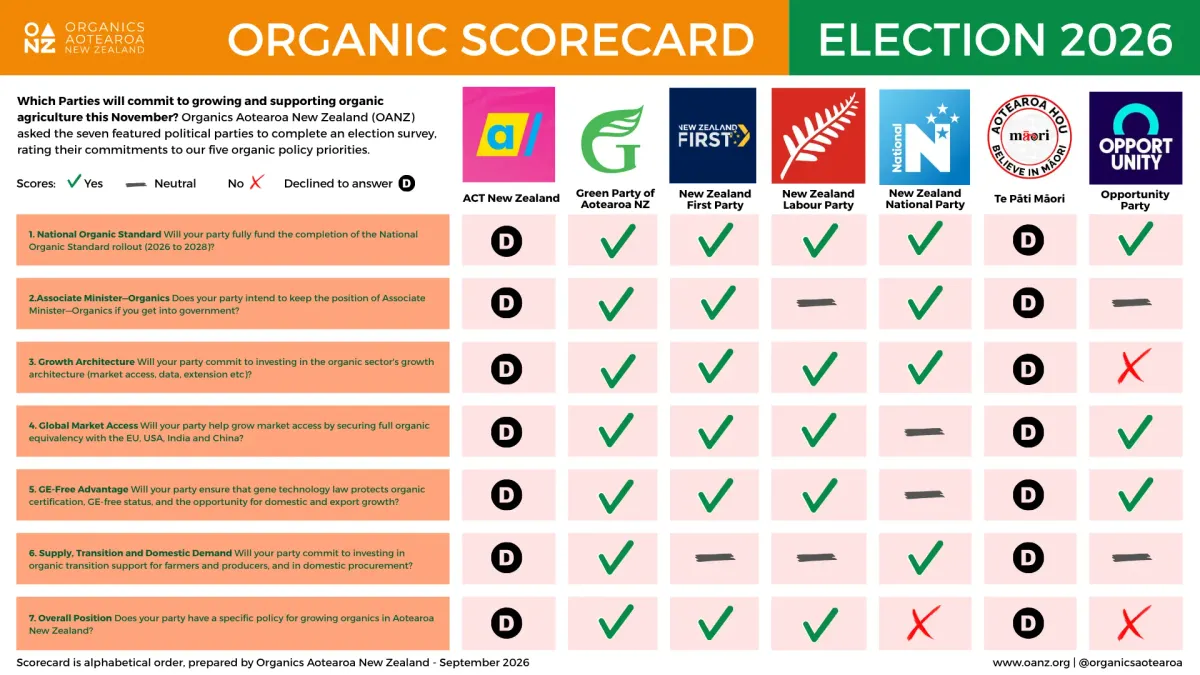
Organics Aotearoa New Zealand put the same seven questions to seven parties this election. Five answered. ACT and Te Pāti Māori didn't respond to a single one.
Seven, not "every party": there are 17 parties registered to contest the party vote this November. OANZ's own account of the process, in a press release confirming the scorecard's launch, says its manifesto and the seven questions were sent to every registered political party, with each given "ample opportunity to respond" and every published answer checked back with the party before it went up. What's actually published, though, only covers seven: the six sitting in Parliament plus the Opportunities Party. Nothing OANZ has put out explains why the other ten registered parties, from the Cannabis Party to four that only registered in August, don't appear in the results at all.
That's the first thing worth being clear-eyed about in the Vote Organic Scorecard, released today by OANZ, the industry body representing New Zealand's organic sector. OANZ says the scorecard is meant to help an estimated 120,000 organic-connected voters decide how to vote on 7 November, plus whoever else cares about the sector's future. It's a follow-up to the manifesto OANZ took to Wellington in August, when the organisation told MPs and officials that not one party had a specific policy for growing organics. This time, OANZ asked its seven directly, and published a full response tracker alongside the summary scorecard, so you can read what each party actually said rather than just how OANZ scored it.
The seven questions map onto the five priorities from OANZ's 2026 Organic Election Manifesto: fully fund the National Organic Standard rollout, invest in the sector's growth architecture, secure global market access, protect GE-free status, and grow organic supply and domestic demand. Two extra questions ask whether a party would keep the Associate Minister for Organics role, and whether it has any specific policy for growing organics at all.
Here's where the five who answered landed.
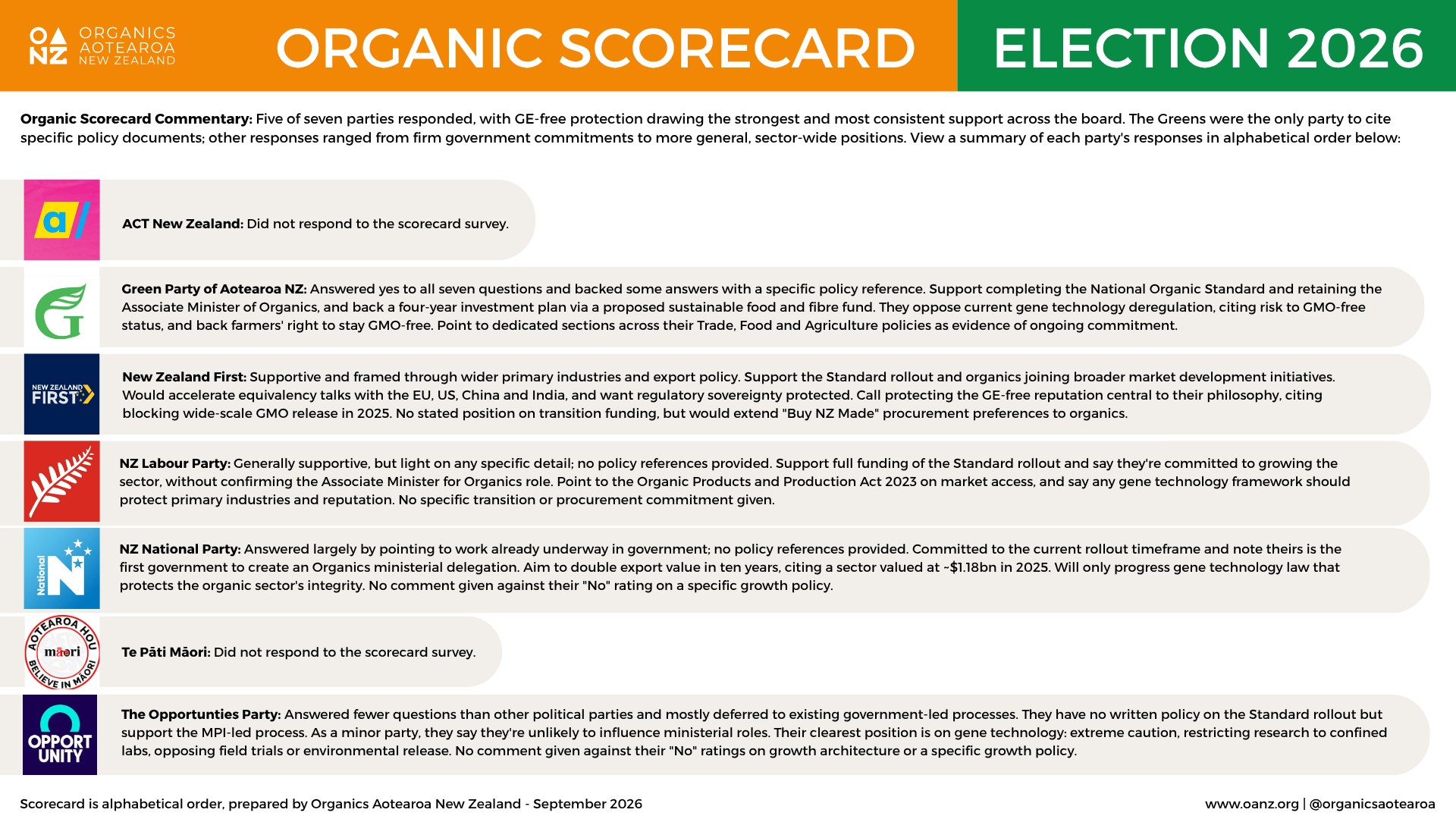
The Green Party: yes to everything
Greens answered yes on all seven questions, and backed it up with the most detail of any party. They point to sections in their Trade, Food and Agriculture policies, say they'd fund a four-year investment plan through a proposed sustainable food and fibre fund, and back low-interest loans and grants for regenerative and organic transition. On gene technology, they say they oppose what they call the current government's deregulation, arguing it risks New Zealand's GMO-free reputation, and back the right of both organic and conventional farmers to stay GMO-free.
New Zealand First: broadly supportive, with a sovereignty caveat
NZ First answered yes or leaning-yes on most questions, framed throughout as part of wider primary industries and export policy rather than an organics-specific platform. They'd accelerate equivalency talks with the EU, US, China and India, though they add that any equivalency deal "should protect New Zealand's regulatory sovereignty" and shouldn't impose disproportionate costs on producers. On gene technology, they point to blocking what they call the "widescale environmental release of GMOs" within the coalition government in 2025. They have no stated position on dedicated transition funding, but say they'd extend "Buy New Zealand Made" procurement preferences to organic products in schools and hospitals.
Labour: supportive but thin on detail
Labour said yes to funding the Standard rollout and to growth architecture and supply chain investment, but didn't confirm whether they'd keep the Associate Minister for Organics role, and gave no policy documents to back any of their answers. Their one specific reference point is the Organic Products and Production Act 2023, which they cite for market access. Beyond that, it's mostly general language about being "committed to growing the Organics sector."
National: pointing to what's already happening
National's answers read differently to the rest, because they're the government answering as the government. Rather than committing to anything new, they describe work already underway: sticking to the existing rollout timeframe, noting theirs is the first New Zealand government to create a ministerial delegation for organics, and citing a sector valued at roughly $1.18 billion in 2025 with about $606 million of that in exports (the same figure OANZ itself rounds to "$1.2 billion" elsewhere). They want to double export value within ten years. On gene technology, they say they'll "only progress" legislation that protects the organic sector's integrity, without saying what that would look like in practice. And on the direct question, do they have a specific policy for growing organics, their answer is no, with no comment offered against it.
The Opportunities Party: mostly deferring
TOP answered fewer questions than anyone who responded at all. They have no written policy on the Standard rollout, but say they support the existing MPI-led process. As a minor party, they're upfront that they're unlikely to have much say over ministerial roles either way. Their clearest position, by some distance, is on gene technology: restrict all research and development to confined laboratory settings, and oppose any field trials or environmental release. On growth architecture and on having a specific organics policy, they answered no to both, and offered no comment against either.
What "neutral" actually means here
One thing worth being precise about: OANZ's published scorecard marks some answers as "Neutral", shown with a dash. But in the underlying response tracker, several of those same cells are marked simply "-", which the tracker's own key defines as "no answer or comment" rather than a considered middle position. It's a small distinction, but a real one: a party that didn't address a question isn't quite the same as a party that took a deliberately neutral stance on it, and the scorecard doesn't visually separate the two.
Why ACT stayed silent, and what it says instead
Farmers Weekly reported on ACT's response after the scorecard gave the party a D grade for its non-answers. OANZ spokesperson Brendan Hoare told the paper he was surprised by ACT's silence, given how positively the party's former agriculture spokesperson Mark Cameron had engaged with the organics sector before retiring from politics this year over ill health.
Associate Agriculture Minister and ACT MP Andrew Hoggard gave his own explanation directly to Farmers Weekly: with multiple sector surveys landing in an election year, the party prioritises ones it can answer straightforwardly. "A tick-box survey where a 'yes' only counts if it comes with a funding commitment is not one of them. That's a request for a cheque and I won't make spending promises with taxpayers' money that way," he said. He did confirm organics is growing at roughly three times the rate of conventional primary produce, and put the sector's value at $1.2 billion, both figures independent of anything OANZ published on its own scorecard page.
On gene technology specifically, Hoggard rejected the idea that organics and new gene tech are incompatible, pointing to wilding pines as an example: a workable pathway through the Gene Technology Bill, he argued, could allow sterile pines that can't self-seed, cutting the cost of controlling an existing high-country weed problem. On the Associate Minister for Organics question, where every other responding party said yes, Hoggard was blunt about ACT's instinct: "We need a smaller government, not bigger."
It's worth calling out directly: this is the same minister who, as Food Safety Minister, already leans on organic certification to do labelling work he's chosen not to require. In July 2025, FSANZ changed the definition of genetically modified food so a gene-edited product with no "novel DNA" in it no longer counts as GM for labelling purposes, even though the DNA was deliberately altered, and Hoggard adopted the change that same month. When RNZ asked him what people who don't want gene-edited food should do, his answer in full was: "So if the organic sector, for example, doesn't want to allow these new breeding techniques in their production, then people who also think they don't want to consume food that's had new breeding techniques used in them, then they can just buy organic and know that 'okay, that hasn't been used'. If this is something you're not worried about, then just go ahead shopping as normal. If it is something you are concerned about, producers who will be using the old methodologies will still be able to highlight on the packaging that, 'hey, we don't use the X, Y and Z' or 'we don't do this or that'. And you just need to go and look for that food."
Government drops the labelling requirement, then tells the public to go find a voluntary label instead, one no producer has to print, in no standard wording, with no penalty for skipping it. GE-Free NZ's Jon Carapiet called it "disingenuous" at the time: "the average consumer certainly can't afford to go and buy organics on everyday basis. I wish they could, but they can't." OFT covered this in full, including nine years of evidence from a near-identical voluntary-labelling experiment, on alcohol and pregnancy warnings, that failed to work. Whatever Hoggard's own comfort with gene tech, he's already made organic certification carry the job the government decided not to make mandatory.
Te Pāti Māori's silence has less explanation attached to it. Farmers Weekly reported the party could not be reached for comment either.
The gap the scorecard opens with
Organic land still makes up just 0.6% of New Zealand farmland, even though OANZ says the sector is growing at twice the rate of the wider food and fibre industry (Hoggard's own figure to Farmers Weekly put it at three times the rate of conventional primary produce specifically, a narrower comparison, not a contradiction of OANZ's). Either way, that's the number OANZ chose to open the scorecard with, and it's the one that makes the rest of it matter: whichever government forms after 7 November gets to decide whether that gap closes, or just sits there as a missed opportunity for another term.
This isn't the last word from OANZ before the vote, either. The organisation says it'll keep the scorecard updated as parties release or refine policy over the campaign, and it's got a webinar with political party leaders scheduled for early October.
Before you go: if this is useful, you can sign up for free to get posts like this in your inbox, or leave a one-off tip if you'd rather support the work directly.