New Zealand Keeps Asking About Food Labelling. It Keeps Getting the Same Answer.
"Just buy organic." That's the government's answer when people worry about gene-edited food losing its label. New Zealand already ran this exact experiment, on alcohol and pregnancy, and it took nine years and a body of research to prove it doesn't work.
Three days ago I wrote about the bacon label the government was asked to fix and refused to. Turns out that's not a one-off. It's a pattern, and one moment captures it better than any other.
"Just buy organic"
In July 2025, FSANZ changed the definition of genetically modified food. A gene-edited food with no "novel DNA" in it is no longer GM for labelling purposes, even though the DNA was deliberately altered. Food Safety Minister Andrew Hoggard adopted the change that same month.
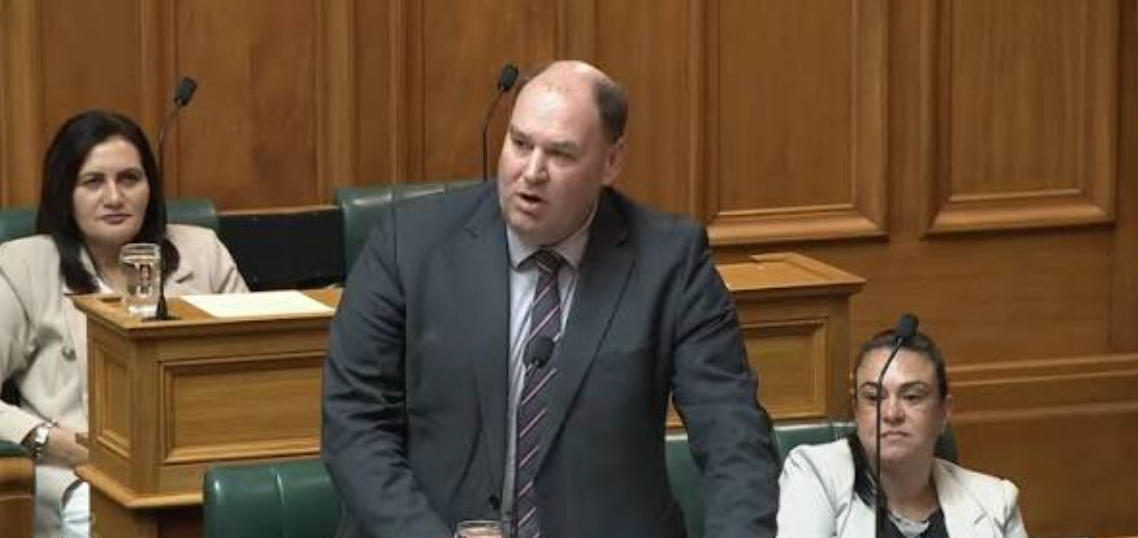
RNZ asked him what people who don't want gene-edited food should do. His answer, in full:
"So if the organic sector, for example, doesn't want to allow these new breeding techniques in their production, then people who also think they don't want to consume food that's had new breeding techniques used in them, then they can just buy organic and know that 'okay, that hasn't been used'. If this is something you're not worried about, then just go ahead shopping as normal. If it is something you are concerned about, producers who will be using the old methodologies will still be able to highlight on the packaging that, 'hey, we don't use the X, Y and Z' or 'we don't do this or that'. And you just need to go and look for that food."
Government removes the labelling requirement. Government tells the public to go find a voluntary label instead, one no producer is required to print, in no standard wording, with no penalty for skipping it.
GE Free NZ's Jon Carapiet called it "disingenuous": "the average consumer certainly can't afford to go and buy organics on everyday basis. I wish they could, but they can't." Hoggard also said he had no evidence of health issues from GMO consumption. Nobody asked him about safety. They asked him about choice.
Sourcing note: I couldn't find video of this interview. RNZ's story links to two radio segments, both audio. I won't claim a clip exists that I can't verify.
We've already run this experiment
New Zealand and Australia already tested "industry discloses voluntarily, shoppers go find the honest ones" as real policy, on a comparable public health stake: pregnancy warning labels on alcohol. It's documented in full in an academic paper I read cover to cover, by researchers at the George Institute for Global Health (Heenan et al., 2023, Health Promotion International).
The first application for a mandatory label went to the regulator in 1996. In 2011, instead of mandating one, the industry was allowed to run its own voluntary scheme, exactly the model Hoggard is now proposing for gene-edited food. Labels read things like "enjoy in moderation" and "it is safest not to drink while pregnant."
It failed, and this was measured, not assumed:
- Only 38% of products carried the label after two years (2013 evaluation).
- Under 50% uptake and low consumer understanding after six years (2017 evaluation).
- 94% of the warning graphics used were smaller than a pea.
- NZ-specific research (Rout and Hannan, 2016) found 38% of consumers thought "safest not to drink" meant some alcohol during pregnancy was fine.
The voluntary scheme ran nine years before a mandatory one replaced it in 2020. When industry argued a mandatory label would cost too much, FSANZ's own cost-benefit analysis found the social and health cost to government from drinking during pregnancy far outweighed the cost of printing a different label. The industry argument was considered anyway. The final vote to mandate the label still only passed 6 to 4.
That's nine years where the main public information tool for a completely preventable, lifelong condition was tested and found not to work.
Why this matters here
Hoggard is proposing the identical mechanism that just failed for nine years: no mandatory disclosure, industry decides whether to bother, the burden shifts entirely onto the shopper. The pregnancy label research didn't find consumers careless or indifferent. It found that voluntary, industry-written labels are too small, too vague, and too easy to skip, because the people writing them have no reason to make them work.
Nobody is currently required to tell you whether your bread's wheat, or the corn behind your meat, was gene-edited without novel DNA. Under Hoggard's framing, anyone who'd rather avoid it is doing exactly what alcohol shoppers did for nine years: hunting for a voluntary claim that may never get printed.
The wider pattern
A regulator or select committee asks the public. The input runs heavily one-sided. The decision goes the other way anyway. This shows up repeatedly:
- Pork and bacon: a parliamentary committee found in 2023 that "made from local and imported ingredients," permitted under regulation 10 of the Country of Origin Labelling Regulations, could mislead shoppers about the roughly 60% of NZ pork that's imported. The phrase is true whether the product is 1% local or 99% imported, no proportion required, so it satisfies the law while telling the shopper nothing. Food Safety Minister Cameron Brewer confirmed on 9 September 2026 that nothing will change, saying he wasn't aware of evidence the problem was happening "at scale." (Full story here.)
- The Gene Technology Bill drew 14,458 submissions, and the Health Select Committee's own report says "most opposed" it, in the same breath it "recommends by majority that it be passed." (The 97%-opposed figure quoted elsewhere is GE Free NZ's own count, not the committee's, and I couldn't independently verify it.)
- Health Star Ratings stayed voluntary despite a majority of Australian and NZ food ministers voting in February 2026 to progress mandatory ratings. Hoggard voted against it, a reversal from his own stated position going into the meeting, per a Cabinet Economic Policy Committee paper.
- Lab-grown meat is the exception worth naming honestly: FSANZ's Standard 1.5.4 makes "cell-cultured" labelling mandatory. This isn't "industry always wins." It's narrower than that.
- Alcohol nutrition disclosure was exempt from basic Nutrition Information Panel requirements for decades. That only started closing on 13 August 2025, when FSANZ mandated energy labelling on packaged alcoholic beverages, gazetted with a three-year transition to August 2028.
- Going back furthest, the 2001 Royal Commission on Genetic Modification drew 10,000+ submissions after a 92,000-signature petition forced it into being, concluded "proceed with caution," and the resulting moratorium still expired in 2003 amid protests.
Why it keeps happening
MBIE's own Regulatory Impact Statement on country of origin labelling names both sides plainly: "Many food retailers and manufacturers oppose the high-level policy because of the additional costs it will impose. The main supporters of the high-level policy are consumers and consumer representative groups." Nobody needs to be captured or corrupt for this to keep happening. The process weighs quantified industry compliance cost against unquantified public harm, runs jointly with Australia so NZ rarely moves alone, and treats a submission count as input rather than a mandate. That structure produces the same outcome most of the time on its own.
The burden runs backwards
There's a deeper layer here, and it's in Parliament's own paperwork, not a fringe reading. The person who has to prove something to a regulator isn't the one introducing a new technique. It's the one who didn't.
The Gene Technology Bill committee report includes the Green Party's dissent: "The Greens are deeply opposed to the disproportionate onus being placed on conventional producers to maintain or 'obtain' that status at their own expense, thereby having to pay the cost of testing their products to prove they have avoided contamination before claiming a non-GMO status." Their evidence isn't hypothetical, it's Australia right now: "The Regulatory Impact Statement affirmed that this is what occurs in Australia now where conventional canola producers are liable for the cost of testing their crop's purity."
A canola grower who changed nothing pays out of pocket to prove they weren't contaminated by someone else's choice, before they're allowed to say so on a label. The grower who introduced the new technology carries none of that cost, and as of the FSANZ definition change, may not even have to disclose it.
Organic certification, non-GMO verification, spray-free claims: same shape every time. The producer doing less, no synthetic fertiliser, no added pesticide, no gene editing, pays an auditor and keeps the paperwork to earn the right to say what they didn't do. The producer using the input pays nothing and says nothing, because the system only asks "is this safe," and once that's answered, silence is free.
It doesn't have to run this way. A regulator could just as easily require anyone using a chemical input or a new breeding technique to declare it, and leave everyone else alone. New Zealand's doesn't.
"Just go and look for that food" only works if someone's actually required to write the label. Right now, on gene-edited food, nobody is.
Before you go
Organic Food Together is free to read, with no ads and nothing behind a wall. If you'd like new investigations in your inbox, you can sign up as a free member. And if the work is useful, you can leave a one-off tip to help keep it independent.