Seven Ticks, Hardly Any Mentions: The Greens on Organics
The Greens were the only party to tick all seven boxes on OANZ's organic scorecard. So OANZ opened by asking Steve Abel why the word "organic" hardly appears in Green policy. Here's what he said on that, GE, small growers and exports.
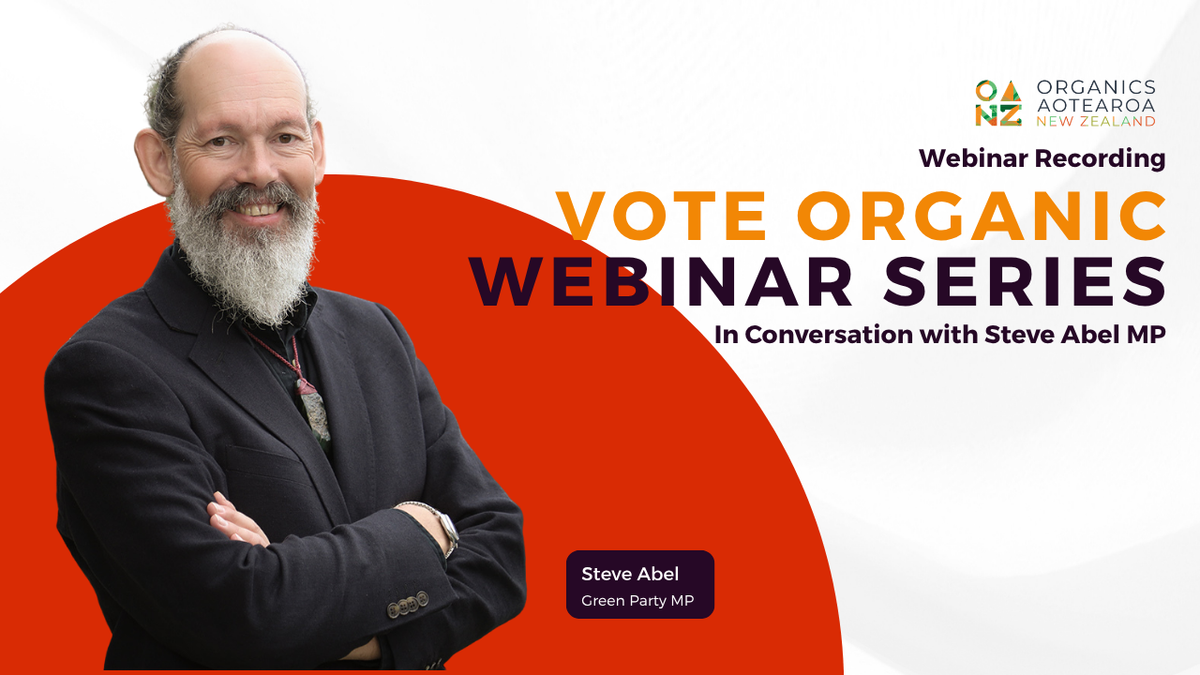
The Greens ticked all seven boxes. So OANZ opened with a harder question.
Why does the word "organic" barely appear in Green Party policy?
That was how Brendan Hoare started his interview with Steve Abel on 29 September, the second in Organics Aotearoa New Zealand's Vote Organic webinar series. It went out at 8pm, straight after ACT's Andrew Hoggard. You can watch the full recording; it runs just under half an hour.
Abel is the Green Party's agriculture spokesperson. Hoare said OANZ meets him every month or six weeks, which was a deliberate contrast with Hoggard, who OANZ said it had only recently got to know.
VOTE ORGANIC Webinar Recording: In Conversation with Steve Abel MP
The missing word
The Greens answered yes to every question on the Vote Organic scorecard, with more detail than any other party. I covered the full results when they came out.
Abel's honest take on the missing word was "editor efficiency". The party didn't want to repeat a term over and over, and he said they may have "thrown the baby out with the bath water."
He told a story about the previous policy, when "regenerative" was the word of the day. He got a call from Harry, the husband of the late Green co-leader Jeanette Fitzsimons, telling him that was garbage and organic was the real thing. Abel said he took the point: organic has an actual definition.
He also said his own focus has been on regulating conventional farming, calling out the worst of it: cows in mud in Southland, nitrate in Canterbury's water, and a large irrigation scheme in Hawke's Bay. Hoare pushed back gently. OANZ's campaign is a positive one, he said, and people need a carrot.
What he'd do as organics minister
The Greens said yes to keeping an Associate Minister for Organics. Asked what he'd do in the role, Abel said he'd start by asking OANZ for its list of priorities and working through it. He saw the job as advocacy, pushing Cabinet to recognise how valuable organics is.
He didn't name anything specific beyond that.
Small growers
On compliance costs for small certified producers, Abel pointed to the Greens' Fair Food Fund, part of their affordable food policy. He described it as a $150 million fund to help small-scale local producers get to market. The policy page itself describes the fund a little differently, as money to expand community-led food security initiatives.
His example wasn't organic. A group of Hawke's Bay pea growers wanted to bid on the McCain factory, he said, and couldn't find any fund to pay for the scoping work.
On compliance itself, he said food safety rules shouldn't be so onerous they stop small operators selling food, while still protecting public health. That's close to where Hoggard landed. The same policy page commits to food regulations that are "proportionate to scale" and to prioritising local food in public procurement, which Hoare also raised.
The word organic doesn't appear anywhere on that page.
Exports
Asked about organic exports, Abel was candid that the Greens' export vision is broader than organics. The world sees New Zealand as a producer of natural food, he said, even though a lot of it is actually produced with chemicals. Organic, in his view, is what makes that reputation true.
GE
Most audience questions were about gene technology, and this was where Abel had the most to say.
He said he's the only MP this term to sit on both the select committee for the Gene Technology Bill and the one that handled changes to the HSNO and ACVM Acts. He said he's "utterly unconvinced" GE and non-GE crops can coexist.
His sharpest example was GM ryegrass. If it's released into pasture, he said, it will spread and can't be pulled back, and AgResearch conceded as much in the hearings.
He also argued there's no high-value GE food sold directly in any supermarket in the world. (There is already a GM tomato approved here, though whether it counts as high value is another question.) Most GE crops, he said, are low-value commodities like soy, canola and maize, and around 80% ends up as livestock feed. Countries that went GE, in his view, ended up with more agrichemical use, resistant weeds, dearer seed and more power for Bayer, Syngenta and BASF.
Asked whether the Greens would make the organic sector's GE-free status a bottom line in coalition talks, he said "absolutely", and that he'd go further and protect conventional farmers' right to stay GE-free too.
Food as health
Asked whether farm policy should be treated as public health policy, he said yes. Vegetable consumption is falling, he said, while processed food climbs. He also linked intensive dairying in Canterbury to nitrate in drinking water, which he said is associated with bowel cancer and pre-term birth.
His connection dropped out twice during this part.
The close
Abel closed with a campaign pitch rather than anything on organics. He called the current government one of the most anti-environmental of his lifetime and said the election "hangs on a knife edge."
Hoare's last word was a reminder to the audience. Don't take what Steve says at face value, he said. Go and read the policy.
That's fair advice, and it cuts both ways. The Greens gave the strongest answers on the scorecard. On the call, though, the word organic still didn't come up much. Most of Abel's answers were about what's wrong with conventional farming and GE, not about what a Green government would do to grow organics.
Next in the series: NZ First's Mark Patterson and The Opportunity Party's Daniel Eb, on 5 October.
Before you go
If this was useful, you can get every post by email for free. And if you'd like to help keep it independent, you can leave a one-off tip.