Not GM, Unless You Buy Organic
Fenton Hazelwood asked whose name is on the box when GM rules shift. Here's the same question from the shopping trolley: a GM tomato already approved here, a gene-silencing hive treatment being trialled here, and two rulebooks that disagree about what counts.
On 3 October, Fenton Hazelwood published the best piece I've read on gene technology this year. It's called Whose Name Is on the Box? and it's written for growers. That's exactly why shoppers should read it.
Fenton has spent about 35 years in New Zealand food and fibre. In 2002 he did the work and audits that made Pukekohe grower Balle Bros the first in the country to gain EurepGAP certification for fruit and vegetables. His argument, briefly: almost every success story for GM is a commodity crop that vanishes into stock feed, fuel or oil. New Zealand's big plant exports are the opposite. They're eaten whole, sold with a variety and often a grower's name attached, and the certification schemes growers export under require them to declare GMO status. Customers set that rule, not Wellington.
He also spots something most coverage misses. Two parts of our own system now give different answers about the same technology. And the grower is the one standing in the gap.
His line on why this matters: "Parliament can repeal a law in an afternoon. It can't recall pollen."
Read the whole thing. His source list alone is worth the scroll.
Here's what I found when I asked his question from the other end of the supply chain.
The Bill lapsed. It isn't dead.
Parliament was dissolved on 1 October, ahead of the 7 November election.
Every bill still unfinished at that point lapses, but lapsed business can be reinstated by the next Parliament, a rule in place since 2005.
So the Gene Technology Bill is paused, not finished.
As introduced, the Bill would have exempted some gene-edited products from regulation where they can't be told apart from conventionally bred ones.
It would also have stopped regional and district councils from treating GMOs differently from other organisms in their plans.
Fenton warns that planning law changes could also take away regions' power to declare themselves GE-free, which he calls the one form of separation we actually have.
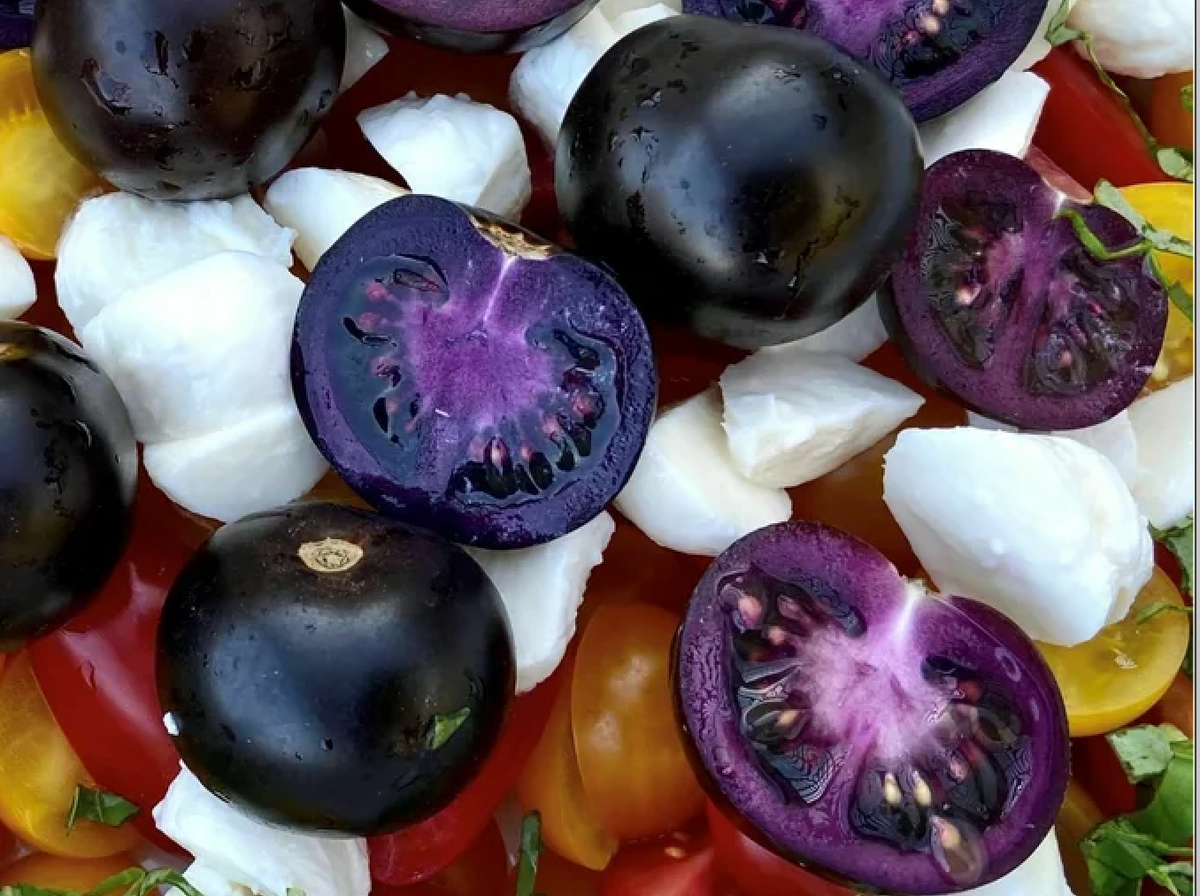
A GM tomato is already approved as food here
In October 2025 the trans-Tasman food standards body approved a purple tomato carrying two snapdragon genes for sale in Australia and New Zealand.
It must be labelled "genetically modified", and loose tomatoes need that statement displayed with them.
There are two exemptions. Food made and sold for immediate eating by restaurants, takeaways and caterers doesn't need the label, and neither does food where GM material is unintentionally present at no more than 1 per cent of an ingredient.
Growing it here would need EPA approval, and anyone importing fresh ones would need to consult the EPA and MPI first.
New Zealand Food Safety made a submission supporting the approval. Soil & Health opposed it.
The same report notes that food businesses must answer truthfully if you ask at the counter whether an ingredient is from a GM source.
So ask. It's free, and the law is on your side.
Gene-edited food made without novel DNA is a different story. Since the definition changed in 2025 it doesn't need a GM label at all, which I covered last month.
The gene silencer that isn't GM
Double-stranded RNA, or dsRNA, is a short strand of genetic code matched to one gene in a target pest. When the pest takes it up, its cells stop making the protein that gene codes for.
In 2018 our EPA decided that plants and animals treated with dsRNA in this way are not genetically modified organisms under the HSNO Act, and it reissued that determination in June 2021.
In December 2023 the US EPA registered the world's first sprayable dsRNA pesticide, for potato beetles, describing it as working "without resulting in a genetically modified organism".
This isn't only an American story. Victoria University of Wellington researchers have been testing a dsRNA varroa treatment in New Zealand hives since 2022.
Their field trials ran at Halcombe in the North Island and near Ashburton in the South Island, starting with 40 colonies per treatment.
They found little or no effect on bee survival, colony growth or honey production.
The product, vadescana, is sold in the United States as Norroa. As of the review's June 2026 publication, New Zealand had not registered any dsRNA biopesticide.
The research was funded partly by the product's developer, GreenLight Biosciences, and partly by MBIE, and three of the authors work for GreenLight.
When the team surveyed 175 New Zealand beekeepers, 10 per cent still believed dsRNA involved genetic modification after being given an explanation, and another 26 per cent weren't sure.
Given that two New Zealand rulebooks can't agree either, that seems fair.
Where organic draws the line
New Zealand's national organic rules, the Organic Standards Regulations 2025, come into force on 31 March 2028.
Regulation 12 bans gene technology from organic production, along with methods that alter genetic material in ways natural methods can't, material used to speed gene-altering agents into cells, and anything made from organisms produced that way.
It also lets MPI add further banned technologies by notice.
MPI used that power on 10 August 2026. Its Organic Notice: Operators 2026 takes effect alongside the regulations on 31 March 2028.
It bans recombinant DNA and RNA techniques, and any technique that targets specific genes, naming genome editing, base editing and gene silencing.
One carve-out: a vaccinated animal stays organic even if its vaccine was made with a banned method.
The rule even reaches the wrapper. Organic packaging can't use bioplastics made with those technologies.
Put those documents side by side and you get Fenton's gap in a single hive. A gene-silencing varroa treatment, if it's ever registered here, would be a non-GM pest treatment under HSNO and a banned technology in an organic hive.
Organic beekeeping already runs on a closed list. BioGro's honey standard, reviewed this year, permits eight varroa treatments: formic, lactic, acetic and oxalic acid, menthol, thymol, eucalyptol and camphor.
Use anything else and the hive goes into quarantine, every bit of its wax is replaced, and nothing it produces can be sold as organic for the next 12 months.
I went through what that means for a jar of organic honey in July.
If you buy certified organic honey, that's the line you're paying for.
The fresh produce question nobody has asked
Fenton's closing ask is that the fresh produce question be put openly to growers, exporters and their customers before anything is released.
MPI's latest export forecast puts horticulture at $9.5 billion for the year to June 2026.
Arable exports, the nearest thing we have to the commodity crops GM was built for, are forecast at $325 million.
Dairy, at $28.6 billion, and meat and wool, at $14.1 billion, are bigger again. Fenton says he'd want those exporters to show the evidence either way too.
He asked whose name is on the box. If it's a takeaway box, nobody has to print the word GM. They just have to tell you if you ask.
Further reading: New Zealand Keeps Asking About Food Labelling. It Keeps Getting the Same Answer. and "Consumers Warm to Gene Editing": Where Is the Evidence?
Before you go
Organic Food Together is independent and free to read. If this was useful, sign up free to get the next one, or leave a one-off tip to help keep it going.