Six Ticks, One Dash and a 10pm Argument: NZ First on Organics
NZ First ticked six of seven boxes on OANZ's organic scorecard. Mark Patterson was asked about the one it didn't, why NZ First backed the ACVM bill, and what he'd do as organics minister. His written answers promise more than he did on the call.
At 10pm on the Tuesday before the vote, NZ First was still arguing with Andrew Hoggard about whether to amend the ACVM bill.
That's how Mark Patterson told it on 5 October, in the third of Organics Aotearoa New Zealand's Vote Organic webinars. It followed ACT's Andrew Hoggard and the Greens' Steve Abel. You can watch the full recording; it runs about 28 minutes.
Patterson is NZ First's Minister for Rural Communities and an associate agriculture minister. He's also a sheep and beef farmer, conventional, and in his words a "fairly low impact" one.
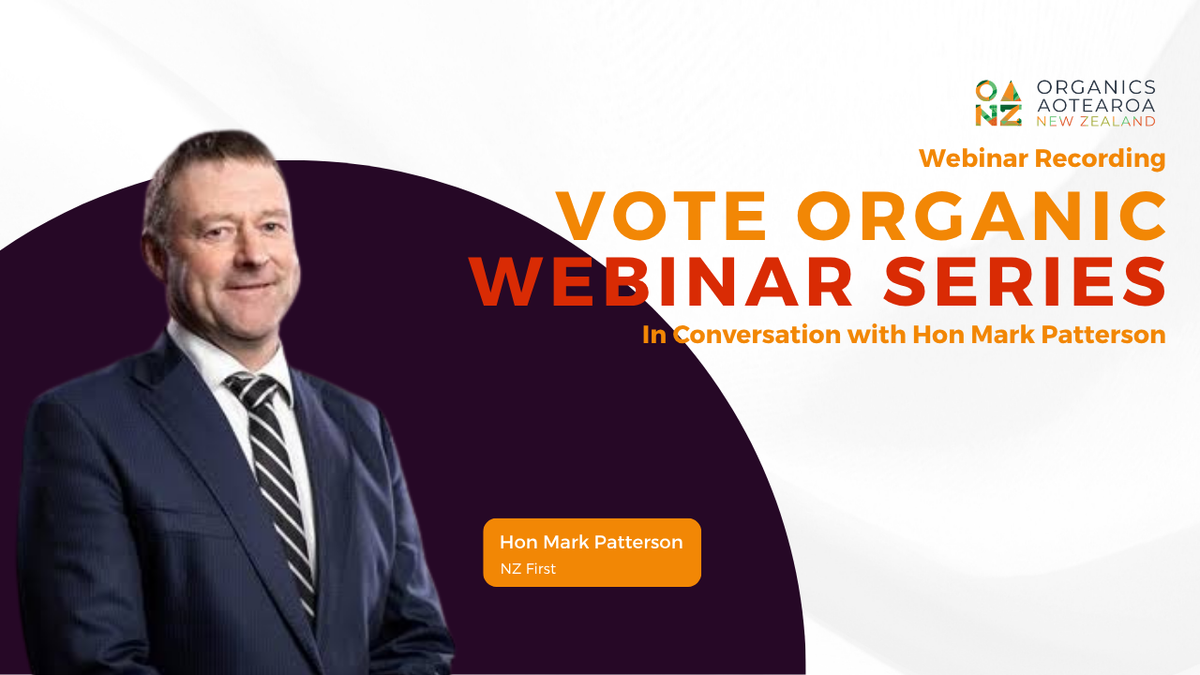
VOTE ORGANIC Webinar Series: In Conversation with Hon Mark Patterson.
Six ticks and a dash
NZ First answered yes to six of the seven questions on OANZ's scorecard, which is built from its 2026 election manifesto. Only the Greens did better, with seven. I covered the full results when they came out.
Brendan Hoare, hosting for OANZ, said the people brought in to check answers against party policy thought NZ First's one dash should have been a tick.
The dash was on question six: investing in organic transition support and domestic procurement. Patterson said NZ First is behind "most of" that "in concept". The manifesto wasn't out yet, he said, the party was flooded with questionnaires, and sometimes it errs on the side of caution when things haven't been signed off.
NZ First's written answer to that question is more interesting than the dash. It says the party has no stated position on public procurement favouring organic products. Then, a few lines later, it says NZ First will extend its government buying rules, which already require wool over synthetic fibres in government buildings, to prefer New Zealand-grown organic products in schools and hospitals.
That's a bigger promise than anything Patterson made on the call.
What he'd do as organics minister
NZ First said yes to keeping an Associate Minister for Organics. Asked what he'd do in the job, Patterson started with the basics: get the organic standards and labelling right, then branding and promotion at home and overseas.
He said organics is growing in value "but possibly not in area", and the question was how to get more farmers to convert.
He was keenest on local food networks. He pointed to Dunedin, where he said one paid coordinator pulls small growers together to supply markets more efficiently.
He also called cuts to bioeconomy science funding shortsighted. "We're a biological economy," he said.
His model for the job was wool: bring the sector in and ask for its priorities, rather than assume Wellington knows best. "No big bang stuff," he said.
Funding
OANZ's sector pays levies through wine, beef and lamb and the rest, Hoare said, but none of it reaches OANZ, and no organic farmer wants another levy. Would NZ First look at reworking existing ones?
"Very much so," Patterson said. Then he raised something he wasn't sure was relevant: expanding the Horticulture Export Authority Act, which avocados and blueberries already use, to deer velvet, manuka honey and possibly wool.
It was an open door, not an answer.
The ACVM bill
Most of the questions OANZ received in advance were about gene technology. One audience member asked why NZ First supported the ACVM amendment bill while standing against the gene tech and HSNO bills. ACVM is the law covering agricultural chemicals and vet medicines.
Patterson said NZ First backed streamlining it because industry had complained how hard it was to register new chemicals and vet medicines.
Then came what he called "late mail" from OANZ, the group he'd opened the call by describing as a "textbook advocacy group": informative, engaged and consistent. An Official Information Act request had turned up a double-stranded RNA product used in a varroa treatment, which he said had slipped through the cracks. He didn't name it. The only one I've found in use here is vadescana, the gene-silencing hive treatment Victoria University researchers have been trialling in New Zealand hives since 2022.
OANZ's discovery set off talks with Hoggard about amendments the weekend before the bill went to the House. They were still going at 10pm on the Tuesday, he said.
Hoggard won them over. His case, as Patterson relayed it, was that the problem sat with HSNO, the hazardous substances and new organisms law, where the product had been treated as a hazardous substance rather than a new organism.
"The HSNO is the gateway to the ACVM," Patterson said. NZ First has held up the HSNO amendment over concern it could be a back door, he said, and defining what counts as a new organism is "where the real action is."
Both that bill and the Gene Technology Bill lapsed when Parliament was dissolved on 1 October, though the next Parliament can reinstate them.
GE
On the Gene Technology Bill itself, Patterson said the coalition agreement left NZ First open to liberalising, with assurances on human health and the environment. "We never quite made that line," he said.
The gaps he listed were coexistence between organic, conventional and gene-edited farming, liability and traceability, and trade access. NZ First became more cautious as time went on, he said. He named Simon Terry and Professor Jack Heinemann as helpful in getting MPs up to speed.
He was candid that the pressure isn't easing. Europe has moved, he said, and the people pushing for change are ramping it up.
His sharpest claim was the political one. Without NZ First, he said, New Zealand would have some of the most liberal gene technology rules in the world today.
Small growers
New organic regulations could double or triple verification costs for small growers, one questioner said. Would NZ First commit to a realistic exemption threshold?
"Yes," Patterson said. He said NZ First had pushed for a higher threshold during consultation and didn't think it had been finalised. The MPI consultation closed on 22 September, with $12,700 and $30,000 on the table against the current $10,000.
He went back to aggregation: join small growers up, supply local markets, and cut out "the middleman." He corrected himself mid-sentence to "middle woman."
Food as health
Asked whether farm policy should be treated as public health policy, he said yes. He tied it to food security since the McCain's and Wattie's factory closures. "We can't necessarily live on milk powder and mutton," he said.
NZ First has been watching Australia, which he said came at a national food strategy from a health angle, including a campaign for one extra serve of fruit and vegetables a day. Hoare asked what if that extra serve was organic. "Absolutely," said Patterson.
The treaty question
Hoare told Patterson that OANZ changed its name from the Organic Federation of New Zealand as part of its engagement with Māori, and that the sector agreed together to include a treaty partnership in its organic act.
Patterson said he hadn't known that. He talked instead about treaty "overreach", NZ First's policy to reform the Waitangi Tribunal, and getting Māori land more productive, pointing to 13,000 cases he said are sitting in the Māori Land Court.
He didn't say what NZ First would do about the clause.
The close
Hoare finished on a lighter note. Hoggard had told OANZ he comes from an organic family, his father a stalwart of Soil & Health. Any confessions?
"It must be election time," Patterson said. "He's casting for every angle."
His pitch was the record. NZ First had been "in your corner this term", he said, and on GE that's hard to argue with. On organics itself, most of what he offered on the call was process: listen to the sector, bring its leaders together.
The most concrete organic commitment NZ First has made this campaign is the procurement line in its written answer. It's the one marked with a dash.
Next in the series: The Opportunity Party's Daniel Eb, who followed Patterson the same night.
Before you go
If this was useful, you can get every post by email for free. And if you'd like to help keep it independent, you can leave a one-off tip.