Can New Zealand Feed Itself?
Wattie's and McCain are closing. Marsden Point is rubble. The trams are gone. New Zealand keeps dismantling what works — and calling the rebuild progress. This needs to stop.
While politicians argue about the cost of living, New Zealand is quietly dismantling the infrastructure that keeps it fed, fuelled, and free.
There is a pattern running through New Zealand's history that nobody in power wants to name. We build something that works — something that protects us, feeds us, moves us, keeps the lights on. Then a generation later, someone in a suit explains that it is too expensive, too old-fashioned, or insufficiently profitable for a corporate entity headquartered somewhere far away. We tear it out. We sell the parts. We move on.
Then one day the ships stop coming, or the fields have no buyer, or the city seizes at rush hour — and we look around at what we had and what we threw away and shake our heads. We spend decades and billions rebuilding what worked. We call the rebuild progress.
This is that story. Again.
What James Wattie understood
In 1934, a young man in Hawke's Bay noticed something that made him furious. An Auckland jam manufacturer was importing fruit pulp from Tasmania — two thousand miles across the Tasman — while an abundance of fruit lay rotting on the ground in the Heretaunga Plains. New Zealand fruit. Good fruit. Going to waste so an Australian company could charge more for the imported version.
James Wattie went from bank to bank seeking a loan. Nobody wanted to back him. He persuaded the directors of the Hawke's Bay Fruitgrowers cooperative to rent him a four-room cottage for ten dollars a year. He set up a small canning plant. His first product was jam — made from the fruit that had been rotting in the paddocks. The logic was simple and obvious and he was astonished nobody else had acted on it: New Zealand grows extraordinary food, and New Zealanders should eat it.
By the Second World War, Wattie's entire productive capacity was supplying Allied forces across the Pacific. He built factories in Gisborne, in Christchurch, across the country. By the 1970s he employed thousands of New Zealanders and had built the largest food processing company in the southern hemisphere. He was knighted. He died in 1974 with a reputation, as those who worked for him recorded, for humility and genuine care for the people who made the operation work — a man who built something great and never forgot where it came from.
In 1992, eighteen years after his death, H.J. Heinz bought the company he built for $565 million. In 2026, the Pittsburgh-based multinational that now owns it confirmed it was closing the factories he built.
The fruit is not rotting in the paddocks this time. But the farmers who grew peas and carrots and corn for Wattie's for twenty and thirty years have no market for their crops. The logic has come full circle. And nobody in Wellington appears to find that particularly interesting.
The week New Zealand's food processing industry broke
In the final week of March 2026, two of New Zealand's largest food processors announced they were done. On 24 March, McCain Foods sent letters to growers confirming it would close its Hastings plant — which processes more than 50,000 tonnes of peas, beans, sweetcorn and carrots each year — by January 2027. Three days later, on 27 March, Heinz Wattie's confirmed it would close manufacturing sites in Christchurch, Dunedin and Auckland and end its entire frozen vegetables business in New Zealand.
Two companies. Four plants. Three days apart. The Green Party called immediately for an urgent select committee inquiry, noting bluntly that there was "little public information about what led to these factories closing." That sentence deserves to hang in the air for a moment. Two of the country's most significant food processors, closing within days of each other, and the government does not know why.
Coincidence or coordinated corporate timing? That is a legitimate question. What is not in question is the effect: more than 650 jobs gone directly, $18 million in annual grower returns stripped from Hawke's Bay alone, and more than 320 farmers across Canterbury and Hawke's Bay left without a market for their crops.
The official reasons are real. Energy costs are brutal — gas prices up 300 percent over seven years, diesel roughly doubled. But there is a harder truth beneath the press releases. Wattie's own managing director admitted the company had experienced volume declines of around 20 percent over the last five years. And Stats NZ data reveals why: the average New Zealand household spends just $3.10 a week on frozen and processed vegetables. That is the entire category. Not a collapse in consumption — but a margin so fragile that when energy costs tripled and cheap imports flooded in from countries with lower standards, the business case for processing here evaporated.
That last point is the one nobody wants to say plainly. Imports are killing the local industry. Vegetables New Zealand said it directly: imports of canned and frozen vegetables are killing the New Zealand processing sector. We grow world-class food in this country. We export much of it to Japan, Australia and Europe. And then we import the cheap processed version back — produced offshore, to lower standards, by the same class of multinationals that have just announced they are leaving.
"If New Zealand growers do not have viable markets for their produce, they too will shut up shop. This situation will have a negative impact on New Zealand's ability to feed its people, in an increasingly uncertain world where trade is being disrupted and transportation costs are rising." — Vegetables New Zealand
The question nobody in government is asking
Before the machinery goes quiet, someone in this country needs to be asking — loudly, publicly, and with urgency — what happens to the processing equipment inside these factories. The freezing tunnels. The blanching lines. The pea viners. The carrot washers. The cold-chain infrastructure built up over decades, calibrated to the geography of Canterbury and Hawke's Bay, designed around the two-and-a-half-hour window from harvest to freezer that defines this industry.
Will it be offered to New Zealand buyers? Could a grower cooperative step in? Could a family do what the Bowans did in Timaru in 2009 — walk into the building a multinational abandoned and build something better?
Or will it be stripped out and scrapped, shipped offshore, eliminated before anyone can change their mind — so that no competitor, no cooperative, no future government with the spine to act, can ever walk in and switch it back on?
We know which of those outcomes is more likely. We have seen the template.
What happens when the equipment stays
In 2009, Bluebird Foods — owned by PepsiCo, headquartered in New York — closed its factory in Washdyke, near Timaru. Commercial decision. The numbers no longer worked for a global corporation optimising across dozens of markets.
The Bowan family had supplied Bluebird with potatoes for years. When the closure was announced, they made a different calculation. They bought the factory. They installed new equipment from the Netherlands. They kept the staff who wanted to stay. They named their product Heartland Chips and put it on supermarket shelves with a simple promise: grown on our farm, made in our factory, owned by New Zealanders.
Today, fifteen years on, Heartland employs forty people, grows its own potatoes on its own land in South Canterbury, processes them in the factory PepsiCo abandoned, and sells into New Zealand, Australia and Singapore. The Bowan grandchildren sell bags of potatoes at the mailbox for pocket money, just as Raymond did as a boy fifty years ago. The multinational left. A New Zealand family built something better from what was left behind.
This is what happens when the equipment stays. When someone local has the clarity to see that what a multinational discards is not worthless — it is simply inconvenient for their global spreadsheet.
The Bowan story is not a feel-good exception. It is a proof of concept. And right now, today, it is a template waiting to be followed — if anyone moves fast enough, and if the equipment has not already been scrapped.
The processor that never forgot what it was
Here is the detail buried in the Wattie's and McCain story that almost nobody is reporting. While two foreign-owned multinationals close their NZ processing operations, there is a third frozen vegetable processor that is still standing — and doing one thing notably better.
Talley's, a Nelson-based New Zealand family company, operates a processing plant at Fairton near Ashburton in Mid-Canterbury. It employs 360 staff. It works with over 100 contract growers across 4,500 hectares between the Rangitata and Rakaia rivers. And its Fairton plant can take a pea from harvest to frozen in 90 minutes — which its general manager describes as probably unique in the world, made possible only by staying physically close to the growers.
There is another difference. Talley's is the only frozen vegetable brand on New Zealand supermarket shelves using 100 percent New Zealand-grown vegetables. Wattie's was importing cauliflower and broccoli from China, Ecuador and Spain. McCain was supplementing its peas and corn from the United States, Chile and Vietnam. Neither company was required to tell you this on the packet. Talley's did not need to be told — it was the point of the whole operation.
So the painful irony of March 2026 is this: the two processors that were quietly importing foreign vegetables and selling them under New Zealand branding are closing. The one that stayed genuinely local — family-owned, 100 percent NZ produce, proximity to growers as a competitive advantage rather than an inconvenience — is still standing.
Talley's is not large enough to absorb every grower that Wattie's and McCain are abandoning. The Hawke's Bay catchment is beyond its geographic reach. And Talley's carries its own controversial history — on labour relations, health and safety, and environmental compliance — that deserves scrutiny in its own right. But on this specific point: staying 100 percent NZ grown, staying close to the source, treating proximity to growers as a strength rather than an inconvenience — that model kept it viable when the multinationals left. That is worth noting regardless of the fuller picture.
Talley's deserves its own story — and we will tell it. But for now it stands as proof of what survives when a company never loses sight of what it is: a New Zealand processor, making New Zealand food, for New Zealand people. That idea was always commercially viable. The others just stopped believing in it.
The refinery: sixty years of public investment, destroyed in months
Walter Nash understood something in 1957 that too many politicians today appear to have forgotten entirely. New Zealand is a small island nation at the bottom of the Pacific, a very long way from anywhere. When the world stops working normally — when wars erupt, when shipping lanes close, when global supply chains seize — this country has almost no margin for error. Nash had lived through what the Second World War did to a nation dependent on imported supply. He initiated the construction of a domestic oil refinery so it could not happen to New Zealand again.
Construction began at Marsden Point, Northland, in 1962. The land was compulsorily acquired under public works legislation — because some decisions are too important to leave to the market. The refinery opened on 30 May 1964, commissioned by Prime Minister Keith Holyoake as a new energy era for the country. It was structured as a joint venture: 69 percent owned by Shell, BP, Caltex, Mobil and Europa from day one. The government held a stake and strategic oversight. New Zealand taxpayers provided the land, the political will, and — repeatedly — the money. The multinationals provided the capital and collected the returns.
In 1973, Prime Minister Norman Kirk approved a $160 million expansion after the Yom Kippur War sent crude oil from three dollars to twenty dollars a barrel. Kirk understood what an oil shock does to an isolated country. He acted before the crisis deepened.
In 1981, Robert Muldoon's Think Big programme backed a $1.84 billion expansion — government-guaranteed Eurodollar loans, repaid by a special levy on petrol prices that every New Zealand motorist paid for years, knowingly, as the cost of national energy security. A workforce of 1,700 built it. The expansion doubled refined oil production. By 2003, Marsden Point produced 70 percent of New Zealand's petrol and 90 percent of its diesel.
Then the incoming Labour government under David Lange and Finance Minister Roger Douglas discovered that Muldoon had made a secret commitment to financially underwrite the entire Think Big expansion — without Parliamentary approval. The liability was absorbed onto the Crown balance sheet. In 1988, the Petroleum Sector Reform Act handed full ownership and control of the refinery to the multinational consortium. As a parting gift to the new private owners, the government gave them $85 million of taxpayer money to help them "adjust to the new environment."
Let that register. Taxpayers built it. Taxpayers funded the Think Big expansion through a decade of petrol levies. Taxpayers absorbed the hidden debt Muldoon had racked up without telling Parliament. And then taxpayers paid the multinationals eighty-five million dollars to take the whole thing off New Zealand's hands.
The public investment total — the initial build, the Kirk expansion, the Think Big loans, the privatisation gift — exceeded two billion dollars in historical money. Every cent of it flowed into infrastructure the multinationals then owned outright.
For thirty more years the refinery kept producing. Then in August 2020, with New Zealand locked down and distracted by a pandemic, the shareholders — BP, ExxonMobil and Z Energy — announced they were considering closing the refining operation. The closure, it later emerged, was a condition of Ampol's takeover of Z Energy — a foreign corporate acquisition deal, conducted without any input from the New Zealand public, that wrote the permanent end of domestic refining capacity into contract law.
Jacinda Ardern's Labour government had the opportunity to intervene. The case was put to Energy Minister Megan Woods. The government considered a subsidy to keep the refinery running for five to ten years. The answer was no. The Greens celebrated the closure as a climate victory, apparently indifferent to the fact that the emissions simply relocated to refineries in Asia and disappeared from New Zealand's accounting books. The government stood aside. Refining ended on 31 March 2022.
Jacinda Ardern will be remembered for many things. She will not be remembered for protecting New Zealand's fuel security. She had the power to intervene and the evidence to justify it — and her government looked at a strategic national asset built by two generations of New Zealanders and decided it was not their problem. History will record that choice alongside the closing of the trams, the gift of the refinery to the multinationals, and every other moment when short-term thinking dismantled what long-term thinking had built.
There is a broader pattern worth naming, even if the full picture remains incomplete. Jacinda Ardern was publicly and proudly aligned with the World Economic Forum's agenda — she attended Davos, adopted its language, and positioned New Zealand as a model progressive state. The WEF's priorities include accelerated decarbonisation of energy infrastructure. New Zealand's commitment to Agenda 2030 and net-zero targets created a political environment in which the closure of a domestic oil refinery could be framed not as a strategic loss but as a climate achievement. Whether that framing was the cause of the decision or simply the cover for it is a question this article cannot answer definitively. What it can say is this: the outcome was entirely consistent with those external frameworks. And the people who bore the cost — the Northland workers, the New Zealand motorists now exposed to global supply disruptions, the country sitting on 52 days of fuel when the next crisis hits — were not the people in the Davos room when the priorities were set.
What happened next should be taught in every New Zealand school.
Within months of the final crude oil shipment, Channel Infrastructure began the systematic destruction of the refinery's capability. All cabling was cut at ground level. Heat exchanger bundles were removed and sent offsite for recycling. Only the shells and structures remained. The CEO described it explicitly as "not a mothballing — a permanent process." The demolition ran ten years ahead of the schedule the company had published in its own annual report.
There is only one reason to demolish a strategic asset ten years ahead of schedule. To ensure that no competitor, no cooperative, no future government with more backbone than the last one, can ever walk in and restart it. A mothballed refinery is an option. A demolished one is a closed door. They made sure it was closed permanently.
The asset New Zealand taxpayers built, paid for, expanded, underwritten and gifted to multinationals was stripped to its bones — cables cut at the ground, heat exchangers carted away for scrap — so that it could never again threaten their import model. Call it what you like. It was cold, deliberate, and entirely legal. And spineless politicians on both sides of the House let it happen.
The cost of rebuilding? A 2024 feasibility study put it at between $4.9 billion and $7.3 billion. Finance Minister Nicola Willis acknowledged New Zealand would be more resilient if the refinery were still running — then confirmed rebuilding was not an option.
When the Iran war disrupted global oil supply in early 2026, New Zealand found itself with 52 days of fuel in stock or in transit. Fifty-two days. The government's response was to announce $20 million for diesel storage tanks at the site. Twenty million dollars. Against $1.84 billion spent building what was destroyed. Against $4.9 billion needed to rebuild it. A tent, offered to someone whose house was burned down.
We have done all of this before
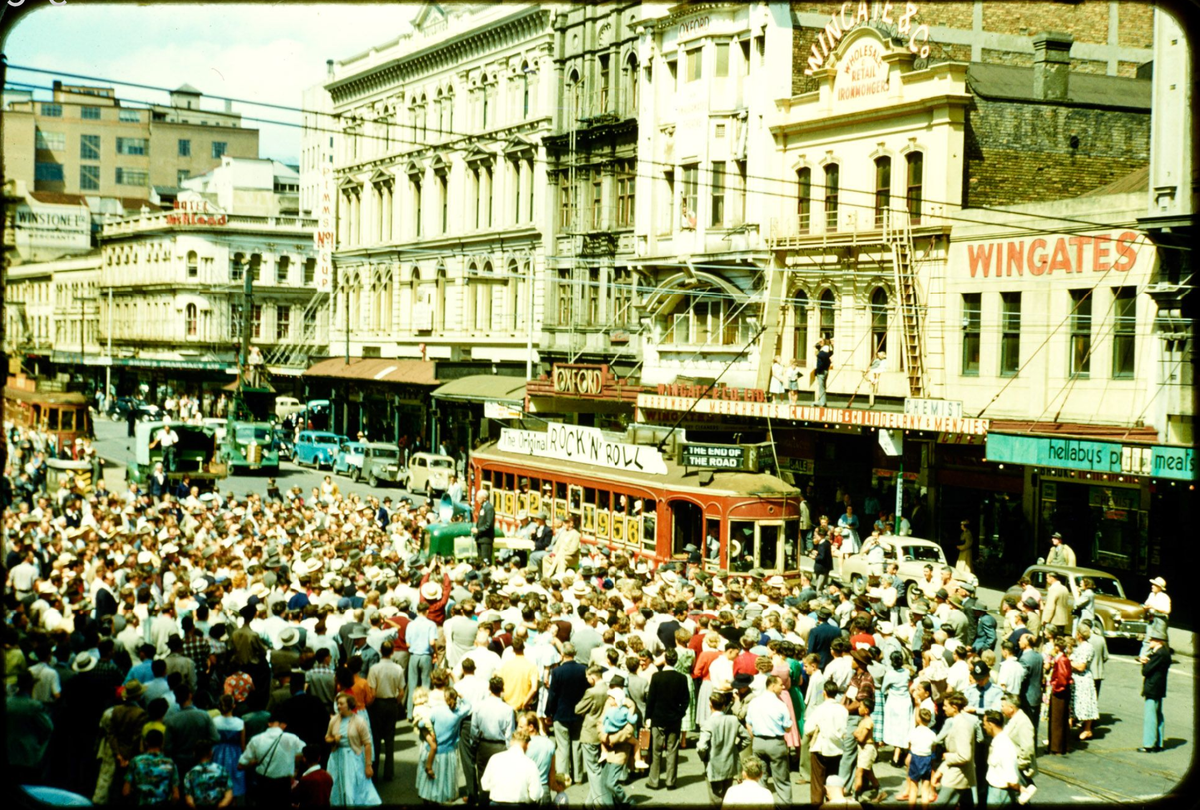
In 1945, Auckland's electric tram network carried 118 million passengers a year in a city of 200,000 people. Electric, efficient, profitable, and woven into the fabric of how the city moved. The world's only coast-to-coast tramway, running from the Waitematā Harbour to the Manukau Harbour. The backbone of how Auckland lived.
In 1956 it was declared old-fashioned. The 72 kilometres of track were ripped up and sold for scrap. The tram bodies were stripped of their running gear, trucked to Thames, and sold to become garden sheds and baches on the Coromandel. The final tram ran down Queen Street on 29 December 1956. The NZ Herald wrote that a golden chariot drawn by ten white horses could scarcely have attracted more attention. Then it was gone.
Public transport patronage in Auckland fell 20 to 30 percent immediately and never recovered. The city turned to motorways. Congestion became Auckland's defining identity for the next seventy years. Transport modal share collapsed from over 50 percent in the 1940s to under 10 percent by the 1970s.
Auckland is now spending $5.5 billion on a 3.45-kilometre underground rail tunnel — years late, a billion over budget — to reconnect the rail lines that would never have needed reconnecting if the trams had been left running. The City Rail Link was first proposed in 1923 at a cost of £400,000. It will open in 2026 at a cost of $5.5 billion. One hundred years. Ten thousand times the original estimate. The logic — electric transport moving people through the city — is identical to what worked in 1945. We just had to spend a century suffering the consequences first.
The pattern is so consistent it borders on ritual. Build something that works. Declare it inconvenient. Tear it out. Spend decades regretting it. Spend billions rebuilding it. Call the rebuild progress.
The billion-dollar proof nobody in government is studying
In the middle of all this destruction, there is a counterpoint that almost nobody in politics wants to acknowledge. New Zealand's organic food sector reached $1.18 billion in value in 2025. It grew 37 percent in five years. Organic exports grew at nearly twice the rate of total primary sector exports. The sector delivers premium returns, lower environmental impact, and global demand that is outpacing supply.
It achieved all of this with essentially zero government support.
No transition fund for farmers wanting to convert — despite the three-year period without certified premium income that makes the financial risk of conversion impossible for most. No national strategy. No organic trade equivalency deals. The National Organic Standard was passed into law and then left unimplemented for years. Certification remains expensive and complex.
Organic farmland covers 0.6 percent of New Zealand's total agricultural area. Globally, 11 to 14 percent is needed to meet demand. If New Zealand moved from 0.6 to even 3 percent of farmland in organic production, the returns — in a sector where NZ's clean-green credentials command genuine global premiums — would be transformational. The market exists. The land exists. The farmers exist. What does not exist is a government willing to remove the barriers that make conversion financially unsurvivable for most who consider it.
While this sector was building itself to a billion dollars, the government was simultaneously considering raising the allowable glyphosate residue limits on food crops. That is not indifference. That is active obstruction of the country's highest-value, lowest-impact form of food production.
And then there is the Gene Technology Bill. Independent economic analysis commissioned by OANZ estimated that releasing GMOs into the New Zealand environment could reduce primary sector export revenue by between $10 billion and $20 billion annually — by contaminating the GE-free status that underpins our premium market positioning globally. The organic sector fought it hard. More than 15,000 public submissions opposed the Bill. The government pushed ahead regardless. In a country that exports food as its primary business, deliberately risking a $10 to $20 billion annual hit to protect the interests of gene technology companies is not a policy position. It is a choice about whose side you are on.
A $1.18 billion industry. Built from nothing. No government support. In spite of the policy environment rather than because of it. The organic sector does not need a subsidy. It needs the government to stop making its job harder.
It is election year. Time for harder questions.
New Zealand produces far more food than it can eat. We are a nation of five million people that feeds tens of millions more. Our soil grows extraordinary things. Our farmers are among the most skilled in the world. Our organic sector built a $1.18 billion industry with no help at all.
And yet. We are entirely dependent on imported refined fuel to run those farms. Imported ultra-processed food is filling the centre aisles of our supermarkets while our processing plants close. Corporate investment flows into NZ food infrastructure until it no longer suits the global balance sheet — and then it leaves, often taking the equipment with it.
At every decision point in this story — Marsden Point, the trams, Wattie's, McCain — the answer from Wellington has been some version of the same line: not our problem. The market will sort it. Trust the supply chain.
Every decision had a name. Walter Nash built the refinery because he understood what isolation means. Norman Kirk expanded it because he had watched oil shocks break economies. Roger Douglas handed it to the multinationals because he believed markets were always smarter than governments. Jacinda Ardern's government let them close it and the Greens cheered while the emissions quietly relocated to Asian refineries and disappeared from our books. The 1956 Auckland Transport Board ripped out the trams because trolleybuses seemed modern. James Wattie built a food processing empire from a four-room cottage because he was outraged by waste and believed in this country's ability to feed itself. His successors in Pittsburgh closed the factories.
None of the people who made the destructive decisions were stupid. They were operating within the logic available to them — quarterly earnings, election cycles, ideological fashion, corporate strategy. The problem is that none of those frameworks is adequate for running a small island nation that needs to be able to fuel itself, feed itself, and function when the global supply chain stops cooperating.
A corporation owes no loyalty to a place. BP owes nothing to Northland. Kraft Heinz owes nothing to Hawke's Bay. They are structures legally obligated to maximise returns to shareholders and they do exactly that. You cannot expect them to act otherwise. What you can expect — what you must demand — is that your government does. That is literally what government is for.
The question is not which party has the better tax policy. The question is which leader has the vision to stop this country from dismantling itself — and the courage to say so out loud.
Hard times create strong men. Strong men create good times. Good times create weak men. And weak men create hard times.
The cycle is real, and it maps onto this story with uncomfortable precision.
James Wattie grew up in the Depression, built his company through a war, and understood viscerally what happens when supply fails. Walter Nash governed in the shadow of the Second World War and built a refinery specifically because he had seen what energy dependence does to an isolated nation. Norman Kirk watched oil shocks in real time and acted. Robert Muldoon, whatever his faults, believed a country should be able to fuel itself and spent billions making it so. These were people forged by hard times. They built things accordingly.
Then came the good times. And with the good times came the generation that inherited what the hard-times builders had built — and decided it was all too expensive, too old-fashioned, too inconvenient for the modern world. Roger Douglas. The 1956 transport planners. Ardern's government. The Kraft Heinz board. The Channel Infrastructure shareholders who stripped the cables from the ground ten years ahead of schedule to make sure nobody could ever go back.
The uncomfortable question your instinct raises is the right one: do we need hard times again before the greatness rises? Before someone builds the next refinery, plants the next tram track, sets up the next cannery in a four-room cottage?
The honest answer is: the hard times may already be arriving. Fifty-two days of fuel. Fruit and vegetable prices up nearly 10 percent in a year. Processing plants closing. Farms converting to dairy because there is nothing else left to grow for. The supply chains the optimists told us would always work are showing, one by one, that they don't — not when there's a war in the Middle East, not when a pandemic stops the ships, not when the multinationals decide the margins are better elsewhere.
But here is the more demanding version of that question. James Wattie did not wait for catastrophe to teach him the lesson. He noticed the fruit rotting in the paddocks — during ordinary times — and acted. Walter Nash built the refinery before the crisis forced him. The lesson of the hard times was already available from history. They just chose to learn it without needing to live through it first.
That is the test for every politician, every leader, every voter paying attention right now. The hard times' lesson is visible. The Marsden Point template is documented. The Wattie's equipment is sitting in those factories in Christchurch and Dunedin and Auckland and Hastings right now, and the question of what happens to it is answerable today — before January 2027, before the cables get cut and the answer becomes a $5 billion rebuild in thirty years.
The greatness does not require the catastrophe. It only requires someone to look clearly at what is happening and decide that it is unacceptable. James Wattie looked at the rotting fruit and built an empire. What are we looking at right now, and what are we building?
What we should be demanding
Before January 2027, someone needs to ask publicly what happens to the Wattie's and McCain processing equipment. Is there legislation to require it be offered first to New Zealand buyers? Could a grower cooperative purchase it? Could the government facilitate that — the way Nash facilitated a refinery, not by owning it outright but by making sure the capability stayed in New Zealand hands?
Beyond the immediate crisis: where are the subsidies for New Zealand-grown food? Where is the organic transition fund that lets farmers absorb three years of conversion costs without losing their farms? Where is the food processing infrastructure strategy that treats the ability to freeze and can and process New Zealand vegetables not as a trade matter but as a security matter — the same way Nash treated fuel in 1957?
Where is the political leader willing to stand in public and say: we grow extraordinary food in this country, our first obligation is to be able to feed our own population with our own production, and we will not keep handing our strategic capabilities to entities that owe us nothing and leave whenever it suits them?
Talley's is there. Family-owned, NZ produce, 360 jobs, 90 minutes from paddock to frozen — proving every day that the local model is not only morally right but commercially viable. The Bowan family in Timaru is there. The organic sector, building its second billion without a dollar of government support, is there. The answers are not theoretical. They are operating. They just need a government willing to see them and build on them rather than standing aside while the multinationals close the factories and catch the flight home.
James Wattie started in a four-room cottage. Walter Nash started with compulsorily acquired land in Northland. The tram engineers started with horse-drawn carriages in 1884 and built a coast-to-coast electric network within twenty years. None of them waited for permission or perfect conditions. They saw what the country needed and they built it.
Hard times create strong people. The hard times are visible. The question is who is paying attention.
Organic Food Together is a personal discovery journal uncovering the hidden infrastructure of New Zealand's food system.