Who Owns the Malt in Your Beer
Beer has four ingredients and malt is the one nobody thinks about. Follow it back from a New Zealand bottle and you reach three French agricultural co-operatives, a private equity firm, a distributor owned by a competitor, and a court judgment nobody was meant to see. Part two of the malt series.
Beer has four ingredients. Water, malt, hops, yeast. Malt is the one nobody thinks about, and it decides nearly everything: the colour of the beer, most of its flavour, and all of the sugar the yeast turns into alcohol.
Malt is barley that has been soaked in water until it begins to sprout, then dried in a kiln to stop it. That's the whole process. Grain, water, heat, time. A malthouse is a large, expensive building that does this at industrial scale, and there are not many of them.
I went looking for who owns the malt New Zealand brewers buy. I expected a list of companies. What I found was a list of French farmers.
The three co-operatives
Almost all the industrial malting capacity in Australia and New Zealand traces back to three French agricultural co-operatives. Not three French companies. Three co-operatives, which are owned by their farmer members.
Malteurop is the one New Zealanders have just learned the name of. It has run the malthouse at Marton in the Rangitīkei since 2008, and in July 2026 it announced the plant will close. That closure, and what it breaks in the domestic supply chain, was the first piece in this series. This one is about who Malteurop actually is.
Malteurop belongs to Vivescia, a co-operative agri-food group with around 7,100 employees across 25 countries, owned by roughly 9,500 farming entrepreneurs in the north-east of France as at its 2023-24 financial year. Vivescia's own history of itself traces the group back to nine Champagne co-operatives that merged in the 1990s. It also owns Grands Moulins de Paris, so the same co-operative that malts the barley in a Tui also mills flour for French bakers.
Barrett Burston is the Australian maltster most New Zealand craft brewers have bought from. Soufflet Malt's page for the brand lists three malting plants: Geelong in Victoria, Pinkenba in Queensland and Welshpool in Western Australia. Its ownership chain is longer. Barrett Burston sits inside Soufflet Malt, which sits inside Malteries Soufflet, which is a subsidiary of InVivo, a French agricultural group. InVivo's own announcement of the deal names its strategic partners in Malteries Soufflet as KKR, Bpifrance and Crédit Agricole Group. Trade coverage puts their contribution at €550 million toward the acquisition, after an initial €440 million in December 2021. So: a French co-operative, an American private equity firm, a French state investment bank and a French bank.
Barrett Burston arrived in that structure through the takeover of United Malt Group, an ASX-listed company that had demerged from GrainCorp in 2020. The firm that advised on the transaction records that it was signed in July 2023 and completed on 15 November 2023, after clearances in Australia, the US, the UK, Canada, France, Germany, Austria and Ukraine. Eight regulators, for a malt company.
Joe White Maltings is the oldest name of the three and the largest Australian producer. It belongs to Boortmalt, headquartered in Antwerp, which is a subsidiary of Axereal. Boortmalt describes Axereal as Europe's largest grain co-operative; Axereal's own announcements call it France's largest grain cooperative. Take your pick.
Boortmalt got Joe White by buying Cargill's entire global malt business. The legal note on completion dates it to 31 October 2019, with the announcement following on 4 November. Trade coverage at the time put the package at 16 malthouses in nine countries, nearly 600 employees and 1.7 million tonnes of capacity.
That's the map. Three co-operatives, one private equity firm, and a lot of French farmers who have never been here.
What that looks like in tonnes
Capacity figures need a health warning. Nameplate capacity is what a plant is designed to produce, not what it produced last year, and companies quote whichever suits.
Barrett Burston publishes figures plant by plant. Geelong is 100,000 tonnes, commissioned in 1985 and expanded in 1994 from an original 75,000. Perth, at Welshpool, is 50,000, first commissioned in 1978. Pinkenba is 86,000, per the company's own corporate profile. A group figure of 260,000 tonnes a year, described as roughly 30% of Australian malt production capacity, circulates on distributor and brand pages rather than on the company's current site, and I can't date it. Treat that one as a company claim of uncertain vintage, because that's what it is.
Joe White is bigger. Boortmalt lists seven Australian malting sites across five states: Ballarat, Devonport, Cavan, Port Adelaide, Perth, Minto and Tamworth. Two of them aren't running, which I'll come back to.
Then there's a plant almost nobody in New Zealand mentions. Malteurop has its own malthouse at Geelong, in the same town as Barrett Burston's. Malteurop's account of its Australian operation says it bought the 80,000 tonne site in 2008 and opened an additional 120,000 tonne malthouse there in 2018, bringing Australian capacity to 200,000 tonnes and making Geelong one of three key production hubs worldwide. That matters for what happens next.
Globally, Soufflet Malt claims 3.6 million tonnes across 35 malthouses in 20 countries. Boortmalt states 3.1 million tonnes. Malteurop states 2.2 million tonnes across 23 plants in 14 countries. Between them, roughly nine million tonnes of malt a year, controlled by three farmer co-operatives from one country.
The exception, and the small print
The standard line is that the only Australian-owned maltster left is Coopers. At commercial scale that's right. Coopers is the only brewery in Australia with its own maltings on site, and when the plant opened in 2017 it was a A$65 million build producing around 54,000 tonnes a year, of which about 17,000 went into Coopers' own beer.
At craft scale the line isn't right, and I'd rather say so than have a maltster say it for me. Voyager Craft Malt in the Riverina and Loam Malt Studio in Western Australia both placed at the 2026 Malt Cup, a competition that drew 117 entries from 29 malthouses in five countries. Both are Australian-owned and independent. They are very small. They are also the only part of this story that's growing.
The distributor
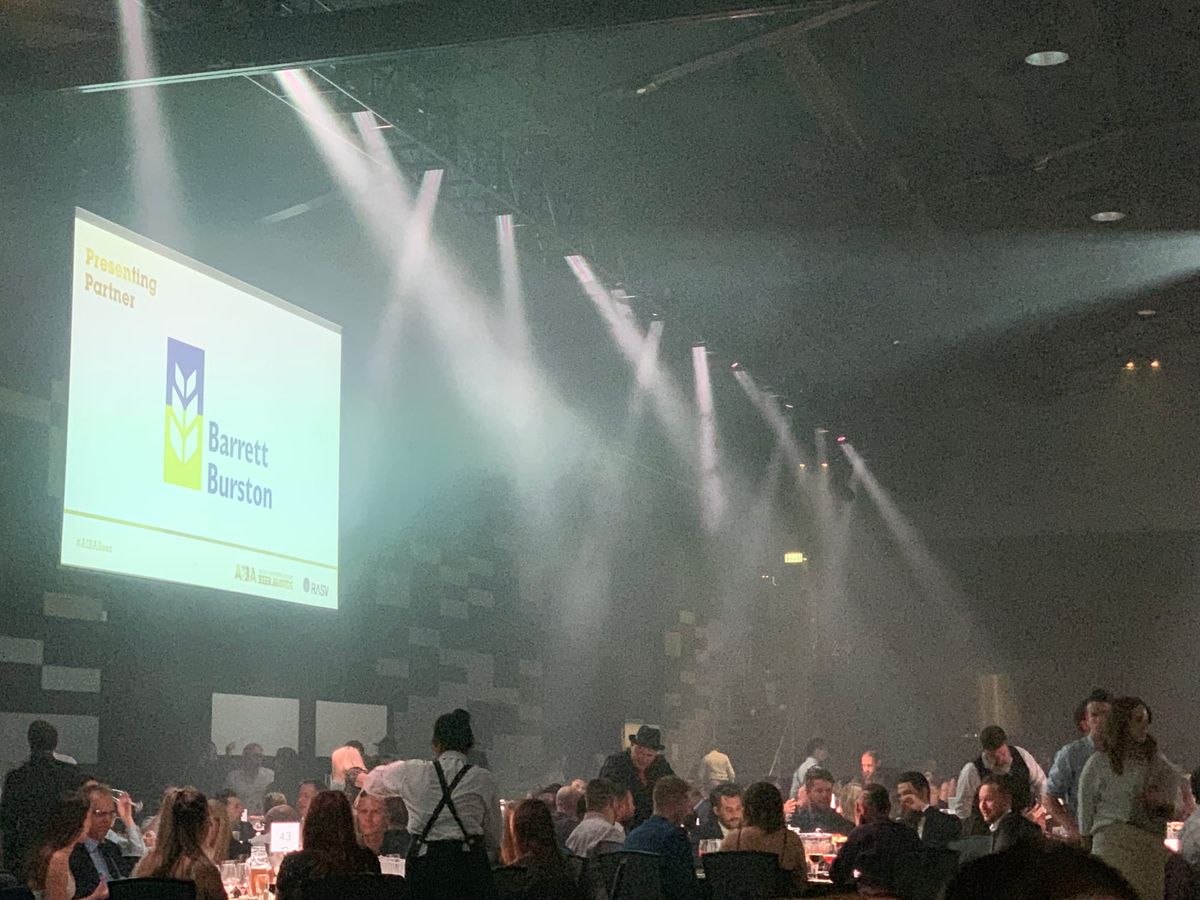
Full disclosure before I go any further, because it matters here more than anywhere else in this piece. Cryer Malt has supplied me for most of my working life and still does. Cryer also sponsored the awards category Epic won in 2006, and the company's founder handed me the trophy. The photograph at the top of this piece is one I took myself, sitting in the room at an industry awards dinner. That is roughly how close this industry sits to itself.
Everything below is structural and sourced. None of it turns on my opinion of anyone's character, which is the part a conflict like this would actually corrupt.
Most New Zealand craft brewers don't buy malt from a maltster. They buy it from Cryer Malt, established in Auckland in 1991 by David Cryer to supply the craft beer industry across New Zealand, Australia and the Pacific Islands. It is the largest distributor of craft brewing ingredients in Australia and New Zealand.
Barrett Burston acquired Cryer Malt in 2017 as a distribution partner. So the biggest craft ingredients distributor in this part of the world is owned by one of the three co-operative chains.
And Cryer's New Zealand malt has been Malteurop's. Cryer's own supply page says its Australasian malts are produced by Malteurop New Zealand and Australia's Barrett Burston. Which means that for the better part of a decade, a distributor owned by Malteurop's competitor has been selling Malteurop's New Zealand malt into the New Zealand craft market.
Nobody has alleged anything improper, and I'm not alleging it either. Cryer has always carried other maltsters' products and still lists German, British, Belgian, Czech and North American brands. And the people who built the business aren't the ones inside the structure now. David Cryer retired in 2023, thirty years after he started selling malt out of his garage, and the staff have turned over since the sale. Nobody working there today drew the corporate chart above their heads.
But when Marton closes, the New Zealand malt in that portfolio stops existing. Malteurop isn't leaving as a supplier, only as a manufacturer, and its Geelong plant is 200,000 tonnes, enough to serve this entire market on its own.
So the choice in front of Cryer isn't Malteurop or Barrett Burston. It's Australian malt from its parent, or Australian malt from its parent's competitor. Either way the New Zealand-grown option comes off the list, and the decision gets made a long way up a chain that no drinker will ever see.
The court case
This next part is the hardest evidence in this piece, and also the part most likely to be misread. So, carefully.
In January 2022 the Supreme Court of Victoria found that Viterra and its parent company Glencore engaged in misleading or deceptive conduct during their $420 million sale of Joe White Maltings to Cargill. Cargill bought Joe White in 2013 and sued in 2014, saying it had been misled about how the business actually operated.
What was at issue was Joe White's practices before the sale. The court's own published summary of the judgment sets out what Cargill alleged had not been disclosed: that Joe White routinely, and without informing customers, supplied malt that did not comply with customers' contractual requirements and specifications, and supplied certificates of analysis that misstated the results of analytical testing, so that certificates reported compliance where there was none; that in some instances certificates misstated the barley varieties used, or failed to disclose that malt had been produced from varieties the customer had not approved; and that gibberellic acid had been used as an additive when some customers prohibited it.
Gibberellic acid is a plant hormone. Maltsters use it in tiny quantities to make barley germinate faster and more evenly. It's legal, it's common, and some customers write contracts saying they don't want it. Those are the customers this concerns.
Legal analysis of the judgment adds that the sale documents did not disclose information about customers being provided with off-grade barley, or barley processed using additional gibberellic acid in conflict with agreed specifications.
Cargill established that Glencore and Viterra made misleading representations at various stages of the sale process, and the court found that conduct giving rise to some of those representations was fraudulent, with Viterra liable for deceit. Cargill was awarded $168.9 million, the difference between the $420 million it paid and Joe White's true value of $251.1 million, with interest calculated at a further $124.2 million. The Court of Appeal upheld it on 23 June 2023.
Now the caveats, all of which matter.
This was conduct under Viterra's ownership, up to 2013. Cargill owned the business from 2013 to 2019. Boortmalt has owned it since 2019. It is not a finding against Boortmalt, and nothing here suggests anything about the malt Joe White makes today. Boortmalt bought the business six years after the conduct and two owners later.
It was also a commercial dispute between two multinationals about a purchase price, not a food safety case. No regulator brought it. No brewer was a party.
That last point is the one I keep turning over. The customers this concerned were brewers who had written specifications into their contracts and were receiving certificates telling them those specifications had been met. They found out because two enormous companies fell out over money and spent a decade litigating. There was no other mechanism by which they would have found out.
And you, holding the beer, had no mechanism at all. There is nothing to read.
Marton is a line item
Piece one covered what the closure of New Zealand's largest malthouse actually breaks. Short version if you've arrived here first: Malteurop stops malting at Marton at the end of September 2026, full closure by the end of the year, 14 jobs gone, roughly 70% of the New Zealand malt market.
What matters here is that it isn't a New Zealand decision. It's one line in a global contraction.
Boortmalt's permanent closures, contract exits and mothballing amount to taking up to 300,000 tonnes of annual malting capacity out of the market, nearly 10% of its worldwide business. That includes the two Australian plants: Tamworth in New South Wales at about 45,000 tonnes a year, and Cavan in South Australia at 77,000 tonnes, a site that had only been reopened in 2021 after significant investment.
Soufflet has done the same. The confirmed closure of its entire Durst Malz business in Germany accounts for around 200,000 tonnes, and in November 2025 it announced the decommissioning of its Pencaitland malthouse in the UK, around 45,000 tonnes. Malteurop has shut its Heidenau plant in Germany. Taken together with other closures, around 350,000 tonnes of annual German malting capacity has gone, roughly 17% of the country's total, driven above all by weak beer demand. German beer sales fell 6.0% in 2025 to around 7.8 billion litres, the lowest since records began in 1993.
Malteurop has not publicly explained the financial reasoning behind the Marton decision, and it declined to comment when approached by the Whanganui Chronicle. That's their right, and I'm not going to read anything into it. Companies decline to comment constantly, usually because a lawyer told them to.
Note the two numbers, because the gap between them is the whole argument. Marton's nameplate capacity is around 42,000 tonnes of malt a year. The barley it bought from growers in the lower North Island is a different figure entirely, and much smaller: it fell from a peak of around 26,000 tonnes a year to between 6,000 and 7,000, as malting barley production moved south. That smaller number is lower North Island purchasing, not the plant's total intake, and a lot of the coverage has run it as though it were. South Island barley was collected at Ashburton, sent north to Marton to be malted, then sent back to Ashburton for sale to South Island brewers. A plant whose grain has already travelled the length of the country before it arrives is a plant you can swap for one across the Tasman without much changing.
Closing the loop
So follow the chain the whole way.
Marton's malt goes to Lion, DB Breweries and Asahi Beverages. Lion's own corporate timeline records Kirin Holdings assuming 100 per cent ownership of Lion Nathan in 2009. DB belongs to Heineken Asia Pacific, having been bought by Asia Pacific Breweries in 2004, which Heineken took full control of in 2012.
And Asahi Beverages was Independent Liquor, founded in Auckland in 1987 and best known for its ready-to-drink range. Australian and Asian private equity took most of it in 2006. Asahi bought the company outright from Pacific Equity Partners and Unitas Capital in September 2011 for about $1.5 billion, which took the last New Zealand shareholding with it.
The maltster was French. The distributor to the craft sector is owned by a French co-operative and an American private equity firm. The three big brewers are Japanese, Dutch and Japanese.
Which leaves one company standing in the middle of it. Gladfield Malt is a 500-acre farm near Dunsandel, about 41 km south of Christchurch, growing grain with another 150 contracted growers and employing 10 full-time staff, producing more than 50 types of malted grain for domestic and export markets. They are fifth-generation farmers. Founder Doug Michael has said the company expanded capacity in anticipation of market changes and expects to gain business from Malteurop's withdrawal. DB has said it intends to keep sourcing New Zealand malt from Gladfield while securing additional volumes from overseas. Lion said it was still assessing its options.
Gladfield says it can fill the gap. It has not published a current capacity figure or announced an expansion, and the last numbers in the public record are old: 20,000 tonnes in 2016, 25,000 tonnes in 2022. I would like to be able to tell you whether that is enough. I can't, and neither can anyone else working from the same public sources.
I've spent nearly thirty years in this industry and I could not have drawn this chart from memory. I had to look up who owned my own supplier. The malt in a New Zealand beer, as of August 2026, is made by companies owned by farmers in Champagne, in the Loire, and in the north-east of France, sold by a distributor owned by one of them, to brewers owned in Tokyo and Amsterdam.
The only link in that chain with a New Zealand address is a 500-acre farm at Dunsandel.
Before you go: if you found this useful, you can sign up free to get new investigations by email. If you'd like to support the research directly, you can leave a one-off tip here.