New Zealand's Largest Malthouse Is Closing. Here's What Actually Breaks.
France's Malteurop is shutting the Marton malthouse that has supplied around 70% of New Zealand's malt since 1979. Where our beer actually comes from, starting with the number almost every report has misread.
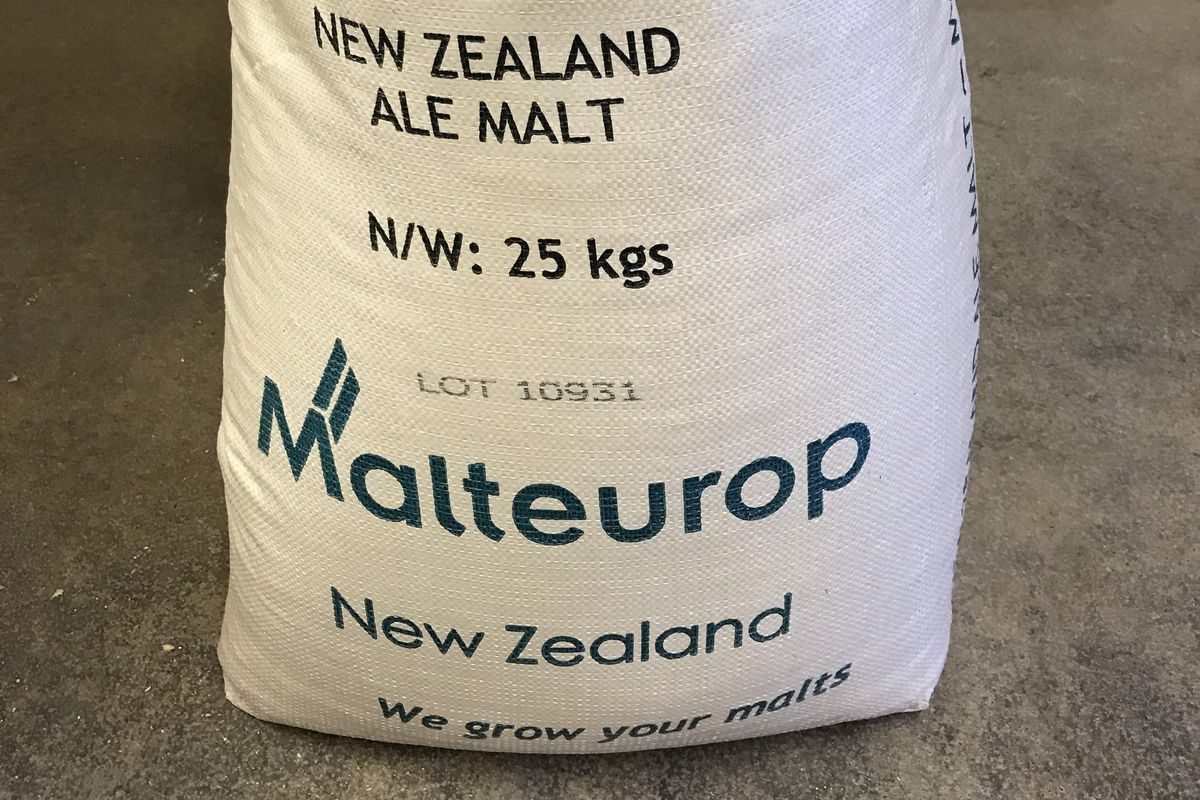
I've spent nearly thirty years buying malt for a living, since I started brewing in January 1997. You don't think about it much once the relationship is set up. A truck turns up, the bags stack up, you brew. It's the most boring part of the supply chain, right up until it isn't.
On 21 July 2026, Malteurop confirmed it will shut the Marton Millings site in the Rangitīkei at the end of September. Forty six years of production. Fourteen jobs at the plant. A letter to barley growers, signed by New Zealand operations manager Glen Simmons and Australia and New Zealand general manager Vincent Lauwerier, told them the company will honour existing 2025-26 season contracts but has no contracts to offer for 2026-27.
The letter named a second site. Malteurop's barley storage facility at Ashburton in Canterbury ceases general operations on the same date, 30 September, with full closure of the New Zealand operation by 31 December 2026. Most of the early coverage led with Marton alone. Ashburton matters more than it looks, and I'll come back to it.
Here's the part that should stop you mid-sip. That one plant has supplied roughly 70% of the malt sold in New Zealand: Lion, DB and Asahi, plus a large share of the craft sector through the distributor Cryer Malt.
Malt is barley that has been steeped in water, allowed to germinate for a few days, then dried in a kiln to stop the process and develop colour and flavour. Germination is the point of it: as the grain prepares to grow it makes enzymes and softens its own hard starch into something a brewer can turn into sugar. Almost every beer you drink is mostly malt and water. It also goes into whisky, malt vinegar, cereal and biscuits.
Take away the malthouse and you haven't taken away the beer. You've taken away where it was made.
Why now
There's no official explanation, because Malteurop hasn't given one. The company was approached for comment by the Whanganui Chronicle and by Local Democracy Reporting and declined. What exists publicly is the grower letter and the numbers.
The numbers aren't subtle. Beer available for consumption in New Zealand fell 10% to 265 million litres in the year to December 2025, the lowest in the series Stats NZ has kept for the past fifteen years. That measure counts what's released to the domestic market rather than what anyone drank, but as a proxy for how much malt the country needs, it does the job. Step back and it's steeper. Alcohol available per adult has fallen from 2.2 standard drinks a day in 2011 to 1.6 in 2025, roughly a quarter in fourteen years. Within beer, the categories above 5% alcohol fell 27% in a single year.
Fewer people drinking beer means less demand for malt. Add excise increases and cost of living pressure and you have a market that's been contracting for years, not having a bad quarter.
Then there's the plant. Built in 1979 and Malteurop's since 2008, it's the largest malting facility in the country. The claim that it was at the end of its working life and needed serious capital comes from Doug Michael of Gladfield Malt, Malteurop's only domestic competitor, who stands to gain from the closure. He told Pursuit of Hoppiness the plant had pretty much reached the end of its life and would have needed a fair bit of money spent to keep it going. Take that for what it is, an interested party's assessment. It's the only assessment on the record and nothing contradicts it.
The scale comparison is where the decision makes sense. Malteurop runs 23 plants in 14 countries and produces about 2.2 million tonnes of malt a year, which makes it the world's third largest maltster behind Soufflet Malt and Boortmalt. Its Geelong plant in Victoria alone is rated at 200,000 tonnes, roughly five times Marton, and could supply the entire New Zealand market by itself. Even so, Geelong makes Malteurop only the third largest maltster in Australia, behind Boortmalt's Joe White plants and Soufflet's Barrett Burston. Marton is a rounding error inside a business of that size.
It also isn't the only one going. Malteurop closed its Heidenau plant in Germany, reported in March 2026. This is a company contracting on more than one continent, not one making a judgement about New Zealand specifically.
Malteurop is owned by Vivescia, a French agricultural co-operative whose own recent annual material describes about 9,500 farming entrepreneurs as members, in the Champagne and north-eastern regions of France. Older sources say 11,000, so if you see that figure elsewhere, it's the earlier count.
Worth being precise about what's leaving. Malteurop is not exiting New Zealand as a supplier. It's exiting as a manufacturer. The same company can keep selling malt here from Geelong, and there's no reason to think it won't.
The number nearly everyone has misread
Slow down here, because most of the coverage has this wrong.
You'll have read that Marton's barley intake collapsed from around 26,000 tonnes a year to 6,000 or 7,000. The figure is real. Douglas Giles of Federated Farmers gave it to the Whanganui Chronicle. But it is not total intake. It's barley bought from lower North Island growers only, across the Rangitīkei, Manawatū, Wairarapa and Hawke's Bay. Malting barley production shifted south over those decades, and South Island grain sits outside that number entirely.
So where did the rest come from? Ashburton. Farmers Weekly sets out the route: South Island barley was collected into Malteurop's Ashburton store, forwarded to Marton in the North Island for malting, then returned to Ashburton for sale to South Island brewers.
Read that twice. South Island barley crossed Cook Strait to be malted, then crossed back to be sold. DB's Timaru brewery sits about 85 km down State Highway 1 from that Ashburton store, in the middle of the country's main malting barley district. Lion's Speight's brewery in Dunedin, which Lion's own chief operating officer described in April 2026 as its second largest, is further down the same road. Whatever else you think about this closure, that round trip was never going to survive a cost review forever.
It also explains why Ashburton closes too, which otherwise looks like odd collateral damage. The store existed to feed Marton. No Marton, no reason for the store.
What nobody has published is what Marton was actually producing. The 42,000 tonne figure is nameplate capacity, the rated maximum a company puts on its website, not output. Against a domestic beer market that has been shrinking for years and a local barley intake down more than 70% from its peak, it's entirely plausible the plant was running well short of its rating. I can't tell you by how much, because no one has said. Anyone who tells you Marton was pushing 42,000 tonnes is guessing. So is anyone who tells you it was pushing 7,000.
What's left standing, and the sum I can't finish
Gladfield Malt at Dunsandel in Canterbury is the only meaningful domestic alternative. Fifth generation family business, ten full time staff, a 500 acre farm of its own, more than fifty malt types, and 150 contracted growers according to its own website. Doug Michael put the figure at 180-odd in a July interview, so treat it as somewhere in that range.
He isn't hedging on capacity. He says Gladfield has room to fill the space, expanded in anticipation of exactly this, and that nobody needs to panic.
I'd like to take him at his word. I can't check it, and here's why.
Gladfield's last published capacity figures are 20,000 tonnes, from 2016, and 25,000 tonnes, from 2022. Both are old, the company has expanded since, and no current number is public. No specific expansion has been announced in response to the closure either.
Set against that, here's my own arithmetic, and I want to be explicit that this is my estimate and not an industry figure. Take 265 million litres of beer, which is 2.65 million hectolitres. Standard strength beer typically uses somewhere between 14 and 16 kilograms of malt per hectolitre. That gives 37,000 to 42,000 tonnes.
Now the three reasons that number is an upper bound rather than a requirement, because a maltster reading this will raise all of them and they're right to.
First, available for consumption includes imported beer, which was brewed with someone else's malt in someone else's country. Second, it excludes New Zealand beer that was exported, which did use malt here. Third, a good deal of mainstream lager uses sugar or other non-malt fermentables, which pulls the kilograms per hectolitre down. Net of all that, the real domestic malt requirement for beer is lower than 37,000 tonnes, and nobody publishes by how much. Add back whisky, food and animal feed and it moves the other way again.
So I'm not claiming a precise hole. I'm claiming that the hole is somewhere in the tens of thousands of tonnes, that the most recent public figure for the only domestic replacement is 25,000 tonnes and four years old, and that the gap between those two facts is not something anyone outside Gladfield can currently close.
The honest line is short. Gladfield says it can fill the gap. Gladfield hasn't published a capacity figure that would let anyone check. Both are true at once.
Michael himself makes the wider point, and it's the one worth holding onto: Gladfield now has an effective domestic monopoly, and malt is priced globally. He's right that brewers keep options. The options are mostly offshore.
What the brewers are doing
The big three are already splitting their approach. DB has said it will keep sourcing New Zealand malt from Gladfield while securing additional volumes from established overseas suppliers, mainly Australian. Lion, as of late July 2026, said it was still assessing its options and had not committed. Lion is the largest brewer in the country, and its decision will do more to set how much of this market Gladfield actually wins than anything Gladfield announces.
Imported malt isn't new, either. Cryer Malt and other distributors have brought in German, Belgian, British and North American malt for craft brewers for years, and plenty of breweries already run split recipes. The 70% figure describes Marton's share of what was sold here, not a country that had never seen a foreign sack.
What changes is the proportion, and two things about the switch rarely make the news.
The first is physical. New Zealand's bulk malt handling was built around a truck from Marton, and the truck brings its own blower. It couples a hose to the silo inlet and blows the malt in. A shipping container brings nothing. To get bulk malt out of a container and into a silo, someone has to own a tipper or a tilting chassis, a receival hopper and a way to lift it from there, or handle one tonne bags with a forklift and a lifting frame. None of that is difficult. All of it is equipment and yard space that a site taking bulk deliveries has never needed, plus a de-vanning step at the port and biosecurity clearance on imported grain that a domestic truck never touched. There's a quality cost too, because every extra pneumatic transfer cracks husk, and husk is what forms the filter bed when the sweet liquid is drained off the grain.
The second is that malt is not interchangeable. Base malt, which is the bulk of any recipe and supplies nearly all the fermentable sugar, varies between maltsters in enzyme strength, protein and extract yield. Specialty malts, the roasted and stewed ones used in small proportions for colour and flavour, vary more again. Change your base malt supplier and you aren't making the same beer from a different bag. You're making a new beer that resembles the old one. Every brewer moving off Marton has months of trial brewing ahead, and some of your favourites will taste slightly different next year without anyone announcing it.
This has happened before
The Marton plant was built on Wings Line in 1979 by the Canterbury Malting Company, which also ran an older malthouse at Heathcote Valley on the edge of Christchurch, going back to the 19th century. By the mid-1980s that company had passed to the country's two big brewers, Lion and DB. In late 1999 they closed Heathcote and moved all production to the newer Marton site, ending a working life of about 130 years. The towers stood empty for over a decade, took earthquake damage, and were demolished in 2012. The site is housing now.
I toured Heathcote on 29 January 1999, months before it closed, and took photographs I've only recently dug out.
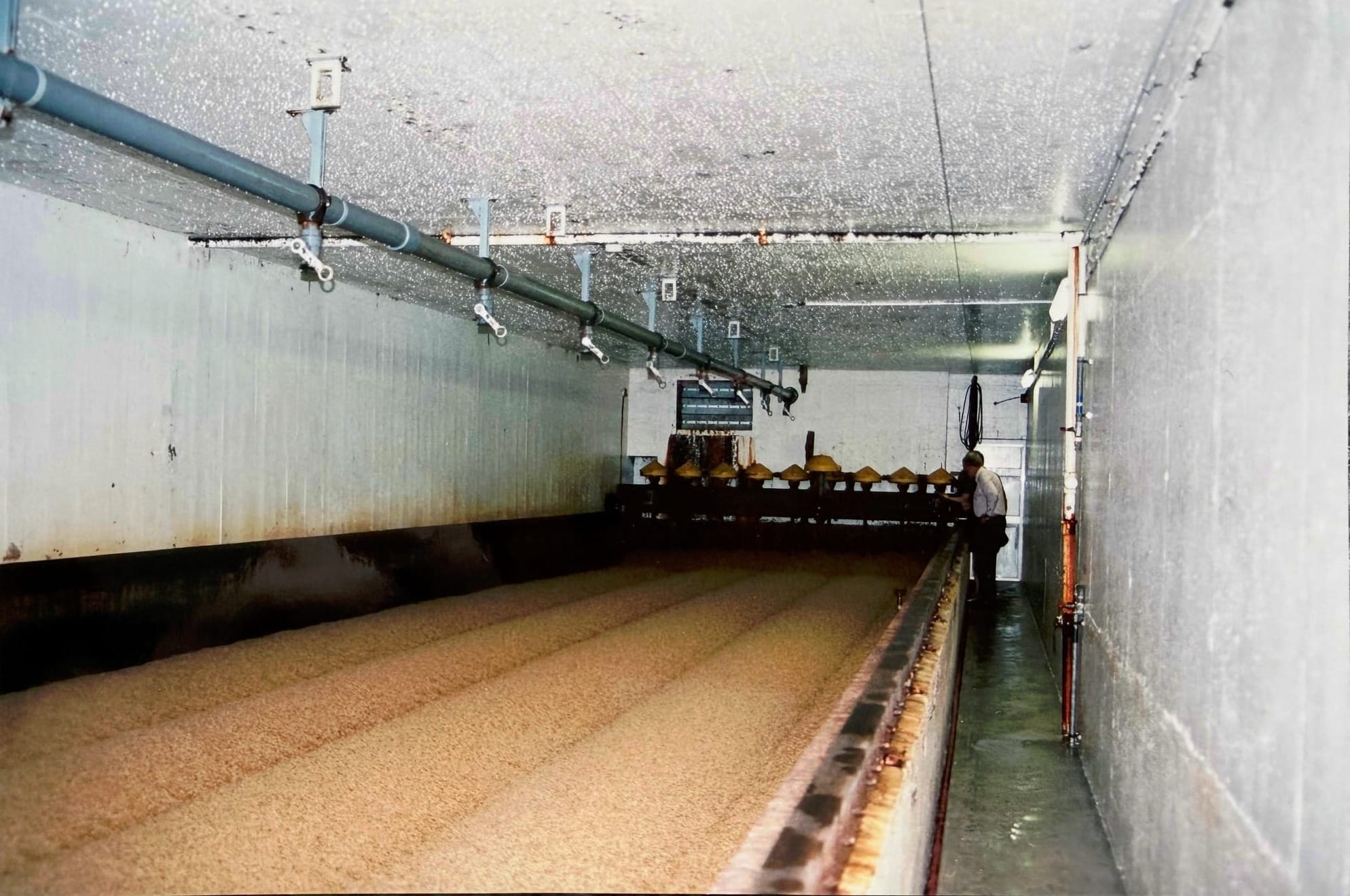
I bring that photograph up because it kills the comfortable version of this story. That's a Saladin box: a concrete vessel with a perforated floor, humidified air forced up through a deep bed of grain, and machinery doing the turning that men once did with wooden shovels. Heathcote in 1999 wasn't a quaint survival being overtaken by progress. It was mechanised, and it was shut anyway.
Not because it couldn't do the job. Because another plant could do it too.
What happened next has been reported by Pursuit of Hoppiness, and I've found it in the one place, so treat it accordingly. The brewers found malting harder work than expected and sold the business in 2000. It went to the grain trader Archer Daniels Midland around 2006, and to Malteurop in 2008.
So this is the second time in living memory that the owners of New Zealand's malting capacity have decided one plant could do the work of two. In 1999 the survivor was Marton. In 2026 the survivor is in Victoria.
The growers get it worse
For brewers this is a logistics problem with a price attached. For arable farmers growing malting barley on contract, it's a livelihood question.
Malting barley and feed barley are the same species and not remotely the same business. Malting barley is grown to a contract specification, with limits on protein and requirements for germination and grain size, and it earns a premium for meeting them. Grain that misses spec becomes feed, at feed prices. Losing a malting contract doesn't stop anyone growing barley. It removes the premium.
Douglas Giles, Federated Farmers' arable chairman for Manawatū-Rangitīkei, says growers were caught off guard, having assumed Malteurop might carry on malting at Marton even at lower tonnages. Conversion to livestock is possible in the region, he notes, because these aren't pure arable properties lacking fences and stock water. It just isn't an economic like-for-like. And he makes a political point worth sitting with: because arable lacks a big export footprint, it hasn't got a lot of profile in Government. Barley that becomes domestic beer never appears in an export statistic, so it never appears in a press release.
Federated Farmers Whanganui president Laura Morrison, a Marton farmer herself, has the number that makes it concrete. In a Federated Farmers confidence survey in January 2026, 41% of arable respondents said their farms were profitable. Dairy was 81%. Meat and wool was 68%. She's also pursuing conversations with Fonterra and Open Country about whether dairy farmers might prioritise New Zealand grown stockfeed over imported palm kernel. Whether that goes anywhere is anyone's guess.
In Canterbury, where most of the malting barley now is, Mid Canterbury Federated Farmers arable chair Bevan Lill called the closure significant but not necessarily a complete surprise, pointing to several years of disappointing pricing and growers already moving away from the crop. His warning is about accumulation rather than this single event. Having already lost Heinz Wattie's and McCain, he says, the sector risks losing critical mass as each associated business goes.
That's the thing about processing capacity. It doesn't come back because you want it to.
What growers might do next, and this part is speculation
Nobody has surveyed the affected growers, so treat what follows as my reasoning rather than reporting.
Most likely, most stay arable. They drop the malting contract, grow feed barley or switch to another crop, and absorb the lost premium. It's the low friction path and needs no capital.
Livestock finishing is second. Giles has already flagged it as feasible in the Manawatū, and the infrastructure is largely in place.
Dairy conversion looks less likely than the geography suggests. The capital cost is substantial, and Horizons Regional Council's nutrient rules make a new conversion in that catchment a harder consenting proposition than it was twenty years ago.
Pine is very unlikely, whatever the current mood about farm conversions. Carbon forestry economics work by buying cheap land, and flat irrigated arable country is not cheap land. The pine story is a hill country story.
The pattern this fits
The same week the closure broke, the Employers and Manufacturers Association released its 2026 election policy positions, warning about what its head of advocacy Alan McDonald described as rapid deindustrialisation across New Zealand manufacturing. His argument is that the country has gone from attracting international business on the strength of its energy supply to having energy costs routinely cited as a reason for shutting plants. The EMA wants a framework that identifies critical industries, with conditional incentives and government backed loans.
Malteurop proves nothing on its own, and the Heidenau closure suggests a global portfolio decision rather than a verdict on New Zealand's energy prices. But the shape is familiar. When a business is a small line on someone else's balance sheet, it's early to be cut and late to be funded.
Worth saying plainly what this is, underneath the corporate language. A French co-operative looked at a small ageing plant on the far edge of its network and decided the maths didn't work. The fourteen people at the plant and the growers across four regions absorb that decision. This is a food security story as much as a brewing one. When 70% of an industry's key input runs through a single foreign owned facility, that industry doesn't control its own supply chain. It's been lucky, for 46 years, that the maths held.
What happens to the site
The buildings probably won't sit empty. Rangitīkei mayor Andy Watson says several commercial entities have already lodged expressions of interest. The site is rail connected and holds 25,000 to 30,000 tonnes of grain storage, which Watson describes as a significant grain storage pathway in fine condition. He'd like to see someone move in who adds value to grain rather than only storing it, and says he's open to suggestions.
So the story doesn't end in September. It moves from a malting plant closing to a question about what the Rangitīkei does with a rail connected grain hub it didn't ask for.
Current grower contracts run to the closure date. After that, New Zealand's beer runs on Gladfield and on imports, largely Australian, until someone decides it's worth rebuilding capacity here. As of August 2026, nobody has said they will.
Forty six years of a truck turning up and the bags stacking up. After September, that truck is coming from a lot further away.
More on this to come: who actually owns the maltsters that will supply us now, and how few of them there turn out to be; what the law does and doesn't require anyone to tell you about what's in a beer; and what "New Zealand grown" means when nobody audits it.
Before you go
If you want the rest of this as it lands, signing up is free. If you'd like to help cover the research time, you can leave a one-off tip.