Live2Give Hired a Mixer Wagon to Mulch Its Onions. Now It Is Coming to Auckland.
Live2Give grows organic vegetables at Aokautere, backloads other growers' produce on its chilled truck, labels its own non-organic lines as non-organic, and starts delivering to Auckland on 3 September.
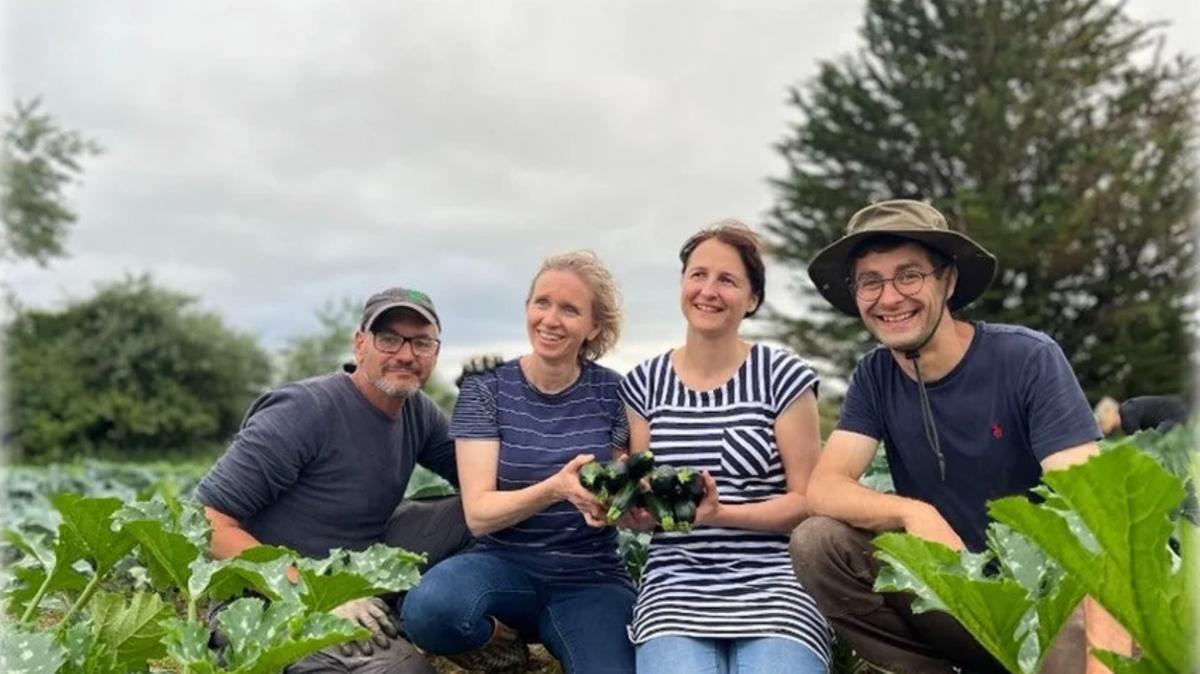
Before this season's main onion crop went in the ground at Live2Give Organic Farm, the team pulled out the perennial weeds by hand, bought in old stringy lucerne and grass silage plus organic straw, hired a mixer wagon to chop and blend it, and then spent three days spreading it. The mixer wagon handled five large round bales at a time and turned them into spreadable mulch in about five minutes. The spreading is what took the three days.
That is a lot of effort and expense for an onion. It is also the single clearest thing I have read all month about where this business is heading.
Palmerston North, two couples, one leased paddock
Live2Give Organics grows certified organic vegetables on leased land at Aokautere, just south of Palmerston North. The farm carries BioGro certification, licence number 6535, which they display next to the logo on every page of the shop. It is a social enterprise, run by two husband and wife teams, Robert and Naomi Hall and Gosia and Tobi Euerl. The farm describes itself as a demonstration farm for regenerative mulch systems. Tobi came out from Germany in May 2022 to help set it up.
The mulch is not decoration. Their own account of the onion prep is specific about why they used stringy silage alongside straw: to avoid a spike in nitrogen mineralisation, which they say matters for how well the onions store. Feeding earthworms, holding moisture through a hot season and smothering weeds are the other reasons. That is a grower thinking about soil biology and shelf life at the same time, which is not a combination you get from a spray programme.
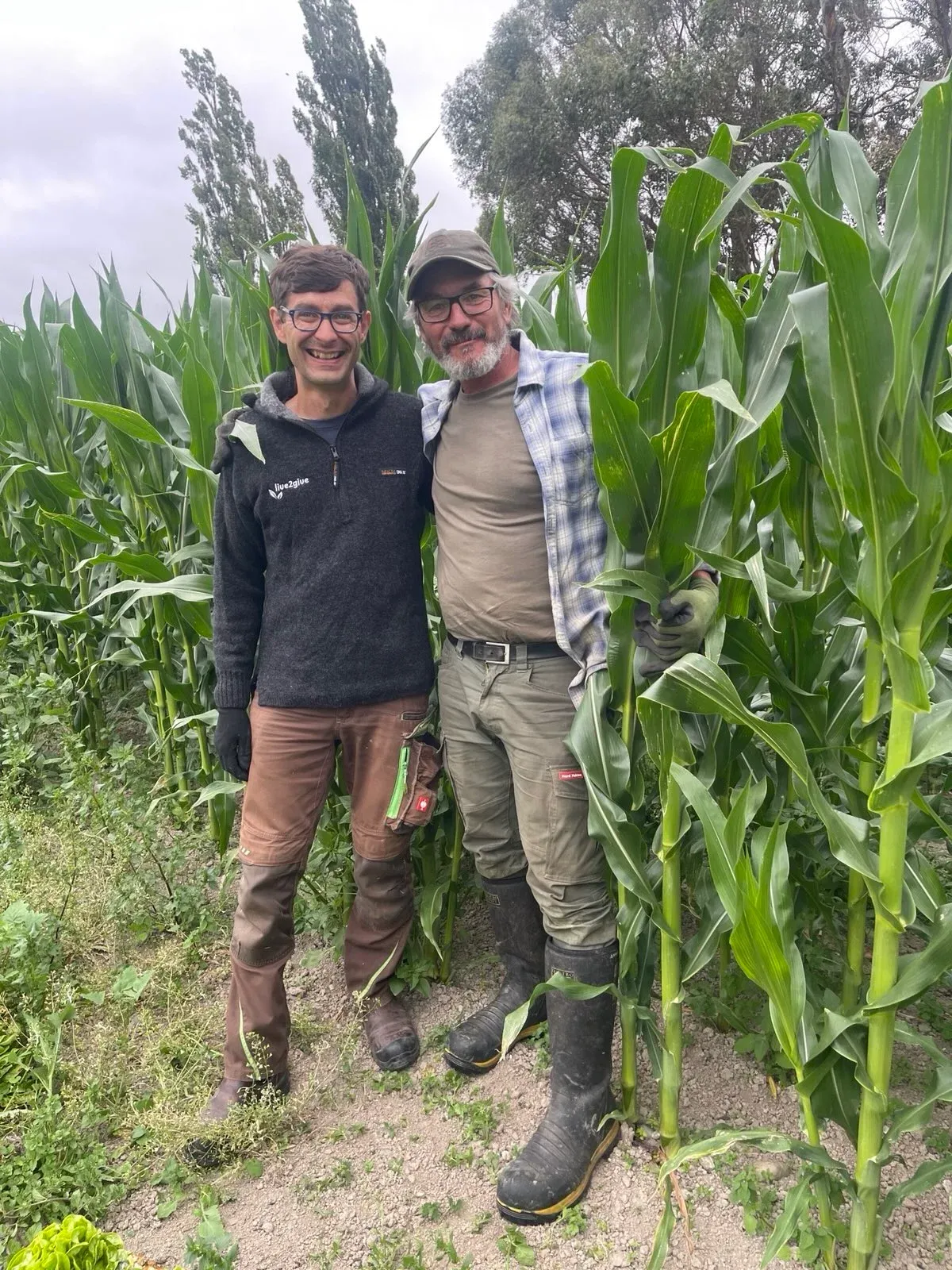
The buying-in is the expensive version, though, and they know it. Back in January they posted a photo of Rob and Tobi standing in a maize cover crop that had grown clean over their heads, with the note that it should lay down enough mulch to plant celery into with no extra material needed. That is the whole idea: grow the mulch where you need it instead of trucking it in and hiring a wagon to chop it. Their stated concern that week was whether their mower could cope. OrganicNZ reported that the farm holds funding from MPI's Sustainable Food and Fibre Futures for an almost four-year proof-of-concept trial of mulch-direct planting for commercial vegetable growing in New Zealand conditions, so the onion paddock and the celery paddock are two points on the same experiment.
They got here by cutting things off
The other thing worth knowing is what they stopped doing.
For more than five years the same founders ran Wholegrain Organics at 134 The Square in Palmerston North: a commercial kitchen, a bread bakery, a café and a retail shop, milling its own wholegrain flours on site. It was a registered charity, and the profits went into Hands-On Food, a programme that put school students into the kitchen to prepare and serve the food. Awatapu College students cooked dinner for paying customers. Food technology classes ran with Manukura School, Cornerstone Christian School and Queen Elizabeth College, and the Herald covered a PledgeMe campaign to fund it in 2021.
The farm came out of the food business rather than the other way round. Rob Hall's own account on the farm's About page is blunt about it: he used to run an organic store, found it hard to get consistently good fresh produce, and started growing it himself. Organics Aotearoa New Zealand's case study tells the same story as a progression from baker to farmer to educator. The growing methods came through a connected group of farms in Germany, India, South Africa and New Zealand.
By the middle of 2022 it had become sprawling and financially unsustainable. Naomi Hall described it to OrganicNZ as "a tree with 10 branches" that did not work as a business. So they cut eight of them off, keeping the two they judged foundational: the farm, and the online shop. The farm is the priority, she said, and the shop is what connects it to everyone else.
Most food businesses in trouble go looking for another revenue line. These ones removed eight. By the time OrganicNZ profiled them in 2024, the shop was running around 160 orders a week across subscriptions and one-offs, and everything since has been built on those two branches rather than bolted onto them.
The bit almost nobody notices: they are a freight system
Open the Live2Give shop in any given week and a lot of what is in it was not grown at Aokautere. In the week I looked, in mid-August 2026, there was cauliflower from Untamed Earth in Christchurch, cabbage from Streamside Organics at Leeston in Selwyn, carrots and pak choi from Crooked Vege in Ōtaki, apples from Te Mata Orchards, avocados from Ongare Point, capsicum from Cambridge, pak choi from Masterton.
There is a reason for that, and it is the problem that quietly kills small organic growers in this country. Chilled freight is priced for pallets. If you have half a crate of surplus zucchini and seventy bunches of pak choi, you cannot get them to a customer in another city at any price that leaves you money. Live2Give already runs a chilled truck from Palmerston North to Wellington every week, so it backloads other people's produce onto it and sells the volume through its own shop. Naomi Hall gave OrganicNZ the example of Crooked Vege: she says yes to whatever they have, and one such week turned into an $800 sale for a start-up CSA, a community supported agriculture scheme selling boxes direct to members.
Streamside, for the record, is a 50-acre certified organic farm at Leeston, started by Dominique Schacherer and Logan Kerr on a single acre in 2014. Untamed Earth is part of the little organic cluster on Colombo Street in Beckenham. These are not businesses that would otherwise be selling into Palmerston North, let alone Auckland.
It runs the other way too. Rourou Kai Ora, a Wellington community project that makes medically tailored meals from locally grown organic produce and runs youth mentoring alongside it, is supplied by Live2Give. Three of their people drove up to Palmerston North in July to meet the packing team in person and put a photo of it online. A charity feeding unwell people organic vegetables in Wellington is doing it through a farm shop in Manawatū, which tells you something about how thin the organic wholesale network in this country actually is.
The labelling is better than the supermarket's
Something else stands out when you read their product list, and it is the thing I have spent most of this year writing about.
They put the caveat inside the product name. Not in the fine print, not on a back panel, in the name: Spray Free (not organic) Broccoli. In Conversion. Australian Spray Free (not organic) Dried Mango. Their bananas are listed as fumigated, which is true of essentially all bananas sold here and disclosed by almost none of them.
A shop that voluntarily writes "not organic" into the name of a product it is trying to sell you is doing something the two supermarket chains have never once done.
Auckland, from 3 September
As of mid-August 2026 their chilled electric delivery van was in Auckland having the chiller unit fitted, and deliveries start on 3 September. Five runs: central, east and south on Thursdays, west and north on Fridays, flat rate of $17.50 whatever the order size, and everything goes out in their swap-a-crate system rather than packaging.
The timing is worth sitting with. Auckland has lost Huckleberry and Wise Cicada. Household budgets are tight and organic is usually the first thing people trim. Into that, a Palmerston North social enterprise is buying an electric van, fitting it with a chiller, and opening five weekly runs across the country's most expensive city to service.
There is a flour mill in the family
One last thread, and it is the one I did not expect.
Rob Hall told the Herald in late 2022 that they had been milling flour for more than twenty years. That milling did not stop when the branches were cut. Organic Flour Mills, run by Lindsay and Jilly Wright in Palmerston North, says on its own site that it acquired the mills from Wholegrain Organics and is continuing the same flour, and Business Central reported in July 2026 that the business grew out of the closure of the Wholegrain operation. Jilly told the magazine they took the mills on because Lindsay loves the milling, and anything to do with machinery.
The two businesses are family. Jilly is Naomi's mother and Lindsay her stepfather, and the two of them introduce themselves that way on camera in a video on the Live2Give page. Live2Give sells the flour under the line "One family, two businesses. One shared mission", and it is not a token listing. Organic Flour Mills has its own top-level menu on the shop, sitting between the fresh produce and the dry goods, with sections for the Zentrofan flours, gluten free, bulk grain, bread recipes and a page explaining how flour works. As of August 2026 the wholemeal wheat and rye start at $7.50 and the spelt at $13.20.
That bulk grain section is the one to look at if you mill at home. Their grain comes from certified growers, mostly in Canterbury, with locally grown spelt, and gluten-free products are milled in a separate room to keep them apart. The mills are Zentrofan air-cyclone mills, which do not grind grain between stones or rollers at all: a current of cool air throws the grain against a basalt stone wall, so there is no friction heat.
Both businesses are expanding in the same year. Live2Give is fitting out an electric truck. Organic Flour Mills told Business Central it has a new mill arriving to keep up with nationwide orders.
When I wrote about where to get organic flour for bread in New Zealand back in February, Organic Flour Mills was a name I had found but not yet bought from. I have since ordered grain from them, though still never the flour. It turns out they were one family away from a vegetable farm I was already watching, which is either good research or a small country.
I am going to keep watching. A business that cut itself back to two branches, spends three days spreading mulch on an onion paddock, gives away freight capacity to other growers, tells you when its own produce is not certified, and buys an electric truck in a cost of living crisis is not drifting. It is being steered. The mill in the family is buying another mill in the same year, which suggests the steering is working.
Before you go
If you found this useful, sign up free to get new pieces as they go out.
If you would like to support the work, you can leave a one-off tip.