Better Than Organic: The New Standard Coming to NZ Shelves
I picked up a packet of beef and noticed a sticker I hadn't seen before. Two hours later I was still reading. Here's what's hiding behind the label — and why regenerative verification might be the most important food standard you haven't heard of yet.
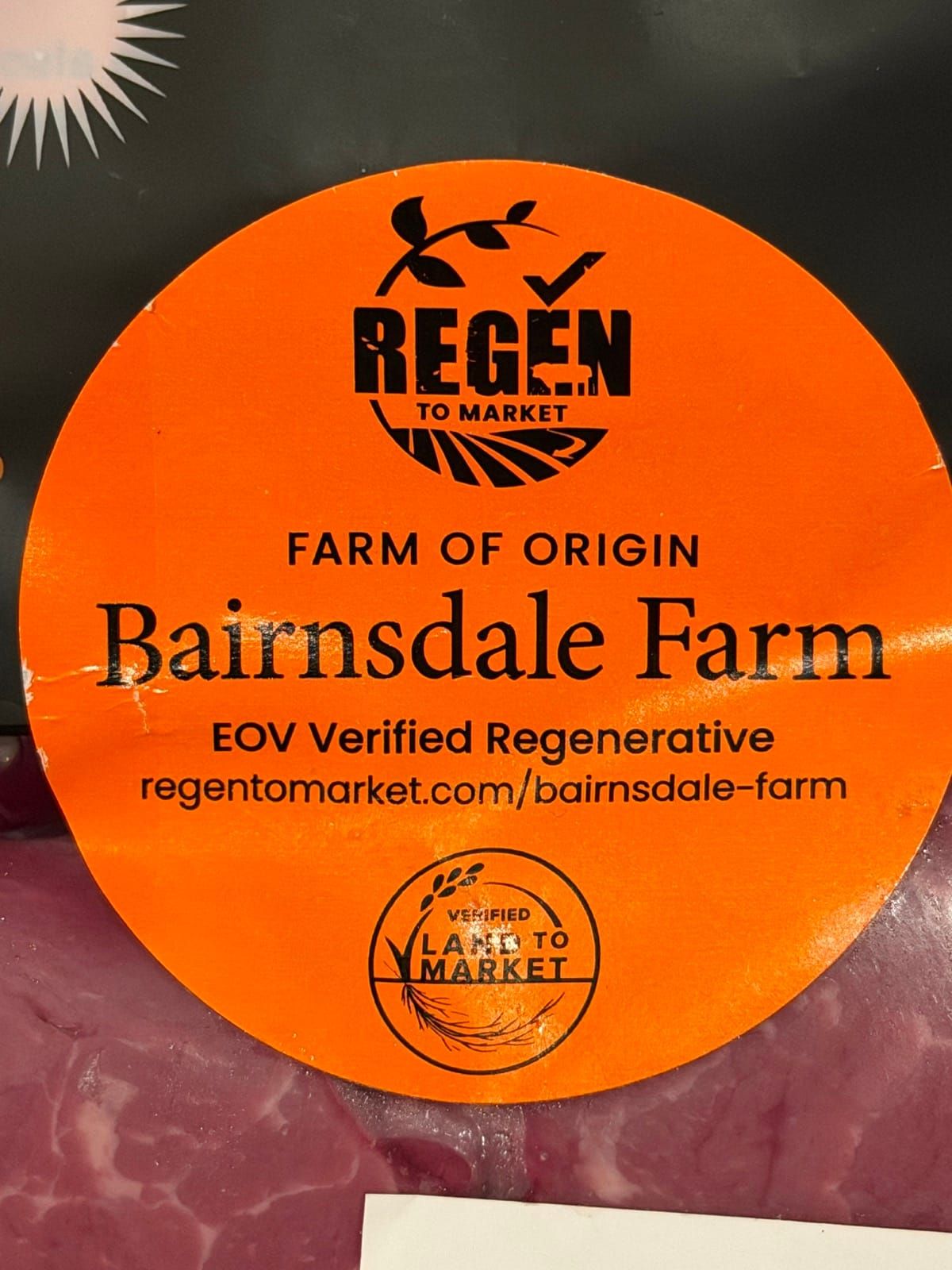
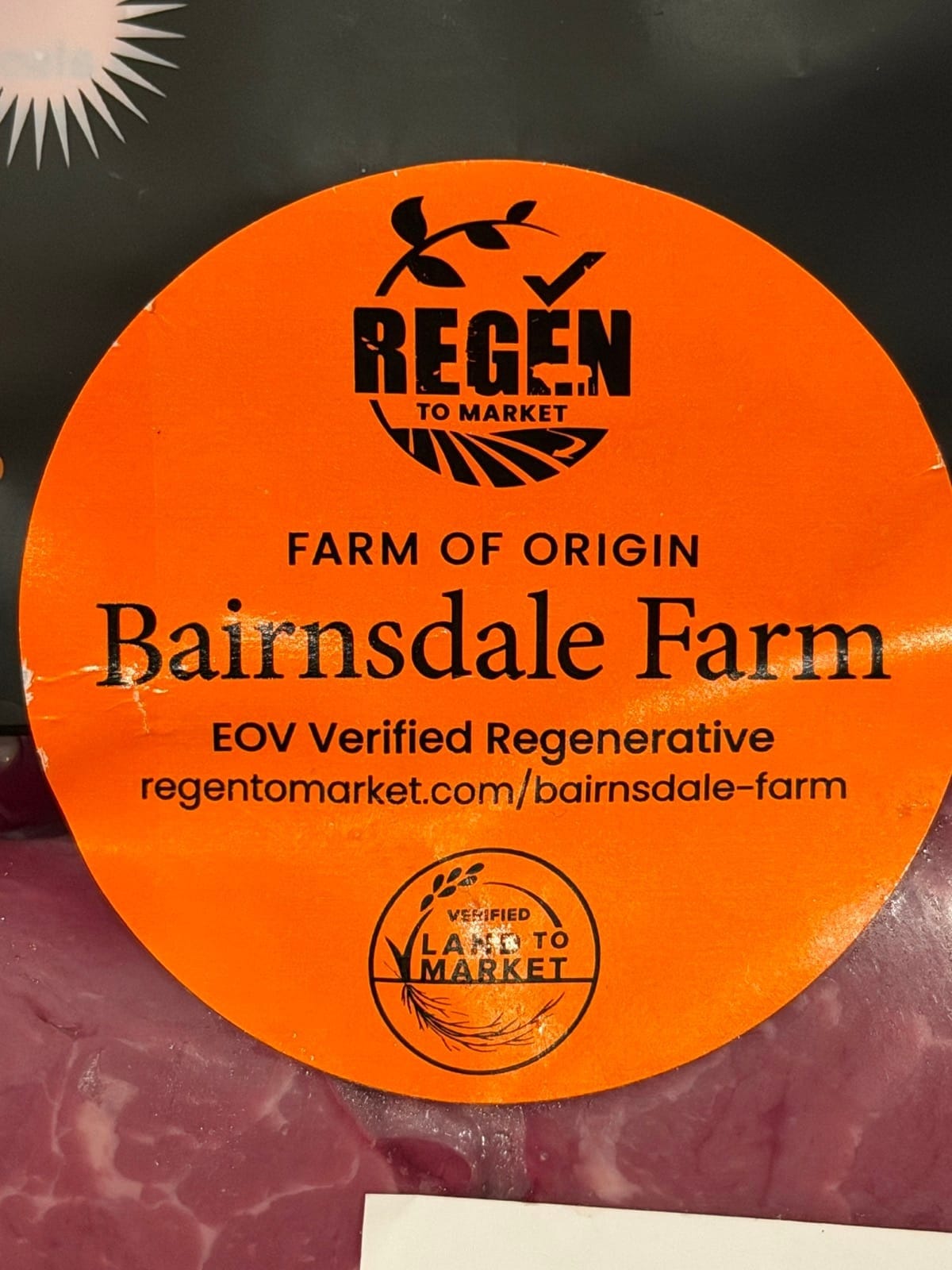
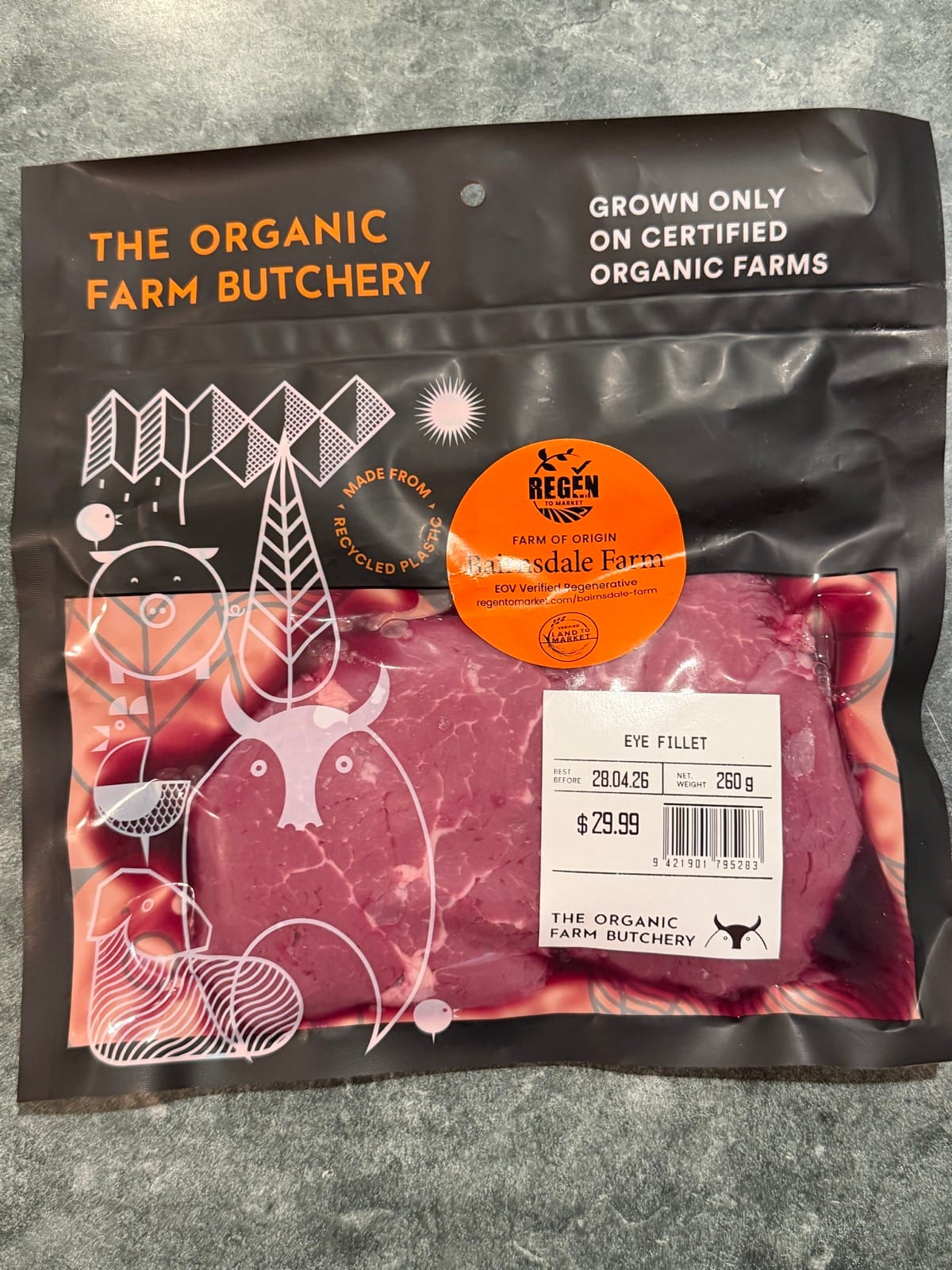
I picked up a packet of eye fillet at Commonsense Mt Eden and noticed a sticker I hadn't seen before. An orange one. It had a farm name on it — Bairnsdale Farm — which immediately caught my attention. Then I looked closer. EOV Verified Regenerative. Land to Market Verified. I had no idea what any of that meant. I looked up the URL on the sticker.
That was a mistake. A good one. Two hours later I was still reading, and now I'm writing this.
Oh — and the eye fillet was the best I've ever eaten. I'm the chef in question, so draw your own conclusions. But I genuinely can't think of a time I've had better. More on that later.
The farmer
Bairnsdale Farm is near Puketitiri, inland Hawke's Bay, run by Malcolm White, his wife Twix and daughter Nicky. They bought it 24 years ago and farmed it hard. Then the land broke.
A drought around 2010 was the turning point. Malcolm attended a seminar at Hawke's Bay Regional Council on how livestock can actually improve rainfall absorption — the opposite of what he'd assumed. He did a short course. He started applying what he'd learned: principles for eliminating overgrazing, building soil cover, deepening pasture roots. The approach was Holistic Management, a grazing and land decision-making framework developed by Zimbabwean ecologist Allan Savory. Gradually, the farm transformed.
The change Malcolm describes now isn't abstract. "We go out to move the cows, and we see hundreds of swallows and fantails just flitting around. Everything goes quiet because falcons come flying over, and then everything comes back out again. It's just beautiful. It's fun, to be honest, and it makes it incredibly interesting. You kind of lose the fear."
I like knowing that. I like knowing there's a Malcolm, and a Twix, and a Nicky, and that their farm is near Puketitiri sending eye fillet to Mt Eden. For most of human history, people knew exactly where their food came from. The farmer had a name. The land had a location. Industrial food systems spent the last 70 years systematically removing that information — anonymous supply chains, commodity meat, supermarket packaging designed to evoke farms that don't exist.
What's on that orange sticker is a partial return to something much older. Standing at my bench reading about their farm, I realised I want this for everything I eat. A name. A place. A farmer who made a decision and stood behind it. It turns out that's a more radical thing to want than it sounds.
The verification system nobody told you about
Here's where it gets interesting — and where most food labels quietly hope you stop asking questions.
The orange sticker connects back to a verification system called EOV: Ecological Outcome Verification. It was developed by the Savory Institute — a US non-profit founded by Allan Savory, a Zimbabwean biologist — in collaboration with Michigan State University, Texas A&M, Ovis 21 (an Argentine sheep operation that led much of the underlying scientific methodology), and The Nature Conservancy. In New Zealand, it's operated exclusively by a consultancy called Ata Regenerative, the country's sole licensed EOV provider, with more than two decades working in the regenerative space.
Here's what EOV actually does. Once a year, an accredited monitor visits the farm and assesses a set of ecological indicators — bare ground, biodiversity, pasture cover, dung decomposition, insect life. Every five years, a deeper assessment adds soil carbon, water infiltration rates, and plant diversity data from permanent monitoring sites. That data goes to a Global Quality Assurance team for independent review. If the land shows consistent positive ecological trends, verification is granted. If it doesn't, it doesn't.
It is not a box-ticking input audit. The claim depends entirely on whether the land is actually improving.
A few numbers worth sitting with. EOV is deployed on more than 6 million acres globally. Here in New Zealand, Ata Regenerative monitors 245 farms across 500,000 hectares. That is a substantial share of the global EOV footprint, in a country our size. New Zealand's large, grass-based pastoral farms turn out to be exceptionally well suited to the model.
One thing worth saying directly. The grazing theory underlying Holistic Management — Savory's framework — has been contested in academic literature, with peer-reviewed critics arguing some of its broader claims are not well supported by experimental evidence. That debate is real and ongoing. But EOV's design effectively sidesteps it. EOV doesn't ask whether a particular grazing theory is correct. It measures whether the land is actually improving — bare ground, biodiversity, soil carbon, water infiltration. The land tells you whether the management is working. That's a different and more rigorous question than "are you following the right method?"
How a verified farm becomes a label in a shop
EOV is the science. Land to Market is what turns that science into something you can see on a packet.
Once a farm passes EOV, it can apply for Land to Market verification — a global programme run by the Savory Institute — which licenses the consumer-facing seal. That seal now appears on over 1,000 products worldwide. Regen to Market is the New Zealand-specific retail pathway, built and run by Ata Regenerative, connecting verified farms to shops like Commonsense.
The full chain from soil to shelf looks like this:
Bairnsdale Farm → regenerative farming using Holistic Management → EOV annual monitoring by Ata Regenerative → passes verification → Land to Market seal issued → The Organic Farm Butchery processes and packs → Regen to Market sticker applied → Commonsense Mt Eden → you.
In plain English: Bairnsdale is the farm. EOV is the ecological checking system. Ata Regenerative runs that system in New Zealand. Land to Market is the seal. Regen to Market is the pathway to shops.
That is an unusually traceable supply chain. Most beef in New Zealand is anonymous — no farm name, no farmer, no region, no story. Just meat in a tray. This packet had a URL pointing back to a named farm, a named farmer, and a named valley an hour inland from Napier.
Why isn't this just normal?
So how is this different from organic?
This is where the packet gets genuinely thought-provoking — because it carries both certifications at once.
The Organic Farm Butchery is a Hawke's Bay-based sourcing and processing business that works with a network of certified organic farms across the North Island. Bairnsdale is one of them. Organic certification is fundamentally about inputs and rules — did the farmer avoid synthetic pesticides, growth hormones, routine antibiotics, prohibited fertilisers? Every certified organic producer is audited annually by an independent certifying body. That's real rigour and it matters. If you want to understand what conventional New Zealand beef may have been exposed to by comparison, that gap is significant.
But here's the tension. As I wrote recently, the word "organic" has a complicated history. When Walter Northbourne coined it in 1940, he meant something specific: a farm as a living system. What it has largely become is a certification framework. In New Zealand, organic certification has historically operated through private certification bodies rather than a fully mandatory domestic regime — although that is now changing. The Organic Products and Production Act became law in 2023, with regulations coming into force in 2025 and a transition period before the new system becomes mandatory from 31 March 2028.
Organic certification still matters. It gives consumers real information about inputs, audits and farming practice. But it does not automatically tell you whether a particular piece of land is actually improving ecologically.
EOV asks that harder question directly. Not: did you follow the rules? But: is the land getting better?
Soil health. Biodiversity. Water infiltration. Ground cover. Ecosystem function. Trending up, or trending down. The land gets a voice. Land is either regenerating or it isn't.
Soil degradation is not an abstract problem. Some widely repeated warnings have claimed the world could lose its topsoil within 60 years if current rates continue — that specific figure is contested, but the underlying reality is serious. Soils are degrading in many places, erosion rates are accelerating, and the way land is managed matters enormously. Organic certification can reduce certain harms. Properly verified regenerative farming is specifically trying to measure whether the land is actually recovering.
Organic was the gold standard for conscious food buyers. It still means something real. But it has also become something large corporations can navigate with a compliance team. Regenerative verification is asking a harder question. Right now, very few products can answer it.
Where things stand right now
Ata Regenerative monitors 245 farms under EOV across New Zealand. But only two farms are currently publicly listed on the Regen to Market farm page: Bairnsdale Farm and Rathmoy Estate. The first Bairnsdale delivery sold out faster than expected.
The infrastructure exists at real scale. The consumer connection is just getting started.
That gap — 245 verified farms, 2 publicly listed in the marketplace — is the most interesting number in this whole story. There is a large body of rigorously verified regenerative land in New Zealand that most consumers have no idea exists, and currently no easy way to buy from. Regen to Market is trying to build that bridge.
Back to the steak
Maybe the best eye fillet I've ever eaten tasted the way it did because the land it came from is genuinely healthy. I can't prove that. The science on nutrient density in regeneratively farmed meat is still emerging.
But I know which farm it came from. I know the farmer's name. I know the valley. I know someone went and checked the soil. And I know the land is trending in the right direction.
In a food system built almost entirely on anonymity, that feels like something worth paying attention to.
Bairnsdale Farm beef is currently available at Commonsense Organics stores in Mt Eden, Wellington City, Lower Hutt, Kilbirnie and Kapiti, plus Naturally Organic Albany, Cornucopia Hastings, Chantal Napier, Organic Buzz Palmerston North, Down to Earth New Plymouth, and Bellatino's Havelock North. Look for the orange Regen to Market sticker.