Your Free-Range Eggs Are From Hens That Haven't Been Outside
A green sign taped to the Woolworths egg shelf says some free-range flocks have moved indoors. It doesn't name a supplier, a brand, a date or an end. Europe caps this at 16 weeks and then the eggs become barn eggs. Organic wrote its own exception. New Zealand wrote nothing at all.
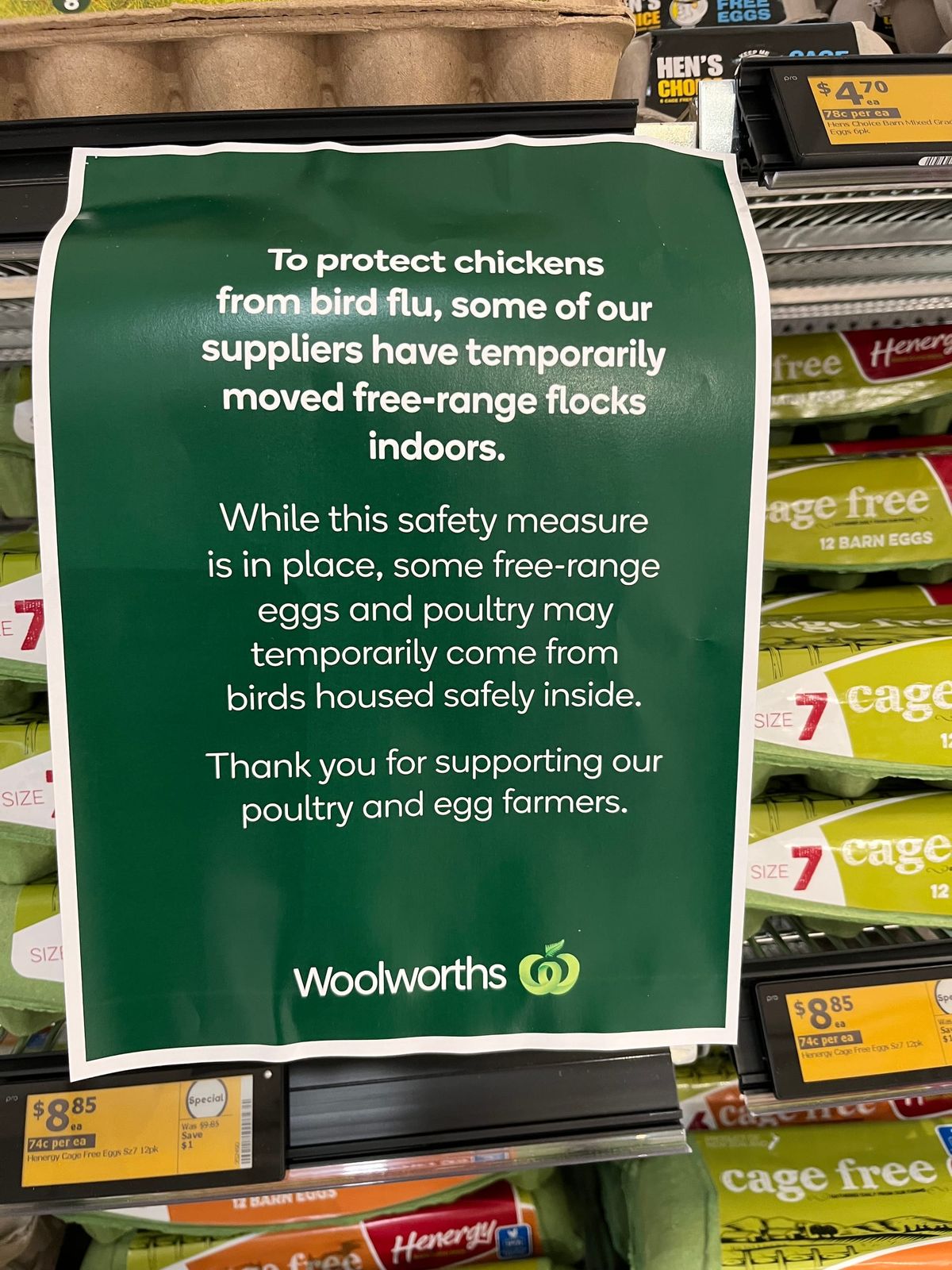
There is a green laminated sign taped across the egg shelf at Woolworths. I photographed it on 4 August.
"To protect chickens from bird flu, some of our suppliers have temporarily moved free-range flocks indoors. While this safety measure is in place, some free-range eggs and poultry may temporarily come from birds housed safely inside. Thank you for supporting our poultry and egg farmers."
Four sentences. Read them again and count the hedges. Some of our suppliers. Some free-range eggs. May temporarily. Housed safely.
Now try to use it. You are holding a carton stamped FR, paying a premium for outdoor access, and the sign has just told you that access might not exist. Which carton? Not stated. Which brand? Not stated. Since when? Not stated. Until when? Not stated.
The disclosure is real. It is also impossible to act on.
What actually happened
New Zealand has two confirmed cases of H5 bird flu. Both were wild birds. A brown skua found disoriented on Petone Beach, confirmed 15 July. A kāhu, the native swamp harrier, in the Wairarapa two days later. Since 17 July there have been no further detections, no evidence of mass mortality in wildlife, and no detection in poultry at all, according to MPI's running situation update.
Two detections. Not two infected birds in the country, which is a different claim and one nobody can make. Both were scavenging species, and scavengers turn up positive because they eat carcasses somebody else never found. But two detections, and no poultry.
What followed was not a government order. Mainland Poultry, which supplies close to 40% of New Zealand's eggs, closed the pop holes on more than 550,000 free-range hens over a weekend. New Zealand has no national housing order of the kind Britain uses, so keeping birds inside remains a decision each producer makes alone.
For scale: the national laying flock is around four million hens, and free range is a significant minority of production rather than the bulk of it. Colony still dominates supply. So what is affected here is not most of the country's eggs, but most of its premium eggs, and they are currently produced indoors, by choice, with no end date announced.
I want to be careful here, because this is the part that gets shouted about. The housing decision is defensible. Free-ranging hens picking up a virus from wild waterfowl and carrying it into a shed is exactly how the December 2024 Otago outbreak is understood to have started. Nobody is being cynical by shutting a pop hole.
The question is what happens to the word on the carton while the pop hole is shut.
The numbers, with dates attached
Because half the figures in circulation are stale, and the other half count different things.
The virus, as at 1 August 2026
- Confirmed H5 detections in New Zealand: two, both wild birds, both scavengers
- Detections in poultry, commercial or backyard: none
- Further detections since 17 July: none
- Wild birds tested in the past 12 months: more than 2,500
- Commercial poultry tested in the past 12 months: about 12,500
- Wild birds tested since the surveillance programme began in 2004: more than 23,000
- Public notifications of sick or dead birds received by MPI on Saturday 18 July: 157. The week before, it was running at one or two a week
- Endangered birds in the DOC vaccination programme: 300 core breeding birds across five species
Eggs
- Eggs produced in New Zealand each year: around 1 billion
- Eggs eaten per person per year: 237 or more, though EPF estimated 229 as at June 2025
- Retail egg sales: over $290 million a year
- Share sold as table eggs: 85%, with the rest going into baking and catering
- Commercial egg farms: around 130
- National laying flock: roughly 4 million hens
- Flock breakdown: 34% free range, 33% barn, the balance colony. These are percentages of the national layer flock, meaning hens rather than farms or volume, and the free-range figure is EPF's own, dated December 2022. Organic is not broken out because it is too small to feature
- Certified organic share of egg volume: around 1%, on older industry estimates
- Free-range outdoor stocking density, maximum: 2,500 hens per hectare, or four square metres per bird (Code of Welfare, updated 2018)
- Free-range indoor stocking density, maximum: 9 hens per square metre
- Barn indoor stocking density, maximum: 7 hens per square metre
- Colony cage space: minimum 750 square centimetres per hen, typically 20 to 80 hens per cage
- Pop-hole minimum dimensions: 35cm high, 40cm wide, evenly distributed along the building
- Free-range hens moved indoors by Mainland Poultry in July: more than 550,000
- Mainland's share of national egg supply: close to 40%
- Hens culled in the December 2024 H7N6 outbreak at an Otago farm: around 160,000
- Threshold for EPF membership, and for the new compulsory biosecurity plans: 100 birds
A note on counting
Farm counts vary wildly depending on the source and what is being measured. Stats NZ business demography at February 2025 counts registered businesses rather than farms, and any GST-registered agricultural operation qualifies regardless of size, which is why its numbers run higher than industry counts. Its figures are also randomly rounded to base three. If you quote a farm count anywhere, say which measure it is and what year.
The legal position, which is stranger than the sign suggests
Free range in New Zealand has minimum standards under the Animal Welfare (Layer Hens) Code of Welfare, updated 2018. Outdoor stocking density is capped at 2,500 hens per hectare, which works out at four square metres of range per bird. Indoors, nine hens per square metre. Pop holes must be at least 35cm high and 40cm wide and evenly distributed along the building so hens can get out without smothering or injury.
A housed bird has none of the outdoor half of that. The pop holes are shut.
Selling those eggs as free range would ordinarily run into the Fair Trading Act, and the Act contains no exemption mechanism. There is no clause a producer can point to. What exists instead is Commerce Commission discretion, meaning the Commission chooses whether to investigate, considering all the circumstances.
So the premium label is currently held up by a regulator's decision not to act. The industry has been talking to the Commission about this since at least March 2025, and one industry figure put it about as plainly as anyone could: if the birds are inside, they are not, in fact, free range.
Everyone else wrote down a number
This is where it gets interesting, because other countries hit this problem years ago and solved it in writing.
Under EU marketing standards for eggs, eggs can still be sold as free range during a housing measure provided the restriction does not run past 16 continuous weeks. After that they must be sold as barn eggs. The limit used to be 12 weeks. It was extended to 16 after the scale of European outbreaks made 12 unworkable.
Britain went through this in 2017 and again in 2021 and 2022, and the industry stickered the cartons themselves, telling shoppers the eggs were laid by hens temporarily housed in barns for their welfare. When housing orders ran past the limit, millions of eggs were relabelled as barn. Defra eventually consulted on removing the derogation altogether so free range could survive a housing measure of any length.
You can argue about whether 16 weeks is the right number. What you cannot argue is that there is a number, printed, that a producer can be measured against and a shopper can look up.
New Zealand has none. No 16 weeks, no 12, no clock, no trigger, no maximum. Which means the honest answer to "how long can a housed hen still be free range" is: nobody has said, and nobody has to.
There is a sharper edge to this that took me a while to see. Every one of those overseas allowances applies to mandatory housing. A government orders the birds inside, and the derogation exists to stop farmers being punished for obeying. New Zealand has no such order. Our housing is voluntary, producer by producer. Under EU rules a producer who housed birds voluntarily would get no derogation at all and would lose the free-range claim immediately.
So we have skipped the order, skipped the clock, and kept the label. That is not a small gap in the rules. It is the whole structure missing.
The part nobody is covering
Here is the bit that made me want to write this.
When the European Commission looked at reforming the 16-week rule, it noted that organic does not need a derogation at all. Organic birds simply stay classified as organic until the housing measure is lifted, because the organic standard already contains the exception.
Canada did the same thing explicitly. When avian influenza hit, the Canadian Food Inspection Agency issued a formal notice to organic operators: organic status continues even when outdoor access is restricted because of an imminent threat, provided the operator documents the periods of confinement. The US rule works similarly, permitting temporary denial of outdoor access while prohibiting continuous total confinement outright.
The exception is written down and the confinement gets logged. A shopper in Ottawa can look up what happened to their organic eggs during a housing order and find an answer.
So the category with the fussier rulebook, the one people accuse of being bureaucratic and precious, turns out to be the one that can go through a disease event without misleading anybody. It thought about this in advance and wrote it down.
And here is my gap, because I would rather tell you what I could not find than pretend otherwise. I do not know what New Zealand's National Organic Standard under the Organic Products and Production Act does in this situation, or what BioGro and AsureQuality are currently telling their licensees. I could not find it published anywhere. That is not a criticism of either certifier. It is a hole in the public record that somebody should fill, and if you know the answer I would like to hear it.
What the photograph shows if you look past the sign
The sign is not the only thing in that photo.
Henergy Cage Free, size 7, 12 barn eggs, $8.85 on special, down from $9.85. Hen's Choice Barn Mixed Grade, six-pack, $4.70. Barn product. Cage-free product. Stacked deep, priced normally, and completely untouched by any of this.
Barn eggs cannot be affected by a housing measure because barn eggs never promised the outdoors in the first place. The system with the weaker welfare story is the one with nothing to explain this month. Its label is doing exactly what it said it would do.
An egg farmer would push back here, and fairly. A housed free-range hen is not living a barn hen's life. She is in the same shed she already slept in every night, at the lower stocking density her farm was built for, with the same perches, nest boxes and litter, eating the same ration. The only thing that changed is the pop hole. And there is a long-running argument, which the industry itself acknowledges, that a good number of free-range hens never used the range much anyway. All of that is true, and none of it is what the carton says.
Nobody engineered that. It is just what happens when a disease event arrives and the only claim under pressure is the one that depends on birds going outside. But it is worth naming, because if this becomes an annual event, and officials expect the virus to establish in wild birds, that asymmetry compounds every winter. Indoor systems will look prudent. Outdoor systems will look exposed. And the argument for cages will arrive dressed as risk management rather than as an argument for cages.
The sign belongs to the supermarket
One last thing about the sign, and it is the detail I keep coming back to.
The industry's own plan, as reported in July, was disclaimer stickers on egg cartons and chicken packaging. That is what the Egg Producers Federation and the Poultry Industry Association of New Zealand said they had prepared. Those are the two industry bodies for eggs and chicken meat respectively, and they are closer than two names suggest: EPF's executive director is also the media contact for PIANZ, on a pianz.org.nz email address, and EPF's homepage sends farmers to a bird flu site hosted on the PIANZ domain. That is also what Britain did in 2017.
This is not that. It is a shelf sign, Woolworths-branded, with the retailer's logo at the bottom and no producer named anywhere on it.
A sticker goes home in your fridge. A shelf sign stays in the aisle, and when it comes down there is no record on any carton anybody bought that the hens were inside. Whether the carton stickers are still coming, or whether the supermarket simply moved first, I do not know.
To be fair to Woolworths, and I want to be, there is a real defence here and I should put it before I put my own view. Nothing in law required that sign. Putting it up was voluntary, and it was done before anyone made them. A retailer cannot sticker cartons it does not pack, so the honest target for the sticker complaint is the packer, not the supermarket. And point-of-sale disclosure is a recognised way of qualifying a claim under the Fair Trading Act, so the sign may well be exactly what turns a potentially misleading label into a lawful one. If the Commerce Commission never acts, that sign will be a large part of the reason.
I think that defence holds for the decision to put a sign up and fails on the wording. A qualification only works if a shopper can apply it. "Some of our suppliers" cannot be applied to the carton in your hand. Naming the affected brands, or dating the notice, would have cost nothing and would have made it usable.
What I do know is that the only written disclosure currently reaching New Zealand shoppers is a laminated page taped to a shelf edge, and it does not name a supplier, a brand, a date, or an end.
What to do with this
Read the stamp on the egg. OR is organic, FR is free range, BN is barn, CL is colony cage. If you want the full story behind that five-character code and who administers it, I pulled it apart in what the stamp on your egg is actually telling you.
Do not try to read it in the pan. Yolk colour is the tell everyone reaches for and the least reliable one going, because yolk colour is a feed formulation decision rather than a pasture one. A housed hen on supplemented feed lays a yolk the same colour as she did in July. I went through the maths on that in the piece on Farmer Brown and the golden yolk, and it remains the single most misleading thing in the egg aisle.
It also helps to know who actually owns the brands sitting side by side on that shelf, which is less competitive than it looks. That is in the egg aisle looks simple, it isn't.
If outdoor access is what you are actually paying for, certified organic is currently the only claim on the shelf with an internationally established mechanism for what happens when the birds come in. I still cannot tell you what that mechanism says in New Zealand. The producers worth knowing are in the guide to eggs in New Zealand, and on the meat side there is still only one certified organic option, covered in New Zealand's only certified organic chicken.
Two detections in wild birds, none in poultry, and a premium label held together by a regulator's discretion and a piece of laminate.
Sources and further reading
Official New Zealand:
- MPI: about bird flu and the risk to New Zealand, updated as detections change
- MPI: surveillance and response, including how many birds are being tested
- MPI: advice for commercial poultry farmers
- MPI: avian influenza, food safety and human health
- DOC: avian influenza and the native bird vaccination programme
- Health New Zealand: avian influenza and human risk
- MPI: organic product requirements in New Zealand
Industry bodies:
Certifiers:
Overseas rules, for comparison:
- EU marketing standards for eggs, including the 16-week limit
- Defra's consultation on removing the 16-week derogation, which explains the problem in the government's own words
- Canada's notice on outdoor access for organic poultry during avian influenza
Reporting worth reading:
- Newsroom on what housing does to the free-range sector
- Newsroom, March 2025, on the industry approaching the Commerce Commission
- The new compulsory biosecurity plans for farms over 100 birds
Before you go
If this was useful, sign up for free and get the next one in your inbox. If you want to support the work directly, you can leave a one-off tip.