What the stamp on your egg is actually telling you
There's a five-character stamp on most NZ supermarket eggs. Here's the story behind the programme that puts it there, who runs it, and what it actually tells you.
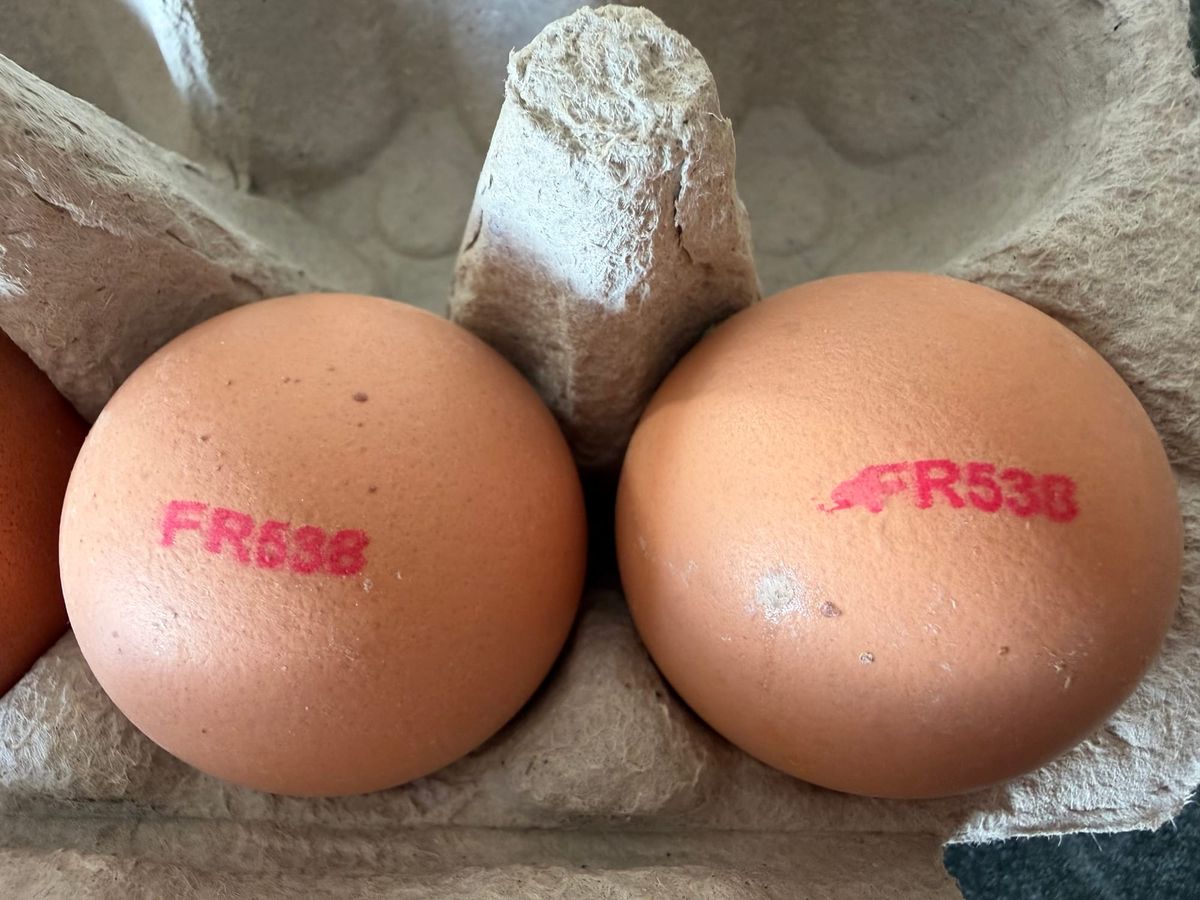
There's a small ink stamp on most eggs sold in New Zealand supermarkets. Five characters. Something like FR538 or BN109. You might have noticed it and wondered what it meant. Or never thought about it at all.
It's part of a programme called Trace My Egg. Enter the code at tracemyegg.co.nz and you'll find the farm name, its location, and how the eggs were produced. It's a genuinely useful thing to be able to do. But the programme has a more complicated story underneath it — one worth understanding before you decide how much weight to put on that little stamp.
Where it came from
Trace My Egg launched in mid-2019, run by the Egg Producers Federation of New Zealand (EPF) — the national industry body that represents commercial egg producers. The EPF was formed in July 1989 and is a mandatory body: any person or organisation that buys 100 or more day-old layer chicks automatically becomes a member, with funding collected through a levy built into the price of those chicks. Its membership spans the full spectrum of farming methods — free-range, organic, barn, and colony cage — and extends beyond farmers to hatcheries, rearers, and affiliated industry suppliers.
The timing of the programme wasn't coincidental. In the years before, New Zealand's egg industry had been through a serious credibility crisis.
In 2017, the Palace Poultry case broke. A Newsroom investigation revealed that millions of eggs sold in Countdown supermarkets under the Palace Poultry free-range brand were likely laid by caged hens. The Ararimu farm in South Auckland, run by Aaron and Terry Fletcher, didn't have enough hens to supply the volume it was selling. Surveillance footage and invoices obtained by Newsroom showed Fletcher collecting pallets of caged eggs from wholesaler Eco Foods Ltd in nearby Bombay. The Commerce Commission referred the case to the Serious Fraud Office due to the scale of the alleged offending. Countdown immediately pulled the brand from shelves.
The supply chain implications reached further. Woodland and Farmer Brown — both owned by Zeagold, a subsidiary of Mainland Poultry — had purchased eggs from Palace Poultry, believing them to be free range. Zeagold pulled all Palace Poultry stock from its supply chain the moment the SFO investigation was revealed, describing it as a betrayal. Less than 3% of Woodland eggs had come from Palace Poultry. Zeagold, like Countdown, was a victim of supplier fraud rather than a participant in it. The Fletchers denied all allegations. The SFO investigated for nearly twelve months and ultimately concluded that the evidence was not of a high enough standard to lay charges. No charges were brought, and the case did not proceed to court.
For consumers, the damage was wider than any single brand. The egg aisle, which had been expanding its free-range offer for years, suddenly looked unreliable at its foundations. There was no legal definition of free-range in New Zealand. There was no egg-level traceability. Those were the gaps the Palace Poultry case exposed.
The EPF's executive director at the time, Michael Brooks, was direct about what prompted the programme: "A few bad eggs have threatened [the industry's] reputation in recent years. To help prevent this from reoccurring we have purpose-built a programme specifically for New Zealand that provides consistent source assurance across the industry."
Trace My Egg was the industry's answer to the fraud problem. That context matters.
Who runs it, and who pays for it
The programme is owned and operated by the Egg Producers Federation (EPF). Founded in July 1989, the EPF is a mandatory industry body — membership is automatic for anyone who buys 100 or more day-old layer chicks, funded through a levy built into the price of chicks. It represents producers across all farming methods: free-range, barn, organic, and colony cage. Sixty percent of the EPF's levy income funds Eggs Incorporated — a separate marketing organisation whose sole purpose is to promote egg consumption to New Zealand consumers. You may have seen its work: the "Egg a Day" campaign, nutrition messaging, school education programmes, and media releases defending eggs against health concerns. The remaining forty percent funds the EPF's industry representation and operational work, which includes Trace My Egg. The same money pool, in other words, funds both the industry's generic marketing arm and its traceability programme.
The EPF's current executive director is Fiona MacMillan, who also holds the same role across the Poultry Industry Association of New Zealand and the NZ Feed Manufacturers Association — three industry bodies, one executive director. The EPF appointed AsureQuality — New Zealand's state-owned food safety and assurance company — to conduct random spot checks on participating farms, in addition to the regulatory verification all egg producers must comply with under MPI.
The brands currently in the programme
As of 2026, the official participating brands listed on tracemyegg.co.nz are seventeen. But the ownership picture collapses that number fast — as we found when we mapped the egg aisle.
Mainland Poultry / Zeagold — Dunedin-based, majority-owned by Asian private equity firm Navis Capital. Produces roughly a third of New Zealand's eggs.
Better Eggs — van der Heyden family, fourth generation, Waikato. Claims close to 30% of major supermarket sales.
IEP Co-operative — Independent Egg Producers Co-operative, NZ's second-largest producer group, family farms across North and South Island. Founded 1920, headquartered in Nelson.
Woolworths NZ private label
- Woolworths (in-store brand)
- Macro (Woolworths NZ organic label)
Independents
- Chester Road — Wairarapa family farm, grass-based compostable packaging; sold through distributors, no dedicated website found
- Hawke's Bay Eggs — family operation, Hawke's Bay
- Local Yolkels — Hawke's Bay and Bay of Plenty, Foodstuffs supermarkets
- Ottos — limited information publicly available
- Quail Valley — Ewing Poultry, Nelson; free-range, organic, and barn eggs, SPCA Certified
- Wairarapa Eggs — free-range, Wairarapa
- Waitawa Creek Eggs — free-range, Auckland region
So of the 17 brands, roughly ten are produced by just four corporate or cooperative groups. The independent names are the ones most likely to represent genuinely distinct farming operations — and several of them are worth knowing about in their own right.
Between Mainland/Zeagold and Better Eggs alone — the two largest producers — the majority of what's on a typical supermarket egg shelf is accounted for. Add IEP as the industry's self-described number two producer and the picture sharpens further: three groups dominate, with genuine independents sharing whatever remains.
How to read the code on your egg
The five-character stamp breaks into two parts. Simple once you know the logic.
First two letters — production methodFR— Free RangeBN— BarnOR— Organic (the letter O, not the number zero)CL— ColonyLast three digits — farm identifier, issued by the EPF. Each participating farm gets its own unique number. If a producer owns multiple farms, each farm gets a different code.
SoFR247means: free-range eggs, from the farm registered as number 247. Enter that code at tracemyegg.co.nz and you get the farm name and location.
Some producers print extra characters beyond the five digits — a shed number, for instance — but that's optional and not part of the Trace My Egg system. Only the five-digit code matters for tracing.
One anti-fraud detail worth knowing: stamping must happen on the farm itself. Eggs cannot be re-stamped once they leave. That's the key mechanism introduced after Palace Poultry — in that case, caged eggs arrived at a property in unmarked packaging and were simply repacked into free-range cartons. A stamp on the shell at the point of lay makes that swap much harder to execute invisibly.
How old are those eggs when you buy them?
The best-before date is the first thing most people look at. It tells you less than you might think — and more than the industry necessarily wants to draw attention to.
Under MPI regulations, eggs get a 35-day best-before date starting from the day they're laid. That's the maximum shelf life claim. Which means the arithmetic works like this: if you pick up a carton with two weeks left on the best-before date, those eggs are already 21 days old.
Supermarket eggs are not necessarily old. Most commercially produced eggs reach supermarkets within a few days of being laid, according to the industry's own figures. But the best-before window is long enough that the journey from farm to shelf to your fridge can span weeks — and the label gives you no way to know where in that window you're buying.
There is no requirement in New Zealand to print a laid-on date or a packed-on date on egg cartons. The best-before date is the only date marker required by law. To work out how old an egg actually is at the time you buy it, you'd need to count back from the best-before date. If the date is 35 days from laying and you have 10 days left, the eggs were laid 25 days ago.
The float test is a practical shortcut. Place an uncracked egg in a glass of water. Fresh eggs lie flat on the bottom. As an egg ages, air seeps in through the porous shell and the air cell at the base enlarges — so older eggs tilt upright, and very old eggs float. A floating egg isn't necessarily unsafe to eat but it warrants a smell test before you use it.
For cooking purposes, age actually matters differently depending on what you're making. Fresher eggs poach and fry better — the white is tighter and holds its shape. Older eggs peel better after hard-boiling because the white separates more cleanly from the shell. If you're baking a cake, age is largely irrelevant.
The freshness question is one place where small independent producers and direct-from-farm operations have a genuine advantage. An egg bought directly from a farm or a farmers' market is typically days old, not weeks. That's a real difference you can taste in a poached egg.
What the stamp actually tells you
The five-digit code breaks into two parts. The first two letters indicate production method: FR for free-range, BN for barn, OR for organic, CL for colony. The three digits that follow are a unique farm code issued by the EPF.
Look up the code and you get: farm name, farm location, production type, and usually a link to the farm's own website.
That's it.
What the stamp does not tell you: stocking density, how many hours per day hens have outdoor access, what the hens are fed, flock size, or any measure of actual on-farm welfare beyond the broad production category. The code confirms where your egg came from and how it was classified. It doesn't tell you much about what life on that farm looks like.
The production categories themselves are defined by the Animal Welfare (Layer Hens) Code of Welfare 2018, not by Trace My Egg. So "free-range" in the stamp means the farm meets the legal minimum for free-range classification. It doesn't mean pasture-raised, or high welfare, or anything beyond the code's baseline requirements.
The real conflict of interest question
The brands most prominently affected by the Palace Poultry case — Farmer Brown and Woodland — are now listed as Trace My Egg participants and carry the programme's logo on their cartons. As established above, Zeagold was found to be a victim of that fraud rather than a participant. But the case still raises a structural question: the programme is administered by the industry body that also represents those brands. The EPF's mandate is to protect and promote the industry's commercial interests. The auditing function has been contracted out to AsureQuality, which provides some separation. But the programme's governance, communications, and participation rules are all set by the industry itself.
This is a common model in New Zealand food. It's worth being clear-eyed about what it means: Trace My Egg is an industry assurance programme, not an independent certification. The difference matters for how you interpret it.
What's not in the programme
Some of the most reputable egg producers in New Zealand aren't on the Trace My Egg list.
Frenz — the country's largest organic free-range producer — isn't there. Neither is Wholesome NZ, Otaika Valley, or most of the smaller certified organic operations sold through specialty stores. Several of those hold BioGro certification, SPCA certification, or AsureQuality Certified Organic status — third-party certifications that many would argue involve more rigorous welfare and production scrutiny than a traceability stamp does. If you want to understand what organic certification actually requires, we've covered that separately.
Their absence from Trace My Egg doesn't signal anything negative about those brands. It signals that the programme isn't the full picture of egg accountability in New Zealand. It's one system, adopted mainly by mainstream supermarket supply chains.
Where the programme adds genuine value
It's easy to be cynical about an industry running its own assurance scheme, but there are real things Trace My Egg does that matter.
Before the programme, a consumer buying free-range eggs had no way to verify which farm those eggs came from. Cartons could aggregate eggs from multiple farms — some of which might have been cutting corners — with no visibility at the egg level. The stamp changed that. Each egg now has a code traceable to a specific property. If fraud is occurring at farm level, the stamp creates a paper trail that makes investigation more tractable.
The combination of MPI's regulatory verification plus AsureQuality spot checks is also a genuine deterrent. It's not foolproof — the Palace Poultry case shows that supply chain fraud can be sophisticated — but it raises the cost of doing the wrong thing.
For consumers who want to know where their supermarket eggs come from, it's a real tool. Entering a code and finding yourself on a farm's website in Northland or Wairarapa — with a name, a family story, a photo — is meaningfully better than nothing.
How to use it
Trace My Egg is worth using. But use it for what it actually is: a source-tracing tool, not a welfare certification.
If you scan a code and find a small independent farm with outdoor access and a working website, that's useful information. If the code resolves to a major corporate producer with a hundred thousand birds across multiple sheds, you know the context of the egg you're holding.
The stamp tells you origin and classification. For anything deeper — stocking density, feed quality, genuine outdoor access, farming philosophy — you need to look at the farm's own information, or at third-party certifications like SPCA Certified or BioGro that exist separately and address different questions. The Egg Is Not Simple goes into what those differences actually mean nutritionally and ecologically.
The small ink mark on your egg is a starting point. It's not the whole answer.
Organic Food Together is building a complete guide to NZ egg brands — farming methods, certifications, ownership, and how to read what the labels are actually saying. In the meantime, browse all our egg coverage here.
This article is part of OFT's eggs series. The full guide to New Zealand's better egg producers — sorted by how they farm, with regional buying tips — lives at Eggs in New Zealand.