The Cheese Decision: Calf Rennet and Conventional Milk, or Lab Rennet and Organic?
I went looking for cheese set the old way, with calf rennet, and walked into a trap. At the supermarket the traditional enzyme comes with conventional milk, and the clean organic milk comes with the lab one. Which sent me past the rennet entirely, to what's in the milk.
I went looking for cheese set the old way, with calf rennet, and walked straight into a trap. At the supermarket the traditional enzyme comes with conventional milk, and the clean organic milk comes with the lab enzyme. You can't buy both in the same block. Which sent me past the rennet entirely, to the thing the label never mentions: what actually goes into the milk.
Here's a problem I didn't expect to have.
I wanted cheese made the old way. Real rennet, the kind from a calf, the way it's been done for thousands of years, because I'd come to think the lab-grown enzyme that sets most modern cheese loses something. Fine. Simple preference. I'll just buy the traditional one.
Except it isn't simple, and the reason it isn't is the whole story.
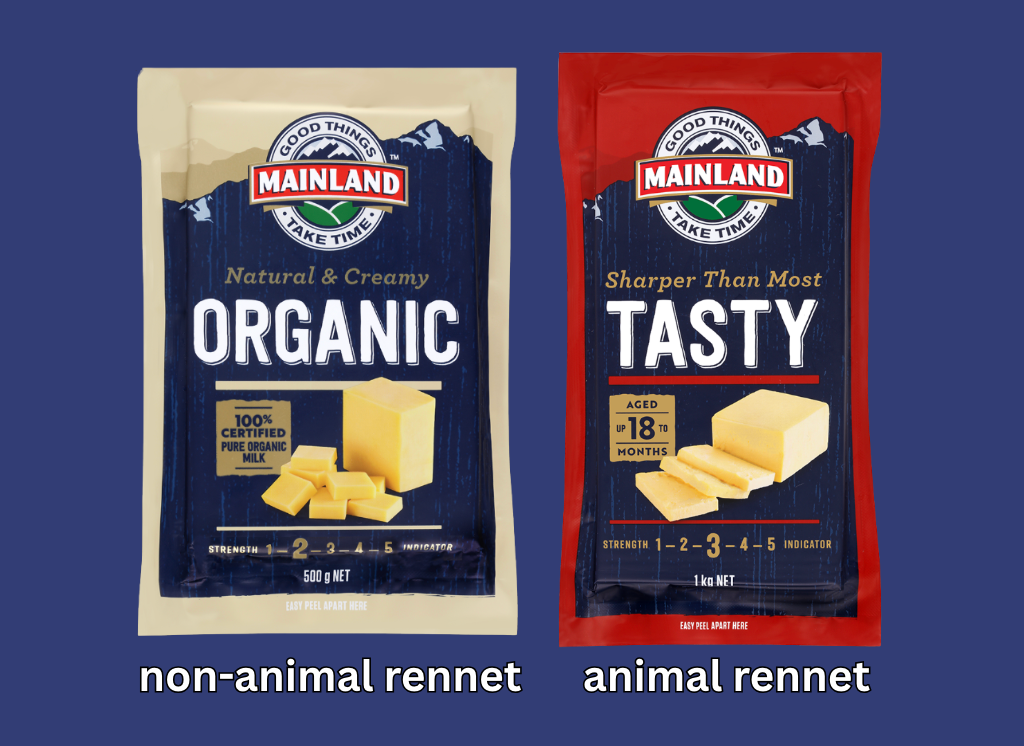
Take Mainland, because it lays the trap out in the open. Their conventional Tasty cheddar is set with animal rennet. Calf rennet, the traditional kind, kept deliberately because it ages and develops flavour in a way the lab version doesn't. So that's my cheese, surely. Except the milk in it is conventional. Their certified organic block, the one with the clean milk, is set with non-animal rennet, the lab enzyme I was trying to avoid.
So the choice on the shelf is this. Traditional enzyme, conventional milk. Or lab enzyme, organic milk. The two things I'd want in one cheese, the old rennet and the clean milk, are split across two different products, and I have to pick which compromise I can live with.
That's annoying. It's also the most useful question this whole rennet rabbit hole has thrown up, because answering it means ignoring the rennet almost entirely and looking at the thing nobody puts on the front of the packet: the milk.
The rennet was never the important part
Start with the enzyme, just to get it out of the way, because it turns out to be the small variable.
The lab rennet, fermentation-produced chymosin, is the same protein as calf chymosin, sequence for sequence. The amount in the finished cheese is tiny, and most of it is spent or removed in the making. The honest difference, the one that holds up, is at the edges: calf rennet isn't pure, it carries supporting enzymes that keep working through a long ageing and build flavour, which is exactly why a serious aged cheddar still benefits from it. Real, but it's a flavour question on long-aged cheese, not a health one.
So if you're choosing on flavour for a properly aged block, the calf rennet has an argument. If you're choosing on what's good for you, the rennet is close to a rounding error. Which means the moment the question becomes "which is better for me," the rennet stops mattering and the milk takes over completely.
And the milk is where everything actually is.
What goes into conventional milk
Here's the part the label never tells you, and it's the reason "conventional milk" is doing far more work in that sentence than it looks.
A litre of conventional New Zealand milk is the output of a system with a lot of inputs, almost none of which appear anywhere on the carton or the cheese. The big one, the one most people have never heard of, is palm kernel.
New Zealand imports around two million tonnes of palm kernel expeller every year, a by-product of South East Asian palm oil, to feed dairy cows when pasture runs short. That's roughly NZ$800 million a year, and New Zealand imports more of it than the entire European Union. It's so normal in the industry that it's just called PKE, and the average shopper has no idea their milk runs partly on it.
It's not benign. Research analysing batches imported into New Zealand found concentrations of iron, magnesium and phosphorus that exceeded safe levels for dairy cattle, with some batches near the limits for aluminium, copper, sulphur and potassium, and no monitoring of any of it. The composition changes load to load. There's evidence those elements, eaten by the cow, can end up in the milk, though the actual effects on milk are not yet known. Even the big processors are wary of it: Fonterra and Synlait actively discourage PKE because it changes milk composition, raising the fat content, yet it stays widely used because of feed shortages. And that's before the part that has nothing to do with the cow at all: palm oil production is tied to tropical deforestation in Indonesia, and an Indonesian government audit in 2018 found 81% of palm oil plantations were breaching environmental regulations.
So the first invisible input in conventional milk is a variable, unmonitored, imported industrial by-product linked to rainforest clearance. None of which is on the label, because feed isn't a labelled ingredient.
Then there's the paddock. Conventional dairy runs on synthetic nitrogen fertiliser to push grass growth, the same nitrogen that ends up as nitrate in waterways and sits at the centre of New Zealand's freshwater problem. There's the routine animal-health layer: conventional cows can receive antibiotics, including dry-cow therapy given across a herd at the end of lactation, and other synthetic treatments as needed. And the feed can include other imported supplements, some GM, the same GM soy and corn story that runs through the chicken and pork on this site.
Stack it up and "conventional milk" means: possibly PKE-supplemented, grown on synthetic nitrogen, from a system that permits routine antibiotics and GM feed. That's not a scandal and it's not unsafe. It's just a great deal more than the word "milk" implies, and you can't see any of it.
What organic certification actually does
Now the other block, the organic one, the one with the lab rennet I didn't want.
Organic certification is often sold as a vibe. It isn't. It's a specific list of things that are no longer allowed, and the list maps almost exactly onto the invisible basket above. Under New Zealand's framework, organic production avoids or excludes synthetic fertilisers and pesticides, antibiotics, growth promotants, genetic modification and irradiation. BioGro, the main certifier, requires a minimum of three years of compliance before a farm is certified at all, and animals are fed a natural diet with outdoor access and raised without synthetic growth hormones or antibiotics. Every input bought in has to be checked: producers must obtain organic status declarations for purchased inputs or confirm they're free from prohibited substances.
Read that against the conventional list and the picture flips. The synthetic nitrogen: not allowed. Routine antibiotics: not allowed. GM feed: not allowed. PKE: a conventional palm-oil by-product that can't clear the input rules, so it's out too. The whole basket of stuff you couldn't see in the conventional milk is the precise basket certification removes.
So the organic block isn't "the same cheese but pricier." It's a different milk, produced under a system that bans most of what's invisibly in the conventional one. The lab rennet sitting in it is, by a wide margin, the least industrial thing about it.
So which one do you actually buy
Lay it out honestly and the answer stops being about rennet at all.
If you're choosing on what's better for you and the land, the organic block wins, and it isn't close. The milk is where the inputs are, and organic certification is a three-year-audited promise to keep the worst of them out. The lab rennet you're trading for that is the same molecule as calf rennet, just purer. You give up a small flavour edge on the enzyme to lose the entire hidden basket in the milk. That's a good trade.
If you're choosing on flavour for a long-aged cheese, the calf-rennet block has a real argument, and there's no shame in it. The traditional enzyme does something in a mature cheddar the lab one doesn't. Just know that you're buying the better enzyme attached to the less clean milk, and that the milk is the bigger variable by far.
And if you want both, the old enzyme and the clean milk, the supermarket simply can't sell it to you. Mainland's two blocks are the trap in miniature: pick your compromise. To escape it you have to leave the supermarket entirely, and that's the third option.
The way out is the hard way
A small organic or traditional cheesemaker can do the thing Mainland's range can't: calf rennet and clean milk in the same cheese. They're not choosing between two mass-market compromises. A certified organic farmhouse maker using traditional animal rennet gives you the old enzyme and milk produced without the basket, in one block.
The catch is the one this whole site keeps running into. They're hard to find. They're rarely in the supermarket. You have to go looking, at a farmers' market, a good independent grocer, direct from the maker, and you'll pay more, and you can't do it on autopilot in the dairy aisle. The moment you want both things at once, the convenient option disappears and you're pushed to the edges of the food system, which is exactly where the people doing it properly have always been.
That's not a counsel of despair. It's just the actual shape of it. The supermarket will sell you a clean enzyme or clean milk, one or the other, conveniently. The whole thing in one block is available, but only if you're willing to make it a small mission. Most weeks you won't, and the organic block is the better default. Some weeks it's worth the trip.
The cheese was never simple. The rennet was just the thing that made me turn the milk over and look.
Before you go
This is the kind of thread OFT pulls most days: start with one ordinary thing on the shelf, turn it over, and follow it back to what's actually in it and who decided. Free to read. No ads. Nothing behind a wall.
If that's your thing, let the next one find you.
Or back the work directly. A one-off $10 keeps the digging going. No account, no subscription.
Related reading from OFT:
- What Is Non-Animal Rennet, and Is It in Your Cheese? — the enzyme itself, and how to read it on a label
- Mainland Organic Cheese: Is Non-Animal Rennet Legit? — the block that lays the whole trap out in the open
- The Real Food Map — where the small makers are, the ones who can give you both at once