What Is Non-Animal Rennet, and Is It in Your Cheese?
Most non-animal rennet in cheese now comes from a handful of global biotech firms, chiefly Novonesis and dsm-firmenich. Here's what fermentation-produced chymosin actually is, how Pfizer first got it approved, and why a process this industrial stays nearly invisible on the label.
Short answer: non-animal rennet is the enzyme that sets most modern cheese, made by fermentation instead of taken from a calf's stomach. Lab-grown microbes produce chymosin, the same curdling enzyme found in traditional animal rennet, so the milk sets the same way without an animal. Industry estimates put it at 80 to 90 percent of commercial cheese in the United States and Britain, and it holds most of the global rennet market. On a New Zealand label it shows up as "non-animal rennet" or just "enzymes." Here's what that actually means, and which cheeses on the shelf here use what.
Cheese is supposed to be one of the simple ones.
Milk, cultures, salt, time. Four things and patience. It's the food people reach for when they want something that feels older and steadier than the rest of the trolley.
Then you turn the block over and read "non-animal rennet," and the simple food has a line in it that nobody explains.
So here is the explanation. What rennet is, what the non-animal version actually is, how common it really is, how to read it on a label here, and the part most coverage skips: which New Zealand cheeses use which, and how many companies won't tell you.
What rennet does
Milk doesn't become cheese on its own. Left alone it sours, but it won't set into a firm curd you can press, age and slice.
The thing that makes it set is an enzyme called chymosin. Its one job is to cut a single milk protein, casein, at one precise spot. Make that cut and the milk separates: solid curds on one side, liquid whey on the other. Everything that follows, cheddar, gouda, brie, parmesan, starts from that one snip.
For thousands of years that enzyme came from one place: the stomach lining of young calves. Calves produce chymosin to curdle their mother's milk. Cheesemakers took the fourth stomach of a slaughtered calf, dried and salted it, and used it to set milk. That is animal rennet. It is the traditional method, and it is exactly as it sounds.
Where the lab version came from
Calf rennet has a problem built into it. The supply depends on how many calves are being slaughtered, which depends on the dairy and meat cycle, which has nothing to do with how much cheese the world wants. As cheese demand grew, the enzyme couldn't keep up.
In the 1960s, cheesemakers started using rennet from certain moulds and fungi instead. This is microbial rennet, and because no animal is involved, it made cheese that vegetarians could eat. It worked, though it could leave a faintly bitter edge in long-aged cheese.
Then in the late 1980s the real shift arrived. Biotech companies took the calf gene that codes for chymosin and inserted it into microorganisms, microbes that could then be grown in fermentation tanks and made to produce the enzyme on demand. The microbe does the calf's job. The enzyme it makes is chymosin, the same molecule, just grown in a tank instead of a stomach.
This is fermentation-produced chymosin, FPC, and it is what "non-animal rennet" almost always means on a modern label. It removed every limit calf rennet had. No slaughter cycle, no seasons, no ceiling. Cheese stopped being a biologically constrained product and became an industrial one that scales as far as the milk supply allows.
One detail worth holding onto, because it matters for how organic certification treats it. The microbe that makes FPC is genetically modified. The enzyme it produces is then harvested and purified, and the final ingredient contains no GM material. The production organism is GM; the thing that ends up in your cheese is not. The standards lean hard on that distinction, which is a story in its own right, and one I got into with a specific block of supermarket cheese in Mainland Organic Cheese: Is Non-Animal Rennet Legit?
How common is it, really
You will see "80 to 90 percent" quoted for this almost everywhere, usually with no region and no date attached. It is worth pinning down, because the number is older and narrower than the way it gets used.
The 80 to 90 percent figure traces back to a 2008 estimate supplied by the culture houses themselves, and it described cheese in the United States and Britain, not the world. Shelburne Farms, a Vermont cheesemaker, sets it out that way. The Vegetarian Resource Group's 2012 update put United States commercial cheese production at about 90 percent FPC, based on estimates from enzyme companies and dairy groups, up from around 70 percent in 2007. Chemistry World gives roughly 90 percent of the rennet used in UK and US cheese, particularly in hard cheeses like cheddar.
Globally the picture is softer. A 2016 paper in the peer-reviewed literature puts chymosin coded from the calf gene at more than 70 percent of the global chymosin market, with 80 percent of that made recombinantly. The Oxford Companion to Cheese will say only that FPC is used in a significant majority of commercial cheese.
So the honest version is this. In the United States and Britain, 80 to 90 percent, on figures now well over a decade old. Worldwide, most commercial cheese, on a market share that is high but less precisely counted. Nobody publishes an audited global number, because the people who would know are the four or five companies selling the enzyme.
That vagueness is itself part of the story. A production method used in the overwhelming majority of the world's cheese has no public statistic anyone can check.
How it reads on a New Zealand label
Here is where the transparency runs out.
On a New Zealand and Australian ingredient list, rennet is treated as a processing aid, not a primary ingredient, under the Food Standards Code. That classification does a lot of work, because processing aids carry far lighter disclosure rules. The result is that a profoundly different production method can hide behind two of the vaguest words on the packet.
What you'll see is one of these:
- "Non-animal rennet" — almost always fermentation-produced chymosin, made by a GM microbe.
- "Enzymes" — could be FPC, could be microbial. The word tells you nothing.
- "Animal rennet" — the traditional calf-derived kind. When a company uses this, they usually say so, because for some cheeses it's a selling point.
- "Vegetable rennet" or "microbial rennet" — the fungal kind, no animal, no GM microbe.
The source, animal, microbial or fermentation, is not required on the label. So a cheese can be the product of precision biotechnology and read like it came off a farm in 1950, and both descriptions are technically honest.
Which NZ cheeses use what
This is the part nobody quite pins down, and now you can see why. The label won't tell you, and the law doesn't make the maker tell you either. So the only way to know is to ask the companies directly, and when people have, the answers split into three groups.
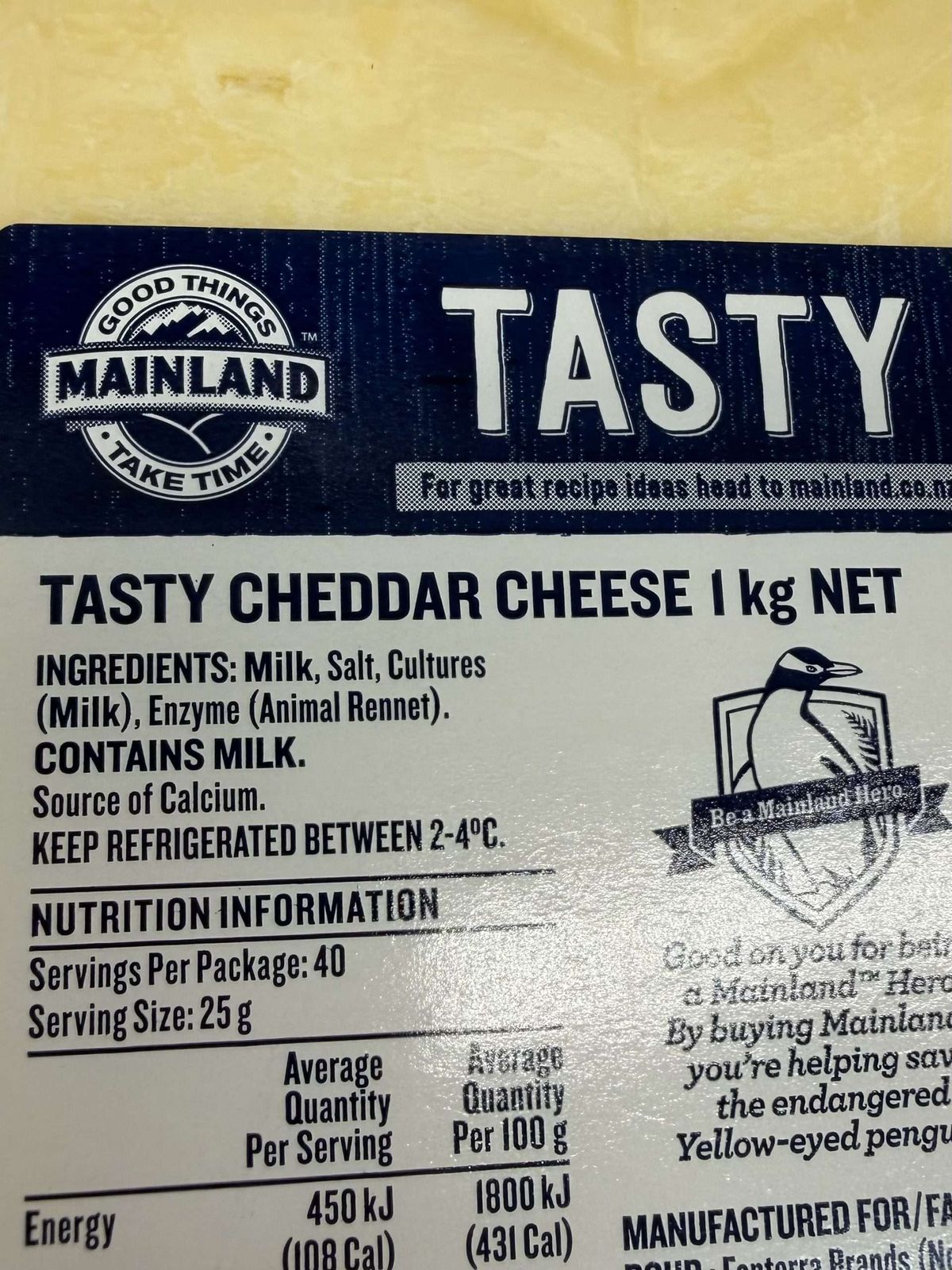
The ones that tell you. Mainland publishes it on their own FAQ: most of their rennet is microbial and vegetarian, but they still use animal rennet in a few products. Their conventional Tasty cheddar is set with calf rennet, and they say so on the label, because the traditional enzyme ages and develops flavour in a way the lab version doesn't. Their certified organic block, by contrast, uses non-animal rennet and carries the Suitable for Vegetarians mark. Same company, same factory heritage, opposite enzymes, sorted by who buys each product. I pulled that thread all the way through in the Mainland Organic piece, and it's the cleanest example of the whole tension on one shelf.
Fonterra's ingredients arm, which supplies a great deal of the cheese sold here, states the same pattern in plainer terms on its own site: most of its cheese is made with vegetarian rennet, with animal rennet used to suit requirements.
The ones that won't. When New Zealand researchers and food writers have rung around asking which rennet each brand uses, a striking number simply declined to answer.
Two write-ups of that exercise exist, and both come from sources with a position, so treat the detail as a lead rather than a settled fact. A 2025 enquiry published by the Hatchard Report, a site that campaigns against gene technology in food, reported that Whitestone in Oamaru, Mahoe in Northland and Hohepa in Hawke's Bay all said they use microbial, plant-based rennet rather than fermentation chymosin; that Barrys Bay in Canterbury said it uses fermentation chymosin exclusively; and that Mainland, along with Goodman Fielder, which makes Puhoi and Ornelle, would not give a clear answer. A separate consumer enquiry by Green Goddess, an online retailer that sells the alternatives, reported the same wall of silence from several brands, with only a couple willing to confirm what they use.
Neither of those is a source I would build a claim on alone, and I have not verified the individual answers. What I would stand behind is the pattern both describe, because it matches what the labels themselves show.
Sit with that for a second. A company knows exactly which enzyme it puts in its cheese. It is not a trade secret; it is an ingredient. When a customer asks and the answer is "no comment," that is a choice, and it is the most telling data point on this whole page. The cheeses that use the traditional calf enzyme tend to say so proudly. The cheeses that use the lab enzyme have every incentive to stay vague, because "non-animal rennet" sounds clean and "fermentation-produced chymosin from a genetically modified microbe" does not. Non-disclosure isn't neutral. It usually points one direction.
The supply shift underneath all of it. New Zealand has stopped making its own calf rennet. Renco, based in Eltham in Taranaki, has been extracting enzymes from animal tissue since 1923 and is a division of AFFCO, owned by the Talley's Family Group. Its rennet was the standard across the New Zealand industry and the one most home cheesemakers learned on.
Supply to the domestic trade dried up over the second half of 2024. The Auckland cheesemaking supplier Curds & Whey posted in September 2024 that Renco rennet was unavailable, then by October had switched to an imported Danisco microbial tablet. Christchurch supplier Urban Cheese now states plainly that New Zealand no longer manufactures animal rennet, with both the 65 IMCU and 280 IMCU calf rennets gone, and points to the collapse in global demand for natural calf rennet as the reason. Another New Zealand supplier dates the end of production to 2025.
As of August 2026 Renco's own website still lists rennet among its products, and I have not found a company statement confirming the closure, so the 2025 date rests on trade suppliers rather than the manufacturer. What is not in doubt is that the country's cheesemakers can no longer buy it. Quietly, a piece of the supply chain closed, the kind of thing that never makes the news but reshapes what ends up in the curd.
I'm not going to print a definitive brand-by-brand table here, because most of it would rest on phone calls I can't verify and answers companies could change tomorrow. What I can tell you is the rule that actually works at the shelf, below.
The vegetarian paradox
Here's the part that turns the whole thing on its head.
Most vegetarians eat cheese. Lacto-vegetarians, the most common kind, eat dairy by definition. Cheese is a staple. And yet traditional cheese, the old, simple, four-ingredient kind, is set with an enzyme taken from the stomach of a slaughtered calf. By the strict logic of vegetarianism, classic cheese was never vegetarian at all. A calf died to make it.
So how is there a "Suitable for Vegetarians" mark on cheese? Because of the lab.
The exact ingredient the natural-food world is most suspicious of, the GM-microbe fermentation enzyme, is the precise reason a block of cheddar can be vegetarian-friendly. Animal rennet is the "natural," traditional one, and it's the one with a dead calf behind it. The industrial, high-tech one is the one with no animal in it at all.
Read the shelf with that in mind and it gets genuinely strange. The shopper avoiding biotech reaches for the most traditional cheese and picks up calf rennet. The vegetarian avoiding the calf reaches for the cheese set by a genetically modified microbe. The "clean" choice and the "natural" choice are pulling in opposite directions, and the label that's supposed to help, "non-animal rennet," is the one doing the least to explain itself.
There's a flavour wrinkle too, and it's why Mainland keeps calf rennet in the Tasty. Animal rennet isn't a single purified enzyme. It carries supporting enzymes that keep working through maturation, breaking down proteins and fats, building the depth and sharpness you want in a long-aged cheddar. Fermentation chymosin is purified and consistent, which is ideal for scale but milder in the ageing. For everyday cheese the difference is small. For a serious aged block, the old calf method still wins on taste. So the traditional, less fussy product is sometimes the better-tasting one, and the premium, "cleaner"-sounding one is the biotech version. The paradox runs all the way down.
So what should you actually do at the shelf
There's one rule that survives all the vagueness:
If the source matters to you, the cheese has to tell you, and if it won't, assume the lab version.
- Want to avoid the GM-microbe enzyme? Look for "animal rennet," "vegetable rennet," or "microbial rennet" stated explicitly. If it just says "non-animal rennet" or "enzymes," it's almost certainly fermentation-produced chymosin.
- Vegetarian and want no slaughtered calf in it? Look for "non-animal rennet," "vegetarian rennet," or the Suitable for Vegetarians mark. The lab enzyme is your friend here, not your enemy.
- Want neither calf nor GM microbe? That's the narrow path: cheeses that state plant or fungal microbial rennet, like some of the smaller NZ makers who'll tell you. You'll usually have to go to the maker, not the supermarket block.
- Brand won't say? Treat the silence as an answer. A company proud of calf rennet says calf rennet. Vagueness is the FPC tell.
None of this makes any of these cheeses unsafe. Fermentation chymosin has been in the food supply since 1990 with no demonstrated harm, and it's classified as safe by every regulator that's looked at it. This was never really a safety question. It's a transparency one, which is the whole point of this site: not what's dangerous, but what you're not being told.
Sources
Figures and claims on this page, with their type and date, so you can check them yourself.
On how widespread FPC is
- Shelburne Farms on rennet — origin of the 80 to 90 percent figure, attributed to culture-house estimates, US and Britain, 2008.
- The Vegetarian Resource Group, 2012 — about 90 percent of US commercial cheese, from enzyme company and dairy group estimates.
- Chemistry World on chymosin — around 90 percent of rennet used in UK and US cheese.
- Recombinant chymosin research, 2016 — calf-gene chymosin at more than 70 percent of the global chymosin market.
- Oxford Companion to Cheese — FPC used in a significant majority of commercial cheese.
On New Zealand supply and company practice
- NZMP, Fonterra's ingredients arm — company statement on its own rennet use.
- Renco New Zealand and AFFCO — company history and ownership.
- Curds & Whey, September 2024 and October 2024 — trade supplier notices on Renco supply ending.
- Urban Cheese and All About Cheese — trade suppliers on the end of New Zealand calf rennet manufacture.
Treated as leads, not citations
- Hatchard Report — campaigns against gene technology in food.
- Green Goddess — online retailer selling alternatives.
Updated 10 August 2026: added sourcing and regional scope for the 80 to 90 percent figure, corrected and sourced the Renco supply account, and noted the standing of two secondary sources. If you spot something wrong, tell me and it gets fixed.
Before you go
You just read the back of the label so you didn't have to puzzle over it in the dairy aisle. That's the job here. One piece most days, pulling apart what's actually in New Zealand's food and who makes it. Free to read. No ads. Nothing behind a wall.
If that's useful, the easiest thing you can do is let the next one find you.
Or back the work directly. A one-off $10 covers the digging. No account, no subscription.
Related reading from OFT:
- Mainland Organic Cheese: Is Non-Animal Rennet Legit? — the whole tension on one supermarket block, and how a GM-made enzyme ends up in a certified organic cheese
- What does the organic label actually mean? — the four NZ certification bodies and what each one audits
- The Real Food Map — makers and shops where the supply chain is short enough to see the whole thing