Mainland Organic Cheese: Is Non-Animal Rennet Legit?
I bought a block of Mainland Organic Cheese this week. Then I turned it over and actually read the back. Non-animal rennet, in a certified organic cheese. Is that legit? The answer turned out to be more interesting than I expected.
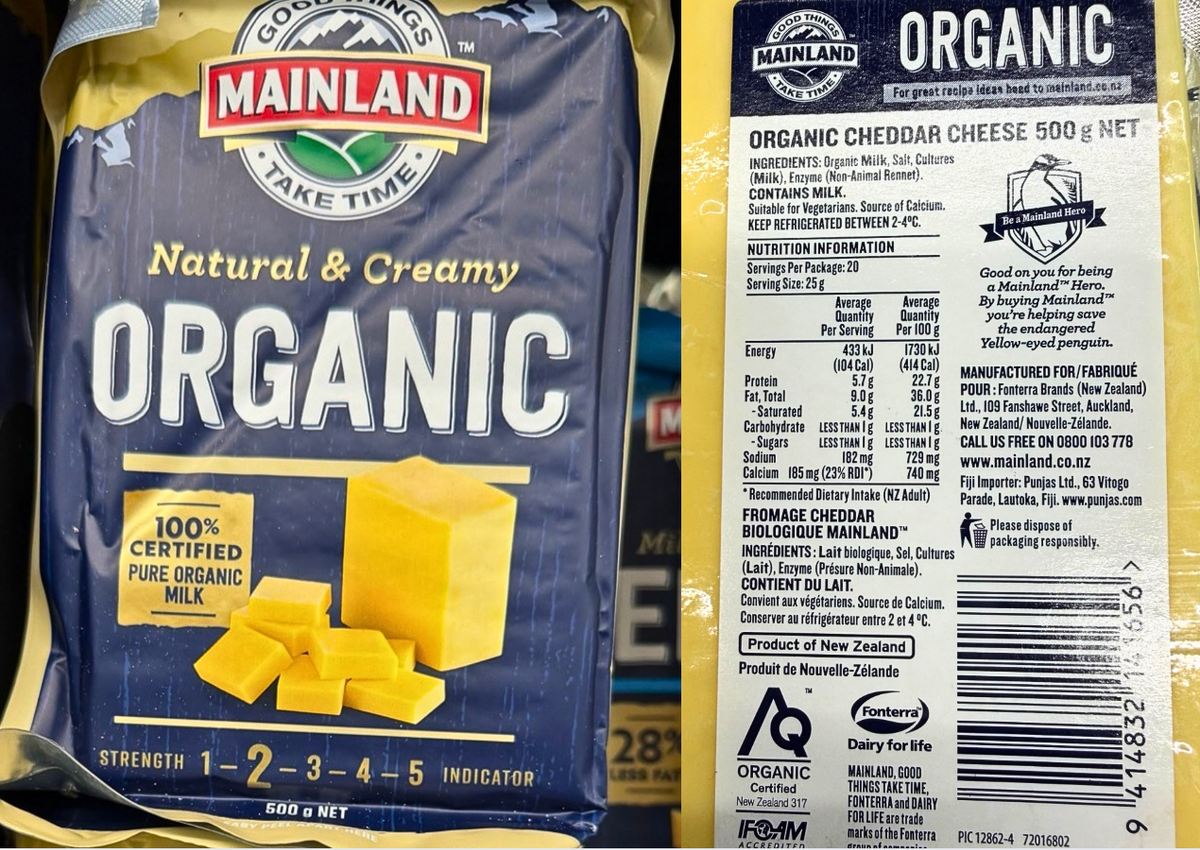
I bought a block of Mainland Organic Cheese this week. Same as I usually do. Navy blue block with the Mainland logo on top, the word organic across the front in big white letters, "Natural & Creamy" above it, "100% Certified Pure Organic Milk" on a tag in the corner. Into the trolley, home it goes.
Then I turned it over and actually read the back.
Organic Milk, Salt, Cultures (Milk), Enzyme (Non-Animal Rennet). And I stopped on that last one. Non-animal rennet. In a certified organic cheese. Is that legit?
The short answer is yes — by the standards, technically, it is. The longer answer is more interesting than I expected when I started looking into it, and it raises a question I don't think the organic label is really answering.
Because once you start looking at what is actually in this block, who makes it, what it costs and why, what it does to your body compared to the cheap stuff, and what that one small line near the bottom of the ingredient list actually means, the picture gets a lot more interesting than the front of the packet suggests.
What's in it
Mainland Organic Cheese is AsureQuality certified organic (New Zealand 317, IFOAM accredited), made from 100% organic milk sourced from New Zealand farms. The ingredient list is short: Organic Milk, Salt, Cultures (Milk), Enzyme (Non-Animal Rennet). It carries the Suitable for Vegetarians mark. It is currently manufactured for Fonterra Brands (New Zealand) Ltd, though that is changing — more on that in a moment.
The milk is the headline ingredient and the reason most people reach for it. Organic dairy in New Zealand means cows grazed on pasture managed without synthetic nitrogen fertiliser or routine herbicides, no palm kernel expeller as feed, no GM feed inputs, and an animal health approach that limits routine antibiotics rather than relying on them as standard practice.
For a country where conventional dairy is the dominant land use and the dominant export earner, having a certified organic cheddar in mainstream supermarkets is not nothing. It is the kind of normalisation the sector has been working toward for thirty years.
What it costs, and what conventional cheese costs
On New World's shelves right now, a 500g block of Mainland Organic is $15.49. That works out to $3.10 per 100 grams.
The first surprise is who it sits beside on price.
| Product | Size | Price | Per 100g |
|---|---|---|---|
| Mainland Organic | 500g | $15.49 | $3.10 |
| Mainland Vintage | 500g | $15.49 | $3.10 |
| Mainland Tasty | 700g | $13.89 | $1.98 |
| Mainland Mild | 500g | $8.99 | $1.80 |
| Mainland Edam | 1kg | $13.89 | $1.39 |
| Pams Tasty | 800g | $13.29 | $1.66 |
| Pams Colby | 1kg | $13.29 | $1.33 |
Prices from New World online, May 2026.
Two products sit at the top of the Mainland range — Organic and Vintage — both at $3.10 per 100g. Everything else is clustered well below, between $1.30 and $2.00 per 100g. The Organic is roughly 60 to 130 percent more than the everyday block, depending on what you compare it to.
So why is everyday cheese so much cheaper, and why does organic carry the premium?
Conventional NZ dairy gets more milk per cow and more cows per hectare than organic. Synthetic nitrogen fertiliser grows more grass, more grass feeds more cows, more cows produce more milk on the same land. Organic systems cap stocking rates at what the land can carry without synthetic inputs. Less milk per hectare means a higher cost per litre at the farm gate before anything else happens.
Conventional NZ dairy also uses palm kernel expeller as a supplementary feed at industry scale — some farms more than others, with Fonterra working to reduce it over recent years, but the supply chain as a whole still depends on it. PKE is cheap, calorie-dense, and a by-product of Indonesian and Malaysian palm oil production. It is also one of the inputs most associated with NZ dairy's environmental and ethical problems offshore. Organic certification prohibits it. Organic cows eat pasture and certified organic supplementary feeds, which cost considerably more per kilogram of milk produced.
Then there are the inputs organic farming doesn't use at all. Synthetic nitrogen on pasture. Glyphosate and other herbicides for pasture renewal and weed control. Antibiotics including dry-cow therapy, and parasite drenches. Each of these lowers the cost of producing conventional milk. Each is prohibited or tightly restricted in certified organic systems.
On top of that, organic farms carry the cost of certification itself — annual fees, audits, paperwork, and a three-year transition period during which the farm has to be farmed organically but the milk cannot yet be sold as organic. And the whole organic supply chain runs at smaller scale, with separate collection runs and separate processing windows.
That is the official version of why organic costs more. There is a less comfortable version too. Conventional dairy is cheap partly because some real costs are externalised — soil compaction, nitrate leaching into Auckland's drinking water and rivers right across the country, methane and nitrous oxide emissions, deforestation pressure offshore from PKE, animal health interventions that organic systems prevent through different management. The price of the cheap block does not include cleaning up the Waikato River. The price of the organic block reflects more of what it actually costs to produce milk without leaving a bill for someone else to pay.
Both versions are true. The price gap is real, and so are the reasons for it.
Is it actually better for you?
This is the question I think most shoppers want answered, and the honest answer is yes — with one important caveat.
The biggest difference is the fat profile. The most thorough work on this is a 2016 systematic review out of Newcastle University, published in the British Journal of Nutrition, which pulled together 196 studies on milk composition from around the world. It found that organic milk and dairy contain around 50% more omega-3 fatty acids than conventional. A separate US-wide study in PLOS One found organic milk contained 62% more omega-3 and 25% less omega-6, giving a much better omega-6 to omega-3 ratio — 2.28 in organic versus 5.77 in conventional.
That ratio matters. Modern Western diets are heavily skewed toward omega-6 from seed oils and grain-fed animal products, and the imbalance is linked to chronic inflammation, cardiovascular disease, and a range of metabolic problems. Organic dairy nudges the ratio in the right direction without adding calories or saturated fat.
Organic dairy also tested higher for conjugated linoleic acid (CLA), vitamin E, and iron. These differences are not enormous, but they are real and they are consistent across studies.
The mechanism is straightforward and worth being honest about. The differences come from what the cows eat. Pasture-fed cows produce milk with more omega-3 and CLA than grain-fed cows. Organic certification effectively forces pasture-based feeding by prohibiting PKE and restricting grain. Conventional pasture-fed cows would show some of the same advantages — the certification isn't the only path to the result — but in practice, organic is the only certified, verifiable signal a NZ shopper can use to know how the cows were actually fed.
The caveat. Organic milk has been shown to contain less iodine than conventional. Iodine deficiency is a real and documented public health issue in New Zealand — it is why iodised salt is recommended and why bread fortification has been debated for years. The difference comes from conventional dairy supplementing cow feed with iodine, and from conventional teat sanitisers containing iodine that carries through into the milk. If you eat varied food, get iodine from seafood, eggs and iodised salt, and don't rely on dairy as your main iodine source, this is unlikely to matter for you. If you live mostly on cheese and milk, it is worth knowing.
There is also the question of what organic dairy doesn't contain. No glyphosate residues from sprayed pasture. No antibiotic residues from routine herd treatment. No metabolites from PKE-based feed regimes. The health significance of any of these in trace amounts is debated, but the absence is itself worth something to many shoppers, and it is part of why people pay the premium.
So: yes, the organic block is better for you. The fat profile is meaningfully better, and the things organic certification removes are real. Just don't let it be your only source of iodine.
The rennet question, in two halves
Now back to the line on the back of the packet.
Cheese needs an enzyme to separate milk into curds and whey. Traditionally this came from the stomach lining of young calves and was called animal rennet. Today most commercial cheese uses something different. The label calls it non-animal rennet. What that almost always means is fermentation-produced chymosin — FPC for short, where chymosin is the specific enzyme that does the curd-cutting work. It is a laboratory-produced version of the same enzyme calves carry in their stomach lining, made by genetically modified microorganisms grown in fermentation tanks. The microbe carries the calf gene that codes for chymosin. The enzyme is then harvested and purified. The final ingredient contains no GM material, but the production organism is GM. I have written about this in more detail in Non-Animal Rennet in Cheese if you want the longer version.
Here is the strange part. Mainland uses animal rennet in their conventional Tasty cheddar. The ingredient list reads: milk, salt, cultures, enzyme (animal rennet). Same brand, same factory tradition. In their certified organic block, they use non-animal rennet — almost certainly FPC.
So a shopper standing in front of the Mainland shelf is looking at two blocks made by the same company. The conventional one contains calf-derived enzyme and nothing made by a GM organism. The organic one contains an enzyme produced by a GM microbe. If your only concern were GM and nothing else, the conventional Tasty would be the cleaner product on that single dimension.
Nobody buys cheese on a single dimension. But it is worth noticing.
Why the split exists
Organic certification doesn't actually require non-animal rennet. Animal rennet is permitted in certified organic cheese in most jurisdictions, including under AsureQuality's standard, provided it meets certain conditions. Some traditional European organic cheesemakers use animal rennet from organically raised calves. Mainland's choice of FPC for their organic block was a choice, not a requirement.
The most plausible reading, and this is OFT's read rather than Mainland's stated reason, is market overlap. The shopper who pays the organic premium and the shopper who wants no slaughtered-calf stomach in their cheese are largely the same person. Mainland Organic carries the Suitable for Vegetarians mark; Mainland Tasty does not. Someone looked at who actually buys each product and made the call.
There is also the supply side. Certified organic calf rennet at scale in New Zealand probably doesn't exist as a commercial supply chain. Conventional calf rennet, on the other hand, is a by-product of a by-product. NZ dairy generates around two million bobby calves a year — male dairy calves slaughtered at a few days old because they cannot produce milk. Their stomachs are a by-product of that. From the conventional dairy industry's logic, using calf rennet in Tasty is using up something the system already produces.
That is not a defence of bobby calf slaughter. It is just an honest description of where animal rennet in conventional NZ cheese comes from, and why the conventional block carries it without controversy.
A note on who actually owns Mainland now
The block on the shelf still reads "Manufactured for Fonterra Brands (New Zealand) Ltd." That is true as the packaging is printed, but the ownership is changing.
In August 2025 Fonterra confirmed it would sell its Mainland brand, along with Anchor and several other consumer brands and international operations, to French dairy giant Lactalis for NZ$3.845 billion. Fonterra farmer shareholders voted on 30 October 2025, with 88.47% in favour of the sale. Completion was expected in the first half of 2026. Lactalis is the largest dairy company in the world.
The cheese in your fridge right now sits inside that transition. Under the sale agreement, Fonterra will continue to supply milk to the divested businesses, so the milk in Mainland Organic is still New Zealand farmer milk. The certification, the milk supply, and the recipe are unchanged by the sale. The parent company is.
Worth knowing, because the marketing on the back of the packet still talks about being a Mainland Hero and saving the Yellow-eyed Penguin, and the words Fonterra and Dairy For Life appear at the bottom of the label. The brand iconography is still pitched as a New Zealand co-op story. Underneath it, ownership is now French. This is the same pattern that runs through a lot of what was once locally owned and locally branded in this country — explored in detail in the Long Drift series on how Wattie's, Foodstuffs and Pams drifted from their original missions, and in Can New Zealand Feed Itself? on the wider question of who owns the country's food infrastructure now.
What I am not saying
I am not saying Mainland Organic is mislabelled. It is correctly certified under the standard that applies to it, and AsureQuality is a legitimate certifier. I am not saying the organic milk inside it is unimportant — it is the main reason to buy this cheese, and the difference between organic and conventional dairy is real at the farm, in the soil, in the water, and in the cow. And I am not saying don't buy it. I am still buying it. Having a certified organic cheddar in a mainstream NZ supermarket is a win.
What I am saying is that the answer to the question I started with — non-animal rennet in a certified organic cheese, is that legit? — turned out to be more complicated than I expected.
Back to the question
How can an ingredient produced by a genetically modified organism end up approved as part of a certified organic cheese?
The major organic standards — IFOAM internationally, the EU regulation, the USDA National Organic Program, and AsureQuality here — distinguish between a product that is a GMO and a product that has been processed using a GMO. FPC falls into the second category. The enzyme molecule itself is not genetically modified. The GM microbe is a manufacturing tool, removed from the final product. By the letter of the standard, FPC is permitted.
So yes, technically, it is legit.
But that is the standards answer, and it is not necessarily the answer I was looking for when I turned the block over in my kitchen. The word organic in the public imagination — in my imagination, when I put the block in the trolley — tends to mean something cleaner and simpler. Pasture, time, milk, salt, cultures, and an enzyme that came from somewhere natural. The reality is that the certified organic version of one of New Zealand's most ordinary supermarket foods relies on a precision biotechnology product made in fermentation tanks by genetically modified microorganisms, and the standards have decided that is fine.
Once you have noticed this once, you start noticing it everywhere. Xanthan gum in your organic hot sauce. Citric acid in your organic tinned tomatoes. Various vitamins and amino acids added to organic processed foods. All of them frequently produced by fermentation using genetically modified microorganisms. All of them permitted in certified organic products under the same logic that permits FPC in this block of cheese.
That is the conversation worth having. Not whether the standards are wrong — that is a much longer argument, and people more qualified than me have been having it for thirty years. But whether the gap between what the standards say and what the shopper assumes is a gap the organic movement should be working to close, or one it has quietly decided to live with.
The block of cheese is good. It is genuinely better for you than the cheap block beside it. I am still going to eat it. And the question is bigger than the cheese.
If you want to find producers and retailers where this question doesn't even arise — where the supply chain is short enough that you can see the whole thing — the Real Food Map is the place to start.