Organic Wine Week 2026: What's On, and What the Word on the Bottle Covers
New Zealand's ninth Organic Wine Week runs 21 to 27 September. Over 70 certified organic wines from 25 producers pour at the Auckland tasting, with more events being added. Here's what's on, what organic certification changes in the vineyard and the winery, and whether it costs you more.
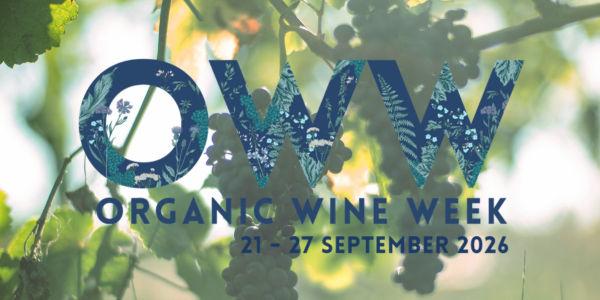
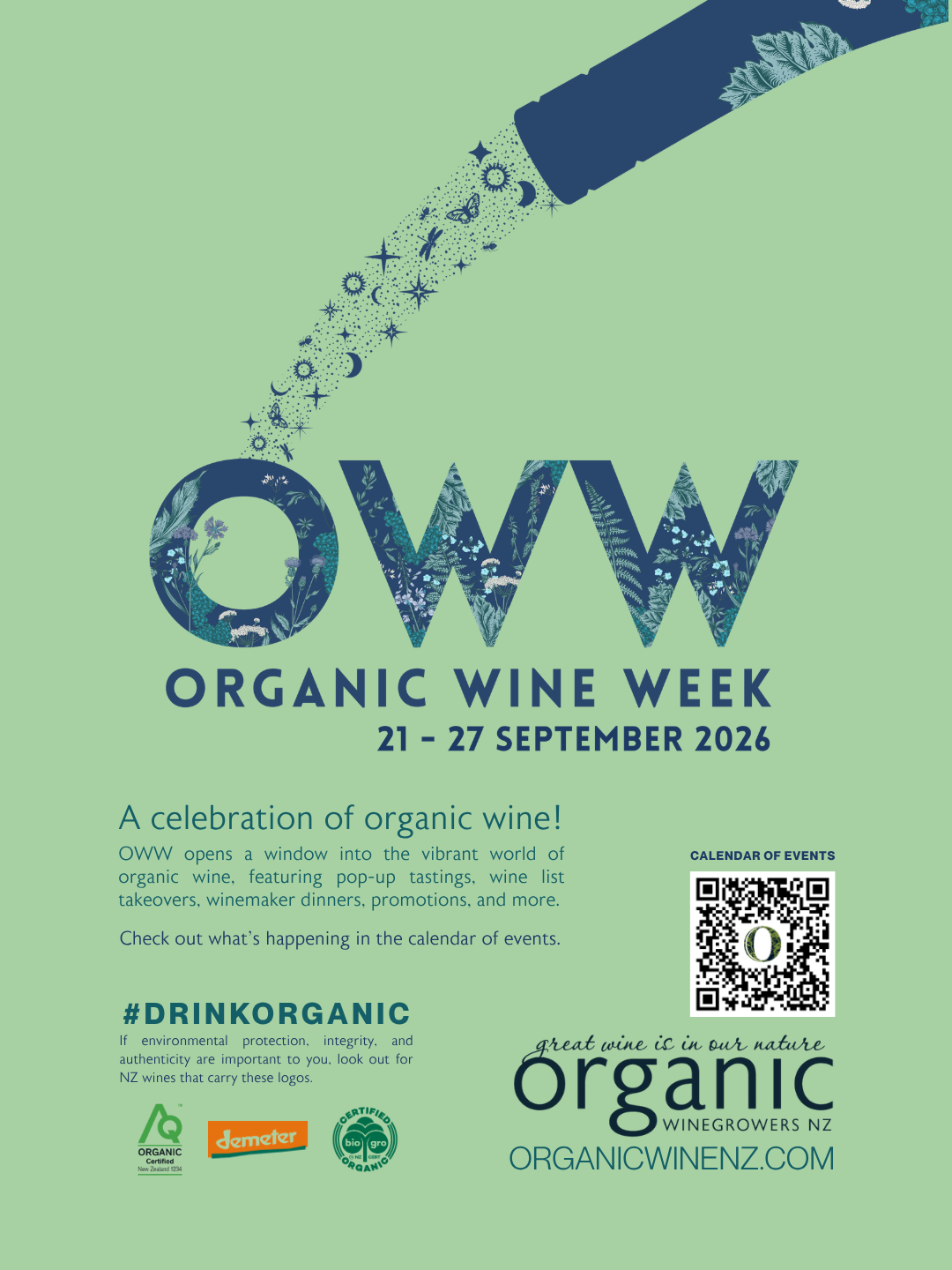
Organic Wine Week 2026 runs from Monday 21 to Sunday 27 September. It is run by Organic Winegrowers New Zealand, a grower-led body that only promotes independently certified organic and biodynamic wines. The headline event is Down to Earth, a walk-around tasting of more than 70 certified organic wines in Auckland on 22 September, with tastings, wine-list takeovers and winemaker dinners running nationwide across the week.
Organic Wine Week runs from Monday 21 to Sunday 27 September. If you have ever stood in front of a wine shelf wondering whether the organic bottle is worth the extra, this is the week the industry makes it easy to find out, usually with someone standing behind the bottle who can answer the question.
Who runs it
Organic Wine Week is run by Organic Winegrowers New Zealand, a grower-led membership organisation based in Blenheim and supported by New Zealand Winegrowers. Its chair is Nick Paulin, who also chaired the Central Otago Winegrowers Association through the years that region pushed its organic vineyard area past 30%.
This is the ninth year. Organic Winegrowers NZ began the week in 2018, and it now sits fixed in the calendar around the spring equinox on 23 September, the point where the days get longer than the nights and the new vintage starts arriving.
"Organic wine consumption is growing, defying the global trend of declining wine consumption," says Paulin, who puts the growth down to a generation of drinkers who want transparency and a wine whose story stands up.
The organisation only promotes wines from independently certified organic and biodynamic growers, which is the part that matters. There is no self-declared tier. Membership is voluntary, so the list of members is not the same thing as the list of every certified producer in the country.
What's on
Two events are confirmed on the Organic Wine Week calendar so far. OWNZ has said the full programme goes up closer to the week.
Event list last updated 29 August 2026. More events are being added and this list will be updated as they appear.
Tasting Flight, Alternative Whites. Monday 21 September at Takapuna Beach Cafe, Auckland.
Down to Earth. Tuesday 22 September at Jacuzzi Bar, Ponsonby, Auckland. This is the headline event: a walk-around tasting of more than 70 certified organic wines from 25 producers, with the people who made them pouring. Wine pours and food are included in the ticket, and early bird tickets are on sale now. A separate trade and media tasting runs earlier the same day, by registration.
Beyond the ticketed events, the week shows up in ordinary places. OWNZ lists the usual formats as pop-up tastings, wine-list takeovers at restaurants, winemaker dinners and retail promotions, most of which are run by member wineries and the shops and bars that stock them. If your local bottle store or wine bar has an organic shelf, the week before the 21st is a good time to ask them what they are doing.
The producers pouring at Down to Earth this year, by region:
- Central Otago: Coal Pit, Domaine Thomson, Peregrine, Quartz Reef, Akarua
- Marlborough: Atipico, Churton, Deep Down, Fugitive, Rimapere, Settlement, Spurlock, Te Whare Ra, The Darling, The Wrekin, Windrush, Zephyr
- Wairarapa: Ata Rangi, Grava, Palliser Estate, Urlar
- Hawke's Bay: Alpha Domus, Decibel
- North Canterbury: Greystone
- Waiheke Island: Kennedy Point
That spread is worth a second look. Organic wine in this country has a reputation as a Central Otago Pinot Noir thing, and five of the 25 are from Central Otago. The rest are not.
Why a drinker might care
The short version, because I have written the long one already.
A conventional vineyard runs three kinds of synthetic chemistry through a season: herbicide to keep the strip under the vines bare, fungicide to fight the moulds that ruin fruit, and insecticide where pests warrant it. None of it is hidden or illegal. It is simply the default, and grapes sit high on the list of New Zealand foods most likely to carry residues. Certified organic farming takes the synthetic version of all three off the table, and puts an annual audit behind that claim.
The part that gets less attention is what happens after the grapes arrive at the winery. Certification does not stop at the vineyard gate. BioGro's viticulture and winemaking standard, reviewed in 2026, covers the cellar in as much detail as the vineyard. A certified winemaker submits a full winemaking plan and the notes and records for each finished wine, has every additive and processing aid approved in writing before it is used, cleans the equipment with approved products, and gets the label signed off before printing. If they buy fruit rather than grow it, they carry the chain of custody for it.
The rules themselves are specific. At least 95% of what goes into a certified wine must be certified organic, and the total of additives, processing aids and any uncertified ingredients has to stay under 5%. Additives are only allowed where the wine genuinely cannot be made without them, and never to speed up processing or to put back flavour or colour lost along the way. Genetic modification and irradiation are prohibited outright, including in the yeast. So are synthetic substances built to imitate natural ones. Chaptalising with approved sugar, adding tartaric or malic acid, oak infusion and fining are all permitted, so this is not a no-additions standard. It is a short, argued list rather than an open one.
That matters more in wine than in most of what you buy, because alcohol sits outside the ordinary labelling rules and wine is the drink where the most gets added. A New Zealand wine label tells you it contains sulphites and nothing else. There is no requirement to declare what was added during the making, and the energy content statement now working its way into the Food Standards Code does not arrive until August 2028. In the European Union, that gap closed in December 2023: wine sold there needs a full ingredient list and nutrition declaration, allowed to sit behind a QR code on the label. So a New Zealand winery shipping to Europe already publishes its ingredient list for European drinkers. The same wine on a shelf here tells you nothing.
Until that changes, organic certification is the only mechanism in this country that audits what goes into the bottle after the grapes come in.
One honest caveat before the price question. Organic says nothing about whether you will like the wine. It is a farming and processing claim, not a quality rating.
Does it actually cost more
Three real costs sit behind a certified bottle. Conversion takes three years, during which the grower farms to the standard and cannot sell at an organic price. Weed control moves from a spray unit to mechanical cultivation, mulch or undervine mowing, which means more passes, more diesel and more hours, and labour is the single biggest line in a New Zealand vineyard budget. And in a wet season the permitted options are narrower, so the downside risk is larger.
So yes, it costs more to grow. That is not the same question as whether it costs you more at the till.
Most of the price gap people notice on the shelf is not the cost of certification. It is which wines got certified. Organic conversion clustered first in premium Pinot Noir country, where the bottle price can absorb the extra cost and the story helps sell it. Compare a Central Otago organic Pinot with the cheapest supermarket Sauvignon Blanc and you are measuring the difference between Central Otago Pinot and cheap Sauvignon, not the cost of organics.
The fair test is same producer, same variety, organic tier against standard tier, and it is now easy to run, because certification is no longer confined to boutique estates. Villa Maria, Giesen and Babich all sell BioGro-certified Sauvignon Blanc in their mainstream ranges. Run that comparison on a shelf or a winery's own website and the gap is usually small, and occasionally runs the other way. Organic wine is not confined to the glass-and-cork end of the market either: Fugitive sells BioGro-certified Marlborough Sauvignon Blanc in a two-litre bag-in-box.
Certification costs the grower real money, and often costs you very little. The gap most people picture is the gap between price tiers, not the gap between farming systems.
At a walk-around tasting you also get to test the premium against your own palate before you spend anything, which is a better use of an evening than reading me on the subject.
Checking a bottle yourself
Four logos do the work in New Zealand: BioGro and AsureQuality for organic, Demeter for biodynamic, and Organic Farm New Zealand. Words like natural, eco, minimal-intervention and sustainable are not certification. Only a certifier's mark means an auditor walked the rows and checked the records. The proof is on the back label.
If you want to check a producer before you go shopping, OWNZ publishes a list of wineries making wine solely from certified organic or biodynamic grapes, a separate list of certified organic vineyards, and a regional guide. Membership is voluntary, so a certified producer can be missing from all three. Certification itself sits with four separate bodies, each holding its own register, and producers certified for export to the United States also appear in the USDA's Global Organic Integrity Database. What I have not been able to find is one public New Zealand register covering every certified producer in one place. If you know of one, tell me and I will link it here.
The questions people actually ask
Is organic the same as natural wine? No. Organic and biodynamic are certified, audited claims about how the grapes were grown and how the wine was made. Natural and minimal-intervention are descriptions with no certifier, no standard and no audit behind them in New Zealand. Plenty of natural wine is made from certified organic fruit. The word itself guarantees nothing.
Is biodynamic more than organic? Yes, in the sense that a Demeter-certified producer meets organic requirements and then adds biodynamic practice on top: specific plant, animal and mineral preparations, and a calendar tied to natural cycles. Whether the extra layer changes the wine is argued about endlessly. The organic floor underneath it is not in dispute.
What about the Sustainable Winegrowing New Zealand logo? Around 98% of New Zealand's producing vineyard area is SWNZ certified, so the logo tells you very little about any individual bottle. It is a real scheme with real audits, but synthetic herbicides and fungicides are permitted under it. It is not an organic claim and is not intended as one.
Is organic wine sulphite-free? No, and under the New Zealand standard it does not have to be. Sulphur dioxide is a restricted additive under BioGro's winemaking rules, meaning a certified producer needs written approval each year to use it. The ceiling is set on total sulphur dioxide in the finished wine at the point it goes on sale, and it moves with sweetness: 150mg per litre for a dry wine, 200 for a medium, 250 for a sweet one. For comparison, the general limit for dry wine in New Zealand is around 250mg per litre. So a certified organic dry white or red sits at roughly 60% of what a conventional one is allowed. Lower is not zero. Anyone who reacts to sulphites should not treat a certifier's logo as an all-clear.
Is organic wine vegan? Not necessarily. Wine has been clarified with egg white, milk products and gelatine for centuries, long before anyone thought to certify anything, and the New Zealand organic standard carries that tradition forward: fresh egg white, casein, food-grade gelatine and certified organic milk are all permitted, alongside the mineral options kaolin and calcium carbonate. Plenty of certified producers fine without animal products and say vegan on the label. Certification and veganism are simply separate claims, and the first does not tell you about the second.
Does organic wine taste better? Certification is a farming and processing claim, not a quality rating. There are excellent organic wines and dull ones, exactly as there are in every other category. What you are buying is a known method with an audit behind it, not a guaranteed result.
Organic Wine Week runs 21 to 27 September. The wine has an audit trail. The label still does not.
Before you go
If this is useful, the best thing you can do is sign up free so the next piece lands in your inbox. If you would like to chip in, there is a one-off tip option here.