Who Made This Chocolate? The Box Won't Say.
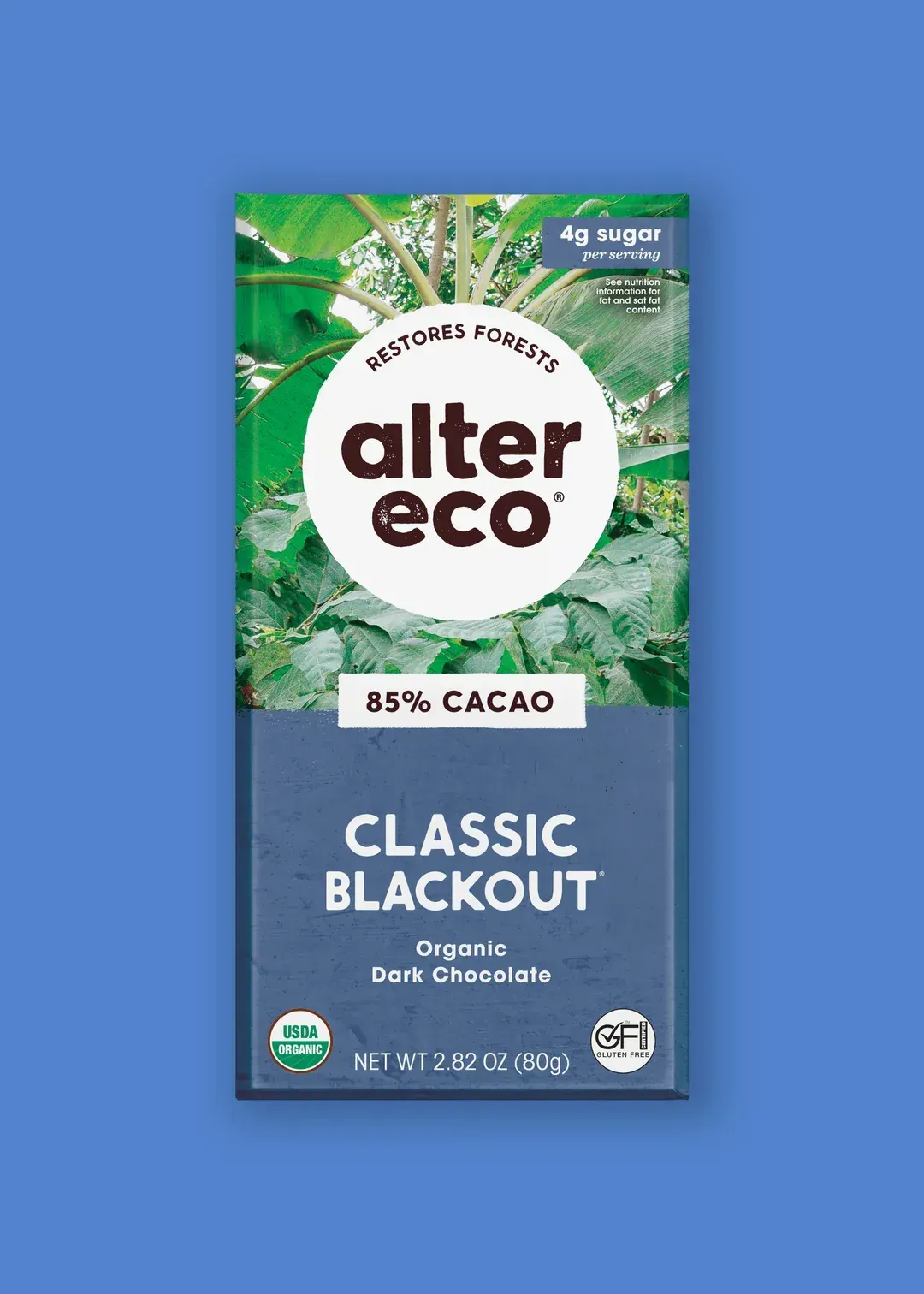
I buy organic chocolate where I can find it, which is how an 85% Alter Eco bar came home from Commonsense this week. Classic Blackout. Deep blue box, cacao trees on the front, a white circle with the brand in it.
I turned it over and decided it was Australian. Sydney address on the back, and a barcode starting 93, which is the Australian country prefix. Then I looked the company up and decided it was American, because it is: San Francisco originally, Houston now. Then I looked at the box again and found the words "Made In Switzerland" sitting in their own little printed rectangle, about a centimetre from where my thumb had been the whole time.
Three guesses on one panel.
What the box tells you
The ingredients list is four lines long. Organic cacao beans, organic raw cane sugar, organic cocoa butter, organic vanilla beans. That is genuinely unusual for a bar that cost me around $11. No soy lecithin, which most 85% bars use to help the chocolate flow through the moulding line.
Around that, a stack of marks. Certified organic by bio.inspecta AG, a Swiss certifier, code CH-BIO-006, plus ACO Certification for the Australasian market. Fair for Life fair trade, with a note that 100% of the agricultural ingredients are covered. B Corp. Plastic Neutral Product. The Climate Label. A line about a carbon-neutral supply chain that restores forests.
What it doesn't tell you is who made the chocolate. The panel says "DISTRIBUTED BY: Alter Eco Pacific, Suite 1B Level 16, 56 Pitt Street, Sydney NSW 2000." Distributed by, not made by. Alter Eco is a brand and a sourcing operation; the chocolate is made under contract by a Swiss factory that is never named, on the box or on the website. Switzerland has a handful of private-label houses that do exactly this work, some of them very good, some making organic chocolate since the early nineties. I have a strong suspicion which one it is. I'm not going to print a guess.
It doesn't tell you where the cacao grew either. No place name appears anywhere on the carton. The product page says Ecuador and the Dominican Republic, and refers to Swiss chocolatiers roasting and conching, still without naming them. Two countries, on a page you have to be curious enough to find.
The panel inside
Then I opened it.
There's an arrow on the tuck flap saying to read more inside, so I pulled the carton apart and flattened it. The whole interior is printed. A photograph of a cacao plot under canopy, hand-drawn arrows labelling banana trees, shade trees, timber trees, cacao trees. FARM LIKE A FOREST across the middle. Underneath, an explanation of growing a diverse mix of trees around the cacao to mimic a forest ecosystem, and eight bullet points: healthy cacao trees, soil fertility, drought resistance, double the trees per acre, biodiversity, carbon absorption, shade for cacao and farmers, farmer income stability.
A hidden panel the size of the front of the pack, given over entirely to how the cacao is grown, that never once says where any of it is.
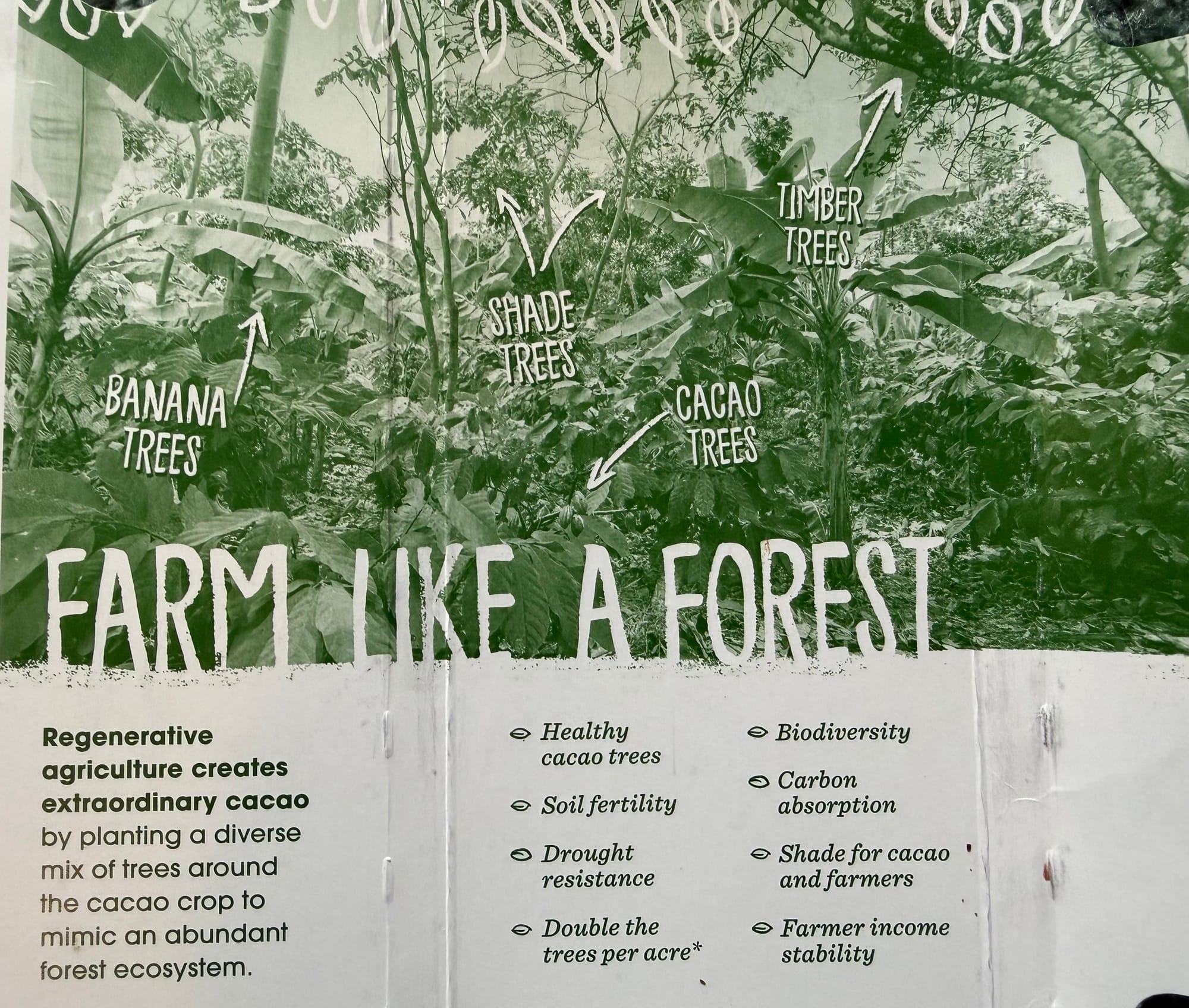
It's also worth separating what's checked here from what isn't. Organic is certified by bio.inspecta. Fair trade is certified by Fair for Life. Regenerative is certified by nobody, because there is no accredited standard sitting behind the word. That's the company describing its own farming programme, with no third party verifying it. The asterisk on "double the trees per acre" resolves to a footnote reading "vs. monoculture cacao", with no study or figure attached.
Three claims on one box. Two audited, one not, and nothing on the packaging distinguishes them.
And who owns it
The brand started in 2004 in San Francisco selling fair trade organic chocolate from South American cooperatives. The Australasian arm was a separate business, founded in 2005 by Ilse Keijzer out of Melbourne, bought by the American company in 2015. That's why a Swiss bar reaches an Auckland shelf through a Sydney office with an Australian barcode.
Since then it has changed hands twice. San Francisco private equity firm NextWorld Evergreen bought it in 2017. In December 2023 it was sold again, to Trek One Capital, a Texas investment group, and the head office moved to Houston. Trek One was newly assembled from family offices and existing businesses, and its only other holding was Tejas Environmental Solutions, a wastewater and saltwater disposal company serving the oil and gas industry.
Trek One said publicly it intended to keep the sourcing commitments, and the marks on the box are current, which is exactly what certification is for: it survives a change of owner. But the cleanest greenest chocolate on the shelf is now a sister company to an oilfield waste business, and no mark on a wrapper is designed to tell you that.
So who does make chocolate here, and where do they get it
This is the part the Alter Eco box made me appreciate more than I expected, because plenty of New Zealand makers answer it on the wrapper without being asked.
Foundry, north of Auckland, prints two ingredients and a place: the Kilombero Valley in Tanzania, Semuliki Forest in Uganda, a named estate on Malekula Island in Vanuatu. Solomons Gold in Tauranga grow and source their own cacao in the Solomon Islands and publish laboratory test results instead of a certificate. Raglan Chocolate puts a photograph of the grower inside the wrapper. Wellington Chocolate Factory buys direct from Pacific growers and pays a premium to do it.
Lay the makers side by side and a pattern shows up. Vanuatu again and again, Malekula especially, plus the Solomons, Papua New Guinea, Samoa and Fiji, alongside beans from Tanzania, Uganda and Peru. New Zealand craft chocolate is largely a Pacific story, built on relationships with our neighbours rather than prestige beans from Latin America.
Fourteen of them now share an emblem called A Bar Apart, launched in July, which asks a maker to have made the chocolate from the bean themselves and to say where the cacao came from and how it was made. I wrote about it in June, and about why almost none of them are certified organic: fine-flavour cacao grown on Pacific smallholdings is mostly organic in practice already, and the certificate would cost the growers money to state a fact that is true anyway. Solomons Gold got partway to certification and walked away from it.
Back on the shelf
So there are two honest ways to tell a stranger about a bar of chocolate, and they don't overlap much.
Alter Eco certifies every ingredient, and won't name its maker or put an origin on the box. Foundry names the island, the microlot and the people, and can only certify the sugar. And the certified one is cheaper: around $11 against $15.90. Whatever the organic stamp is doing in this aisle, it isn't a premium you're paying for. It's a fixed cost that a factory turning out millions of bars a year barely notices, and a real one for a maker in Silverdale.
Both bars are worth buying. They're just answering different questions, and only one of them is the question I asked when I turned the box over.
I bought the Swiss one because it said organic. I still don't know who made it.
Before you go
If you found this useful, you can get new posts free by email.
If you'd like to support the work, you can leave a one-off tip.