Why New Zealand's Best Chocolate Isn't Certified Organic
On 7 July, fourteen New Zealand chocolate makers launch a shared emblem built on transparency rather than organic certification. It's a quiet bet that knowing the farm matters more than knowing the badge — and the best bars on the shelf already prove the point.
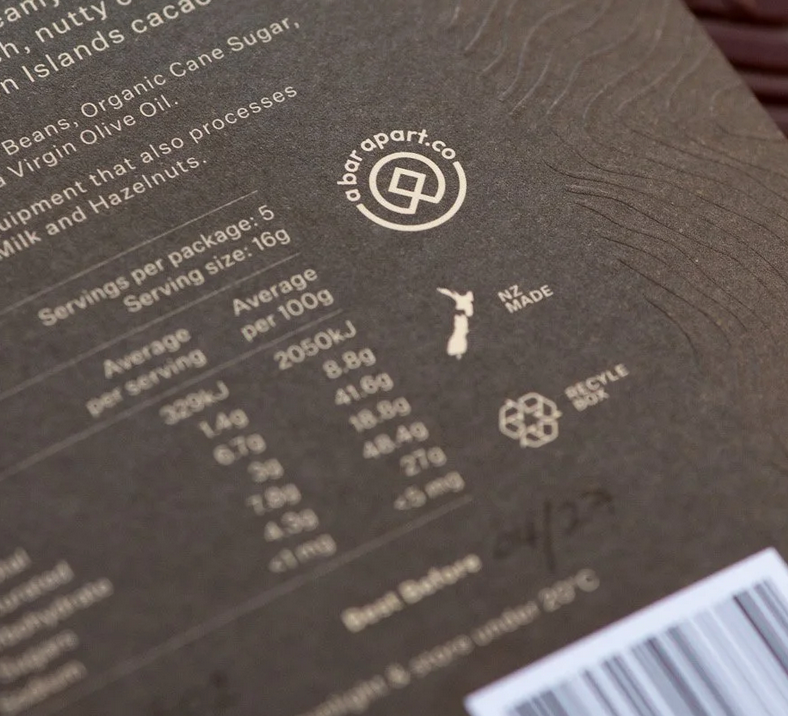
Turn over a bar of Foundry chocolate and read the back. Two ingredients: cacao and organic sugar. No cocoa butter added back in, no soy lecithin to smooth the texture, no vanilla to round the edges. And then, in place of a marketing story, a place name — the Kilombero Valley in Tanzania, say, or Semuliki Forest in Uganda, or a named estate on Malekula Island in Vanuatu. Everything you might want to know about what you're eating, printed on the wrapper. No certificate required.
It's a small thing, a label. But it asks a surprisingly large question. If you can see exactly what's in the bar and exactly where it came from, do you still need a stamp to tell you it's good?
That question sits underneath a new emblem launching this World Chocolate Day. On 7 July, fourteen of the country's bean-to-bar makers come together under a shared mark called A Bar Apart, with a week-long pop-up in Britomart to introduce it. And the most interesting thing about the mark is something it pointedly is not.
A mark built on four things — and organic isn't one of them
A Bar Apart rests on four pillars: that the chocolate is made bean-to-bar by the maker themselves, that the origin of the cacao is transparent, that the process is transparent, and that the result celebrates the diversity of flavour real cacao can carry. Read that list again and notice what's missing. There is no organic requirement. No Fairtrade logo. No third-party certification of any kind.
For a publication that spends most of its time tracing the word "organic" through New Zealand's food system, that absence was the first thing I noticed — and at first it read like a gap. It isn't. It's a position. And the more time you spend with the makers, the more sense it makes.
Why craft chocolate mostly isn't organic — and mostly doesn't want to be
Here is the uncomfortable thing about an organic label on a chocolate bar: it certifies an absence that is usually already there, and stays silent on everything that actually makes the chocolate worth buying.
Fine-flavour cacao is, for the most part, organic by default. It's grown by smallholders on plots often smaller than five hectares, frequently by farmers who couldn't afford synthetic pesticides and herbicides even if they wanted them. The organic standard itself was built for large-scale, single-crop agriculture — bananas, coffee at scale — not for heirloom cacao grown in mixed forest gardens by families. Certification is expensive and administratively heavy, a cost that lands hardest on exactly the small growers the system is meant to reward. And crucially, the organic stamp tells you nothing about fermentation, nothing about the roast, nothing about genetics — the things that decide whether a bar tastes of dried cherries and tobacco or of nothing much at all. It also tells you nothing about whether the farmer was paid fairly, which, as we'll come to, is the part that should keep you up at night.
So most craft makers skip it. Not out of carelessness, but because the badge would cost their growers money while certifying a fact that's already true.
The maker who walked away from the stamp
If you want this argument made flesh, look at Solomons Gold. They grow and source their cacao in the Solomon Islands, controlling the chain from tree to bar to an unusual degree. They were, at one point, in conversion with NASAA Organic — on the path to full certification. And they chose to walk away from it. Not because they changed how they farmed, but because the cost and the paperwork weren't viable for them or for the growers they work with.
What they kept was the substance. The chocolate is still made without synthetic inputs — organic in practice, if not on paper. They sweeten it with organic coconut sap sugar and use organic cocoa butter. And in place of the certificate, they publish their laboratory test results, so you can see what's in the bar directly rather than trusting a logo to vouch for it.
That's the whole philosophy in one maker: the badge wasn't the point. The information was.
Transparency is harder work — for everyone
It would be easy to turn this into a tidy story where transparency simply beats organic. It doesn't, quite, and the honest version is more interesting.
A certificate does one genuinely useful thing: it asks nothing of you. You see the logo, you trust the system behind it, you move on. That's its appeal and its limit. Transparency does the opposite — it hands you the information and the responsibility along with it. "Korosim microlots, Solomon Islands" only means something if you stop and find out what it means, and most people standing in a supermarket aisle on a Tuesday evening simply won't.
So the claim A Bar Apart is really making isn't "we're better than organic." It's something quieter and more respectful: here is what's in the bar, here is where it came from, here is who made it — now you decide what you care about. If organic sugar matters to you, you can see it on a Foundry or Solomons Gold wrapper. If a named forest and a fairly paid grower matter more, that's there too. Transparency doesn't make the choice for you. It just refuses to make it without you.
Why this matters right now
There's a reason this is worth paying attention to in 2026 specifically, and it has to do with what's happened to the price of cocoa.
For most of the last two years the global cocoa market has behaved like something coming apart. Prices spiked to a record — well above US$11,000 a tonne in 2024, several times the long-run normal — as disease and bad weather hammered the West African farms that grow the bulk of the world's cocoa. Then the spike collapsed, falling back below US$4,000 a tonne by early 2026. (These figures move fast; treat them as a snapshot rather than today's number.)
Here's the part that matters. When the market swings like that, the people who absorb the damage are almost never the traders or the big manufacturers. They're the farmers. As prices fell, the major producing nations slashed the guaranteed prices paid to growers — cuts that stripped income from hundreds of thousands of smallholder households who have no buffer against that kind of shock. Commodity chocolate passes that volatility straight down the chain to the people least able to bear it.
A direct-trade craft maker who knows the name of the farm, pays a premium that doesn't lurch with the futures market, and comes back to the same growers year after year is doing something structurally different. That's not a marketing flourish. In a year like this one, it's the difference between a farming family planning ahead and a farming family in freefall. Transparency, in that light, isn't just about your peace of mind on the shelf. It's about whether the relationship behind the bar can survive a bad market.
The question nobody wants asked
The timing carries an odd resonance. Just weeks before the launch, the United States trade representative named New Zealand among more than fifty countries it says have failed to properly enforce a ban on imports made with forced labour, proposing an additional tariff in response — with hearings set, as it happens, for 7 July. The dispute isn't about chocolate, and our government rejects the premise outright. But strip away the trade politics and it lands on something real: New Zealand has no law requiring an importer to know whether forced or child labour sits anywhere in their supply chain.
Cocoa is one of the chains where it most often does. The links between mainstream chocolate and forced and child labour in West Africa are among the most thoroughly documented in the global food system — and most of us eat our way past them without a second thought, because nothing on the wrapper forces the question.
That's the deeper thing transparency does. A maker who can name the farm, and in many cases has stood in it, is answering — before you've even asked — the question the rest of the food system would rather you didn't. Not "is this certified?" but "do you actually know where this came from, and who it cost?" It turns out that's a surprisingly radical thing for a chocolate bar to be able to say.
New Zealand's chocolate is a Pacific story
One more thing emerges when you lay the fourteen makers side by side: where their cacao comes from. Again and again, it's the Pacific. Vanuatu above all — Malekula Island turns up on wrapper after wrapper — alongside the Solomon Islands, Papua New Guinea, Samoa and Fiji. New Zealand's craft makers, by and large, aren't chasing prestige beans from Latin America. They're building relationships with their neighbours.
Wellington Chocolate Factory, the country's bean-to-bar pioneer, traded industrial secrecy for what it openly calls radical transparency, sourcing directly from Pacific growers and paying a premium to do it. Raglan Chocolate prints a photograph and the story of the grower inside every wrapper. The maker behind Raglan, Mike Renfree, came to all this the hard way: he was working as a food technologist for an industrial confectioner when his employer switched to a cheaper cacao mass, and pulling on that thread led him straight into the documented reality of forced labour and child labour in the mainstream chocolate supply chain. He started making his own chocolate partly so he could know, for certain, that none of that was in it.
That's the contrast the big brands can't easily answer. Not "ours is organic and theirs isn't" — but "we can tell you the name of the farm, and they can't."
Back to the shelf
So the next time you're choosing a bar, you don't actually need a rule. You don't need to memorise which logo means what. You need the information — and then your own judgement about what matters to you.
That's the bet fourteen New Zealand makers are placing this July. Not that you'll buy the badge, but that enough of us would rather be trusted with the facts. It's a more demanding kind of label. It's also, if you think about it, the only honest one.
If you want to go: launch week, 7–12 July
A Bar Apart launches with a week-long pop-up shop at the Spacefor Pavilion, 10 Te Ara Tahuhu, Britomart, Auckland, opening on World Chocolate Day, Tuesday 7 July. It runs Tuesday to Saturday 10am–6pm and Sunday 10am–4pm, with bars and treats from all fourteen makers.
There are free lunchtime tastings each weekday from 12–1pm (no ticket needed) — Wonderland on Tuesday, Raglan on Wednesday, Coromandel on Thursday and Valura on Friday — plus free Kōkako coffee for the first 100 people on Saturday from 10am. Ticketed evening events (7.30–8.30pm) include flavouring chocolate with Baron Hasselhoff's, Peruvian cacao with Lucid, a chocolate-and-olive-oil tasting with Shirl & Moss and Allpress, and a tea-and-chocolate pairing with The Tea Curator.
Full programme and tickets: A Bar Apart launch week · book evening events
Meet the makers
The fourteen founding makers behind A Bar Apart, and where to find them:
- Ao Cacao — Auckland
- Baron Hasselhoff's — Wellington
- Coromandel Chocolate — Whangamatā
- Foundry Chocolate — Silverdale, Auckland
- Hogarth Chocolate Makers — Nelson
- Lucid Chocolatier — Wairarapa
- Miann Chocolate Factory — Auckland
- Raglan Chocolate — Raglan
- Shirl & Moss — Auckland
- Solomons Gold — Tauranga
- Trice Chocolates — Wellington
- Valura Chocolate — Auckland
- Wellington Chocolate Factory — Wellington
- Wonderland Chocolate — Wellington
Find out more: the A Bar Apart emblem and makers directory, and their own explainer on big chocolate versus bean-to-bar craft.