Three Economists Explained Our Food Prices. None Of Them Mentioned The Supermarkets.
A reader asked how much of the $10 he pays for a dozen eggs reaches the farmer and how much the supermarket clips. Nobody in the article was asked. Three economists explained record food prices, and every cause they named sat somewhere no New Zealander can reach.
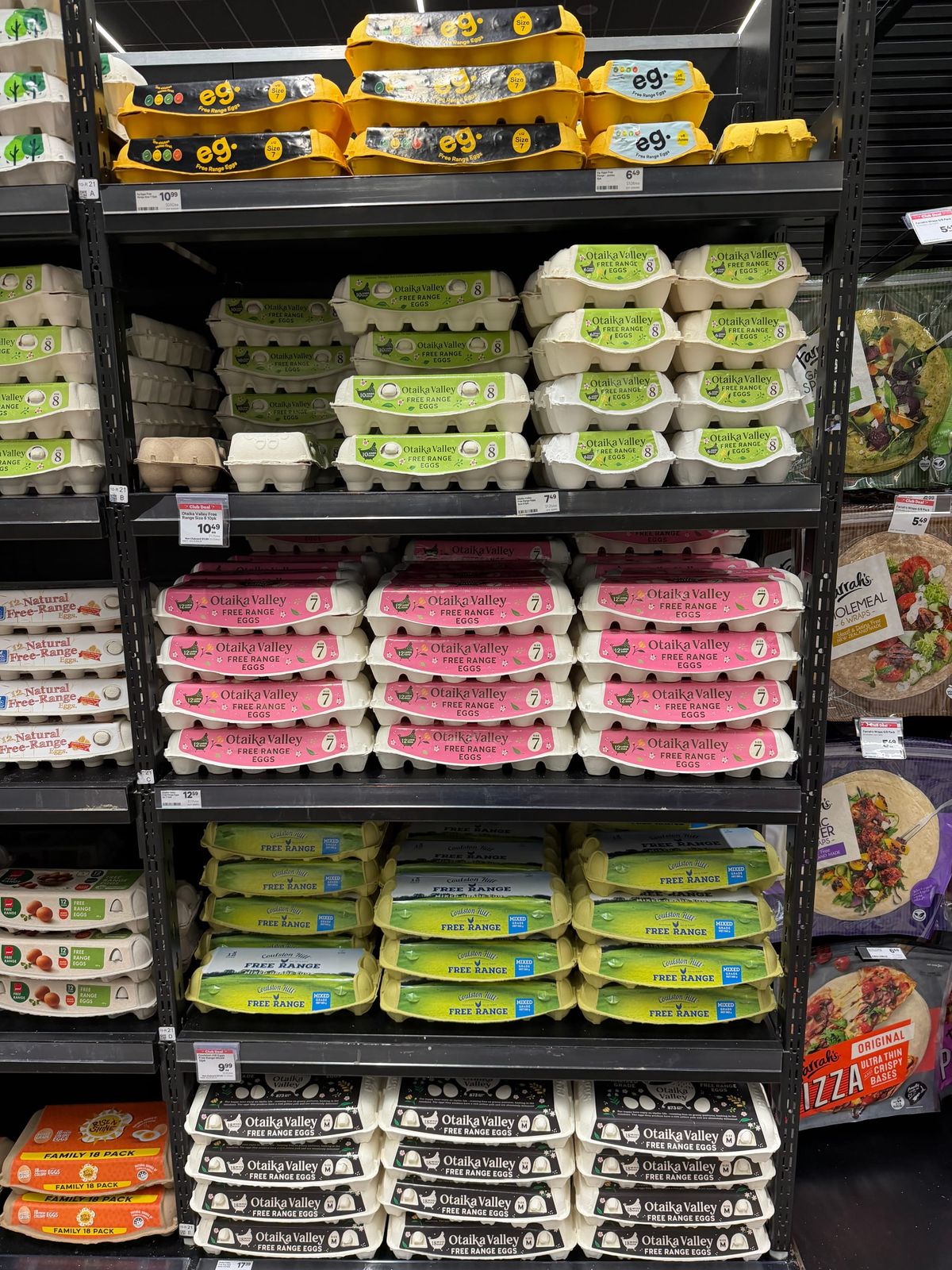
Under the RNZ story about record food prices, somebody left a comment that was better than the article.
His point was roughly this. If a dozen eggs costs him $10 and the farmer needs $8.50 of that to stay in business, fine. That is a story he can live with. If the farmer gets $6 and the supermarket keeps $4, that is a much harder thing to swallow. What would actually help, he said, is somebody on the inside telling him how much of his money gets clipped on the way through.
Nobody in the article told him, because nobody in the article was asked.
Fresh fish at $49.62 a kilogram. Lamb chops at $24.23. Fish and chips at $11.07. Two litres of milk at $5.12, and a loaf of white sliced at $2.38.
Every one of those is a record as Stats NZ measures them, a caveat I will come back to. RNZ ran the list on Monday and then asked three economists why.
Westpac's Satish Ranchhod pointed out that the things rising fastest are the things we produce and sell to the world, with strong demand at home and offshore, and rising fuel costs feeding into on-farm operating costs before rippling through transport and packaging. Infometrics' Brad Olsen put much of it down to global protein demand, including American GLP-1 users who eat less but want what they do eat to be protein dense. Simplicity's Shamubeel Eaqub made the sharpest point in the piece: a slowing inflation rate means nothing to somebody still paying a lot for the basics.
I have no argument with most of that. Butter really is set at a global auction. Cheese, milk, lamb and beef really do carry a price anchored to what a buyer in Shanghai will pay. That is the export parity problem, it is real, and I have written about it before.
But look at the shape of the answer. Global protein demand. Weight loss drugs in America. Fuel. Plastic. On-farm costs. Every single cause named sits upstream, offshore, or both. Every one of them is something no New Zealander can do anything about.
A supermarket does appear, once. Ranchhod says all of those costs eventually land on the supermarket shelf. Which is exactly the point. In the whole explanation the shelf is a surface, a place where the price arrives after everything that matters has already happened to it.
There is one link in that chain that is domestic, concentrated, regulated, and described in writing by a government agency as lacking competition. Nobody was asked about it.
What the Commerce Commission said in June
On 2 June this year the Commerce Commission published its third annual grocery report, covering the 2025 financial year. Grocery Commissioner Pierre van Heerden's summary was that the major supermarkets have kept hold of over 80 percent of the national grocery retail market, that margins and profitability were relatively flat, and that retail prices increased.
Hold those three facts next to each other. Share unchanged. Margins unchanged. Prices up.
The report says as much in its own words: these patterns are not what the Commission would expect in a market experiencing increasing competition, where sustained downward pressure on margins would be more likely.
Then there is the profitability, and this is where the report earns its reading. Figure 11 of the report itself plots EBIT margins for thirteen grocery retailers from FY20 to FY25. Foodstuffs North Island sits at the top of that chart every year from FY20 through FY24, above Walmart, above Tesco, above Coles, above Woolworths Australia, above the lot of them. Canada's Loblaw only passes it in FY25. Foodstuffs South Island climbs steadily across the same period and finishes third.
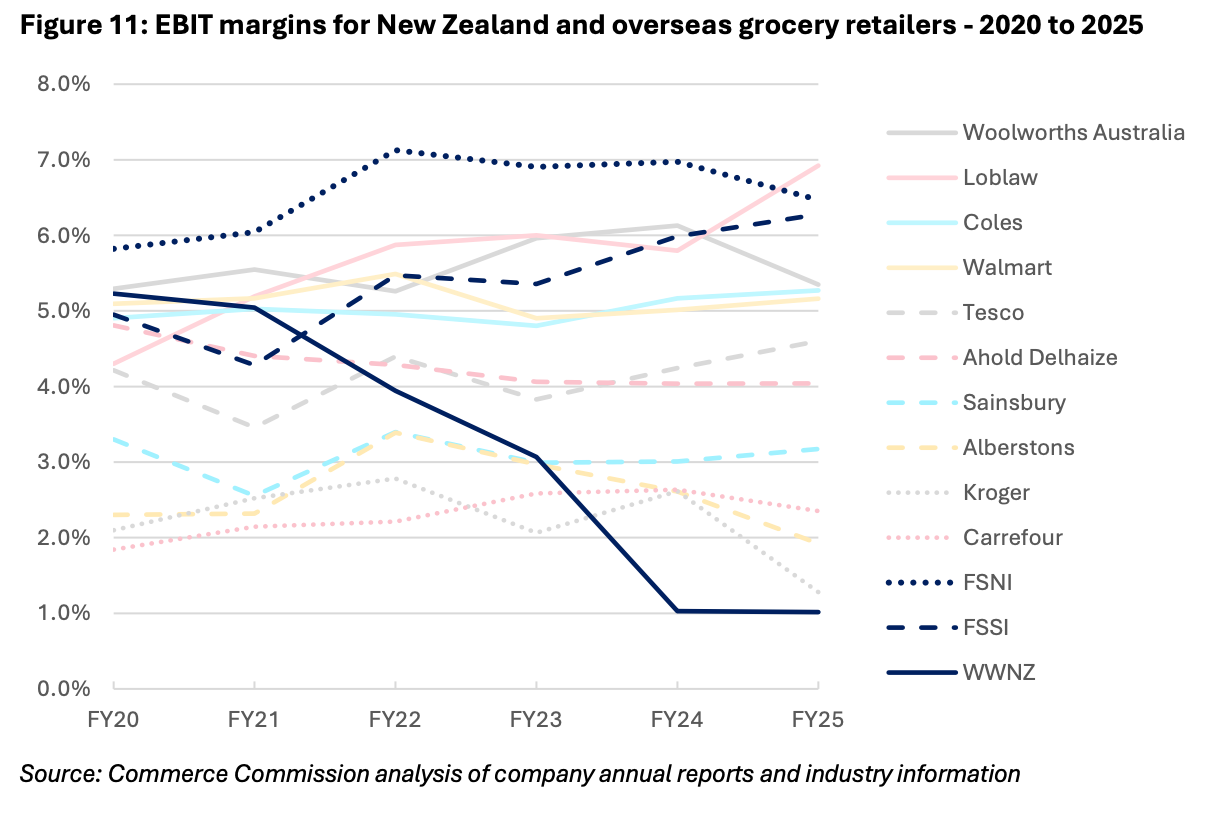
Two New Zealand co-operatives, in a country of five million people, running the fattest margins in that comparison for five of the six years.
The obvious defence is that a co-operative is not a listed company and the comparison is not like for like. There is something in that. Foodstuffs returns value to its member-owners rather than to shareholders, and how a co-operative books rebates and property differs from how Tesco does. But the comparison is the Commission's, not mine, drawn from company annual reports, and the Commission is the body with the statutory power to demand the underlying numbers.
The part that complicates the easy version of this story is the third player. Woolworths New Zealand finishes last on the same chart, at around one percent, and the net profit figures on the page before have it below zero. It made a loss. So this is not a tale of everyone at the checkout getting rich. The New Zealand-owned co-operatives are the profitable ones, the Australian-owned chain is not, and its most recent half-year results show EBIT rebounding 22.4 percent.
The concentration is worse than the market share suggests. The Commission puts New Zealand's grocery Herfindahl-Hirschman Index at 3,585 for 2025. Anything above 2,500 is conventionally called highly concentrated. The United Kingdom sits at 1,515 and Ireland at 1,934, both in the moderate band. Our index is more than twice Britain's.
And here is the figure I have not seen reported anywhere, which is the closest thing yet to an answer for the man asking about his eggs. Rebates, discounts and payments flowing between the three major retailers and their suppliers were worth about $6 billion in the 2025 financial year, equal to 26 percent of the majors' combined sales revenue. Arrangements like these are ordinary in grocery the world over. What is not ordinary is the position they leave everyone else in. Smaller retailers told the Commission they cannot get access to them, which is a large part of why they cannot match a promotional price. Suppliers told the Commission the arrangements are complex and that it can be unclear what they are getting in return.
It is still not the number he asked for. The Commission reports how margins moved rather than what they are, and does not compare margin levels between the retailers at all, because each one defines its cost of goods differently. So we know Foodstuffs South Island widened its margins on both fresh and non-fresh goods last year while the other two narrowed theirs slightly. What nobody publishes is how much of your $10 stays in the store.
The Commission also does something worth noticing. Writing about the cost pressures expected in 2026, it states plainly that it has told the retailers those increases are not to be used as an opportunity to widen margins, and that prices are to come down quickly when costs do.
A regulator does not put that sentence in writing about an industry it trusts.
Where the explanation stops
Ranchhod gave RNZ his own decade figures, and they are worth reading in order. Butter up 157 percent. Eggs 125. A loaf of white sliced 120. Mild cheese 75. Cabbage 75. Potatoes 73. Lamb chops 72. Beef mince 71. Two litres of milk 57.
Wages over the same decade: about 52 percent.
Now find the export goods. Butter, cheese, lamb, beef and milk are what we sell to the world, and export demand fits them. It does not fit the items sitting between them. Cabbage rose faster than lamb chops. Nobody is bidding at a global auction for a New Zealand cabbage.
To be fair to him, he offered a second explanation that does cover it. Fuel, on-farm operating costs, transport, packaging. Those hit a cabbage as hard as they hit a lamb, and that is a perfectly good account of why a domestic vegetable outran an export meat.
So notice what the two explanations have in common. One is demand from offshore. The other is costs from upstream. A grower's diesel bill and a dairy auction in Singapore are not the same thing, but they are the same kind of thing: something that happens to food before it reaches the shop.
Bread is up 120 percent, third on the list, and it fits the export story least of all. I mill and bake my own now, which is either a principled stand or just cheaper depending on the week, so this is the one I have read most about. The Foundation for Arable Research puts it plainly on its New Zealand Grown Grains page: at least three-quarters of the bread sold here is made from imported grain, primarily Australian. A New Zealand loaf is not priced off what the world will pay for our wheat. The world is not buying our wheat. We are buying theirs. What is left is a domestic market where, as I found when Bürgen pulled out, two companies own nearly all the bread on the shelf.
Eggs are up 125 percent, and here the honest answer runs the other way. Battery cages were banned outright from 1 January 2023. That ban, the supermarkets' own decision to stop stocking colony eggs, Covid and Ukraine-driven feed costs together took an estimated 600,000 to 700,000 hens out of the commercial flock. That is a welfare policy doing what it was designed to do, with a price attached. Worth saying plainly, because a story that blames everything on one villain is a story nobody has to take seriously. What you can still control is which egg you buy, which I have worked through in some detail.
One caution on the numbers themselves, since I went looking. Those weighted average prices are not what anyone actually paid. Stats NZ calculated them from prices collected in June 2006 and has rolled them forward every month since by applying index movements, and says openly they are not accurate measures of average transaction prices, only reliable indicators of percentage change. So use the percentages, which is what Ranchhod did. Treat the dollar figures as a measuring stick rather than a receipt.
Who gets asked
None of the three economists lied. That is not the point.
Westpac is an Australian-owned bank with a rural lending arm, and Ranchhod quite fairly described strong export earnings as a silver lining for Canterbury, Southland and Otago. Infometrics sells analysis to industry and to councils. Simplicity is a non-profit fund manager, which may be why Eaqub's answer was the least comfortable of the three.
Ask a bank economist why food is expensive and you will get a supply-side answer, because that is the model they work in and the audience they serve. It is not a conspiracy. It is a habit, and habits are harder to see than conspiracies.
The result is a national conversation in which the price of a loaf is explained by injectable weight-loss drugs in Ohio, while a market with more than twice Britain's concentration goes unmentioned.
The tell
The Commissioner's practical advice to shoppers, in that same June report, was to mix up where they buy their groceries so that competitors have a chance to grow.
Read that as what it is. A regulator with statutory powers, four years into reforming a market, asking consumers to fix the structure by shopping somewhere else.
It is also, awkwardly, correct. So it is worth saying where "elsewhere" actually is, because nobody in that report tells you.
Where elsewhere is
Start where the pressure is lightest. The record prices are concentrated in the things we sell to the world, and in the staples at the top of that list. Seasonal vegetables swing with the season rather than climbing the way butter has, and the meats we raise mainly for ourselves have been steadier than the ones we export. That is the half of the shop where there is less inflation to escape in the first place.
That is also the part where leaving the supermarket costs you the least. A greengrocer, a Saturday market or a weekly box will match or beat a supermarket on seasonal vegetables more often than people expect, and the gap between conventional and certified organic is narrowest here too. Not zero. Narrow. Whatever brassica is going this month is the cheapest good thing in the country.
Meat is the one where buying direct changes the arithmetic most, because you are cutting out the part of the chain the Commission has been writing reports about. A butcher, a farm-gate order, a half share in a beast with somebody else. It takes freezer space and a bit of organising, which is the honest reason most people don't do it.
I keep a running directory of places to buy food in New Zealand that are not the two big chains. It is incomplete and it always will be, but it is a start on the question the Commissioner left hanging.
And then the part I am not going to pretend about. The expensive half of that record list is expensive because of an auction on the other side of the world, and no amount of shopping around fixes it. Butter is up 157 percent and it is not going back. Cheese, milk, lamb and beef are priced off what somebody in Shanghai or Los Angeles will pay, and you and I are bidding against them for food grown in our own country. Buying local, buying direct and buying organic do a lot of things, and lowering that number is not one of them.
Which is why the retail end matters. It is the only part of this anybody here can actually reach, and it is the part nobody with a microphone is asking about.
Before you go
If you want more of this, sign up free. If you want to chip in for the research, there is a one-off tip link.