Organic Food Is Sold Out. You Weren't on the List.
Imagine organic food was rationed and you weren't on the list. A 1975 cookie experiment explains why that would make you want it more. Then the notice comes down, and the real numbers aren't far off.
Imagine a notice on the supermarket door.
Organic food is now limited. There isn't enough to go round, so only a small number of households will be allowed to buy it. The list has been drawn up. The people on it were told weeks ago.
You weren't.
Sit with that for a minute. How do you feel about a bag of organic carrots right now?
If the honest answer is "more interested than I was thirty seconds ago," you're normal. Psychologists measured that feeling fifty years ago. They used a jar of chocolate chip cookies.
Two cookies or ten
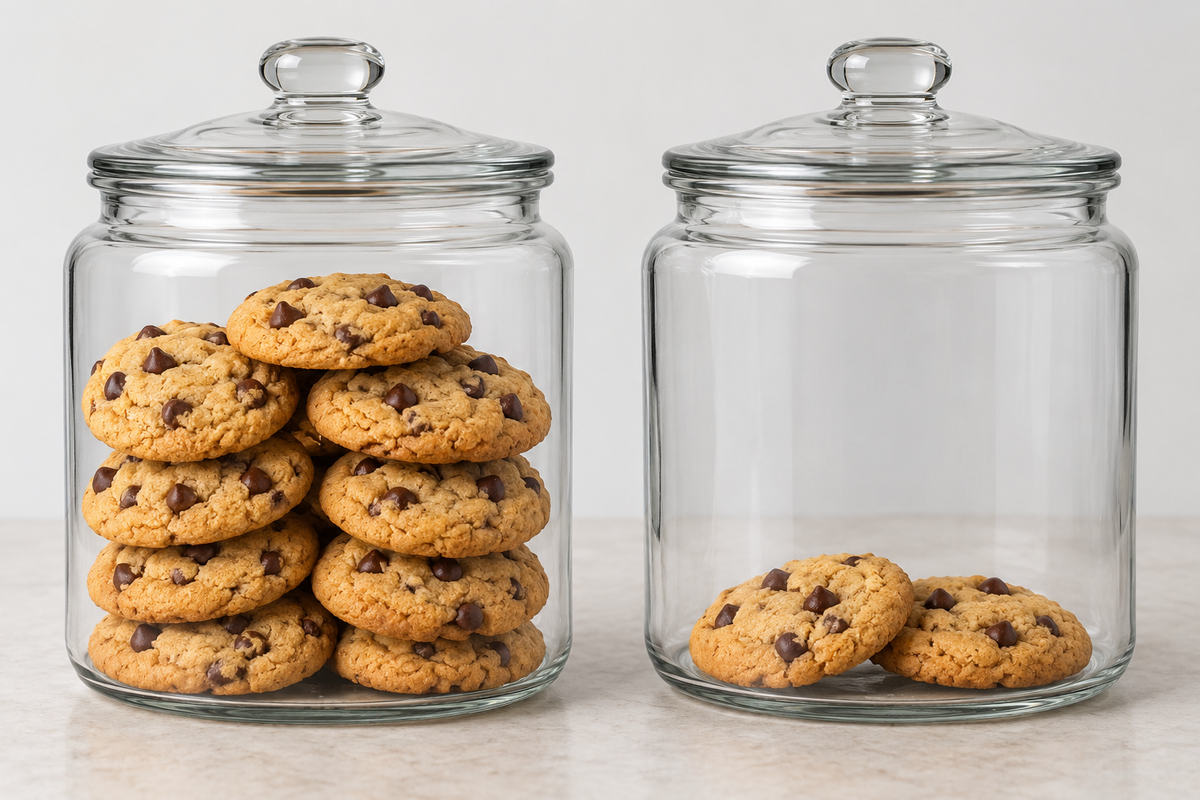
In 1975, a team led by psychologist Stephen Worchel sat women from an introductory psychology class at the University of North Carolina in front of a glass jar of chocolate chip cookies. Some jars held ten. Some held two. Same cookies.
The women looking at two cookies liked them more, and rated them more attractive, than the women looking at ten.
Then the researchers got sneaky. Partway through, a second experimenter walked in, apologised for interrupting, and swapped jars. A woman who'd been looking at ten cookies was suddenly looking at two. She rated them higher still. Losing something beat never having it.
The excuse for the swap mattered as well. When the second experimenter said his own participants had eaten more cookies than he'd expected, the two left behind were rated higher than when he said he'd taken the jar by accident. Scarce because other people wanted them beat scarce by mistake.
The cookies that had just become scarce were also judged to be worth more per pound.
The authors spelled out the lesson for anyone with something to sell. Start with plenty, then cut the supply fast and blame popular demand.
One more result. Everyone was asked how good the cookies tasted. Scarcity made no measurable difference.
The cookie didn't get better. The feeling about the cookie did.
It's one study, on about two hundred students, half a century ago. Hold it loosely. You've met the idea anyway, every time a booking site told you two other people are looking at this room.
There's a catch, and the researchers found it themselves. They ran the experiment a second time and asked everyone afterwards what they thought it was about. Thirteen of the 66 had worked it out. Their ratings ran the other way: they liked the cookies that had just become scarce the least. Too few of them to prove anything, but the pattern was exactly backwards.
So consider yourself warned. It works best on people who don't see it coming.
We ran our own version, with eggs
New Zealand got a live test in January 2023. A law against battery cages took effect on 1 January, supply was already squeezed, and Foodstuffs put temporary limits on how many eggs each customer could buy, CNN reported.
Trade Me told CNN that searches for chickens and chicken gear were up 190% that month on the same stretch a month earlier. A bakery owner near Christchurch said his sister's hens had sold at auction for more than double the usual price.
The SPCA felt the need to remind everyone that hens live eight to ten years and don't lay for all of them.
Nobody needed a study to tell them eggs mattered. The moment there weren't enough, a lot of people decided they wanted their own supply.
The potato with a guard on it
The most famous use of the trick may be a legend.
The story goes that in 1786 Antoine Parmentier, who'd lived on potatoes as a prisoner during the Seven Years' War, borrowed about two hectares outside Paris from Louis XVI. Anything grown underground was considered poor people's food. He planted potatoes anyway and had soldiers guard the field. Word went round that anything guarded must be valuable. The crop was stolen.
The story is disputed. Neuilly-sur-Seine, the town where the field was, put potato flowers on its coat of arms regardless. Civic heraldry has never been big on fact-checking.
The scarcity is real
Here's the uncomfortable part. The notice on the supermarket door is made up. The scarcity isn't.
Just 0.6% of New Zealand's farmland is certified organic, according to the 2025 market report from Organics Aotearoa New Zealand, the sector's national body. That's 89,544 hectares.
FiBL's 2026 global figures put Liechtenstein, the top country on this measure, at 43.5%.
The same OANZ report puts New Zealand's organic exports at $606.7 million a year. Spending on organic here at home, including $190 million in cafes and restaurants, comes to $572 million. The overseas customer is the bigger one.
So the scenario at the top isn't much of a stretch. Organic food in this country is genuinely scarce. We just never describe it that way.
Two cookies the whole time
If scarcity makes people want things, why isn't anyone queueing for organic in general?
Go back to the jar. The biggest jump came from watching the supply drop, and from being told it dropped because other people wanted it. Organic as a category has never had that moment here. It's been two cookies in the jar the whole time. Nobody swapped it in front of you.
Some of the best of it never reaches the jar at all. The finest organic kiwifruit grown in this country is easier to buy in Sacramento than in Tauranga, because Organic SunGold is grown for export. Nobody tells you you're missing out on it. It was never meant for you.
Where the queue already is
Make the scarcity visible, though, and people behave exactly like the students.
Last Christmas I bought a punnet of Peter Robson's strawberries at Commonsense in Mt Eden. Best strawberry of my life. I went back the following week for more, and they were gone. The staff said they couldn't keep up: the berries sell out as soon as they arrive. That's at around $10 a punnet.
Nobody put up a notice. The supply is small because one grower in Te Horo can only pick so many. And the reason the shelf is empty is the one the cookie study found most powerful: other people got there first.
Someone else knows something
So who gets the strawberries? Not people on a list. People who found out first.
That's the real gate, and it isn't made of soldiers. It was the point of It Usually Starts With One Fact: most people come to organic through one thing they learned, a new baby, say, or a "banned in Europe" that turned out to be true. And of the piece on time: working out whether it's worth it costs hours, and most people don't have them spare.
So the nagging sense that someone else knows more than you is not a sales tactic here. Mostly it's just true.
Take the notice down
Here's the honest version of the notice on the supermarket door.
There's no list. Nobody's guarding anything. There's 0.6% of the farmland, and a strawberry grower in Te Horo who can't keep up.
The people who get the strawberries aren't special. They knew about them, and they turned up on the right day.
Go early.
Before you go
If you want more like this in your inbox, sign up free. If this was useful and you'd like to chip in once, leave a tip.