Don't Be Too Patient: What England and Denmark Told New Zealand Organics
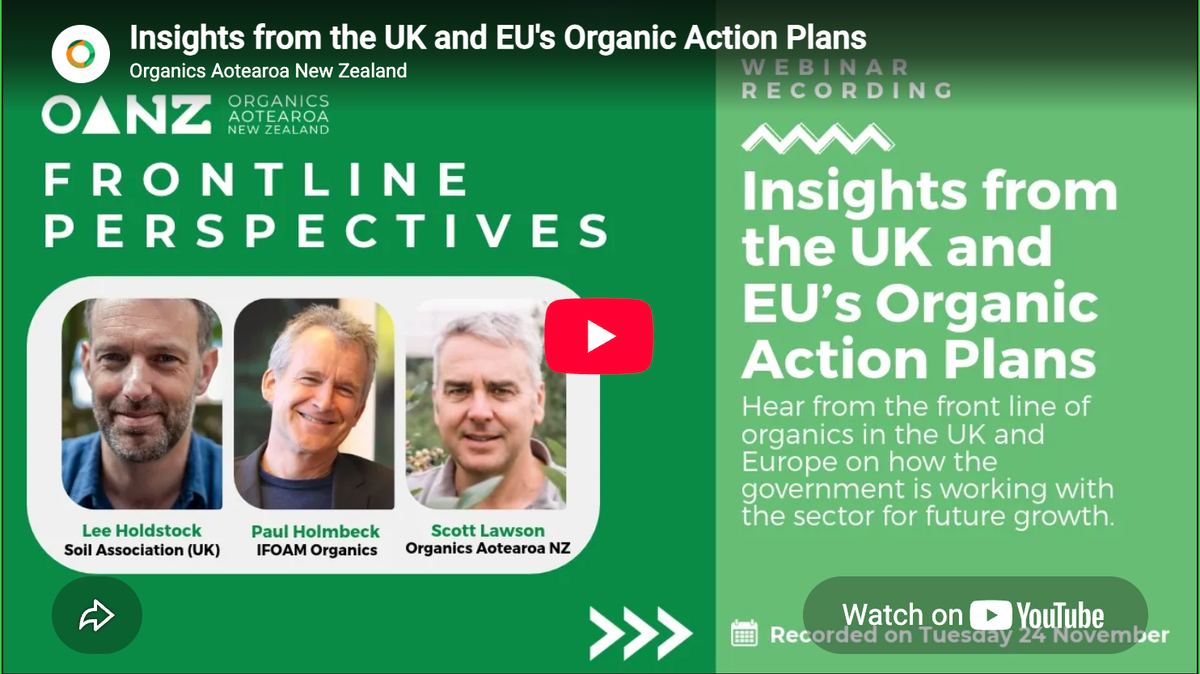
Lee Holdstock's lesson from England was that you have to be really patient. Paul Holmbeck's first words in reply were "don't be too patient." They were on the same webinar, and they were both right.
OANZ, the organic sector's industry body, ran the session on 24 November 2026, five days after its webinar on gene-silencing bee treatments, as the last of its webinars before the election result, which host and OANZ adviser Brendan Hoare said was due on Friday 27 November. Holdstock is head of regulatory and trade affairs at England's Soil Association. Holmbeck spent 17 years as political director for organics in Denmark and sits on the world board of IFOAM Organics International. OANZ board member Scott Lawson, who grows blueberries and carrots in Hawke's Bay, set out where New Zealand stands. Holmbeck joined at breakfast, Danish time. Hoare hoped that wasn't a hot toddy in his mug.
Where New Zealand is starting from
Lawson put the organic sector at about $1.2 billion, with just over $600 million of that in exports, and said OANZ's last market report showed growth of 9% a year. The Organic Products and Production Act 2023 takes full effect in March 2028, after what Lawson called almost 20 years of the sector asking for it. New Zealand also has something no other country has: a dedicated Associate Minister of Agriculture for Organics, Mike Butterick, appointed in May 2026. Butterick spoke to OANZ's Vote Organic webinar in October and defended National having no specific organics policy.
What it doesn't have is much money. Lawson said OANZ is a voluntary membership organisation that has had very little government support. When something big comes along, like the Gene Technology Bill, it raises money from the public and ring-fences it so the rest of its advocacy stays separate. Hoare said OANZ has put a manifesto to all the parties, along with a budget he described as costed and very reasonable.
England: seven years and four ministers
England went more than 20 years without an organic action plan until the government published a new one on 14 October 2026. Holdstock said the Soil Association had been working on it through the English Organic Forum for six or seven years. Scotland already got its own plan at the start of 2026.
The waiting followed a pattern. Holdstock described a minister "hovering over the thing with his pen and then he got sacked," and said it happened to them about four times. One minister was reshuffled and, luckily for them, came back at a higher level.
What finally moved it was evidence. Holdstock said the UK organic market has grown every year for 15 years while organic farmland went the other way, from 5% of the UK's land area to 3%. That gap left the country more dependent on organic imports, and the trade imbalance became the core argument. The sector also showed the government where organic farming fits its existing environmental plans, particularly on biodiversity and water quality, and made the case for local economies, jobs and public procurement.
There is a catch. The plan has no specific budget, so Holdstock said the sector now has to prove its worth and get creative about funding. The 10% figure that gets quoted is officially an "ambition", not a target. He said it came from independent modelling of what 10% organic would look like, and the sector and the government settled on it as realistic enough to hold people to. He contrasted it with the EU's more ambitious Farm to Fork target, which he said inspires people but which modelling he has seen puts Europe on course to miss, at about 16%.
Late in the process the sector added a data observatory to the plan. Holdstock's reasoning was simple: without numbers to show progress, nobody should honestly expect a second plan.
Denmark's four lessons
Holmbeck said all 27 EU countries now have national goals for growing organic farmland, backed by successive EU action plans modelled on Denmark's. The European Commission says it intends to put at least 30% of its agricultural research and innovation budget into topics relevant to organics.
Denmark is the country I compared New Zealand with earlier this month, at 11% organic farmland against our 0.6%. Holmbeck said organic now takes 30% to 60% of retail sales for many basic foods, including milk, eggs, flour and many fruits and vegetables. Public kitchens in Danish cities of any size are 60% to 90% organic. On the farm side he put organic at about 40% of vegetable production, 25% of eggs and 13% of milk. None of it happened on its own, he said. Policy was the key, and he gave New Zealand four lessons from it.
The first, and the one he ranked above everything else, is to invest in the organic sector's own capacity to drive change. He said the three leading organic markets, Switzerland, Austria and Denmark, have two things in common: organic organisations that can work professionally with retailers, and policy that supports that work. He called it the most important proposal in OANZ's manifesto, and said that without it nothing else really happens.
The second is to pull and push at the same time, building markets while helping farmers convert. On the farmer side he suggested cheap organic transition checks, where someone walks the farm with the farmer, and investment in farmers learning from each other. On the market side he told New Zealand not to focus only on supermarkets, and to back the local food movement and the young farmers building local markets.
The third is a stakeholder body embedded in the ministry, ideally set up in law, with a mandate to develop policy and to keep pushing until it is actually implemented. Denmark had an Organic Council to advise its ministry. Asked what OANZ's manifesto had missed, this is what he named.
The fourth is to build organics into bigger policies on water, climate and biodiversity. Holmbeck said most of Denmark's organic funding has come that way rather than through organic budgets, including €170 million for developing plant-based organic foods in its 2021 climate policy for agriculture.
Can a volunteer sector do this?
Lawson asked the question OANZ lives with. Can a sector get an action plan in place and working with little more than membership money and volunteer time?
"I would say the short answer is no," Holmbeck said.
In Denmark, he said, farmers put in the first seed money, then processors as they grew stronger, and those investments paid for the lobbying that brought in more resources. Volunteer effort is great, he said, but it won't go on forever. Denmark also chose to put its energy into building the sector rather than fighting every battle, and found that a stronger sector gave it more influence on issues like GMOs anyway. He noted Denmark passed the world's first GMO law.
Hoare said OANZ has been asking for a body across several ministries, as New Zealand once had. Holmbeck's advice was to be strategic instead: scan which policies are in the pipeline, on diets or biodiversity for example, and turn up with concrete pieces of organics to build into them.
What members asked
On certification costs, Holdstock said Soil Association Certification, owned by the Soil Association charity, sets its fees so larger businesses pay a levy that helps certify smaller growers below cost. Holmbeck said certification and inspection in Denmark is done by the government for free, and the sector has had to fight several times to keep it that way. His argument is that a farmer shouldn't have to pay more to farm in a way that benefits everyone. He also pointed to participatory guarantee systems (PGS), a cheaper, peer-based form of certification that he said is booming in the global south, and said Chile and Brazil now recognise each other's.
On the age of farmers, Holdstock said the average UK farmer is approaching their late 50s and organic farmers are only a couple of years younger. Holmbeck said that in Denmark, "we have more farmers over 90 than we have under 25." He pointed to Portugal, which targeted recruitment and subsidies at young organic farmers, and said it cut the average farmer age dramatically while growing organic land among the fastest in Europe.
On regenerative farming as a stepping stone, Holdstock said yes, in the UK a fair number of farmers who try regenerative go on to full organic. He quoted the line, which he credited to Holmbeck, that the sector needs to be "woke to regen, not provoked by it." Holmbeck added the guard rails. Regenerative is a huge tent, he said, with experimenting farmers at one end and, at the other, big food and agrichemical companies claiming the word on the strength of a few practices and possibly no change in pesticide use. Holdstock said new EU rules on green claims should make generic claims like that harder to make.
The last word
Hoare asked each speaker for one thing New Zealand shouldn't lose sight of. Holmbeck said to build the organic sector's own infrastructure and capacity, which means growing the organisation and finding the investment for it. Holdstock said to collect the data, because buyers increasingly want evidence that the impact is real.
Lawson's worry was closer to home. He said New Zealand runs a two-speed economy, with real focus on exports and not enough support for local food production, while organic imports rise and growers get older. He wants the lessons from England and Denmark turned into policy that covers both the big exporters and the small, younger growers feeding people here.
The recording is on OANZ's YouTube channel. It runs about 45 minutes, and the minister with the pen is worth the first 10.
Insights from the UK and EU's Organic Action Plans
Before you go
If you want more like this in your inbox, sign up free.
If this was useful and you'd like to chip in once, leave a tip.