Taiwan Sent Back a Tonne of New Zealand Strawberries. They'd Have Been Legal Here.
Taiwan's food regulator stopped a Costco shipment of New Zealand strawberries at the border this week. The two pesticides it found are both legal on strawberries here, at limits several times higher. Here's why other countries draw the line lower, and what our own testing finds.
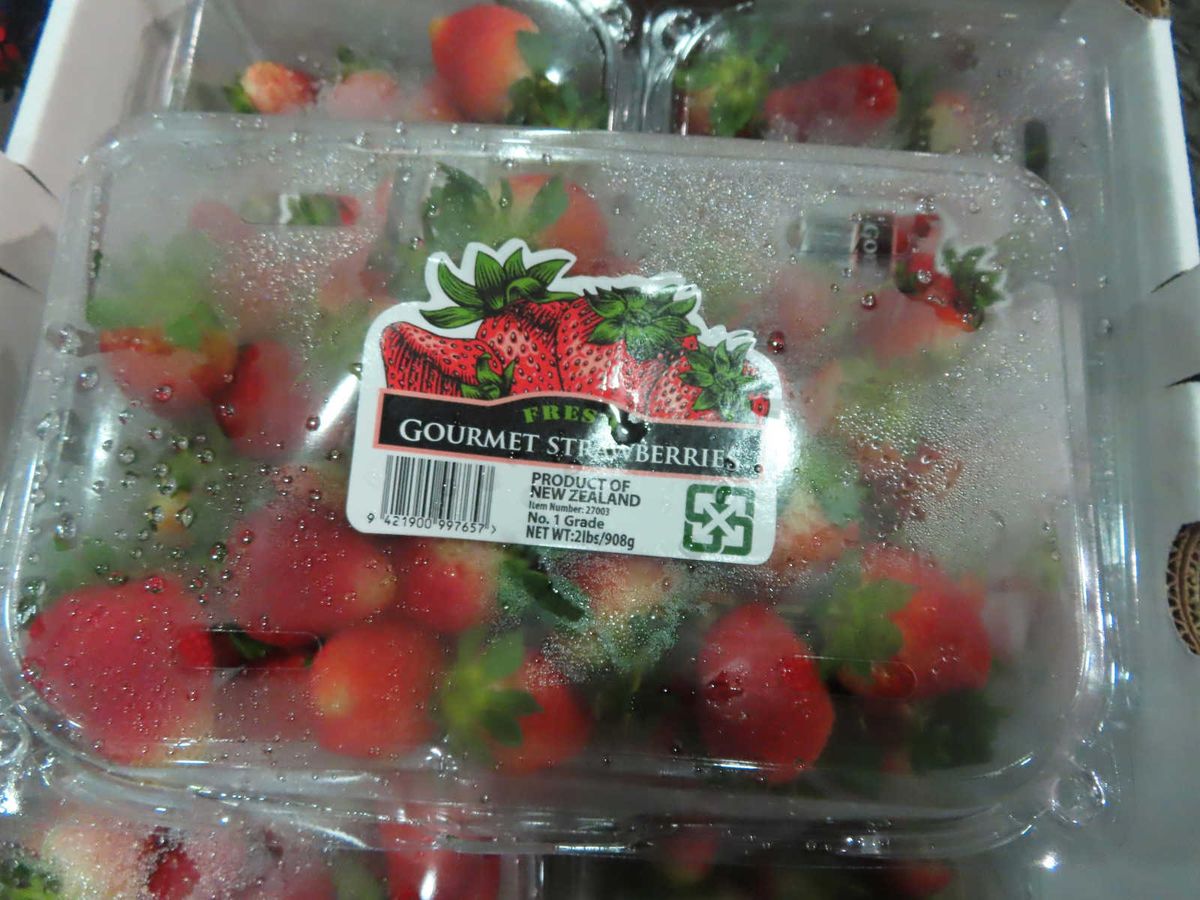
On 24 November Taiwan's Food and Drug Administration rejected a Costco shipment of New Zealand strawberries at its border. Testing found 0.7 ppm of the insecticide carbaryl, against a Taiwanese limit of 0.5 ppm for small berries. It also found 0.25 ppm of the fungicide fenhexamid, which Taiwan doesn't allow on strawberries at all. The whole shipment, 157 boxes and 1,140.45 kg, has to be shipped back or destroyed. Taiwan has lifted its testing of Costco's strawberry imports from as little as 2% of shipments to between 20% and 50%, Taiwan News reported. The fruit carried the brand name NEW ZEALAND GOURMET, and Costco told Taiwanese reporters none of it was sold in Taiwan. The rejection was announced the week Costco Taiwan's Black Friday sale started. Timing is everything.
It wasn't the only one. A week earlier, on 17 November, the same agency rejected 1,056 kg of "FRESH NZ STRAWBERRIES" brought in by a different importer, Jia Lan Horticulture Engineering. That batch carried 2.0 ppm of carbaryl, four times Taiwan's limit, plus 0.04 ppm of fenhexamid. Two shipments, two importers, more than two tonnes of fruit, one week.
Here, it would have been fine
New Zealand sets its own limits in the Food Notice on maximum residue levels, the current version of which came into force on 10 September 2026. It allows carbaryl at 3 mg/kg on "Fruits", one blanket figure for the whole category. It allows fenhexamid on strawberries at 3 mg/kg. (One ppm is one mg/kg.)
Put Taiwan's readings next to those numbers. On the Costco shipment, the carbaryl was about a quarter of what New Zealand allows and the fenhexamid about a twelfth. Even the earlier batch's 2.0 ppm of carbaryl was two-thirds of the New Zealand limit. On the numbers, both rejected shipments could have been sold here without anyone breaking a rule.
Both chemicals are still in use on New Zealand strawberries. WorkSafe's restricted entry rules, which came into force in June 2025, list a 500 g/litre carbaryl product with a 12-day stand-down before workers can re-enter a sprayed strawberry crop. Bayer lists its fenhexamid product Teldor for strawberries with a one-day withholding period, which means it can go on the day before picking.
Why other countries draw the line lower
My first thought was that Taiwan is simply fussier. The answer turned out to be three different things wearing the same coat.
Fenhexamid: Taiwan never set a limit. Taiwan runs what's called a positive list. If a pesticide and crop combination isn't on the list, the residue "shall not be detected", a US Department of Agriculture briefing on Taiwan's system explains. Taiwan does not automatically adopt international Codex limits, and getting a new one approved takes about two years. That's how the system bites. In 2024 a Japanese strawberry shipment was seized for 0.02 ppm of flonicamid because Taiwan had no strawberry limit for it; days later a 0.7 ppm limit took effect and the same fruit would have been legal.
It isn't only us. Over one six-month stretch Taiwan tested 676 shipments of Japanese strawberries and 30 failed, mostly on residues. So on fenhexamid, Taiwan's zero is about paperwork as much as danger. The European Union, hardly relaxed about pesticides, set its fenhexamid limit for strawberries at 5 mg/kg in 2015, above New Zealand's 3. Fair is fair.
Carbaryl: much of the world has moved on. This is the more uncomfortable one. Taiwan's limit is a sixth of ours. The EU went further in 2007 and refused to approve carbaryl at all, ordering every member state to withdraw authorisations by 21 November 2007. Its reasons included that consumer exposure had not been shown to be acceptable, concerns about possible carcinogenic properties, and high risks to birds, mammals and aquatic life. In New Zealand, the Environmental Protection Authority put carbaryl on its Priority Chemicals List of substances most in need of review. In 2021 it said carbaryl use had dropped because products had been withdrawn from sale. Nineteen years after Europe, carbaryl products are still listed in New Zealand's workplace spray rules. And somebody's strawberries had it on them.
The default limit: ten times looser. When New Zealand has no specific limit for a chemical on a food, a default of 0.1 mg/kg applies, as the 2022-23 residue survey report shows for imports. The EU's default is 0.01 mg/kg. Japan used 0.01 for glyphosate in honey, and that's what cost New Zealand beekeepers in 2021 (more on that below).
None of this proves New Zealand food is unsafe. Limits are set from residue trials and dietary risk assessments, and countries reach different answers. What it does show is that "within New Zealand limits" and "acceptable to our customers" are not the same sentence.
It isn't the first time
Japan's health ministry put New Zealand strawberries on stepped-up carbaryl testing from 18 January 2022, naming a shipper listed as FRESH AS.
Honey went through the same thing. Japan rejected five New Zealand honey shipments in early 2021 for glyphosate, in a market worth about $67 million a year. Japan's limit was 0.01 mg/kg. MPI's answer was to make glyphosate testing compulsory for honey going to Japan from 21 January 2021. That put an extra cost on beekeepers, who generally weren't the ones spraying.
What our own testing finds
New Zealand Food Safety runs the Food Residues Survey Programme, which buys produce off the shelf and screens it for hundreds of chemicals. Strawberries didn't appear in the over-limit lists of the last two published rounds. They did turn up in MPI's other big study, the Total Diet Study: all four summer strawberry samples carried residues, twelve chemicals between them, and one had acephate at about 30 times the limit for strawberries, as we reported in October. The leafy greens tell the rest.
In 2022-23 it tested 300 samples and found 33 results over the legal limit, from 27 samples. That's roughly one sample in eleven. Twenty-two of those samples were New Zealand grown. Kale and broccoli had chlorpyrifos over the limit. Silverbeet had 3.6 mg/kg of methamidophos, an organophosphate not authorised for that crop, against a limit of 0.01. That's 360 times over.
Documents released under the Official Information Act later showed the agency's own first assessment found that a health risk for children could not be excluded. A later assessment found no risk, citing washing, cooking and the one-off nature of the finding, NZ Food Safety's Vincent Arbuckle told Farmers Weekly. There was no recall. By the time anyone knew, the silverbeet had been eaten.
The 2024-25 round, published in March 2026, found 10 results over the limit from 6 samples. Every one was New Zealand grown; every imported sample passed. Watercress carried the insecticide indoxacarb at 1.8 mg/kg against a 0.1 limit, from off-label use. Beans carried sulfoxaflor at 1.3 against 0.1, also off-label.
And when limits are broken, little happens. RNZ reported in June 2025 that 75 breaches of residue limits in recent surveys had produced "educational letters" to seven businesses, no fines, no recalls and no prosecutions. The same reporting found a third of wheat samples tested in 2015 were over the glyphosate limit, some by 50 times, and MPI had not tested for glyphosate since. MPI's position is that none of the breaches posed a food safety risk and that 99.99% of test results were within the law.
Clean, green, and guessing
New Zealanders rate ourselves well. In Lincoln University's 2019 environmental perceptions survey, 63.3% said our natural environment was good or very good compared with other developed countries. It was the best-rated item in the survey, as it had been in every year the survey ran. Ask the plainer question and the confidence wobbles: only 34.4% agreed that New Zealand's environment is "clean and green", and about 39% disagreed. So we aren't sure we're clean. We're just sure we're cleaner than everyone else. In 2022 the survey dropped its questions on New Zealand's image altogether.
We also say we're worried. In 2007, 62% of New Zealanders told a government survey they were concerned about pesticides used to grow food, as we covered in October.
What nobody could tell you was how much we actually use. In 2022 the Parliamentary Commissioner for the Environment, Simon Upton, found officials lacked clear information on how much of each chemical is used, or where. More than 30,000 chemicals were approved for use, and only about 200 were regularly tested for in the environment. A Ministry for Regulation review published in 2025 noted New Zealand stopped providing pesticide data to the UN's Food and Agriculture Organization in 2009, and that there is no reliable New Zealand data on pesticide quantities. In that review's own comparison table, New Zealand's "2022" figures were 2009 numbers. In February 2026 the Environmental Protection Authority told an Official Information Act request it does not collect information on the amount used each year. Importers and manufacturers have had to report their quantities since 1 January 2026; as of mid-October, nothing from it had been published.
We went quiet. The UN estimated anyway. Its 2026 soil report described New Zealand as a "very high" user of pesticides, at about 8.8 kg per hectare in 2020. A country that believes it is cleaner than other developed countries, that hasn't counted its own sprays in years, is rated by the UN as one of the heavy users. Three facts. They don't sit comfortably together.
Old approvals hang around. The Ministry for the Environment wrote in 2019 that chemical approvals in New Zealand are mostly given in perpetuity, with no formal review period. Chlorpyrifos, the one found on that kale and broccoli, was banned by the EPA in July 2025; by then it was already banned in the EU and Canada. Most products had to be out of use by January 2026, but under the EPA's direction the last two can be used until 8 July 2027.
Meanwhile our buyers test. Japan tests. Taiwan tests, and in one week it sent more than two tonnes of our strawberries home.
Organic, as MPI defines it, means avoiding or excluding synthetic pesticides. Carbaryl and fenhexamid are both synthetic. Organic strawberries are hard to find in New Zealand. After this week, they look worth the hunt.
Before you go
If you want more like this in your inbox, sign up free.
If this was useful and you'd like to chip in once, leave a tip.