I Grabbed a BLT at a Petrol Station. It Had 71 Ingredients.
Bacon, lettuce, tomato, bread. It's a recipe that fits in its own name. The gourmet BLT I grabbed on Friday had 71 ingredients. I went through every one, then tried to work out how a sandwich ends up like this.
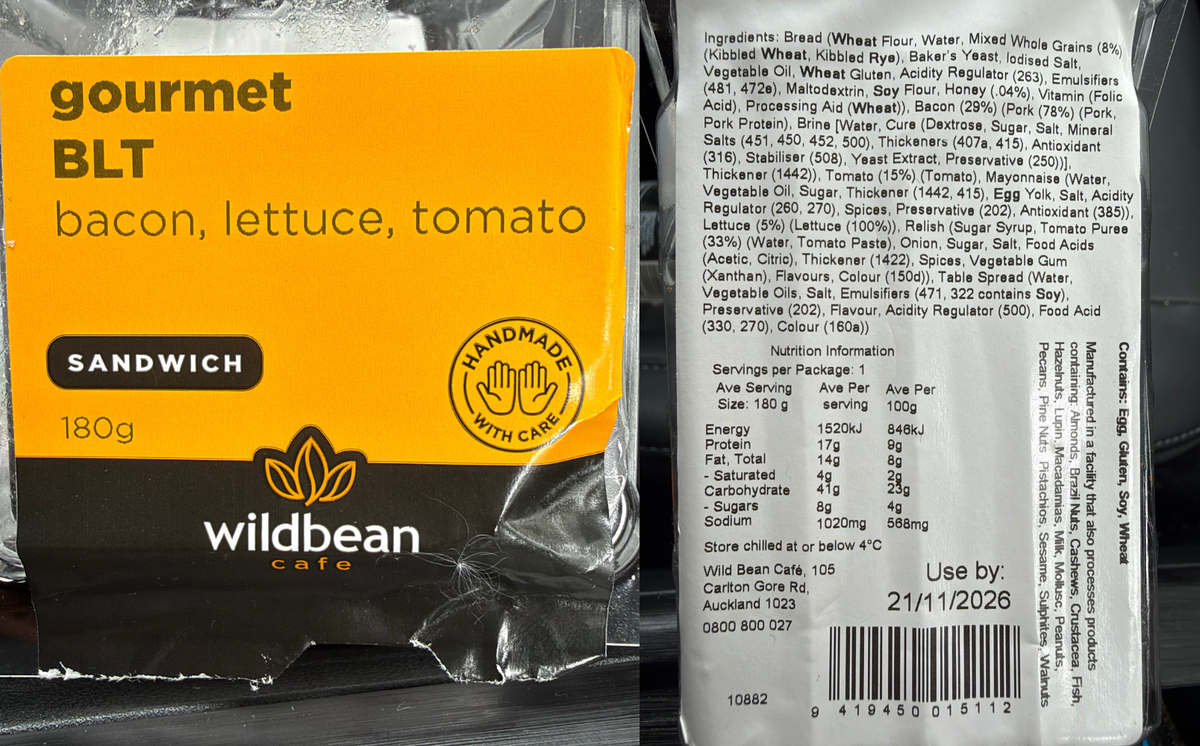
On Friday I drove to Tauranga for a work event. I was late, I was hungry, and I grabbed a sandwich from the petrol station on the way. The front of the pack said gourmet BLT, bacon, lettuce, tomato, with a little badge of two open hands and the words "Handmade with care". Somewhere down the road, I turned it over.
The BLT is one of the few foods that tells you its recipe in its name. Bread, bacon, lettuce, tomato. Bread at its simplest is flour, water, salt and a starter. Bacon is pork and a salt cure. Add the lettuce and tomato and you're at about eight ingredients, nine if you butter it. That's what I think a reasonable person expects when they pick one up.
This one has 71.
Here they are, straight off the back of the pack, with the numbers translated using the official food additive code list. Get comfortable.
The bread: wheat flour, water, kibbled wheat, kibbled rye, baker's yeast, iodised salt, vegetable oil, wheat gluten, calcium acetate (263), sodium stearoyl lactylate or a related lactylate (481), diacetyltartaric and fatty acid esters of glycerol (472e), maltodextrin, soy flour, honey (0.04%), folic acid, and a processing aid made from wheat.
The bacon (29% of the sandwich): pork, pork protein, water, dextrose, sugar, salt, three kinds of phosphate (451, 450, 452), sodium bicarbonate or carbonate (500), processed eucheuma seaweed (407a), xanthan gum (415), sodium erythorbate (316), potassium chloride (508), yeast extract, sodium nitrite (250) and a modified starch called hydroxypropyl distarch phosphate (1442).
The tomato (15%): tomato. Well done, tomato.
The mayonnaise: water, vegetable oil, sugar, modified starch (1442), xanthan gum (415), egg yolk, salt, acetic acid (260), lactic acid (270), spices, potassium sorbate (202) and calcium disodium EDTA (385).
The lettuce (5%): lettuce (100%). Someone in the label department wanted that on the record.
The relish: sugar syrup, tomato purée made from water and tomato paste, onion, sugar, salt, acetic and citric acids, another modified starch, acetylated distarch adipate (1422), spices, xanthan gum, flavours and caramel IV colouring (150d).
The table spread: water, vegetable oils, salt, mono- and diglycerides of fatty acids (471), lecithin from soy (322), potassium sorbate (202), flavour, sodium bicarbonate or carbonate (500), citric acid (330), lactic acid (270) and carotene (160a).
Count every line and you get 71. Twenty-three of them are different food additives. The bacon, lettuce and tomato, the three things the sandwich is named after, make up 49% of its weight. The other half is bread and condiments, which is a lot of supporting cast for a three-person show.
A few of my favourites
The bacon is 78% pork. The rest is a brine of water, sugars, phosphates, seaweed, starch and friends, plus "pork protein", which is pork added to the pork. Phosphates have been known for decades to increase the yield of meat products, because they help meat hold water. Adding protein back in does a similar job. There's a 2023 patent from food machinery company John Bean Technologies for injecting pork protein and water into pork bellies so the finished bacon weighs more than the raw belly did. I can't tell from the label exactly how this bacon was made. But on paper, the B in this BLT is partly water, held in place by additives.
Where did the pork come from? The label doesn't say. Bacon sold on its own has to carry its country of origin, but this bacon came inside a sandwich. NZ Pork says around 60% of the pork eaten here comes from overseas.
Sugar shows up seven ways. Dextrose and sugar in the bacon cure. Sugar in the mayo. Sugar syrup and sugar in the relish. Honey in the bread, and maltodextrin, which gets in on a technicality. It only adds up to 8 grams of sugars in the whole sandwich. It's not the amount that gets me, it's the commitment. It's in nearly every component, like a guest who turns up to every party.
The relish is mostly sugar syrup. Ingredients have to be listed in descending order of weight, and sugar syrup comes first, ahead of the tomato purée at 33%. And the tomato purée is itself water and tomato paste. Watered-down tomato, in a sandwich that already has a tomato in it.
The butter isn't butter. The table spread is water and vegetable oils with emulsifiers, and carotene (160a) to colour it yellow. Butter is cream and salt. This is 11 ingredients doing an impression.
The honey is 0.04% of the bread. Four parts in ten thousand. That's not a flavour, that's a cameo.
The processing aid is the line that says the least. Processing aids don't normally have to appear on an ingredient list at all. This one is only there because it's made from wheat, and wheat has to be declared even when it arrives as a processing aid. What it does in the loaf is anyone's guess.
The only name on the pack is Wild Bean Café, with a Carlton Gore Road address in Auckland. Who actually made the sandwich isn't stated. Handmade with care, by persons unknown.
Does anyone read this?
I didn't, not in the shop. I was hungry and in a hurry, which I suspect is how most of these get bought.
Food Standards Australia New Zealand surveys about 2,000 Australians and New Zealanders every year about labels. Its October 2026 report found 80.5% of people say they're confident using food labels. Among those who look at the ingredient list, food additives are what they look for most. Among the people who aren't confident, a third say they don't have time to read labels, a third say they often don't understand what the information means, and four in ten say the print is too small. On this sandwich the print is small and there are 71 things on it. I'd need my glasses.
How did a sandwich get here?
Bread is a good place to start, because it's the bit we used to make at home. Bread was once flour, water, salt and yeast, and took between eight and 20 hours to make. In 1961 the Chorleywood process changed that, and soft, consistent bread now takes much less time and costs much less to produce. Most of the numbers in the bread on this sandwich are there to make that speed work: helping dough handle the machines, keeping slices in shape, slowing the staling.
Multiply that thinking across every component and you get 71 ingredients. Each one saves a cent somewhere, or a day of shelf life, or a step in the factory. None of them is there because a BLT needed it.
The money explains the rest. Last year The Lancet ran a three-paper series on ultra-processed food, written by 43 researchers. The third paper describes the business model as using cheap commodity ingredients and industrial manufacturing to keep costs down. It says ultra-processed food is more profitable than other kinds of food, and that's what keeps it growing. It says these manufacturers are the most effective in the food business at generating shareholder returns. Global sales grew from US$1.5 trillion in 2009 to $1.9 trillion in 2023.
Shareholders are fine people, I'm sure. But they've never met you, they won't be in the car with you on State Highway 2, and your health isn't on their spreadsheet. The person who wants your BLT to be bacon, lettuce and tomato is you.
Does it get worse from here?
Probably, if nobody's looking. Every ingredient that does its job cheaper than the real thing is an argument for the next one. Today the butter is a spread, the relish is syrup and the bacon carries water. I'd like to think there's a floor. I haven't found it yet.
And the health bit, briefly
Everything on this label is legal. New Zealand Food Safety says all additives go through a safety assessment, with each one checked to be safe at the level proposed for it. One at a time, that is. Nobody eats them one at a time.
A few things are worth knowing if this is lunch most days. The World Health Organization's cancer agency classifies processed meat as a cause of bowel cancer, and bacon counts. This one sandwich carries 1,020 mg of sodium, about half of the WHO's daily limit of 2,000 mg, and that's before breakfast or dinner. And researchers are only just starting to look at what a steady diet of these additives does. One large French study linked the emulsifier in the spread (471) and the seaweed family in the bacon (407a) to higher cancer risk. It's early, it's observational, and the authors say it needs repeating. But it's a question worth having in the back of your mind next time you're standing at the chiller.
One BLT on a Friday isn't the problem. It's the habit, and the fact that the front of the pack lists three ingredients when the back lists 71.
Eight would have done it. The tomato managed one. So did the lettuce, and it put it in writing: lettuce (100%).
Before you go
If you want more like this in your inbox, sign up free.
If this was useful and you'd like to chip in once, leave a tip.