The Bugs That Learned to Ignore RNA
The New Zealand team testing Norroa says pests can become resistant to RNA pesticides within a few generations. Monsanto paid for both studies they cite, and what those found is stranger than resistance to a single product.

Buried in the conclusions of a June 2026 review by the New Zealand team testing Norroa is one sentence: "Resistance development to dsRNA biopesticides is possible within a relatively small number of insect generations." Three of the review's authors work for GreenLight Biosciences, the company that makes Norroa, and GreenLight helped fund it along with the Ministry of Business, Innovation and Employment. So this isn't a warning from the product's critics. It's from the people who want it on the market.
The review backs that sentence with two references and moves on. It doesn't say what those two studies found. They're worth reading, because Monsanto paid for both, and what they found goes further than "pests can get used to it."
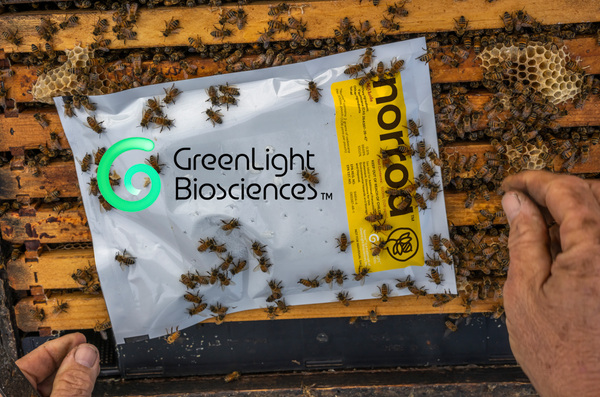
If you missed the earlier posts, the short version: Norroa is a pouch you put in a beehive. It carries a piece of double-stranded RNA (dsRNA) that switches off one gene in the varroa mite. It's registered in the United States, and we covered the organic sector's webinar on it here. A separate post looks at GreenLight itself. This one is about what happens when the pest fights back.
Study one: the rootworm
In 2018, twenty scientists published a paper in PLoS One titled "Development and characterization of the first dsRNA-resistant insect population." Every one of the twenty worked for Monsanto. Monsanto paid for the study and had a hand in its design, its analysis and the decision to publish.
The insect was the western corn rootworm, and the RNA came from Monsanto's own genetically modified corn, which makes a dsRNA that kills the larvae. In 2012 the team planted a tented plot of that corn near Waterman, Illinois, collected the beetles that survived it, and kept selecting them in the lab. The resulting colony was at least 130 times more resistant than normal rootworms.
Then came the part that matters for anyone thinking about a second or third RNA product. The resistant larvae weren't only shrugging off the one RNA they'd been bred against. They were resistant to every other dsRNA the team tested on them, aimed at completely different genes. The reason was simple and slightly alarming: their guts had stopped taking the RNA in. If the RNA never gets into the cells, it doesn't matter which gene it was designed to switch off.
The beetles stayed resistant as adults. The resistance was recessive, carried at a single spot in the genome, and it didn't protect them against the Bt toxin in the same corn, which is why the authors recommended stacking RNA with other traits and planting refuges of ordinary corn.
It's a bit like a lock company publishing the best paper on picking its own locks. To their credit, they published it.
Study two: the potato beetle
The second study, published in Scientific Reports in 2021, is closer to Norroa because nothing was genetically modified. The team, led from the University of Tennessee, dipped potato leaves in dsRNA and fed them to Colorado potato beetles. That's the same basic idea as GreenLight's potato spray, Calantha, though Calantha targets a different gene. Monsanto funded the work alongside a United States Department of Agriculture grant, and three of the authors were Bayer employees.
In the first round of selection, about 1 in 300 larvae in the main colony survived. By the ninth round, 95 percent survived a dose nearly 800 times stronger. The finished colony was more than 11,100 times more resistant than the beetles it came from. It was also resistant to a second dsRNA aimed at a different gene, and only about four times less sensitive to a Bt protein. The authors called it "the first documented case of resistance in an insect pest with high pesticide resistance potential using dsRNA delivered through non-transgenic techniques."
When Science magazine covered RNA pesticides in June 2024, William Moar, a Bayer scientist on both studies, called the rootworm result "sobering," because there's no easy way round it.
What nobody has tested in varroa
Here's the gap. I couldn't find a single published study testing whether varroa can become resistant to Norroa's RNA, or to any RNA. The New Zealand review doesn't report any such testing. A GreenLight-funded field trial in Florida, published in March 2026 with five GreenLight staff among its authors, says outright that it didn't assess resistance to Norroa.
What we do know isn't reassuring. A review from the University of the Sunshine Coast, published on 5 November 2026, says the way varroa takes up dsRNA "remains poorly understood." The authors couldn't find the gene that many insects use as their main RNA doorway, and suggest mites may take RNA in by a more general route. The same review names reduced uptake, the rootworm trick, as the resistance mechanism seen so far. Its abstract also says RNA is less prone than chemical miticides to resistance caused by changes at the target. Both statements can be true at once, and that's the uncomfortable bit: the resistance that's actually turned up in the lab doesn't touch the target at all.
The same four Australian authors wrote in The Conversation in June 2026 that RNA treatments "are also unlikely to give rise to genetic resistance." By November, writing for scientists, it had become "not impossible." Both are defensible. They just land differently.
New Zealand's mites already have form. A 2024 Victoria University study found it took 26 times more flumethrin to kill half the mites tested than in a 2003 trial, which the authors read as evidence of developing resistance. It found no resistance to amitraz. Those two chemicals are the workhorses: between 2017 and 2021, 84 to 92 percent of commercial beekeepers used amitraz each year, and 68 to 81 percent used flumethrin.
Norroa also doesn't kill mites. The American label says it works "by preventing the production of offspring" and should go in early, before mite numbers reach the treatment threshold. Phil Lester, who leads the New Zealand research, told Farmers Weekly in June that the mites are only sterile while they're exposed to the RNA.
The fair bit
Everything above happened in a lab. I couldn't find any report of a pest becoming resistant to an RNA pesticide in a real field, anywhere, as of November 2026. The potato beetle authors said their method, which used beetles collected from several states, constant exposure and steadily rising doses, probably sped resistance up compared with a farm. They also said resistance genes "may not be rare in field populations," so the caveat cuts both ways.
The industry's answer is resistance management, and it's not nothing. A 2025 review led by GreenLight's Ken Narva says RNA sprays should be timed so only one pest generation is exposed, then followed with a product from a different mode-of-action group. Calantha's US label tells growers to avoid using it on consecutive generations, to watch for loss of effectiveness, and to stop at four applications a year. New York state goes further and limits Calantha to two applications a year to keep the beetle from developing resistance. Norroa's label says to rotate it with other miticides "where possible."
The catch with rotation is the rootworm result. If resistance comes from the gut refusing RNA, rotating from one RNA product to another won't help. You'd have to rotate back to the chemicals, the very ones Norroa was meant to rescue beekeepers from.
Where it stands here
As of 23 November 2026, a search of MPI's ACVM register for "Norroa" and for its active ingredient, vadescana, returns nothing. GreenLight's application to register it was notified in the Gazette on 28 May 2025. The New Zealand review says the country "has yet to register the use of any dsRNA biopesticide."
So there's no New Zealand label yet, and no way to know what resistance rules it will carry. The American labels already differ on one small, telling point. If a Calantha grower thinks the spray has stopped working, the label says to report it to their local GreenLight Biosciences representative. Calantha's registration expires at midnight on 31 December 2026.
Before you go
If you want more like this in your inbox, sign up free.
If this was useful and you'd like to chip in once, leave a tip.