I Found Out Who Made My Chocolate. A Second Bar Told Me.
In August I couldn't find out who made my Alter Eco bar. Then I bought a Bennetto, a brand I thought was from here, because it said Swiss-made. Both lead to the same company, a chocolate maker owned by a Swiss retailer.
In August I turned over an Alter Eco bar, found "Made In Switzerland" printed on the back, and couldn't find out who had actually made it. The box said distributed by, not made by. I said I had a suspicion. I didn't print it.
A different bar answered the question.
The bar I thought was from here
A while later I picked up a Bennetto. I had it filed in my head as a New Zealand chocolate. Then I wondered whether I was mixing it up with Bennetts, which I had somehow relocated to Devonport. What actually got it into my basket was the line on the pack. Made in Switzerland.
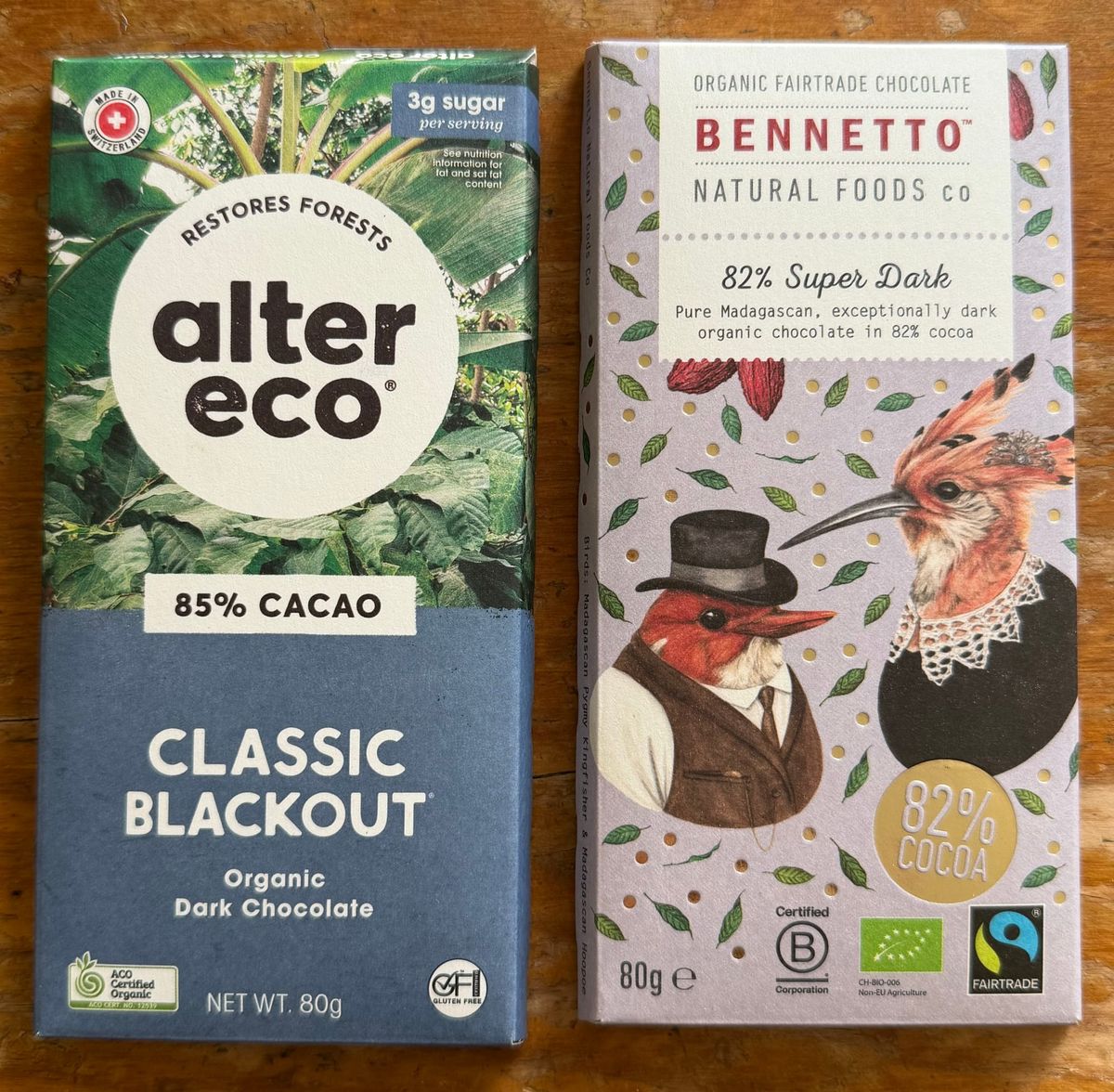
Two organic bars, two brands, both Swiss-made. So I put the boxes side by side on the kitchen table.
What the boxes say
The Alter Eco box says it is distributed by Alter Eco Pacific in Sydney. Its barcode starts 93, the Australian prefix.
The Bennetto box gives Bennetto Natural Foods, 63 Cleveland Street, Christchurch, with a UK importer in Covent Garden. Its barcode starts 94, New Zealand's prefix. Next to the address, in capitals with a Swiss flag: MADE IN SWITZERLAND.
Neither box says who made the chocolate.
Then there are the little printed codes at the bottom, the ones nobody reads.
The Alter Eco reads "Best If Used By: 15/03/28", and under it, 1845989A.
The Bennetto reads "Best Before / Batch Code: 08 05 2028", and under it, 1822025A.
Different boxes, different date styles. Same batch code format: seven digits, starting 18, ending in the letter A.
A matching code format doesn't prove two bars came off the same line on the same day. These clearly didn't; their best-before dates are nearly two months apart. What it does suggest is one coding system. So I went looking for whose.
Same maker
The Chocolate Scorecard rates chocolate companies on how they treat cocoa farmers and forests. Its entry for a Swiss company called HALBA lists the brands HALBA makes. They include Coop in Switzerland, Alter Eco in the US, Canada and Australia, Alter Eco in France, and Bennetto in New Zealand and Australia.
Bennetto's founder has said so too. In May 2023, Lucy Bennetto told the Australian trade magazine Convenience World that the brand produces "with our Swiss manufacturing partner, Halba".
On the Alter Eco side, a US customs record does the talking. A bill of lading dated 6 December 2023 lists Halba as the shipper, at Salinenstrasse 70, Pratteln, Switzerland. The consignee is Alter Eco America in San Francisco. The shipment weighed 68,059 kg. That is a lot of 85 per cent.
That record covers chocolate going to the United States. My bar came through the Australian arm, and the Scorecard lists Alter Eco Australia among Halba's brands.
So the answer to August's question is Halba. Bennetto is made by the same company.
Who Halba is
Halba began in 1933, when a Mr Hallheimer and a Mr Baer started making chocolate in a Swiss living room. The company is named after the pair of them. Hal, Ba.
It has been producing for Coop since 1960. That's the Swiss retail company Coop, which Wikipedia describes as Halba's owner. Coop acquired it in 1972. Halba made its first organic chocolate in 2005. Today it signs itself "HALBA, Division of Coop Cooperative", at the same Pratteln address that appears on the Alter Eco shipping record.
Halba's own figures show 22,500 tonnes of chocolate sold, to 119 business customers in 16 countries. About 40 per cent of its chocolate goes to Coop. The rest goes to third-party customers around the world, New Zealand among them. In 2021 Coop replaced its "Qualité & Prix" own-label chocolate with a range called "Halba - Le Chocolatier Suisse", made by Halba.
In the Chocolate Scorecard 2026, Halba took first place worldwide among medium-sized and large chocolate makers. That was a first for the company.
So the company behind two of the more earnest organic bars on our shelves is a supermarket's chocolate division, one that also turns out the supermarket's house brand. It also came top of this year's Chocolate Scorecard. Both things are true.
And Bennetto really was from here
This is the part I had half right.
Bennetto Natural Foods was founded in 2010 by Lucy Bennetto, a high school English and Drama teacher. It began on a kitchen bench with a spice grinder, organic cocoa beans and a group of willing student taste-testers. In an interview on the company's website, she says the first cocoa came from Acopagro, a Fairtrade cooperative at the edge of the Amazon in Peru. She also says, "We started in a garage."
In March 2018, Newshub reported that a Swiss manufacturer had approached her. "We met in Australia at a trade show, they approached our stand, really loved the branding, and also the ethos behind our products," she said. The story didn't name the manufacturer.
By then the 100 gram blocks were already "made entirely in Switzerland". The drinking chocolate was still being made in the test kitchen at the back of her house.
Today the Bennetto website says every bar is made in Switzerland. In the founder interview, Lucy says the manufacturing partner is in Switzerland and "we made this choice for scale". The about page says product development "still begins in Christchurch".
One customer review on that same website, from August this year, says: "I did prefer it when it was NZ made and 100g, but appreciate times change." The bar in front of me is 80g. The 2018 story has the 100 gram bars already Swiss-made, but given what my own memory did with Bennetts, I'm in no position to argue.
It is still New Zealand owned. On the Companies Register, Bennetto Natural Foods Co. Limited is wholly owned by Bennetto Food Brands Limited. Lucy Bennetto holds 83 per cent of that company. One other shareholder, also in Christchurch, holds the rest.
Alter Eco, as I wrote in August, now belongs to Trek One Capital, a Texas investment group. Same Swiss maker. One brand answers to Houston, the other to the teacher who started it in a garage.
Bennetto doesn't name Halba on its box or its website either. It does get closer than Alter Eco. Its founder calls the partner "Switzerland's leading sustainable chocolate manufacturer". She says it ranks first or second on the chocolate scorecard. Alter Eco's product page offers "Swiss chocolatiers".
Same maker, different badges
Turn the boxes over again and they don't look like siblings.
The Alter Eco is certified organic by bio.inspecta, code CH-BIO-006, and by ACO, the Australian certifier. Its fair trade mark is Fair for Life. Alongside sit B Corp, Plastic Neutral and The Climate Label.
The Bennetto carries the EU organic leaf with the same code, CH-BIO-006. Its fair trade mark is Fairtrade, with a Fairtrade ID of 29657. Alongside sit B Corp, Ekos Net Climate Positive, a vegan mark and FSC for the cardboard.
That shared code isn't a factory number. The Swiss Federal Office for Agriculture lists CH-BIO-006 as bio.inspecta's organic code, so it names the certifier, not the factory. Two bars sharing it tells you nothing on its own.
The fair trade marks are more telling. They're two different schemes. The shipping record gives Halba a FLO ID, Fairtrade's identifier, of 1977. The Bennetto box carries 29657. Bennetto's certifications page says that "as a business, we are Fairtrade-certified chocolate producers".
My reading is that a maker like Halba holds the certificates that make each mark possible. Each brand then picks which schemes it signs up to, pays for them, and puts them on its own box. The B Corp marks are a case in point. They belong to the two brands, not the factory.
So two bars from one maker can make quite different promises on the back. The promises come from the brand.
Two dollars
Back at Commonsense, every Bennetto on the shelf was $10.99 for 80g. The Alter Eco bars are $12.99, also 80g. In August I paid around $11 for mine, in the same shop.
They aren't the same range. Bennetto has more bars at 60 per cent with things mixed through them, from coffee brittle to orange and chilli. Alter Eco's range leans dark: 70, 80, 85, 90 and 100 per cent.
Where they overlap, on a plain dark bar, the Bennetto is $2 cheaper. Same Swiss maker, same weight.
The one I was confusing it with
Bennetts is real, and it was never in Devonport. In an April 2025 interview, owner Emily Bennett says her parents started it in Mangawhai in 1998, and all their chocolates are still made there. Ballantynes stocks its hazelnut milk bar, which it lists as made from Belgian couverture.
Devonport does have its own chocolate shop. Devonport Chocolates says it has been at it since 1991, making small batches in its Devonport kitchen.
So my memory had merged a Northland family chocolatier and a North Shore one into a single shop. It then attached the result to a Christchurch brand made in Switzerland.
Back on the table
In August I ended by saying I still didn't know who made my chocolate.
Now I do. It took a second brand, a trade magazine, an American shipping record and a pair of batch codes to find out.
The name still isn't on either box.
Before you go
If you found this useful, you can get new posts free by email.
If you'd like to support the work, you can leave a one-off tip.