Why Is Beef Mince So Expensive in New Zealand?
I stood in front of the mince cabinet and photographed the shelf tags. The cheapest was $21.99 a kilo. The most expensive was $33.98. Both were mince.
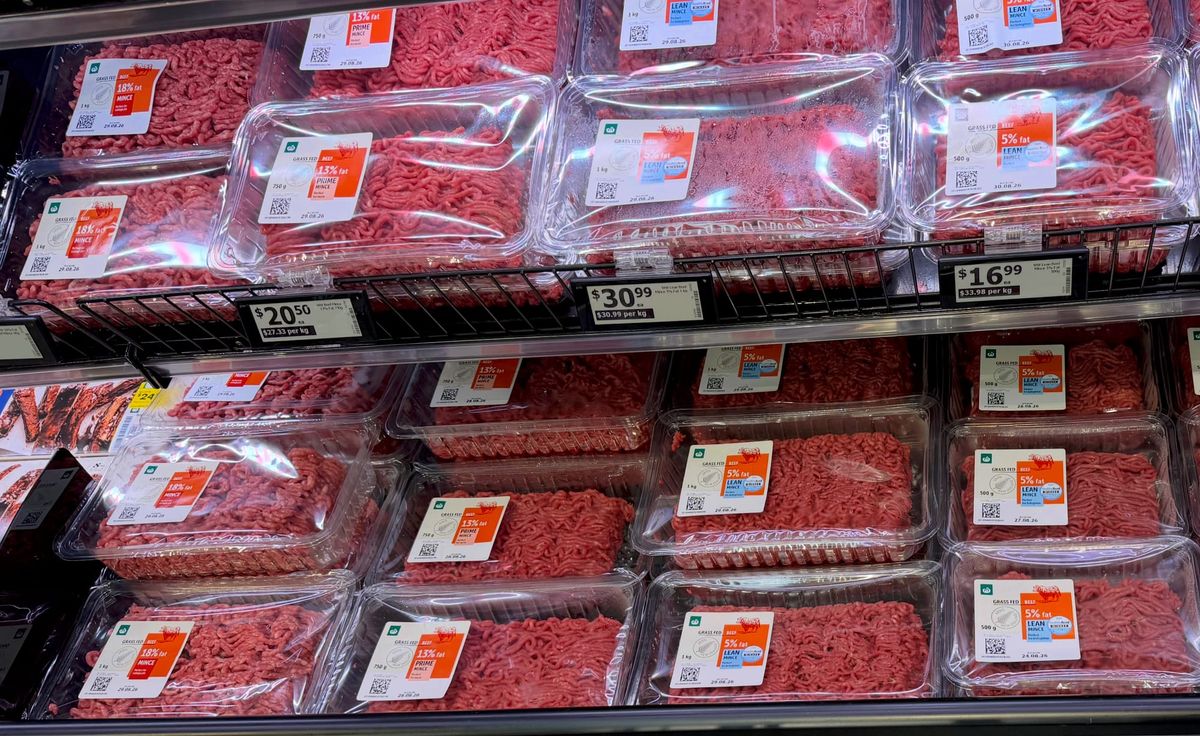
I stood in front of the mince cabinet at Woolworths on Sunday and photographed the shelf tags.
$21.99 a kilo for the one kilo pack. $25.98. $27.33 for the 750 gram. $30.99. And $33.98 a kilo for the 500 gram packs, which is what most people actually pick up.
All of it mince. Same cabinet, a $12 spread per kilo.
That's the story the Farmers Weekly ran last week, and it's the one everyone's talking about. Rabobank has the national average at $24.40 a kilo in July, up from around $18 in early 2024. Chicken breast sat at $14.80 and pork loin chops at $16.70 over the same period, both basically flat.
So mince went from the thing you bought because it was cheap to the thing you think twice about. I wanted to know why.
Mince isn't a cut. It's what's left.
This is the part I didn't properly understand, and it explains most of the price.
Mince is manufacturing beef. It's trim: the lean meat pared off the carcass once the steaks and roasts are taken. And in New Zealand, roughly 60 to 70 percent of the national beef kill is dairy-origin. Cull cows, bulls, dairy-beef crossbreds.
The mince in that cabinet is mostly dairy cow.
Here's the bit that sets the price. Over 85 percent of the beef New Zealand exports to the United States is lean trimmings, and it goes into the American grinding market. Burgers. Same product, different flag.
Which means when you stand at that cabinet you are bidding for a commodity against McDonald's, and the exchange rate is doing more to set your price than your supermarket is. Beef schedules bear that out: interest.co.nz has prime steer at 990 cents a kilo carcass weight in the North Island as at 24 August, against 830 a year ago.
The farmer is getting more. So are you paying it.
And farmers are responding to the same signal you're feeling. Stats NZ figures for the year to June 2025 show beef cattle numbers up 4 percent to 3.8 million, while dairy cattle fell 1 percent to 5.7 million and sheep dropped to 23.3 million. Beef is the one thing going up.
The cow in your mince is not old and she isn't sick
I assumed cull meant something had gone wrong with her. It usually hasn't.
New Zealand research into why dairy cows leave the herd found the most common recorded reasons were failure to get in calf, low production, and unknown. Those three together accounted for 71 percent. One third of culled cows were removed specifically for not being in calf.
She isn't diseased. She's spent.
A New Zealand herd replaces about 22 percent of its cows a year, a figure derived from cows averaging four and a half lactations over a lifetime. The age structure of a typical pasture herd runs 21 percent in their first lactation, 18 percent in their second, down to 5 percent at their ninth or later. Cattle can live around twenty years. She leaves at roughly a quarter of that, because she stopped getting pregnant on schedule or stopped producing enough milk to justify her grass.
And she's the cheap end of the system. Manufacturing cow schedules are running 740 to 780 cents a kilo against that 990 for a prime steer, and because she's a smaller carcass the gap per animal is close to double. Her carcass is the one that becomes the thing you're paying $34 a kilo for.
What the label tells you, and what it doesn't
Better than I expected on one count, worse on another.
The good news: the packs I photographed declare fat content as a number. 5% fat lean mince. 13% fat mince. 18% fat mince. Under the Food Standards Code, once you make a fat claim you have to state it, and Woolworths is stating it.
The bad news is that where a brand uses words instead of numbers, the words mean nothing in law. There is no legal definition of premium, or prime, or standard mince in New Zealand, and no legal cap on fat content at all. New Zealand Food Safety's Paul Dansted told Fair Go in 2021 that it's "really much in the eyes of the consumer".
Fair Go tested six Auckland stores that year and found standard mince at one shop running 23 and 26 percent fat, while another shop's premium averaged 11.8 percent. Both legal. Both accurately labelled, because neither word means anything.
For contrast, the EU sets statutory caps: lean minced meat at 7 percent fat, minced pure beef at 20.
Whether that matters depends on what you're cooking, and I want to be careful here because "you're paying for fat" is a glib line that doesn't survive contact with a kitchen.
If you brown mince and pour the fat off, you did throw away something you paid for. A 500 gram pack at 18 percent holds 90 grams of fat, and drain most of that and you've binned close to $2.70 of a $17 pack. But make a ragu you don't drain, or patties, and the fat is doing the work. It's flavour and moisture, not filler. Go down to 5 percent and a lot of people add oil back in, which is buying fat again at a different price.
So the percentage isn't a good-versus-bad number. It's information you need to decide, and the two ends of the range are genuinely different products.
Which is the actual problem. Where a pack says a number, you can run that calculation. Where it says premium, you can't run it at all.
What's added to it
Nothing, legally. The Food Standards Code permits sulphur dioxide in sausages and sausage meat up to 500 mg/kg and in no other meat product. Raw mince is on the prohibited list.
It has been added, though. A Christchurch company was fined $10,000 in 2020 for selling mince containing sulphites, and there were prosecutions after an MPI operation in greater Auckland. Fair Go's 2021 lab testing found sulphites in both the standard and the prime packs from one Onehunga retailer.
That's a handful of cases over a decade, and I'm not going to pretend it's an epidemic. If you want to know what's in your mince, the fat percentage matters far more than the additive question does.
The small pack tax
Look at those numbers again. $21.99 a kilo for the one kilo pack. $33.98 a kilo for the 500 gram.
The same product, from the same cabinet, costs 55 percent more per kilo if you buy it in the size a single person or a couple actually uses. The household with a freezer and $22 to spend on Sunday pays $22 a kilo. The household buying dinner for tonight pays $34.
That's not a beef market problem. That's just how the shelf works, and it's worth knowing about because it's the one part of this you can do something about today.
And organic?
Here's where it gets odd.
The Organic Food Shop, a certified organic farm operation in Te Awamutu, sells 90/10 organic beef mince at $16.50 for 500 grams. That's $33 a kilo.
The Woolworths 500 gram packs I photographed were $33.98 a kilo.
Certified organic mince, direct from the farm, came in 98 cents a kilo cheaper than conventional supermarket mince in the same pack size.
Be careful with that, and I want to be straight about the caveats. It's a different channel, with pickup or freight rather than a shelf you're already standing at. The organic is frozen, not chilled. And against the $24.40 national average, organic is still about 35 percent more.
But the shape of it has genuinely changed. The organic premium on mince used to be roughly double. Conventional has caught up. And per serve, at 125 grams a head, the gap against that national average is about a dollar a person at dinner. Against the 500 gram pack most people actually buy, there isn't one.
The thing that isn't on any of it
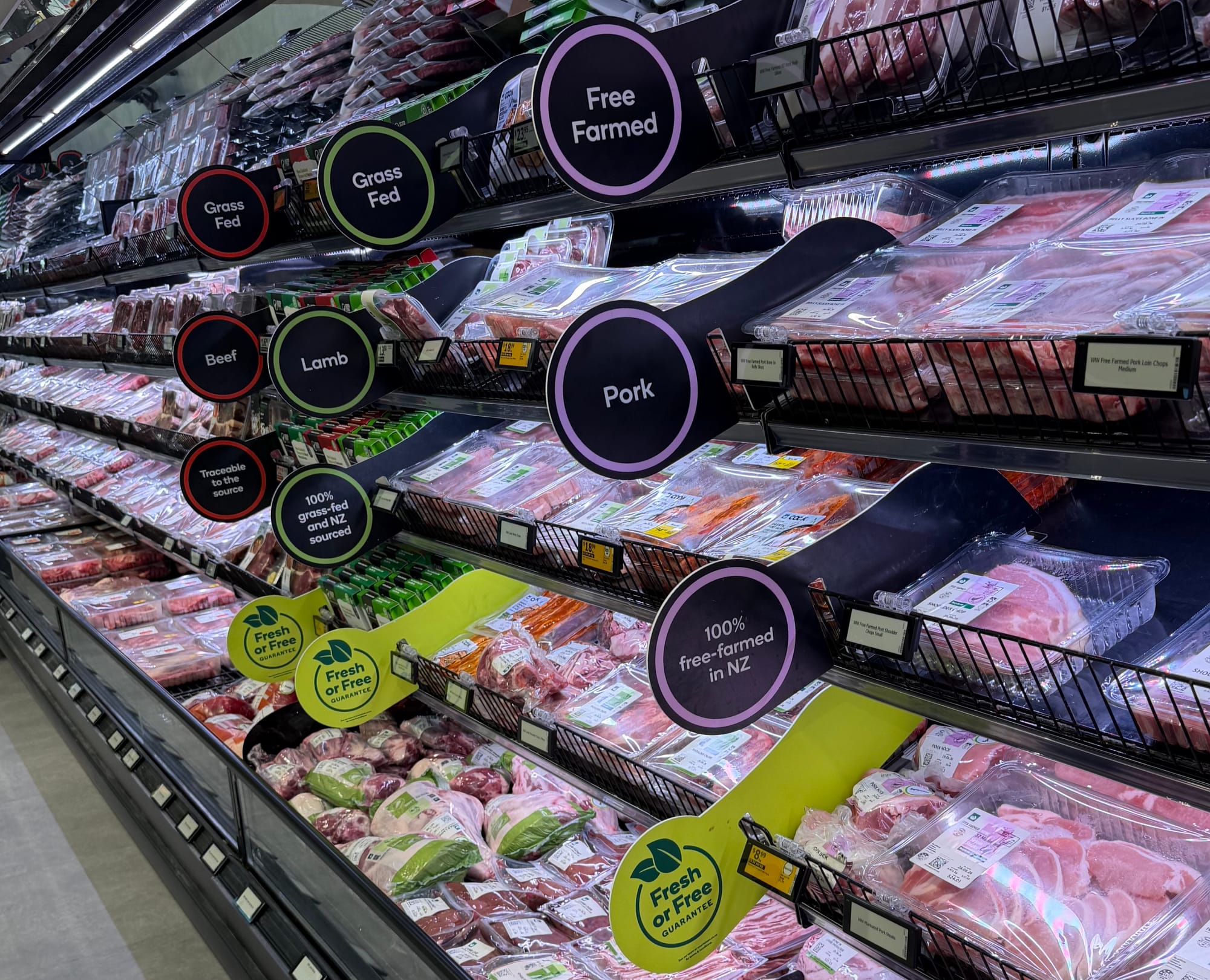
The last photo I took wasn't of a price. It was of the signage hanging over the meat aisle.
Grass Fed. Free Farmed. Traceable to the source. 100% grass fed and NZ sourced. Fresh or Free Guarantee.
Five claims, and every one of them is about where the animal came from. Not one of them tells you anything about what the animal was given while it was alive.
I went looking for that. It took me somewhere I didn't expect, and it's the next post.
Before you go
If you found this useful, sign up for free to get new posts as they go up.
If you'd like to support the work, you can leave a one-off tip.