Why I Bought An RO Filter
What's actually in your water, what happens to it between the treatment plant and your glass, and why understanding that changed what I do about it.

Turn on a tap.
Clean water arrives.
I do this every morning without thinking. Most of us do. But I've been thinking about it lately — really thinking about it — and what I found changed the way I look at the glass I fill.
Start here. In August 1854, a baby named Frances Lewis died in London's Soho district. Her mother washed out the child's soiled nappies and tipped the wastewater into the cesspool across the street. Within ten days, 500 people in the immediate area were dead. Cholera had spread through a contaminated water pump on Broad Street — a pump that hundreds of people used every day for drinking, cooking, and washing, in the complete belief that the water was clean. A physician named John Snow mapped the deaths and traced them to the pump. He removed the handle. The epidemic stopped.
That moment — Snow and the pump handle — is one of the most important public health events in history. Not because of what it solved immediately. Because of what it started. The understanding that contaminated water kills led directly to filtration, to chlorination, to the infrastructure that now delivers safe water to billions of people. The decline in typhoid, cholera, dysentery, and dozens of other waterborne diseases across the developed world in the 20th century is one of the great unrecognised achievements of human civilisation. We take it for granted because it worked.
My ancestors drank from rivers downstream of cities. They got sick. Some of them died. The water coming out of my tap in Auckland is not that water. I want to be clear about that before I say anything else.
And yet. I still bought an RO filter.
Where the curiosity started
I approach food the way I approach most things I care about — by wanting to understand the system behind it. Not from fear. From genuine curiosity about how things work. Once I started looking at what actually goes into Auckland's water supply, what happens along the 9,000 kilometres of pipe between the treatment plant and my glass, and what arrives at the other end — I found myself making different choices.
This is what I found.
What's in the water — the honest list
Auckland's water comes from three sources. About 84 percent from the Hūnua and Waitākere dam catchments — protected native bush, relatively clean water, minimal treatment needed. About 15 percent from the Waikato River — which travels 400 kilometres through dairy farms, geothermal country, and industrial towns before it reaches the treatment plant at Tuakau. (I wrote about what that river carries in detail here.) And a small fraction from groundwater.
By the time it leaves the treatment plant, that water has been coagulated, filtered, disinfected with chlorine, dosed with fluoride, and pH-adjusted. It meets the New Zealand Drinking Water Standards. That's a real thing. It matters.
But "meets the standards" and "contains nothing of interest" are different statements.
Here's what's potentially in treated Auckland tap water:
Chlorine is added to kill bacteria and viruses, and to persist through the distribution network so water arriving at your tap hours later is still biologically protected. It does its job. Chlorine at drinking water concentrations doesn't dramatically disrupt the adult gut microbiome based on the current evidence — but the research is still developing, particularly around infants and long-term low-dose exposure. What we do know is that its job is largely done by the time it reaches you. More on that below.
Chlorination byproducts — specifically trihalomethanes (THMs) and haloacetic acids — form when residual chlorine reacts with organic matter in the water during the distribution journey. They are present in treated water at regulated but non-zero concentrations. Long-term exposure to these compounds has been associated in some studies with increased cancer risk, though the evidence is contested. They weren't there when the water left the treatment plant. They form en route.
Fluoride at 0.7–1.0 parts per million, added to Auckland's supply under powers granted by the Health (Fluoridation of Drinking Water) Amendment Act 2021. The original direction to Auckland was issued in July 2022 by then Director-General of Health Dr Ashley Bloomfield — the first time this centralised power had been used. This is not a safety treatment — it's a policy intervention. The decision about whether you want to ingest it is personal. I've written about the mechanism and the lifetime dose question separately — what fluoride does and the cumulative dose nobody thinks about.
Nitrates in Waikato-sourced water — a slow-rising concern as agricultural intensity in the catchment increases. Currently within standards. The trend is upward. Standard treatment doesn't remove them.
Pesticide residues — the first wide-screening groundwater survey in New Zealand found 48 pesticide compounds at 91 percent of Waikato-region groundwater sites, including glyphosate metabolites, atrazine, chlorpyrifos, and 2,4-D. Most aren't on the monitored list. Activated carbon filtration at the Tuakau plant provides partial removal. Not complete.
Pharmaceuticals — antibiotics, hormones, anti-inflammatories, antidepressants — that pass through conventional sewage treatment and enter the Waikato River from Hamilton's wastewater. New Zealand has not systematically monitored pharmaceutical compounds in treated drinking water. The Our Freshwater 2026 report listed this as a specific knowledge gap.
PFAS — per- and polyfluoroalkyl substances, the so-called forever chemicals — detected in New Zealand groundwater and globally present in waterways. Standard treatment doesn't remove them.
Microplastics — introduced by the pipes themselves. More on this shortly.
None of these are present at concentrations that would cause acute harm. That's not the question I'm asking. The question I'm asking is about lifetime accumulation — which I'll come back to at the end.
The journey between the plant and your glass
Here's the part I didn't fully understand until I started researching it.
Most people assume the water leaves the treatment plant clean and arrives at the tap in roughly the same condition. That assumption is wrong in several interesting ways.
Chlorine decays as water travels. Research consistently shows free chlorine residuals decrease significantly with distance from the treatment plant — dropping by over 40 percent after 24 hours at high initial concentrations, with free chlorine disappearing entirely in the peripheral sections of some distribution systems. The treatment plant doses higher specifically to ensure enough residual remains at the far end of a 9,000-kilometre network. What this means practically: if you live close to a treatment plant or reservoir, your tap water has notably higher chlorine than someone at the end of a long distribution branch. Not necessarily better — just more of what the system needs to maintain protection across its full reach.
Old iron pipes corrode — and that corrosion reacts with chlorine. Auckland's pipe network spans infrastructure of very different ages. Some of it is modern plastic. Some of it is cast iron laid decades ago. Cast iron pipes corrode from the inside, forming rust scales on the pipe wall. In the most straightforward case this adds dissolved iron to the water — at typical levels not acutely harmful, but contributing to that slightly metallic taste you may have noticed. More significantly: a study from UC Riverside found that rusted cast iron pipes react with residual chlorine to produce hexavalent chromium — the carcinogenic compound at the centre of the Erin Brockovich case. The mechanism is the chlorine in municipal water transforming the trivalent chromium in iron corrosion scales into the toxic hexavalent form. This is not widely known. It happens inside the pipe, after the water has left the treatment plant.
Old iron pipes also consume chlorine dramatically faster than new pipes — effective chlorine wall decay constants can increase by up to 431 percent with pipe age in cast iron. So in old pipe networks, more chlorine is being consumed by the pipe itself, less is available to maintain disinfection, and more chlorination byproducts are forming as the chlorine reacts with the pipe scale along the way.
Then there's what happened inside your house. Most Auckland homes built from the 1960s through to the 1990s had copper supply pipes — hot and cold lines running through the walls to every tap. Copper has real advantages: it's naturally antimicrobial, killing bacteria on contact, and it doesn't rust. But it corrodes differently. In soft or slightly acidic water — and Auckland's water is relatively soft — copper pipes develop pinhole leaks and shed dissolved copper into the water. At elevated levels copper causes gastrointestinal illness; chronically, it stresses the liver and kidneys. Older copper installations may also have lead solder at the joints, a legacy of pre-1970s plumbing practice. If your home was built before the 1990s and the internal plumbing hasn't been replaced, there's a reasonable chance some of that original copper is still in the walls.
New plastic pipes have their own issues. From roughly the 1990s onward, PVC and polyethylene replaced copper in new NZ residential construction. They don't corrode, don't contribute metals, and are cheaper to install. But research has found they introduce something else: microplastics. Independent studies have found that PVC pipes release the highest quantity of microplastic particles compared to other pipe materials tested — with stagnant water showing concentrations up to ten times higher than flowing water. The mechanism is surface pitting and peeling accelerated by chlorine exposure and age. Beyond microplastics, plastic pipes also continuously leach dissolved organic compounds including bisphenols into the water. The irony is hard to ignore: old metal pipes leach metals, new plastic pipes leach plastics. Neither is neutral.
The practical implication: the water that sat in your household pipes overnight is the most contaminated water you'll drink all day. Running the tap for 30 seconds before filling your glass — especially in the morning — flushes that stagnant water and draws fresher supply from the main. Almost nobody does this.
What I did and why
After working through all of the above, I bought an AquaTru countertop RO system, available in New Zealand through Right Spin Health for around $845.
Let me explain why this one specifically, and be honest about the trade-offs.
What the AquaTru is: A benchtop four-stage RO unit — no plumbing, no installation, sits on the kitchen counter and fills from tap water poured into its reservoir. It produces roughly 2–3 litres of purified water every 12–15 minutes, which is enough for drinking and cooking without having to think about it. The design matters: no plumber, no under-sink modification, no commitment. You fill it, walk away, and come back to clean water.
What it's certified to remove: The AquaTru is NSF certified and has been independently tested against the 74 contaminants regulated by the EPA. The list it explicitly covers is the right list: lead, chlorine, arsenic, chromium 6, fluoride, herbicides and pesticides, disinfection byproducts, perchlorates, prescription drug residue, plastic particles, and VOCs. That last one — VOCs — matters, and I'll come back to it in the distillation comparison below. Chromium 6 is on there specifically, which is notable given the hexavalent chromium mechanism I described above.
The water efficiency angle: Standard RO systems have historically been wasteful — the traditional ratio is roughly three litres discarded for every one litre of purified water produced, as the reject stream carries concentrated contaminants to drain. The AquaTru uses recirculation technology that brings this down to approximately one litre discarded for every two litres produced. That's a meaningful improvement, and worth considering if water conservation matters to you.
What it doesn't have: No remineralisation stage. The AquaTru produces stripped water — pure, but flat-tasting and lacking the calcium and magnesium that contribute both to taste and to whatever mineral contribution drinking water makes to your diet. The honest answer here is that most minerals come from food, not water, so the health concern is minor. But if you want the fuller taste of remineralised water, you'd add a separate remineralisation filter or use mineral drops — a straightforward extra step that costs very little.
The endorsement worth noting: The AquaTru carries a recommendation from Robert Slovak, described as the father of reverse osmosis purification — the engineer who developed the first commercial RO system in the 1970s. That's not marketing filler. If the person who built the technology recommends this specific unit, it's worth paying attention to.
What it doesn't fully handle:
PFAS — standard RO membranes provide partial removal but not near-complete removal of the shorter-chain PFAS compounds. Specialist activated carbon media handles these better. I'm watching this space as the research develops.
The practical reality:
This is a point-of-use system — it only treats water drawn from this unit. The water I shower in, brush my teeth with, and make tea from at other taps is still straight municipal supply. For most healthy adults that's probably fine. The focus on drinking water is the most direct and practical intervention available at the household level.
Unlike under-sink systems, the AquaTru doesn't waste water to drain automatically — the reject water collects in a separate chamber and can be used for watering plants or cleaning. Small thing, but it removes one of the common objections to RO.
(A note: I bought the AquaTru myself after my own research and have no commercial relationship with AquaTru or Right Spin Health. I'm mentioning it because it's what I use and because the specs are genuinely good — not because anyone asked me to.)
I looked at distillation too
Distillation is, technically, the highest purity method available for household water treatment.
The mechanism is elegant. Boil water, collect steam, condense. Everything non-volatile stays in the boiling chamber — bacteria, viruses, heavy metals, arsenic, fluoride, nitrates, dissolved salts, microplastics, pharmaceuticals. You get water that is 99.9 percent free of dissolved solids. No membrane to replace, no pressure system, no plumbing modification required. A good quality countertop distiller lasts 10 to 15 years with basic maintenance.
There is one genuine technical weakness. Volatile organic compounds — VOCs like certain pesticide residues and trihalomethanes — have boiling points close to or below water. They vaporise with the steam and can carry over into the distillate. Without a carbon post-filter, a basic distiller can actually concentrate VOCs. Modern distillers address this in one of three ways: a gas vent that allows VOCs to escape before condensation, a fractional column that separates the lighter VOCs, or — most commonly — an activated carbon post-filter. That carbon filter is not optional; it's a required part of the system.
With carbon filtration included, distillation + carbon is arguably the most complete purification available at household scale. Everything removed by RO, plus slightly more complete removal of some dissolved solids.
Why did I choose RO instead?
Energy. Distillation consumes roughly three kilowatt-hours per gallon — approximately ten times the energy per litre of an RO system. Over a year of daily use, that's a meaningful difference in electricity cost and environmental footprint.
Speed and volume. A countertop distiller produces 4–6 litres per cycle over several hours. An RO system produces water on demand from the tap. For a household that uses filtered water for drinking, cooking, and hot drinks, the distiller would be running almost continuously.
Taste. Distilled water is stripped of everything, including the dissolved minerals that contribute to the taste of water. The flat quality of truly pure water is an acquired preference. Remineralised RO water — with calcium and magnesium added back in a controlled ratio — tastes clean and rounded in a way that's immediately pleasant.
The honest conclusion: for households wanting maximum purity and willing to manage the energy cost and batch production, distillation with carbon post-filtration is the superior method. For households wanting practical daily-use purification at lower running cost with better taste — RO with remineralisation is the sweet spot.
If I were off-grid, or dealing with a water source significantly more contaminated than Auckland municipal supply, I would probably choose distillation.
The lifetime accumulation question
Here's the frame I keep returning to.
All of the regulated contaminants in Auckland's water are present within limits set to protect human health. Those limits are based on a defined exposure — typically a certain number of litres per day over a certain number of years — with safety margins built in. They reflect the best available science and are taken seriously by the people who set them.
But they describe individual contaminants in isolation. What the standards don't fully address is the mixture — the combination of low-dose chlorination byproducts, low-dose pesticide residues, low-dose pharmaceutical compounds, low-dose microplastics, and low-dose fluoride, all arriving simultaneously, every day, for a lifetime. The science on long-term low-dose exposure to chemical mixtures is genuinely incomplete. That's not alarm — it's an honest statement about where the research currently sits.
I've written about this specifically in the context of fluoride — the way that talking about concentrations (0.7 parts per million) obscures the cumulative picture (approximately 40–60 grams over an 80-year lifetime). The same logic applies to everything else in the list. Concentrations that sound harmless when stated as a single daily dose become a different calculation when multiplied by 80 years and compounded with everything else arriving simultaneously.
This doesn't mean I think the water is going to hurt me. What it means is that when I think about the water I drink every single day for the rest of my life, I find it reasonable to do a little more work at my end of the pipe.
What the system deserves
I want to come back to where I started.
Watercare runs 366 tests per day across the Auckland network. The treatment plant at Tuakau — which processes Waikato River water — is one of the most sophisticated in Australasia, built specifically to handle a challenging source. When the arsenic levels in the Waikato River briefly elevated in November 2024 and again in August 2025, Watercare detected it, reduced draw from the Waikato source, and shifted to Hūnua dam supply within hours. The system worked.
A billion people on this planet don't have reliable access to clean drinking water. Waterborne diseases kill 1.5 million people annually, almost entirely in places without the infrastructure we take for granted. The Broad Street pump is still happening — in Yemen, in the DRC, in displaced communities after every major disaster. The miracle of a tap is real.
I'm not rejecting that system. I'm refining at the margins of it, at my end, with a filter that costs a few hundred dollars and requires a membrane change every couple of years.
The system gets you safe water.
Personal responsibility gets you optimal water.
Both things are true. Neither cancels the other out.
Practical notes for anyone thinking about this
If you're on Auckland mains supply and want to do something simple: A basic activated carbon filter at the kitchen tap removes chlorine, improves taste, and handles VOCs. It costs almost nothing, requires no plumbing, and is the highest return-on-effort improvement for most households. It does not remove fluoride, nitrates, or microplastics.
If you want to go further: A multi-stage countertop RO unit like the AquaTru handles the full practical list — chlorine, chlorination byproducts, fluoride, nitrates, heavy metals including arsenic and chromium 6, pesticides, pharmaceuticals, and microplastics. No plumbing required. Around NZ$845 from Right Spin Health. If you want remineralised water, add mineral drops to the output tank — a simple extra step. This is what I use.
If you want maximum purity and don't mind the trade-offs: A quality countertop distiller with carbon post-filter is the most complete option. Budget for higher electricity use and batch production time. Pair with remineralisation.
Run your tap for 30 seconds in the morning. Before filling your glass or kettle for the first time each day, flush the water that sat overnight in household pipes. Free, takes thirty seconds, genuinely matters — especially if you're in an older home with copper or ageing plastic supply lines.
Check what's in your zone. Watercare publishes area-specific water quality reports covering different parts of the Auckland network. If you want to know whether your area is currently drawing more from the Hūnua dams or the Waikato River, and what the residual chlorine looks like at your end of the network, the reports are there and updated regularly. A pool test strip from any hardware store will tell you in thirty seconds what chlorine residual is actually coming out of your tap right now.
Part of the OFT water series: What's Actually In Auckland's Tap Water · What's in our water and what "safe" actually means · Water Solutions · Fluoride in drinking water: what it does and who decides · The lifetime fluoride dose
 Name *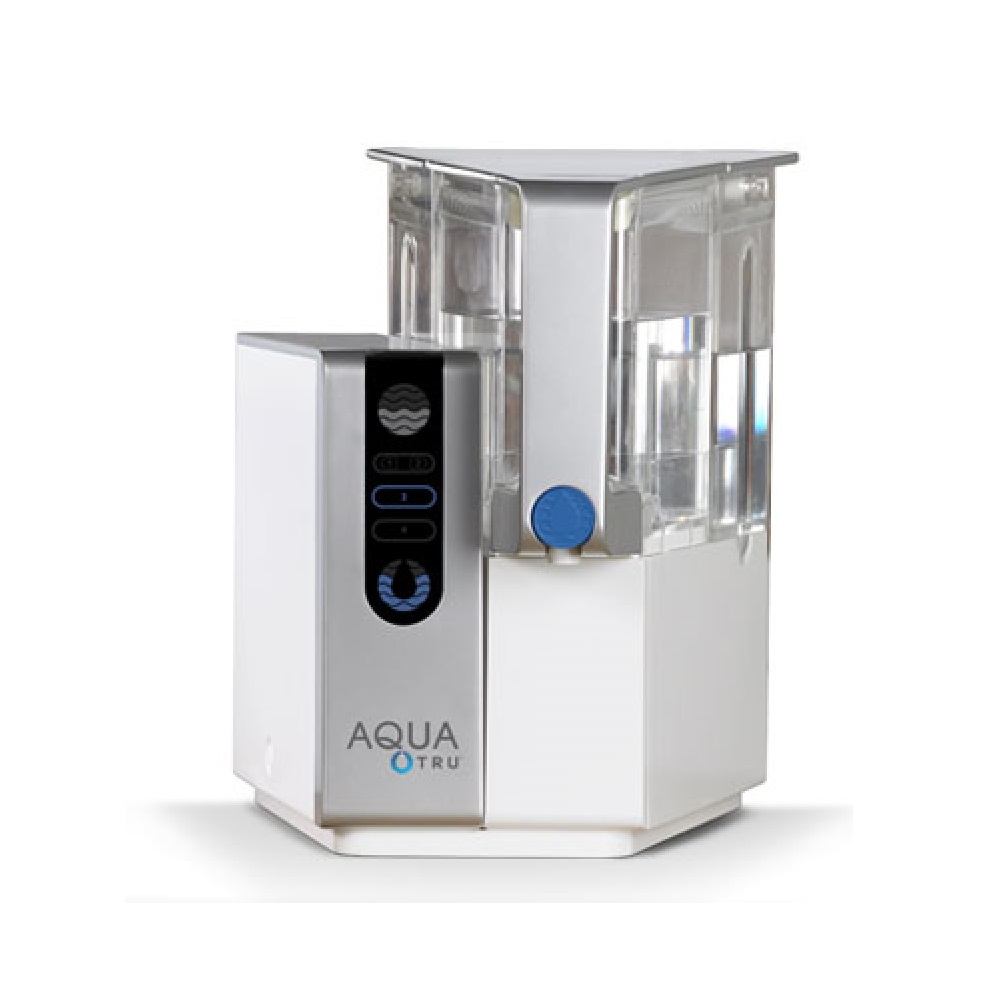
I bought the AquaTru myself after my own research and have no commercial relationship with AquaTru or Right Spin Health
 Organic Together