What the Organic Sector Wants From the November Election
No political party has a policy for growing organics in New Zealand. OANZ took a five-point manifesto to Parliament to change that. I read all six pages: here's what the asks mean at the checkout, and why the coming scorecard is the real story.
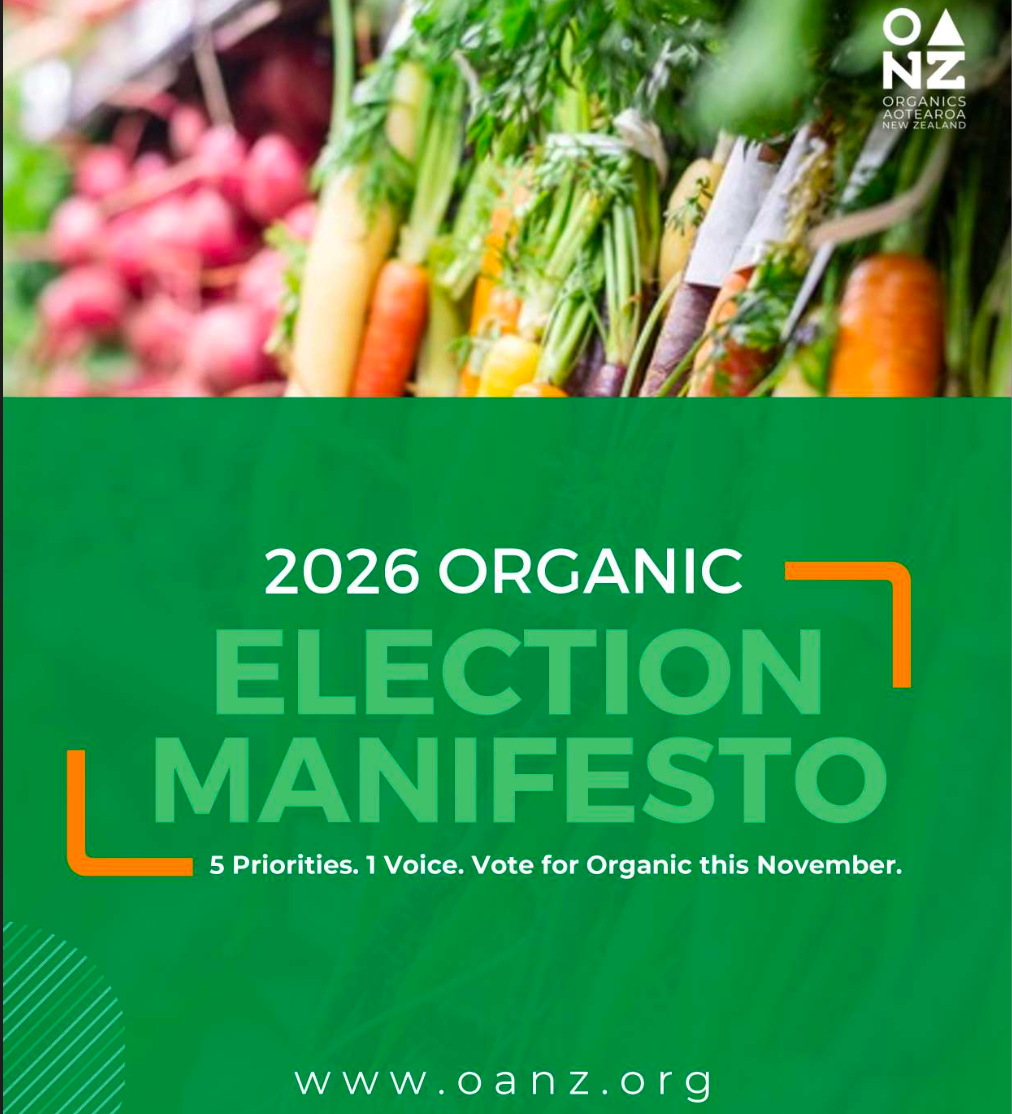
Not one political party in New Zealand currently has a policy for growing organics. That is the message Organics Aotearoa New Zealand brought back from two days in Wellington late last month, where a delegation presented its 2026 Organic Election Manifesto to MPs and officials ahead of the November vote.
I read the full six-page document so you don't have to. The cover is mostly carrots. The contents are mostly export economics. But buried inside the trade numbers are five asks that would change what you see on a supermarket shelf, and one tool worth watching between now and election day.
First, the disclosure. OANZ is the organic sector's national lobby body. The manifesto is an advocacy document, and the numbers in it come from OANZ's own 2025 Organic Market Report. I'm not on their board, by choice, so read this as one independent set of eyes on what they're asking for.
The numbers they're carrying into the room
The sector OANZ represents was worth $1.18 billion in 2024. Exports earned $606.7 million of that, growing at 9.6 percent a year since 2020, which OANZ points out is roughly three times the growth rate of primary sector exports overall. Global demand for certified organic food and drink is forecast to pass US$650 billion by 2033.
Here's the number I keep coming back to, though. Domestic sales were $572 million, $382 million through retail and $190 million through food service. New Zealanders are buying nearly as much organic food at home as the country sells to the world. The manifesto leads with the export story. The domestic story is almost the same size and gets a fraction of the airtime.
And one honest wrinkle in the growth narrative: certified organic land sits at 89,554 hectares, up just 4.3 percent since 2020. That's 0.6 percent of New Zealand's farmland producing around 1.2 percent of food and fibre export value. The value per hectare is genuinely impressive. The hectares themselves have barely moved.
The five asks, translated for the checkout
1. Fully fund the National Organic Standard rollout. The standard starts coming into force from July 2026, so this is already underway. Done properly, it means the word "organic" on a New Zealand label is finally backed by regulation rather than trust. For shoppers, this is the big one.
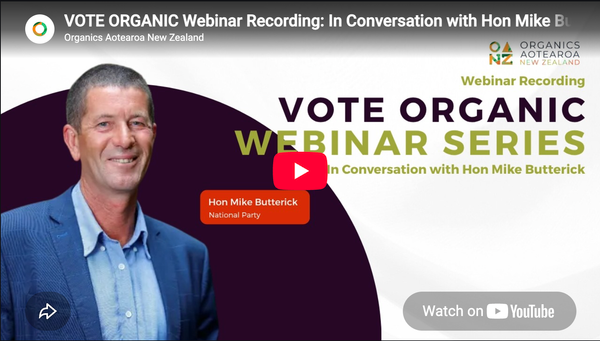
2. Fund the sector's growth, and keep the Associate Minister for Organics. Mike Butterick's appointment as Associate Minister of Agriculture (Organics) is believed to be a world first, and the role is already active. In mid-July he toured Hawke's Bay organic operations with OANZ, from Hōhepa's inclusive farming model through BioRich Compost, Hapi and Chantal Organics to Bostock's apple packhouse and winery. OANZ wants the role to survive the election, plus a four-year tapered investment in market access, market development, data, and helping farmers transition.
3. Secure global market access. Equivalency deals with the EU, USA and China so exporters aren't certifying the same product twice. This is the trade plumbing. You won't see it, but exporters feel it daily.
4. Protect the GE-free advantage. OANZ frames the Gene Technology Bill as a direct threat to organic integrity and to something simpler: your right to know whether your food contains GMOs. Wherever you land on gene technology, the labelling question belongs to everyone who eats.
5. Grow supply, transition and domestic demand. More support for farmers converting to organics, and public procurement putting organic food into schools and hospitals. This is the ask that would most change who gets to eat organic food in this country, and it sits fifth on the list.
The scorecard is the real story
OANZ put seven direct questions to every party it met, covering the ministerial role, the standard, investment, market access, GE-free status, transition support, and whether the party has any organics policy at all. The answers will be published as a colour-coded Organic Political Scorecard in the lead-up to the election, aimed at what OANZ estimates is around 120,000 organic-aligned voters.
That document will do something this manifesto can't. The manifesto tells us what the sector wants. The scorecard will tell us, in green and red, which parties bothered to answer. Given the delegation's starting point, that not a single party has an organics policy today, the baseline is blank. Any colour at all will be new information.
What I make of it
The manifesto is written for Wellington, and it shows. Export earnings, GDP contributions, a $4.7 billion roadmap by 2030. Fair enough; that's the language that moves budget bids, and it's clearly the language the Minister hears. Reflecting on his Hawke's Bay visit, Butterick tied the sector's opportunity directly to the Government's ambition to double export value in ten years. The sector is speaking export because export is what's listening.
But the things that matter most to the people reading this site, a trustworthy label, GMO transparency, organic food in public institutions, affordability, are folded quietly inside priorities one, four and five.
New Zealand already grows some of the best organic food in the world and ships most of it offshore. I've written before about why we don't eat our own organic food. This manifesto could start fixing that, but only if the domestic asks survive contact with the politics.
The election is in November. The scorecard lands before it. I'll cover it when it does.
The full manifesto is available as a PDF from OANZ.
Before you go
If you found this useful, sign up for free updates or leave a one-off tip to support independent food journalism in New Zealand.