The Rothschild, the surfer, and the beef box
When Hickory Bay Farm's beef boxes sold out after a Seven Sharp story, I started pulling threads. They led to a Rothschild heir's 2002 organic promise, a family who quietly made it real, and the strange reason certified organic beef can't call itself organic.
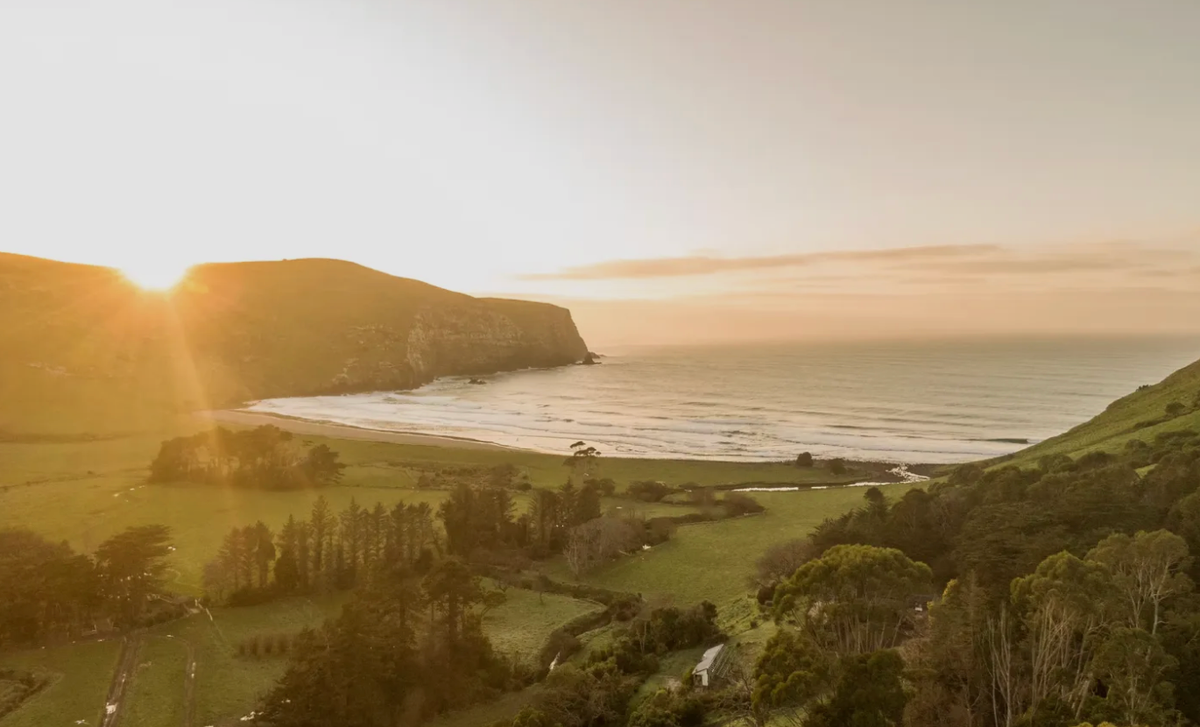
On the evening of 8 May, Seven Sharp ran a story about a family selling beef boxes from a remote farm at the end of seven kilometres of gravel road on Banks Peninsula. Before the credits rolled, the orders had started. Kristin Savage later told The Press that sales jumped "about 1000%" — not a mountain on the graph, he said, but a steep J-curve — and that he and his wife Rachel spent the following month doing nothing but packing boxes.
Four minutes of television did that. Sit with it for a second, because it's the most important fact in this story. The demand for traceable, farm-direct food in this country is not hypothetical. It is sitting there, fully formed, waiting — and right now the only thing connecting it to the farms that can meet it is the luck of a producer's story catching a TV researcher's eye.
I went looking at Hickory Bay Farm the way I look at everything: through the labels, the registers, and the paper trail. What I found was a better story than the one on the telly. It involves a Rothschild, a promise made to the New Zealand government in 2002, a schoolteacher and an intensive-care nurse who became the people who kept it, and a quirk of organic certification that means some of the most genuinely organic beef in Canterbury is sold in a box that isn't allowed to say so.
The farm at the end of the road
Hickory Bay sits on the eastern tip of Banks Peninsula, a roughly 500-hectare coastal hill farm backing onto one of Canterbury's best-known surf breaks. Kristin and Rachel Savage have been there since 2011. They were first-time farmers when they arrived — RNZ's Country Life told their backstory in 2024: he was a commerce teacher at Wellington College, she was a flight retrieval ICU nurse, and they learned farming, in his words, sink or swim, guided by Rachel's parents, the Ashburton farmers Keith and Rosemary Townshend. The Companies Register shows all four as directors of Hickory Bay Farm Limited, registered in February 2011. This is a family operation in the full sense: two generations, in together.
The farm runs about 70 Speckle Park cattle — a Canadian breed prized for marbling on grass — alongside grazing dairy stock. The beef box business launched in November 2025, built on a frustration Savage described to The Press: export-grade New Zealand beef ends up cheaper in a London supermarket than honest beef costs here, while Kiwi shoppers stand in the meat aisle guessing where anything came from. Their answer was the oldest one there is — sell it yourself. Whole-animal economics, transparent cut breakdowns, a 20 per cent deposit against finished weight, delivery nationwide.
And one more thing, the thing that caught my eye: everywhere the farm describes itself — its website, its social channels, the summer Hoedown it hosts in the woolshed — it uses the words certified organic farm. BioGro's public licensee lists confirm it: Hickory Bay Farm appears on the certifier's register of organic meat, dairy and egg producers.
But go to the beef boxes themselves and the word vanishes. The product pages say Speckle Park, naturally salted pastures, proudly grass-fed. Not organic. A certified organic farm, selling beef it does not call organic.
That gap is not sloppiness. It's the system, and we'll get to it. First: how did a remote Banks Peninsula hill farm come to be certified organic in the first place? Because that thread, when you pull it, goes somewhere unexpected.
The heir and the promise
In 2002, the farm at Hickory Bay was bought for $2.69 million by a 23-year-old Englishman named David de Rothschild — youngest son of Sir Evelyn de Rothschild, longtime chairman of the family's London bank, and a direct descendant of the dynasty's founders. David was the one who didn't go into banking. He became an adventurer and environmentalist instead, later famous for sailing the Plastiki, a catamaran built from 12,500 reclaimed plastic bottles, ten thousand miles across the Pacific to publicise ocean plastic.
To buy sensitive coastal farmland here, he needed Overseas Investment Commission approval, and the case he made — reported by the NZ Herald at the time — was that he would create a "wholly sustainable organic environment" at Hickory Bay, describing it as a fifty-year plan in the family tradition of environmental guardianship. A few years in, the regulator came asking whether the promises were being kept. The answer his company gave, through its New Zealand director, was concrete: the farm had attained BioGro organic certification and was already sending organic lamb to the works.
Read that again with 2026 eyes. A Rothschild heir, barely into his twenties, standing in front of a government regulator pointing to a BioGro certificate as proof of good faith. Whatever else you make of overseas ownership of New Zealand farmland — and regular readers know I make plenty of it — the organic conversion of Hickory Bay was a condition of a foreign buyer's promise, made two decades before "regenerative" became a marketing department's favourite word.
In 2011 the Savages took over the farm. And here the records show something I didn't expect: de Rothschild never entirely left. The Companies Register shows HB Land Limited — incorporated in June 2002, the month the farm changed hands — still registered today, still filing annual returns as recently as September 2025, with David de Rothschild as its sole shareholder and a director since day one. Property records show the core farm titles are held by the Savages' company, Hickory Bay Farm Limited. But land at Hickory Bay remains with the Rothschild company. He sold the farm to the family who would fulfil his promise — and kept a piece of the bay for himself.
I find that strangely fitting. The fifty-year plan, it turns out, may still be running. It just changed hands.
The label that isn't there
So: a farm certified organic under BioGro since the de Rothschild years, recertified and maintained under the Savages, raising grass-fed cattle on coastal pasture with a paper trail most producers would kill for. Why doesn't the box say organic?
Because in organic certification, the certificate follows the chain, not just the farm. Every hand that touches the product between paddock and plate — the truck, the slaughter plant, the boning room, the packing bench — has to operate under organic certification for the final product to carry the claim. Break the chain anywhere and the word falls off the label, no matter how the animal lived.
Hickory Bay's cattle, the family has said publicly, are processed in Ashburton and cut and packed in Oxford, North Canterbury. I went through the public registers of both certifiers — BioGro's licensee lists and AsureQuality's register of certified operators, the latter updated 15 May 2026 — and as at mid-June 2026, no Oxford butchery appears on either, under its own certification, and Hickory Bay's processing chain doesn't appear as a certified handler operation.
Here's the detail that turns this from a gap into a story. AsureQuality's register shows there is a certified organic slaughter pathway in Ashburton — Ashburton Meat Processors, the district's local abattoir, appears on the register. But it appears as a subcontractor under another company's licence: New Zealand Organic Meats, which holds the certification that the plant operates under for that work. The certificate belongs to the chain, not the building. The same plant, potentially in the same week, can produce beef that is legally organic for one client's certified chain and legally silent for everyone else's.
Think about what that means for a small producer. The physical capability exists, possibly in the very plant their cattle already visit. The farm-level certification exists. What's missing is the licence wrapping their particular chain — an annual cost and an administrative load that a 70-cattle operation selling boxes off a Shopify page has to weigh against a word on a label. Most weigh it and walk away. So the Savages do the honest thing: they market what they can prove without the chain — grass-fed, single farm, named paddocks — and leave "organic" on the farm gate where the certificate lives.
The result is a market where the word organic on supermarket beef is vanishingly rare, while some of the most rigorously organic cattle in Canterbury are sold in boxes that legally can't mention it. New Zealand's new organic regime — the Organic Products and Production Act and its national standard — was meant to make the word trustworthy. It does. But trust built this way has a toll gate, and the toll falls hardest on exactly the small, direct, transparent producers the organic movement was built by.
If you've followed my certification reporting — on eggs, on chicken, on what BioGro's logo does and doesn't guarantee — file this one under the same heading: the certificate is real, the system is honest, and the system's edges are where the most interesting food in the country quietly lives.
The fifty-year clock
David de Rothschild was in his early twenties when he pledged an organic farm to the New Zealand government. King Charles — then a much-mocked Prince of Wales — began converting Highgrove to organic in the mid-1980s, decades before the supermarkets followed, while the commentariat laughed about a man who talked to his plants. Two heirs to two of the oldest fortunes in Britain, independently arriving at the same answer for their own land.
I'm not going to tell you they know something hidden. They don't need to. What they have is something more interesting and more verifiable: unlimited choice, the best advice money can buy, and — this is the part that matters — no pressure to make the land pay by Friday. Organic conversion is brutal on a quarterly clock. It pencils out beautifully on a dynastic one. And once you start looking, the pattern of who farms on the long clock runs much wider, and much closer to home, than you'd expect. That's a story I'll tell properly soon.
The duopoly buys on a weekly clock. The aristocrats farm on a fifty-year one. The Savages — a teacher and a nurse who learned farming from their in-laws at the end of a gravel road — are what it looks like when the fifty-year clock gets handed to a working family. They calved 25 cows last spring. They might do 40 next year. The herd grows at the speed of demand, the demand showed itself in one J-curve on a Thursday night in May, and somewhere down the bay, the man who made the original promise still owns a quiet piece of the place.
Export-quality beef, the man said, shouldn't be cheaper in London than at home. On that, at least, the schoolteacher and the Rothschild have always agreed.
This story was built entirely from public records and published sources: the Companies Register, Land Information New Zealand records, BioGro and AsureQuality's public registers of certified operators (as at June 2026), reporting by The Press, RNZ Country Life and the NZ Herald, and Hickory Bay Farm's own published material. Hickory Bay Farm beef boxes are sold at hickorybay.co.nz. Their farm is on the Real Food Map.