The pohutukawa on the carton: who's behind Otaika Valley eggs?
A friend told me she buys Otaika Valley free range eggs because she liked the pohutukawa flower on the label. She didn't know who owned the brand. Neither did I, in any real detail. So I went looking.
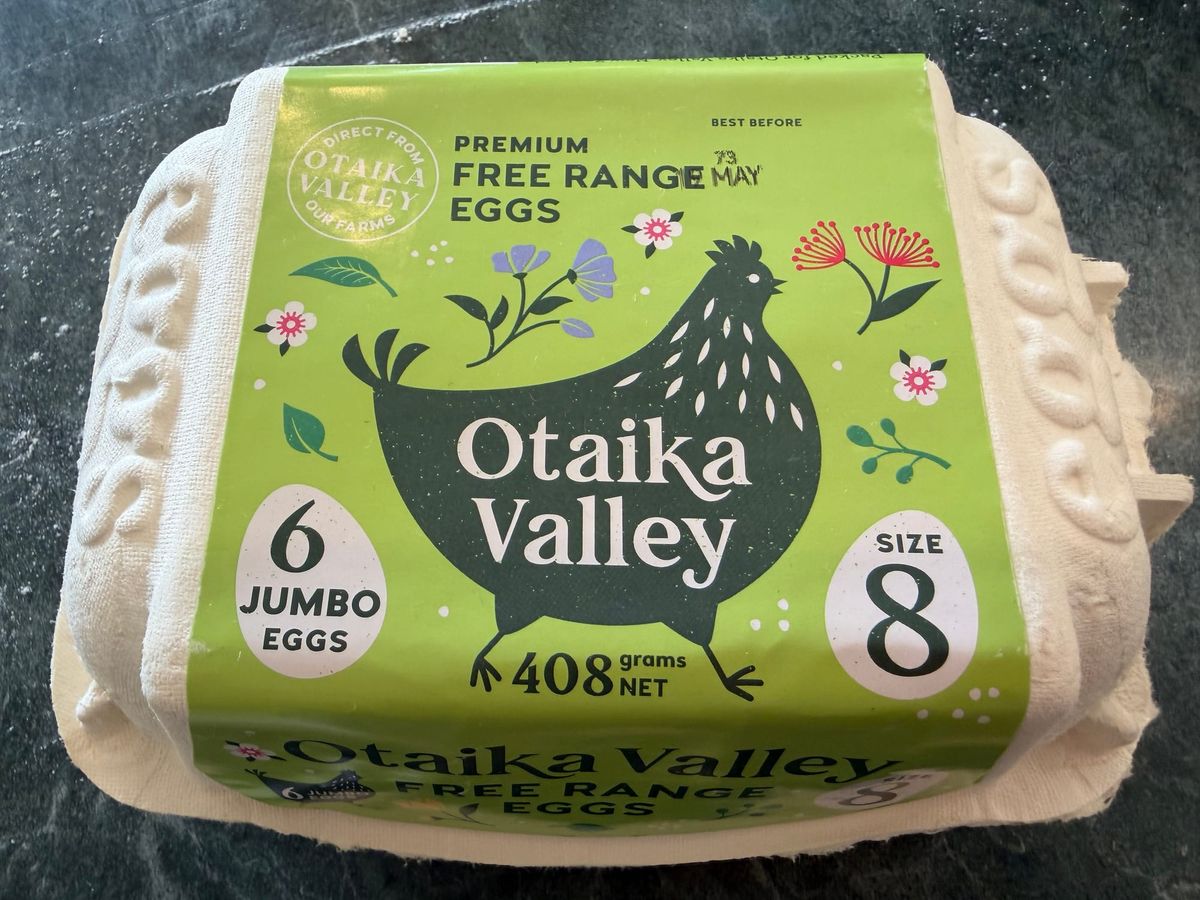
A friend told me she buys Otaika Valley free range eggs.
Why? "I like the label," she said. "The little flowers. The pohutukawa flower."
I asked if she knew who owned it. She didn't.
Neither did I, in any real detail. So I went looking.
A family business, three generations in
Otaika Valley is the trading name of a free-range egg operation run by the Sandle family, with farms in the Otaika Valley south of Whangārei and at Kaharoa near Rotorua. The Sandles have been in poultry farming for four generations, but they only moved into free-range egg production in 2007, when Peter Sandle bought the original Otaika Valley farm.
Today the business is split across the family. William Sandle is the general manager and account manager. His sister Trudy Sandle runs the Whangārei packhouse. Trudy's husband James Mason runs the Whangārei farm. Peter and his wife Riet continue to be involved. The packhouse employs around 20 staff.
This is, by the standards of the New Zealand egg industry, genuinely a family business — not a brand owned by an offshore investor with a charming name on the carton. That alone makes it different from a chunk of what's on the shelf.
How big is it, actually?
Bigger than the "humble" framing on their About page suggests.
Otaika Valley describes itself as one of the top commercial egg producers in New Zealand and the number two free-range egg brand in the country. The Whangārei farm alone runs around 45,000 hens. A 2017 expansion plan included building a new 100-acre farm at Kaharoa to house another 100,000 birds.
Their flocks are kept in age groups of between 4,000 and 7,000 birds, each with its own shed and ranging area. Eggs roll out of sloped nesting areas onto conveyors and are weighed automatically before being graded. There are no white commercial hens used for egg production in New Zealand — the brown-shell eggs in the carton come from brown-feathered hens, which is a quirk of the entire NZ industry, not Otaika Valley specifically.
The McDonald's contract
This is the part most people don't realise.
When McDonald's New Zealand announced in 2015 that it was moving to 100% free-range eggs across all its restaurants, two suppliers were named: Otaika Valley in the North Island, and Zeagold Foods in Otago. McDonald's now sources its free-range eggs from Otaika Valley and Zeagold, and those two suppliers between them account for around 7.5 percent of all free-range eggs sold in New Zealand.
McDonald's cracks somewhere over 10 million eggs a year for its NZ restaurants. Otaika Valley supplies around 40 percent of that volume.
If you've eaten a McMuffin in New Zealand in the last decade, you've probably eaten an Otaika Valley egg.
I find this genuinely interesting — not as a criticism, but as a piece of infrastructure most people don't see. The egg in the carton on a supermarket shelf and the egg in a fast food sandwich can come from the same flock. Scale is what makes that contract possible. Scale is also what makes the carton on the supermarket shelf possible at the price it sits at.
What "free range" actually means here
This is the part that needs to be said clearly, because the term does a lot of heavy lifting on the carton and not all of it is earned.
In New Zealand there is no government-mandated definition of free range. The Code of Welfare for Layer Hens (2018) describes it as hens kept in barns with access to an outdoor range during daylight hours. There's a maximum indoor stocking density of 10 birds per square metre. There are no rules prescribing the size of the outdoor range area or maximum flock numbers.
The industry's working benchmark for free-range stocking density is 2,500 birds per hectare outdoors — about 1,000 per acre. Otaika Valley says they run around 750 birds per acre, so they're below the maximum. For comparison, Sunset Farms in Pukekohe runs around 400 birds per acre, and certified organic standards typically require considerably more space again.
"Certified" — but certified by whom?
Otaika Valley's website describes the eggs as "certified free range." It doesn't say which scheme. I went looking for the answer.
There are three independent third-party certifications that mean something on a New Zealand egg carton:
- SPCA Certified — animal welfare standard above the Code of Welfare minimum, audited independently
- BioGro — certified organic, the strictest standard for feed, land, and welfare
- AsureQuality — government-owned auditor; runs both organic certification and Code of Welfare compliance audits
Otaika Valley's packaging, website, and marketing material carry none of these logos. The dessein design agency case study for the 2022 carton refresh — which describes the pohutukawa flower, the colour palette, the typography in detail — doesn't mention any certification mark. SPCA Certified producers prominently advertise it. Better Eggs literally has "SPCA" in their product name on supermarket shelves: "Better Eggs SPCA Free Range Size 7 6 Pack." Frenz puts "Organic" in the product name. Otaika Valley's product name is just "Otaika Valley Free Range."
I asked the question a different way. Other free-range producers who are audited under the Code of Welfare typically state who audits them. New Day Eggs, run by the Independent Egg Producers Co-operative, explicitly states their farms are independently audited by AsureQuality Ltd against the Code of Welfare. Otaika Valley's public-facing material says only "certified" without naming the certifier — which is a tell. If they had a recognised independent welfare or organic certification, they would name it. They name nothing.
The likely picture, based on the available evidence:
- They hold a Risk Management Programme (RMP) under the Animal Products Act 1999 — which all commercial egg producers must hold and which is audited by MPI inspectors. This is the legal minimum.
- They comply with the Code of Welfare for Layer Hens 2012, which is also a legal requirement, with a free-range audit likely conducted by AsureQuality or a similar accredited body.
- They are audited by McDonald's directly twice a year as part of the supply contract — McDonald's NZ confirms its supply is "independently audited, with all farms adhering to the Animal Welfare (Layer Hens), Code of Welfare 2012."
That's it. There is no certification scheme above the legal minimum for which Otaika Valley publicly displays a logo or makes a claim. SAFE has pointed out that the New Zealand egg industry has no industry-wide free-range certification scheme — by design, because the industry body (the Egg Producers Federation) represents producers across cage, colony, barn and free-range systems and has no incentive to introduce a labelling system that would draw distinctions between them.
So when an Otaika Valley carton says "certified free range," what it most likely means in practice is: the legally required RMP, plus the legally required Code of Welfare compliance, plus the McDonald's contract audit. It does not mean SPCA Certified. It does not mean organic. It does not mean any independent welfare certification beyond the legal minimum.
This is, frankly, what most "certified free range" claims in New Zealand mean unless the carton tells you otherwise. The certification language is doing a lot of work for what is, structurally, just compliance with the law plus a private commercial audit by a fast-food customer.
The feed question
This is the part that doesn't appear on the carton at all.
Otaika Valley's website says the hens are "fed a diet full of wholesome natural grains." That's about as much as you'll find. There's no mention of feed origin, no mention of GMO status, no mention of soy.
In New Zealand, the standard layer-hen feed across the conventional and free-range industry uses imported soy meal as the protein backbone. Around 98 percent of the soy derivatives used in New Zealand come from Argentina, where soy is overwhelmingly genetically modified and grown with glyphosate. Unless a producer specifically states otherwise — and is certified organic, or audited as GMO-free — it's reasonable to assume conventional free-range eggs in New Zealand are produced from hens fed GMO soy.
Otaika Valley does not, on any public-facing material I could find, claim non-GMO feed.
This isn't a criticism specific to Otaika Valley. It's a description of the entire conventional and free-range egg sector in New Zealand. The producers that go beyond it — Green Henz in the Waitaki, Sunset Farms in Pukekohe, BioGro-certified organic producers more broadly — explicitly say so on their websites and packaging, because that's where the differentiation lies.
If you want eggs from hens that are GMO-free, you need to look for the BioGro logo or a producer that explicitly states it. The pohutukawa flower on the carton is a design choice, not a certification.
So what's actually behind the carton?
Three generations of a Northland family. Two farms. Around 20 packhouse staff. A North Island distribution footprint into Foodstuffs, Woolworths, Farro, Nosh, and My Food Bag. A McDonald's contract that supplies a meaningful chunk of the country's free-range egg demand.
A genuine free-range operation by the Code of Welfare standard, with stocking density below the legal maximum. "Certified" in a sense that, on closer inspection, means compliance with the Code of Welfare and a Risk Management Programme — both legal requirements — plus a private commercial audit conducted by McDonald's. Not SPCA Certified. Not BioGro organic. No publicly displayed independent third-party welfare or organic certification logo on the carton. Hens almost certainly fed conventional GMO-derived soy meal, like nearly every other free-range egg in the supermarket aisle.
A nicely designed carton with a pohutukawa flower on it.
That's not nothing. It's a real family business doing real free-range farming, and it's better than a cage egg, and the design is good enough that my friend reaches for it without thinking. But what's on the carton and what's behind the carton are two different stories, and the second one isn't a story Otaika Valley is telling.
I'd rather she knew.
Otaika Valley Free Range Eggs is privately owned and operated by the Sandle family. Farms are located at 725 State Highway 1, Puwera (south of Whangārei) and at Kaharoa near Rotorua. Eggs are sold through Foodstuffs (New World, Pak'nSave), Woolworths, Farro Fresh, Nosh, My Food Bag, and various independent retailers across the North Island.
This article is part of OFT's eggs series. The full guide to New Zealand's better egg producers — sorted by how they farm, with regional buying tips — lives at Eggs in New Zealand.