The Olive Oil Scandal and What It Means in New Zealand
The world buys more "Italian" extra virgin than Italy could grow. Most scare stats mash three different problems into one. Here's what's actually going on with olive oil — and why New Zealand's testing rules quietly sidestep most of it.

Start with a number you can't argue with.
Italy makes about 15% of the world's olive oil. It's the second-largest exporter on the planet. And it's also the world's single biggest importer of olive oil.
Read that twice. A country that grows a sixth of the global supply somehow ships out more "Italian extra virgin" than its own trees could ever produce. The arithmetic doesn't close. It can't.
So I went looking for where the gap gets filled. The answer turns out to be the whole story.
More sold than grown
Cheap oil from Spain, Greece, Tunisia and North Africa arrives in Italy, gets bottled, and leaves wearing an Italian label. Much of the oil "from Italy" was never grown there. That's not a rumour and it's not new — Italy has been the world's biggest olive oil importer for years, and the fraud is most often committed by blending imported oil into domestic and selling the result as local.
Spain, for the record, is the actual giant. It grows close to half the world's olive oil, often at prices well below Italy's. But "Spanish extra virgin" never carried the romance that "Italian" does, and romance is what gets counterfeited. The label is the asset. The oil inside is negotiable.
It helps to know the trade has been gaming this for a very long time. Even the Romans ran early traceability and labelling rules to fight olive oil fraud. Two thousand years later we're still at it, just with better chemistry on both sides.
Three problems, not one
Here's where most of what you've read about olive oil falls apart. The scare-piece version mashes three completely different problems into a single terrifying statistic — and that statistic is usually wrong, or at least unknowable. Pull them apart and the picture gets clearer, and oddly, more honest.
The first is quality failure. A lot of oil sold as "extra virgin" simply isn't anymore. It's gone rancid, oxidised, sat too long under supermarket lights, and no longer meets the chemical and sensory grade for the words on the bottle. Retail testing finds this constantly. It's the most common problem and the least sinister — degradation, not crime. University of California testing has repeatedly found imported "extra virgin" on shelves failing the grade for exactly these defects: rancid, fusty, musty.
The second is adulteration — real olive oil cut with cheap seed oil, sometimes tinted with chlorophyll to fake the green. This one is real, and Italian police have made the busts to prove it: tanks of "oily substance," drums of chlorophyll, forged labels, tonnes seized at a time. But the honest part nobody says out loud is that the prevalence is genuinely disputed. The famous figure — that half the extra virgin sold in Italy and three-quarters in the US fails the grade — comes from one journalist's estimate well over a decade ago. When the FDA actually pulled retail bottles and tested them, it found confirmed adulteration was low. Both things can be partly true. What's not true is that anyone knows the real rate. So I won't pretend to.
The third is origin laundering — real olive oil, fake nationality. This is the subtraction problem from the top of the page, and it's the cleanest of the three, because the maths gives it away before any lab does.
That separation is the piece the wellness internet can't write, because its whole model depends on collapsing these three into one number you'll share in a panic. Keep them apart and you can actually see what you're holding.
A quick note on the cheap oil
When olive oil does get cut, the filler is usually a refined seed oil — and canola is near the top of that list. Which is its own story: how it's grown, how it's extracted with hexane, why "vegetable oil" tells you almost nothing. I've pulled that one apart separately. [link to canola piece]
For now, the point that matters here is narrow. The thing being passed off as olive oil is often a product with a very different origin and a very different process behind it — and you'd never know from the front of the bottle.
Why New Zealand is built differently
Most of this is possible because of one structural fact: in the EU and the US, "extra virgin" leans heavily on self-certification. The producer declares it, and to a large degree it's taken on trust.
Here's the first surprise: New Zealand has no mandatory tests for olive oil at all — not for imported oil, not for local. Nothing in law stops a bottle on a shelf being called "extra virgin" when it isn't. The legal floor is the same bare floor as everywhere else.
What's different is what the industry built on top of it. With no standard to lean on, New Zealand growers wrote their own — and made it tougher than a law probably would have been. The OliveMark, the red seal from Olives New Zealand, certifies an oil as genuinely extra virgin and 100% New Zealand grown, against limits stricter than the international baseline: free fatty acids under 0.5% where the IOC allows 0.8%, peroxide value under 15 where the IOC allows 20, plus an IOC-qualified sensory panel checking for defects and confirming real fruitiness. Certified bottles also have to show the month the oil was pressed, with a best-before no more than two years out — freshness written into the rules.
The catch is in the word voluntary. The mark only covers NZ-grown oil, only growers who choose to certify, and it isn't carried by every distributor. And here's the number that reframes everything: roughly 90% of the olive oil sold in New Zealand is imported — mostly Spain, Greece and Italy — none of it held to the OliveMark bar. So the protection is real, but it's a certified island in a much bigger imported sea.
Then there's the thing no label can fake: distance. New Zealand olives are picked between late March and early May, pressed within hours, and at their peak for maybe twelve to eighteen months. A local bottle hasn't spent weeks in a hot shipping container crossing the equator. That short chain is the real advantage — not romance, just freshness that survives because it never had far to travel. It's also why NZ oils punch well above their size at international competitions in New York and beyond.
You can see what the obsessive end of that looks like at Dali Estate in Martinborough, where Ross Vintiner hand-rakes the olives over five weeks — three times longer than machine-shaking — to protect the polyphenols, the antioxidant compounds that carry both the pepper in the flavour and most of the health claims. His picual came back at 721 milligrams per kilo, the highest recorded in New Zealand, where 200 to 400 is a normal range. That's not romance, it's a lab result — and it's the kind of number a fresh, carefully made local oil can reach that a bottle shipped halfway around the world cannot. Country Calendar filmed a harvest there in 2025.
The catch
It would be neat to end there. Buy local, problem solved. It isn't quite that clean.
In 2022, Consumer tested twenty extra virgin oils. Some labelled "New Zealand" on the front turned out to contain imported oil — one openly blended with Australian oil to meet demand, with no olive origin stated anywhere on the bottle. Here's the part that matters, though: those weren't OliveMark oils. The mark requires 100% New Zealand, so a blend can't carry it. In the same test, the two oils that did wear the red seal — Olivo and Kapiti — both took gold. So the episode reads less like "even NZ oil is dodgy" and more like a live demonstration of what the mark is for: it sorted the trustworthy from the murky in a single round of testing.
The honest version, then. New Zealand has no legal floor, and most of what's sold here is imported and unchecked. But the certified local oil is about as well-protected as olive oil gets anywhere. Better-built, not bulletproof — and the red seal is the difference between the two.
How to actually check a bottle
You don't need a lab. You need four habits.
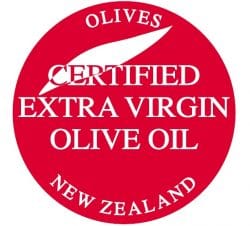
Look for the OliveMark. The red mark is your shortcut past the whole origin question — it means certified extra virgin and 100% grown here. If you want to go further, Olives New Zealand publishes a list of certified oils each harvest year, and you can check a bottle against it.
Read the date it was pressed. Freshness is the whole edge, and the OliveMark rule bakes it in: certified bottles must show the month they were processed, with a best-before no more than 24 months out. An oil pressed this autumn is a different product from one pressed two years ago, even if both are technically in date. No pressing or harvest date anywhere on the bottle? That absence is itself information.
Favour single-origin over "packed in NZ." "Packed in New Zealand" can sit on top of blended imported oil. A named grove, region or grower is much harder to fake and much easier to stand behind.
Trust your nose. Real fresh extra virgin smells green and grassy and finishes with a peppery catch at the back of your throat. Flat, waxy, or vaguely "buttery" is a warning. If you can taste before you commit — at a market or a good grocer — do.
A word on "organic" specifically
This is the part worth slowing down on, because the marks do different jobs and it's easy to assume one covers the other.
The OliveMark certifies two things: that the oil is genuinely extra virgin, and that it's genuinely New Zealand. It does not certify organic. Organic is a separate layer — certified under the Organic Products Regulations 2022 by a recognised body such as BioGro, AsureQuality Organic or Demeter, with its own logo and licence number on the label.
So a bottle can be OliveMark-certified and conventionally grown. It can be certified organic and not carry the OliveMark. The strongest bottle on an organic shelf carries both, and a verifiable harvest date as well. If you only see one mark, you know exactly which question is still open.
Why the organic shelf is nearly empty
Here's the part that surprised me most, and it's the real reason a certified-organic New Zealand olive oil is so hard to find: the problem usually isn't the orchard. It's the press.
To carry an organic label, the whole chain has to be certified — not just the trees, but the mill that presses the fruit and the facility that bottles it. A grower can farm exactly to organic standard for years and still be unable to sell a certified organic oil, simply because the nearest press isn't certified. Run organic fruit through a shared conventional mill and the chain breaks.
That's not hypothetical. Totara Tunnel in Te Horo grows to organic principles, lives off-grid, and used to carry BioGro — until they left the programme. Not because anything changed in the grove. Because they couldn't find a certified organic processor to press their olives, and the audit costs kept climbing for a claim they could no longer honestly display. Their growing hasn't changed at all. The certificate just had nowhere to land.
It's the same gap I found at Hickory Bay — certification that holds on the farm and quietly falls over somewhere in the processing chain. In olives it looks close to structural: a country with only a scattering of presses, very few of them certified organic, so the oil comes out the other end uncertifiable no matter how it went in.
There are early signs of a fix. Kakariki in the Moutere Hills built its own press and now offers contract pressing to other growers, and more small dedicated presses are exactly what would let an organic grower keep the chain intact. Until there are enough of them, "certified organic" on a New Zealand olive oil will stay rare — and a lot of genuinely organic fruit will keep being sold as merely "extra virgin."
The groves that clear the bar
Two clear the whole thing today. Bella Olea in Greytown is certified organic through Organic Farm NZ and carries the OliveMark. Green Ridge Estate in Marlborough is Demeter-certified biodynamic, grown on the same soils as the region's wine. A wider set make excellent oil but stop short of organic certification — Rangihoua and Allpress on Waiheke, Kakariki in the Moutere — spray-free or OliveMark-certified, not organic. I'll map the certified-and-organic ones properly in the buying guide that follows, rather than pad the list with names that don't clear the bar — which is, after all, the entire point of this piece.
Sources and further reading
The global picture
- 60 Minutes / CBS News — how olive oil fraud works, the Agromafia, and the often-quoted estimates of how much "extra virgin" misses the grade: https://www.cbsnews.com/news/60-minutes-overtime-how-to-buy-olive-oil/
- AP via Fox News — Italian prosecutors investigating seven producers for selling ordinary oil as extra virgin: https://www.foxnews.com/world/italian-prosecutors-investigate-7-olive-oil-makers-for-falsely-claiming-virgin-label
- A 42-tonne fake-olive-oil seizure in Puglia, with drums of chlorophyll used to fake the colour: https://www.aol.com/italian-authorities-confiscate-almost-1-150329999.html
- The counter-view — the North American Olive Oil Association (an industry body) on FDA testing that found adulteration low. Worth reading precisely because the source has an interest: https://www.aboutoliveoil.org/olive-oil-fraud
New Zealand
- NZ Herald / Listener — confirms New Zealand has no mandatory olive oil standard, that OliveMark is voluntary, and that ~90% of oil sold here is imported: https://www.nzherald.co.nz/the-listener/health/is-it-worth-spending-big-money-on-premium-olive-oil/premium/5MMSZ66MONG6NPD66IZ3WPOJZU/
- Consumer NZ (via Scoop) — the 2022 investigation that found "New Zealand"-labelled oils blended with Australian oil: https://www.scoop.co.nz/stories/BU2202/S00186/some-new-zealand-olive-oils-may-not-be-as-local-as-you-think.htm
- RNZ — earlier Consumer testing; no adulteration found among the NZ oils tested: https://www.rnz.co.nz/national/programmes/up-this-way/audio/2018627708/which-is-the-best-olive-oil
- NZ Herald / Viva — how to spot a quality extra virgin: https://www.nzherald.co.nz/viva/food-drink/how-to-spot-quality-extra-virgin-olive-oil-and-5-of-the-best-to-shop-now/4DFWXNJ3D5EQ5IUZCUQJOANJXQ/
The marks, and how to check them yourself
- Olives New Zealand — what the OliveMark certifies and why it exists: https://olivesnz.org.nz/nz-evoo/ and https://olivesnz.org.nz/olivemark-certified-evoo/
- The actual certified lists — check a bottle against them: 2024 (https://olivesnz.org.nz/wp-content/uploads/2025/12/2024-EVOO-Certification-Listing-Dec24.pdf) and 2025 (https://olivesnz.org.nz/wp-content/uploads/2025/12/Certification-Website-List-Dec-25.pdf)
- Olives NZ producer directory, by region: https://olivesnz.org.nz/business-listing-by-regions/
- On the freshness science behind all this — Lagutin, Lewis & Austin (Callaghan Innovation), in Food New Zealand, June/July 2025, pp. 28–29: https://issuu.com/annescott1/docs/food_new_zealand_june_july_2025
- BioGro — find-a-certified-business directory, to verify an organic claim by licence number: https://www.biogro.co.nz/find-organic
The growers named here
- Bella Olea (Greytown) via Olivver: https://www.olivver.co.nz/
- Green Ridge Estate (Marlborough): http://www.greenridgeestate.co.nz/
- Totara Tunnel (Te Horo) — including their own account of leaving BioGro: https://totaratunnelolives.co.nz/
- Kakariki Olives (Moutere): https://www.kakarikiolives.co.nz/
Worth a watch / a longer read
- Country Calendar, 2025 — Dali Olives, Martinborough: a NZ EVOO grower built on the phenol/freshness argument, OliveMark and all (TVNZ+, S2025 E23): https://www.tvnz.co.nz/shows/country-calendar/episodes/s2025-e23
- RNZ Country Life — Dali's Ross Vintiner on biodynamic method and record polyphenol levels (721 mg/kg, against a 200–400 norm): https://www.rnz.co.nz/national/programmes/countrylife/audio/2018758460/dali-olive-oil-a-picture-of-health
- NZ Geographic, "Hard Pressed" — the full history of the modern NZ olive oil industry, from Blumenfeld's first press to the Marlborough pioneers: https://www.nzgeo.com/stories/hard-pressed/
Next in this series: the canola story — hexane, GM sourcing, and why "vegetable oil" is the least informative label in your pantry. [link]