Queenstown -The Last Organic Shop in Town
Huckleberry's gone. Wise Cicada's gone. Independent organic retail is dying fastest in NZ's biggest city — yet a small shop in a Frankton mall survives by serving eight regions at once. What its survival reveals about what "organic" is really worth in Central Otago.
The model is dying, and it's dying first in the places that should be able to carry it.
In November 2024, Huckleberry went into liquidation. Three organic grocery stores across Auckland, around thirty staff, gone over a long weekend. The company had even struck a wholesale deal with Woolworths two years earlier to try to hold its prices down. It wasn't enough. One of its directors put the cause plainly: when money tightens, organic and natural wholefoods get reclassified in the shopper's head as a luxury, and luxuries are the first thing cut.
Wise Cicada — for years the best-known organic grocer and cafe in the country's largest city — is gone too.
This is the backdrop you need to hold in your mind to understand what's quietly remarkable about a small shop in a Frankton mall. If certified-organic retail can't survive in Auckland, a city of about 1.7 million people with its concentration of money, how does it survive in a tourist town at the bottom of the South Island?
A shop built on reach
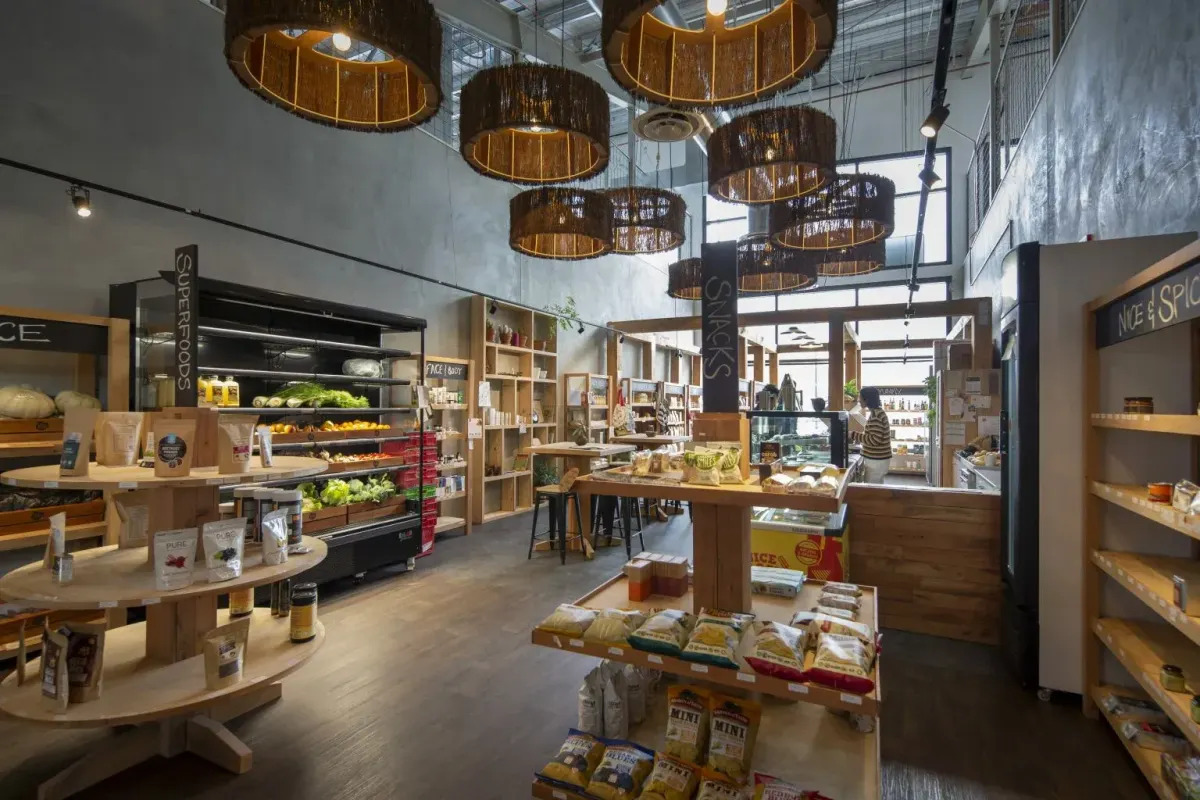
Soul Food Organic sits in The Market at Queenstown Central, out in Frankton. Walk in and it reads like a boutique grocer: fresh organic produce, pantry staples, meats, and a counter doing house smoothies, juices and gluten-free lunch. Easy to file as a nice health-food shop and move on.
That would be a mistake, because the shop floor isn't the whole of what this business is.
Soul Food began two decades ago as a tiny store in Wanaka. It has since grown into two physical sites and a delivery operation that, by its own listing, reaches across eight regions: Wanaka, Queenstown, Cromwell, Invercargill, Dunedin, the West Coast, Otago and Southland.
Here's my read of what that delivery list actually means. Functionally, this behaves less like a single Queenstown shop than like a small organic delivery service for the lower South Island that happens to have a storefront attached. And that, I'd argue, is the answer to the survival question. Auckland's organic grocers died competing for a dense market that the supermarkets were busy absorbing from underneath them. Soul Food does close to the opposite: it stitches together thin, scattered demand spread across hundreds of kilometres of farmland and small towns, places no supermarket organic aisle bothers to serve well. Where the city model failed by being too concentrated, this one appears to survive by being spread out.
The long way south
Here is where it gets interesting for anyone who cares how food actually moves.
Certified-organic produce doesn't grow conveniently near Queenstown in any volume. So Soul Food brings it in. One of its named suppliers is Streamside Organics, a 50-acre farm just south of Christchurch — and from the Wakatipu, that's the better part of 480 kilometres away. A six-hour drive, one way.
So the certified produce on these shelves has travelled. A lot. Which raises the honest question we always end up at: what are you actually buying when you buy "organic" this far from where it grew?
The answer, in this case, is that the certification is real and it lives upstream. Streamside is AsureQuality certified — number 1444 — and is explicit that anything not certified gets labelled "spray free" instead. That mark means what it's supposed to mean: audited compliance, inspection, a certifying body that can pull the licence. The shop's job is to carry that verified chain the last several hundred kilometres to a customer in Queenstown. The provenance is genuine; it's just long.
Hold that against the other model this region runs on. A celebrity farm an hour from here sells "organic" and "spray-free" produce grown right there on the Crown Terrace, with no certification behind the words at all. Soul Food sells certified produce trucked in from the far side of the island. Close and unverified, or distant and audited — that's the actual choice on the table in Central Otago, and it's not as simple as "buy local" would have you believe.
The quiet irony at the till
There's a twist worth one line. The man who built this shop over twenty years is, by his own account, "not a staunch organics person" — he's said a certified label doesn't guarantee something is healthy, and the lack of one doesn't make it harmful. It's a striking thing to hear from the proprietor of the one shop in town built on certified organics. Even here, at the audited end of the spectrum, nobody treats the certificate as the whole story.
That honesty is, if anything, a point in the shop's favour. It isn't selling certification as a magic word. It's selling food, and letting the verification speak for itself.
What we lose if this one goes
Strip away the romance and the stakes are structural.
Right now, New Zealand is in the middle of making "organic" a legally protected word. The Organic Products and Production Act passed in 2023, and its regulations came into force in late 2025 — but with a three-year transition before compliance becomes mandatory, around 2028. Only then will the term mean something fully enforceable on a label. And a law only protects a word. It doesn't keep the shops that trade in the real thing alive in the meantime.
And those shops are the infrastructure. They are how audited, certified food actually reaches people who don't live next door to a certified farm. When a Huckleberry closes, or a Wise Cicada, the certified growers behind them lose a route to market — and the shopper loses the one place where "organic" came with paperwork instead of a marketing campaign. The vacuum doesn't stay empty. It fills with the louder, looser, uncertified version of the word, because that version has better branding and deeper pockets.
So a small shop in a Frankton mall, propping up an eight-region delivery run to keep certified food moving across the bottom of the country, turns out to be doing something the law can't do on its own. It's keeping the verified meaning of the word in circulation.
That's worth noticing before it's gone. Because in this part of the country, it's the last one of its kind.
Sources
- Huckleberry liquidation and "luxury spend" — NZ Herald, Nov 2024: https://www.nzherald.co.nz/business/small-business/organic-grocer-huckleberry-in-liquidation-three-auckland-stores-to-close-up-to-35-staff-affected/B7CPRXPLHVHBRJL7J6MMDHA4WA/
- Soul Food origin in Wanaka + store description — Queenstown Central: https://queenstowncentral.co.nz/soul-food-organic-living-for-a-better-future/ and https://queenstowncentral.co.nz/tenant/soul-food-organic/
- Eight-region delivery — Soul Food Organic: https://www.soulfoodorganic.co.nz/
- Streamside Organics supplies Soul Food (stockist list) — https://www.streamsideorganics.co.nz/pages/about
- Streamside AsureQuality certification #1444 — https://www.streamsideorganics.co.nz/collections/all
- Auckland population — Stats NZ 2023 census (Auckland Region 1,656,486)
- Organic Products and Production Act 2023 — became law 5 April 2023; regulations in force late 2025 (Organic Products and Production Regulations 2025 on 3 October 2025), with a 3-year transition before compliance is mandatory (~2028). MPI: https://www.mpi.govt.nz/agriculture/organic-product-requirements-in-nz/changes-to-organic-products-law — Act: https://legislation.govt.nz/act/public/2023/0014/latest/LMS312665.html — Regulations: https://www.legislation.govt.nz/regulation/public/2025/0196/latest/LMS1458653.html and https://www.legislation.govt.nz/regulation/public/2025/0197/latest/whole.html