New Zealand grows its own organic tea. You've probably never tasted it.
This Saturday, the only commercial tea plantation in NZ turns thirty. Zealong is BioGro-certified, sold at Harrods, and family-owned. So why can't you find it at Commonsense Organics? A discovery piece on NZ's only home-grown organic tea, and what's about to change for the word organic.
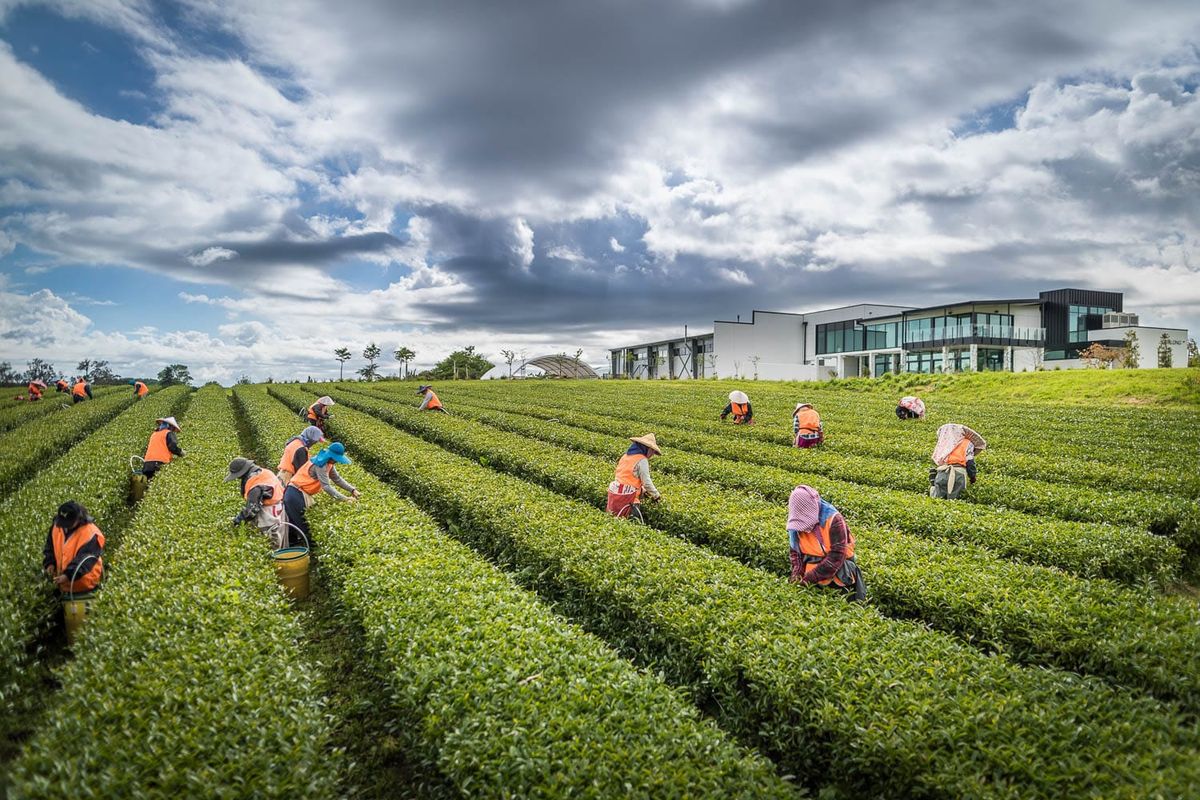
This Saturday — 23 May 2026 — there is a behind-the-scenes public viewing event at a place I had never heard of until last week. It is twenty-five minutes north of Hamilton. It is the only commercial tea plantation in New Zealand. And it is turning thirty.
I came across Zealong by accident, the way most of these stories find me — a news item on a farming site, almost in passing. New Zealand's only tea estate, celebrating its thirtieth year, expanding into powdered teas. I read it twice to make sure I had it right. We grow tea here. Properly. Commercially. Organically. And almost nobody talks about it.
So I went looking.
A flowering camellia, and an unreasonable man
Zealong began in 1996 with a young Taiwanese-born property developer named Vincent Chen, then in his early twenties, looking at a camellia tree in his neighbour's garden in Rototuna. Chen had spent his teenage years in Waikato, and tea, for his family, was not a beverage but a culture. He noticed how well the ornamental camellias flourished in the local conditions — cool nights, foggy mornings, warm days — and thought about the tea plant, which is itself a camellia. Camellia sinensis. The same family.
He and his father, Tzu Wan Chen, flew to Asia and selected fifteen hundred tea cuttings from the best growing regions they could find. New Zealand's biosecurity regime, then as now, is one of the strictest in the world. After ten months in quarantine — not the three years many people assume — only one hundred and thirty cuttings survived.
Rather than treat that as a disaster, Vincent took it as a sign the survivors were the strongest. Those one hundred and thirty plants are the parents of every tea bush at Zealong today. There are now around 1.2 million of them, spread across 48 hectares of a former dairy farm in Gordonton, with around 25 hectares in active tea production. The first commercial teas didn't reach the market until 2009. Tea is a slow crop — cuttings need eighteen months in specialised propagation facilities at about $2.50 per plant before they're ready to go in the ground, and then another four years before the first leaves can be harvested. Add the five-year organic conversion period on top of that and 1996 to 2009 starts to make sense.
The name itself is a portmanteau: New Zealand plus oolong. Oolong was the first tea Chen and his team perfected on the estate, and the brand's three-leaf logo represents the top three leaves on each plant — which is all the pickers take, three times a year. In Chinese, oolong means "black dragon," and Zealong's tea masters call those three leaves "the dragon." Anything older or larger is left to support the plant.
I find this story almost preposterously good. A man looks at a flower, imagines an industry, imports cuttings from across the world, watches ninety-one percent of them die in quarantine, and proceeds anyway. The original dairy farmhouse is still standing — it's now the Teahouse. The result, three decades later, sits on the shelves at Harrods, Fortnum & Mason, and Claridge's, and supplies TeeGschwendner, the world's largest specialty tea retailer, who only consider buying from the top half of one percent of global tea production. They were the first people to grow oolong tea outside Asia. They have won a Lifetime Achievement Award from global tea judges for their contribution to the industry. They were featured in BBC Earth's One Cup, a Thousand Stories documentary series in late 2024 — a six-part global series in which the Zealong segment opens with drone shots of the Waikato countryside and the narrator describing the tea plant as "an alien in New Zealand, a sub-tropical interloper."
A few other things worth knowing. The estate produces about 20 tonnes of finished tea each year, which sounds modest until you understand that 100 tonnes of wet leaf goes in the front end to produce that 20 tonnes coming out the back. The window from picking to roasting to packaging is 36 hours. Three harvests a year, hand-picked: November, January, and March. The harvest workforce includes around 50 skilled pickers brought from Taiwan under the RSE scheme, joining the 45 full-time staff and growing the team to about 125 during peak season. The estate also runs a custom 100hp tractor called The Transformer, built to Zealong's specifications, which handles the trimming and maintenance between harvests.
The processing happens indoors in a purpose-built glasshouse — apparently a world first for tea — letting them control humidity, temperature, and airflow at every stage. The refining process for a single batch runs thirty-six hours non-stop. The team is drawn from more than thirty different nationalities, including staff from traditional tea-growing countries like Taiwan and Sri Lanka. The cultivars are mainly Chin Shin with a small amount of Jin Xuan — both Taiwanese oolong cultivars, which tracks with Chen's background. The estate is also a refuge for native birds and wildlife, which weren't part of the original business plan but seem to have settled in regardless.
Vincent Chen on his own work, in a quiet moment with a University of Waikato interviewer: "My big love is now growing tea, and because it's something I don't understand, I'm learning from my heart to try to understand it."
The business remains privately owned by Vincent Chen and family, who have invested more than $10 million in the venture. CEO Gigi Crawford, who joined Zealong in 2008 after a career in European and Asian high-end consumer goods, has reportedly turned down purchase offers from large Chinese firms. In a tea industry dominated by multinational consolidation, this matters more than it might at first appear.
What "certified organic" actually means here
This is the part that matters to me, and it's the part the news articles tend to gloss over.
Zealong is certified by BioGro, the larger of the two main organic certifiers operating in New Zealand. BioGro certification is also recognised under USDA organic, EU organic, JAS (Japan) organic, and China Organic standards — which is to say, it is internationally portable in a way that matters for export. The estate also holds ISO 22000 and HACCP food safety certifications, and is licensed under Buy NZ Made and the FernMark.
The conversion took five years. That is the period a former conventional farm must spend transitioning before its produce can be sold as certified organic. Five years of farming to organic standards while still being unable to call your tea organic. Five years before the first BioGro-stamped packet could go to market.
Zealong calls itself the largest internationally certified organic tea estate in the world. That's a specific claim — not the biggest tea estate, not the biggest organic one, but the biggest internationally certified organic one. Organic tea is around two percent of the global tea market. In a global industry where most growing happens at scale in countries without rigorous third-party certification, Zealong's position is a real and verifiable one.
The law just changed, and most people haven't noticed
Until very recently, New Zealand was unusual among its trading partners in having no legal definition of the word organic. You could write it on a packet. You could put it on a sign. There was no specific legislation that said what it had to mean. Companies were bound by the Fair Trading Act not to mislead consumers, but there was no national organic standard sitting underneath the claim.
That changed in 2023, slowly, and then again in 2025, more concretely.
The Organic Products and Production Act 2023 received Royal Assent on 5 April 2023. It is the framework legislation — the parent act that authorises a system rather than the system itself. The actual rules sat empty for two years while the Ministry for Primary Industries drafted the secondary regulations. Those secondary regulations — the Organic Standards Regulations 2025 and the Organic Products and Production Regulations 2025 — came into force in September 2025.
There is a three-year transition period. By 2028, anyone making an organic claim on a product produced in New Zealand will need to be approved as an operator under the new system and comply with a national organic standard, with oversight from a recognised entity. Some cost recovery for businesses begins in mid-2026.
This matters for two reasons. One is European market access. The EU has tightened its rules on what can be imported as organic, and New Zealand needs an equivalence arrangement in place by 2027 to keep selling organic produce there. Organic exports across all markets were worth over $165 million in 2022/2023, around $45 million of that to the EU. Without a domestic regulatory regime that the EU recognises, the export economy that supports producers like Zealong gets harder.
The other reason is the one most New Zealanders will never read about. For the first time, the word organic on a domestically produced product will have a legal meaning, with a national standard underneath it, enforced by MPI. Until now, the heavy lifting has been done by third-party certifiers — BioGro, AsureQuality, Demeter, QCONZ — operating to their own standards under what was called the Official Organic Assurance Programme. That programme is being replaced.
The producers who have been doing the work — five-year conversions, paying for annual audits, complying with internationally recognised standards — are about to have the playing field flattened. The shortcut of slapping organic on a packet without doing the work becomes legally risky. The serious operators welcome this. The marginal ones are quieter.
The supermarket shelf, and what's on it
Walk down the tea aisle at your nearest Countdown or New World. The dominant brand on the shelf is Dilmah — a Sri Lankan family company that has been New Zealand's top-selling tea brand since 2006 and Reader's Digest "Most Trusted Tea Brand" for seven consecutive years. Dilmah's mainstream supermarket range isn't organic, though it does have a supermarket Organic Fruit & Herbal range that has appeared in recent years. Beside Dilmah you'll find Bell, Twinings, Red Seal, supermarket house brands, and a small organic section featuring Pukka, Clipper, Higher Living, and Qi.
Every one of the organic options is grown overseas. The herbal blends are mostly blended in the United Kingdom. The Soil Association is the certifier you'll see on most of the British-blended packets — a UK certifier, perfectly legitimate, just not local.
There is nothing wrong with imported organic tea. Tea grows where tea grows, and most of the world's supply comes from places we can't replicate at this latitude. But it's worth sitting with the picture for a moment. The country that grows world-class certified organic tea on a former dairy farm in Waikato — tea that wins international awards, tea that Harrods sells — does not put that tea on its own supermarket shelves.
You can find it. You just have to know where to look.
A short footnote on what happens to organic brands
Take Pukka Herbs as an example. It's a small brand in New Zealand supermarkets, mostly sitting in the herbal infusion section, but its story is the cleanest illustration of what happens to organic brands when they succeed.
Founded in Bristol in 2001 by two herbalists, Pukka spent its first two decades as an exemplar — Soil Association certified, Fair for Life, a B Corp, 1% for the Planet. Unilever bought the brand in 2017 with what the founders called "iron-clad commitments" to keep it independent in spirit. In 2021, Unilever sold its global tea business to a Jersey-based private equity firm for €4.5 billion. By late 2023, Pukka had been fully absorbed into the new Lipton Teas and Infusions group in Amsterdam — the Bristol office closed, around ninety staff made redundant, UK production shifted to the Manchester facility that makes PG Tips, European production moved to Poland. In 2024, B Lab formally stripped Pukka of its B Corp certification, having determined the brand was no longer a "complete and distinct" entity.
The teas are still organic. The certifications are still valid. But the brand that arrived in New Zealand supermarkets a decade ago and the brand on the shelf now are not the same business. The founder story on the box is, increasingly, a museum piece.
Meanwhile, the only certified organic tea grown in this country is still owned by the family that started it.
Where Zealong actually sells in New Zealand
This is where the story gets quietly strange.
Zealong's New Zealand retail footprint, if you trust their stockist list, is organised around three audiences: Waikato locals who can drive to the estate, tourists passing through Auckland and Rotorua, and high-end hospitality.
In Auckland, you can buy Zealong at SkyCity Hotel, at T Galleria by DFS at the bottom of Customs Street, at Aotea Gifts on Lower Albert Street, in selected Mojo Coffee outlets, and at Farro Fresh's six stores. (The stockist list still includes Smith & Caughey's on Queen Street, but that store closed in June 2025 after 145 years, so the list is out of date on that point.) In Hamilton, the list is much longer — the estate boutique itself, the Hamilton Gardens information centre, several cafés along Victoria Street. In Cambridge and Morrinsville, a handful more. There are hotels and tourist outlets in Rotorua and Queenstown.
What I cannot find on the list is any of the obvious places. Commonsense Organics. Naturally Organic. The organic specialty grocers — the people whose entire stock is built around exactly this kind of certification and traceability — do not appear to stock New Zealand's only certified organic tea.
I don't know why. I'd guess it's some combination of margin, volume, distribution agreements, and the fact that Zealong's export economics make domestic specialty retail a small priority. Their loose-leaf comes in 200-gram packs at around $105–$112, and a box of pyramid tea bags is about $30. Those are export prices. They are not Pams-aisle prices. They are not even Pukka-aisle prices, which run around $7 to $9 a box.
The result is that the only certified organic tea grown in this country sits in tourist gift shops and SkyCity, while the organic grocers — the people who would tell their customers about it without prompting — stock the imported alternatives.
What to do with this
I am not writing this to tell anyone to switch their tea. Dilmah, Pukka, Clipper, and the rest are honest products, properly certified where they claim to be, and they cost what most people can afford. The supermarket tea aisle is a perfectly reasonable place to shop.
But the next time you make a cup of tea, it's worth knowing that there is another option. Grown here. On former dairy land. By a team that swells from 45 to 125 during harvest, working under one of the strictest organic standards in the world. With a story that traces back to a single flowering camellia, one hundred and thirty surviving cuttings, and a thirteen-year wait before the first commercial cup was poured.
It is also worth knowing that the regulatory ground under your organic tea is shifting. By 2028, the word organic on a New Zealand-produced packet will mean something specific and enforceable. By 2027, the EU equivalence arrangement that keeps Zealong and the rest of our organic export sector viable in Europe will need to be in place. The next three years are the period in which a generation of work by third-party certifiers gets translated into law.
You can buy Zealong online directly. If you're ever passing through Gordonton, the estate is open to visitors and runs a tea room and a restaurant.
It is not the cheapest tea in the country. It is, as far as I can tell, the only one grown in it.
Zealong is celebrating its thirtieth anniversary with a behind-the-scenes public viewing event on Saturday 23 May 2026 at the estate at 495 Gordonton Road, Hamilton. The first such event in over four years, it includes a walk through the organic tea fields, a tour inside the factory, and a guided tea tasting. Details on the Zealong website.