You Wouldn’t Buy Your Dinner From Temu
New Zealanders assume the frozen vegetables in the supermarket are still mostly local and trustworthy. But as local processing disappears, that choice is quietly being made for us.
Most New Zealanders still assume the basics are taken care of.
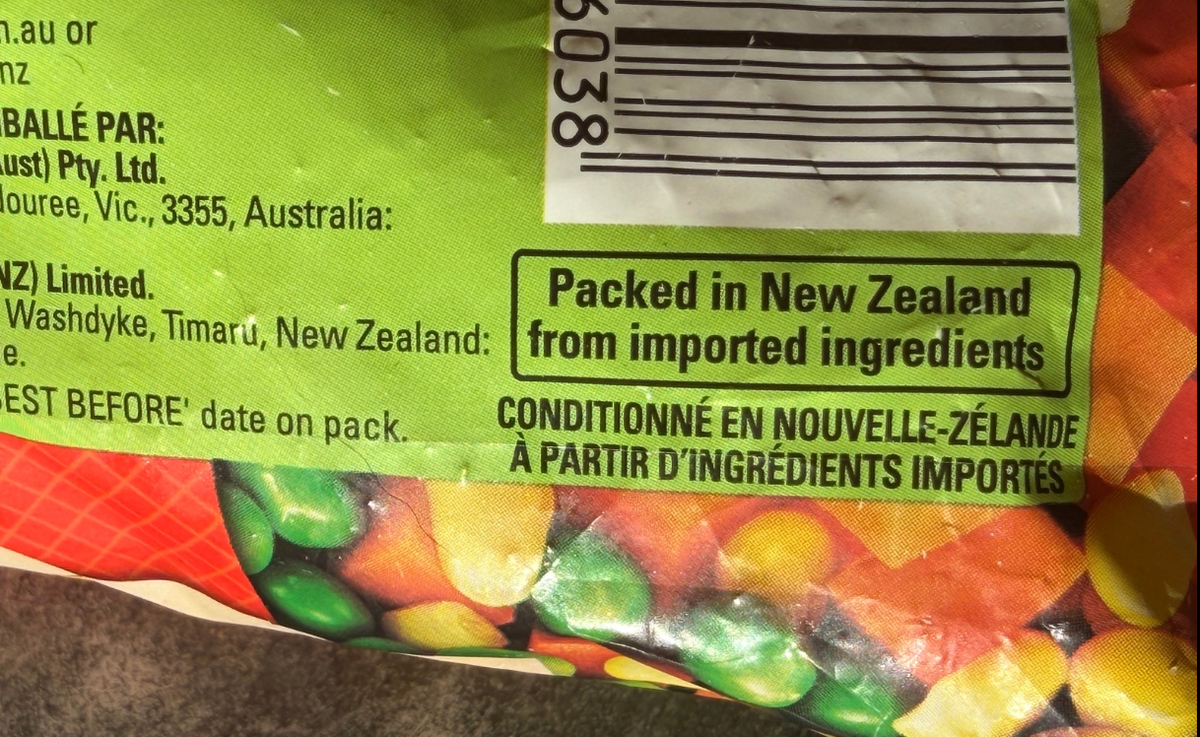
We live in a food-producing nation. We grow great food and export premium food. So most people assume the frozen vegetables in the supermarket are still mostly local, still trustworthy, and still roughly what they used to be.
That is the assumption.
But most people are not standing in the aisle turning over every packet like they’re sitting an exam. They’re feeding a family, watching the bank balance, and grabbing brands they recognise and trust. That trust is doing a lot of heavy lifting.
While people were busy living their lives, New Zealand’s local frozen vegetable processing capacity started disappearing. Wattie’s is exiting frozen vegetables entirely, closing packing lines in Hastings and related sites across Auckland, Christchurch, and Dunedin. McCain’s Hastings vegetable processing plant is closing by January 2027. Once that infrastructure goes, it does not magically grow back.
This matters.
It matters because food security is about more than carrots existing somewhere in the world. It is about whether we can still grow, process, pack, and supply basic staples close to home when supply chains get rough.
Right now, New Zealand has no real food security plan or clear vision for feeding its own people first when pressure hits. Eat New Zealand’s Angela Clifford said we have “no security plan, no vision to feed our own people,” and warned against ending up with only a few manufacturers and then running out of options in a global fuel crisis.
It matters because every lost local plant means more reliance on imported food, longer supply chains, and systems we do not control.
We already understand this with fuel. When we cannot produce enough ourselves, we become takers on the world market. When supply chains tighten, prices spike, and global competition heats up, we do not get a local fallback. We just pay more and hope supply keeps flowing.
Food is no different. If we lose the ability to grow, process, and pack enough of our own staples, we become more exposed when global supply chains wobble. We lose our buffer. We lose our options. And in a real crunch, that matters.
That is not just theory anymore. This week, Eat New Zealand made the same point publicly, arguing for redundancy, decentralisation, and stronger local food capacity before it is too late.
That is why local food capacity matters. It is not just about what is cheapest this week. It is about whether we still have options when the world gets shaky.
And it matters because most shoppers are not consciously choosing this.
If you put two options in front of people and asked plainly:
- New Zealand-grown carrots, grown and processed locally
- Imported conventionally grown carrots, often from China
how many Kiwis would deliberately pick the second?
Not many.
This is not about claiming every imported product is dangerous. It is about trust, traceability, standards, distance, and how much visibility we lose when basic food comes through long, price-driven global supply chains.
China is not a country many New Zealanders instinctively trust with everyday food staples. Fair or unfair, that is the reality many feel. Yet that is increasingly where parts of the freezer aisle are drifting.
Not by conscious choice.
By drift.
By margin pressure.
By habit.
By the comforting assumption that a familiar brand still means what it used to.
Meanwhile, local plants close. Growers lose reliable buyers. Skills and capacity shrink. And the country that prides itself on being clean, green, and good at food becomes more dependent on imported basics.
That is not resilience. That is managed decline dressed up as consumer choice.
Yes, budgets are tight. Yes, organics or premium local cost more. Yes, people do the best they can with what they have.
But we should at least be honest about the trade-offs.
Cheap can come with hidden costs: lower traceability, a growing chemical burden most people never knowingly signed up for, lost local jobs, and a weaker ability to feed ourselves on our own terms when it counts. This is not just about price. It is about dependence, exposure, and what happens when a country becomes a taker on the world market with no meaningful local fallback.
Part of the problem is that the food system has been treated more as a machine for extracting value than a system designed first to feed people. Clifford described it bluntly: New Zealand’s food system has become financialised. Export earnings matter, but when everything is optimised for margin, scale, and efficiency, local resilience starts to look optional right up until the day it is suddenly not.
Once the infrastructure is gone, you do not just switch it back on in a crisis.
You would not buy your dinner from Temu.
Maybe it is time we stopped sleepwalking into a food system that quietly asks us to do the same thing, just with better packaging.
 Ninetonoon,