The empty shelf, and a look at Good Farms eggs
Two shops, zero eggs, and the seasonal reason behind it — then a carton of Good Farms "100% Free Range" I'd never noticed, and what happened when I tried to check the claim. A look at daylight, laying hens, and the gap between a label and the proof behind it.
I went to Commonsense for eggs this morning, and they had none. Not a low shelf or a sad half-dozen — zero, just the empty space where the eggs usually sit.
It isn't a shortage, not really. It's the season. We're about three weeks out from the shortest day, and a hen left to her own devices is not the year-round egg machine the supermarket fridge trains us to expect. She's a creature of light.
A hen runs on daylight
A hen doesn't lay because she's well fed or content, though both certainly help. She lays because of the length of the day — and the part that always gets me is how she measures it. It isn't really her eyes doing the counting. Light passes straight through her feathers, skin and the thin bone of her skull to photoreceptors sitting deep inside her brain, and it's those that read the season and decide whether the ovary wakes and sends an egg on its way. She senses the daylight from the inside. More daylight, more of that signal, more eggs.
It's old wiring. Domestic hens descend from jungle fowl, and they evolved to lay into the lengthening days of spring and summer — the season when a clutch of chicks stood the best chance, with warmth coming and food on the ground. Laying in the depths of winter would have been a poor bet, so they simply didn't. The instinct is still there under all the breeding.
The rough rule is that a hen lays strongly on something like fourteen hours of light a day — and here's the bit I went and checked. In Auckland we only get fourteen hours or more for about three months around midsummer, roughly mid-November into early February. The longest day tops out near fourteen and three-quarter hours, and from there it slides all the way down to under ten hours at the winter solstice in June. So for the larger part of the year a hen running on natural light alone is laying below her best — and right now, three weeks out from the shortest day, she's near the bottom of that curve. Stack on the autumn moult, when hens shed their feathers and pour their energy into regrowing them rather than into eggs, and you get precisely what those two shelves showed me: not much.
So why is the fridge usually full in July?
Light, again — just the artificial kind.
Indoor laying sheds run on a programmed "day," commonly somewhere near sixteen hours of light, that never gets the memo about the season. The hens' bodies are told, in effect, that it's perpetual late spring, and they lay accordingly, straight through the darkest months of the year. That's how there are eggs in June at all, and a good part of how they stay affordable.
I'm not waving a finger at that. It's a real trade-off, and worth seeing clearly from both sides. The scarce, seasonal egg is the price of letting a hen keep her own clock. The dependable year-round egg usually means someone is holding the lights on for her. Neither is a scandal. It's just one of those things that stays invisible until the shelf is empty and you start asking why.
And here's a wrinkle I keep coming back to: "free range" doesn't actually answer this question. Free range describes whether a hen can get outdoors — not whether the shed she sleeps and lays in is lit through the winter. The two things get bundled together in our heads, but they're separate. You can be a free-range hen under sixteen hours of shed light. The label tells you one thing and stays quiet on the other.
Down the road to Farro
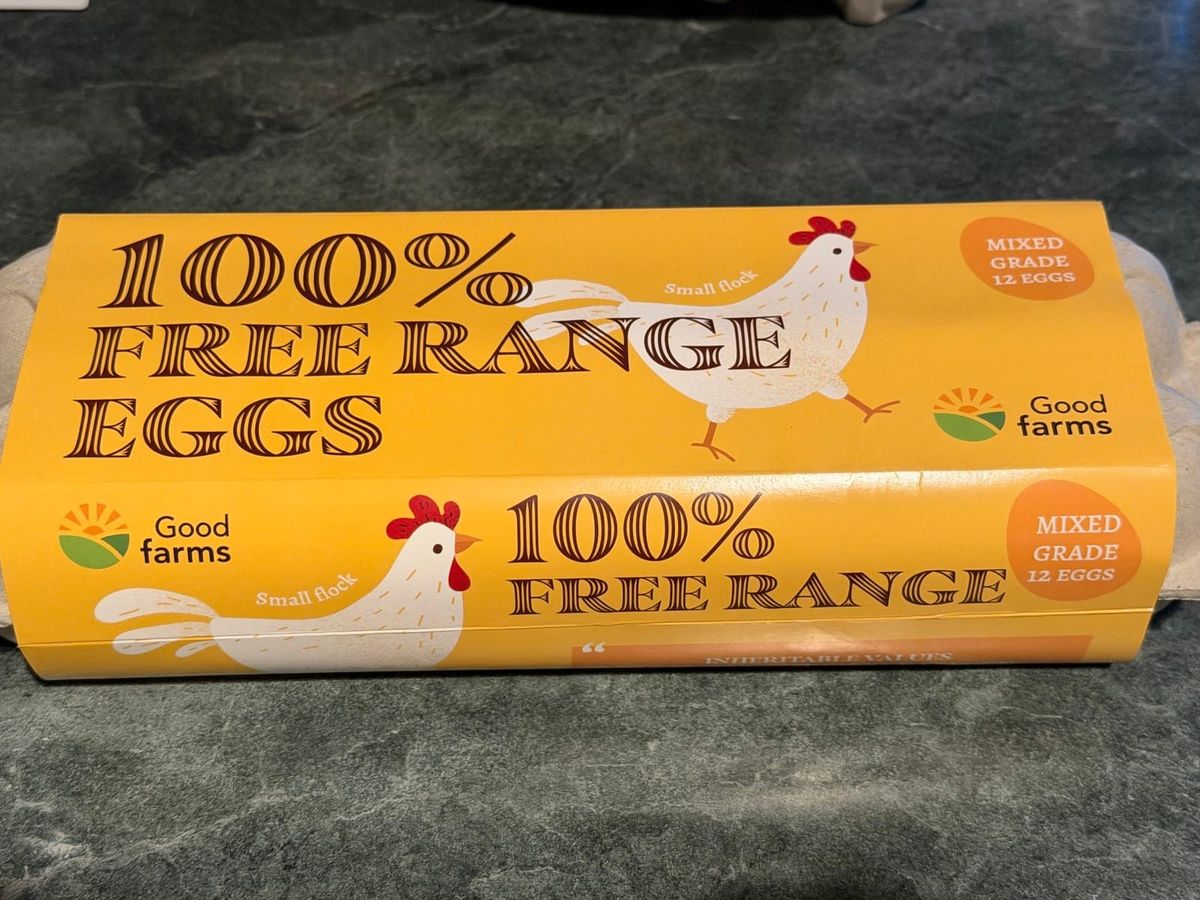
Anyway — I still needed eggs. So I carried on down the road to Farro, which was also running thin; the egg section had clearly had the same kind of morning. And there, in among the gaps, was a carton I'd never seen before.
I'll be honest about why I reached for it: it looked great. Bold type, bolder claims — 100% Free Range right across the front — and a name you couldn't argue with. Good Farms. Who's against good farms? It had the easy confidence of a brand that wants you to feel good about the choice, and standing there with no eggs to my name, I did. I dropped a carton in the basket genuinely pleased, and a little bit excited to go and find out more about whoever these people were.
The website only deepened the good feeling. It was nicely made, and front and centre sat a video: rolling green hills, a farm ute on a gravel track, the line "Inheritable values last generations and beyond." Multigenerational Kiwi farming, the real and rooted thing — or so it played. Then a number caught my eye: ten square metres per hen of free-range farm. That's a lot of room. I was more or less sold. This was shaping up to be exactly the kind of producer I'd hoped to stumble onto.
And then I started actually checking, and the picture began to come apart.
The first red flags
The trouble with "ten square metres per hen" is that nothing was standing behind it. I went back to the carton looking for the one thing that would make any of these claims mean something — an independent certifier's mark. SPCA Certified, BioGro, AsureQuality: a logo from any of those tells you a third party has been onto the farm and audited it against a published standard. In New Zealand that matters more than people realise, because there's no enforceable definition of "free range" at all. The words on their own are just words. Anyone can print them.
There was no mark. Their website mentions annual audits by "third-party verification agencies" but never names one — an odd thing to be shy about if the whole point is to reassure you. So I turned the eggs over, because most New Zealand eggs carry a small ink stamp: a code that traces each egg back to its farm through the national Trace My Egg scheme that much of the industry takes part in. The Good Farms eggs were blank. No stamp, no code, nothing to look up.
So that generous ten square metres, the bold "100% Free Range," the unnamed annual audits — all of it rested on the company's own say-so. Lovely numbers with nothing underneath them. That's when the digging started in earnest.
A rather different company
Here's where the brand and the reality begin to part ways, and I want to stay strictly with what's on the record.
Good Farms isn't an old family farm. It's a Maungaturoto operation about an hour and a half north of Auckland, set up as a company in 2015 — so it's roughly a decade old. And it's run as a business, not a homestead: their own LinkedIn lists seven sheds and around 28,000 hens, and since 2019 they've put the actual hen-keeping out to contract farmers who run the sheds under the Good Farms name. The brand owner, the bird keeper, and the weathered farmer you'd picture from the video are three different things.
And then the part that genuinely caught me out, set against that heritage footage. Good Farms is, by its own description, a Chinese-owned company that markets first and foremost to New Zealand's Chinese community. Their website calls them "the largest Chinese free-range egg enterprise in New Zealand." The selling happens through a WeChat channel and Asian grocery chains — Dahua, Tai Ping, Fruit World — alongside Farro and Woolworths, with eggs bundled together with whole chickens for the cooking those shoppers actually do. None of which is the slightest bit wrong, to be clear: it's a smart, focused business serving a particular community well. It's just a long way from the multigenerational Kiwi farm the video had been selling me thirty seconds earlier.
Notice, too, how that headline claim is built. "The largest Chinese free-range egg enterprise in New Zealand" — the word "Chinese" is quietly carrying the whole sentence. They're not the largest free-range producer in the country; they're the largest within that one niche. The superlative sounds much bigger than what it actually measures.
The video, the second time around
That same video reads differently once you know. Rolling hills, the ute, "inheritable values, generations" — and underneath it, three "strategic partners": Prime Range Meats and Prime Range Fresh, a meat works and butcher chain down in Invercargill at the bottom of the South Island, and Cowala, a New-Zealand-made milk-powder brand built for export. A meat processor the better part of the country away, and a milk-powder exporter. Nothing about eggs, nothing about this land, nothing about anyone's generations. It's the visual language of an old family farm laid over a modern, ten-year-old trading network.
And the thing I keep coming back to: that gap would bother me exactly as much if the owners were fifth-generation locals. It isn't about who owns the company. It's the costume — heritage imagery and an unbacked "free range" promise standing in for the things they're supposed to represent. One certifier's mark would cut straight through it. There still isn't one.
What I came away with
I bought the eggs. They'll be fine; I'm not suggesting otherwise, and I've no reason to think the hens are mistreated. That isn't the point.
The point is the journey from the front of the carton to the back of it. I was pulled in by bold type, a great name and a lovely video, and felt genuinely good about the choice — and then found that almost nothing I'd been sold could actually be checked. The carton gave me a brand and a reassuring adjective; the eggshell gave me nothing; the bigger claims rested on the company's own word and an auditor it wouldn't name.
Which loops back to the empty shelf I started with. There were no eggs at Commonsense this morning because those hens are largely living by the season, slowing as the light fades toward the shortest day — the honest, inconvenient rhythm of a real bird outdoors. The reason a carton is nearly always there somewhere is that a great deal of cleverness goes into making eggs feel simple and constant. Some of that cleverness is lights in a shed. Some of it is bold type and a beautiful video.
The fix is small and never changes. Don't trust the front of the carton. Turn the egg over and look for the stamp. Look for the certifier's mark. If neither is there, you're not buying a verified free-range egg — you're buying a story, and you get to decide how much you trust the storyteller.
Next time I want to go further into who actually sits behind Good Farms — the company structure, the land, and where that organic milk of theirs ends up. But that's another shelf to pull apart another day.
A footnote on the packaging
One thing I only clocked once I got home. The carton comes wrapped in a sturdy printed cardboard sleeve — clever, and good-looking, and doing exactly what good branding is meant to do. But it has a side effect: you can't flip the lid in the shop the way you would with an ordinary carton. You can't check for cracks, and you can't really see what you're getting until you've paid and left.
What I got, once I opened it at the bench, was a dozen of mixed sizes that ran noticeably small — at least three of the twelve I'd call properly little. They're sold as mixed grade, so a few small ones isn't a fault, exactly. But standing there with eggs I'd had no way of sizing up in the shop, I felt faintly short-changed. It's a small thing. But it's the brand in miniature: lovely on the outside, sealed shut, and asking you to take the rest on trust.