New Zealand Lost 2,700 Produce Growers in 20 Years. Now Two of the Country's Three Big Wholesalers Want to Merge.
New Zealand's commercial grower count has fallen from 7,000 to 4,300 in 20 years, and its produce wholesalers may drop from three to two. Inside the Commerce Commission's Statement of Issues on the J&P Turner and T&G Fresh merger, and what it means for growers.
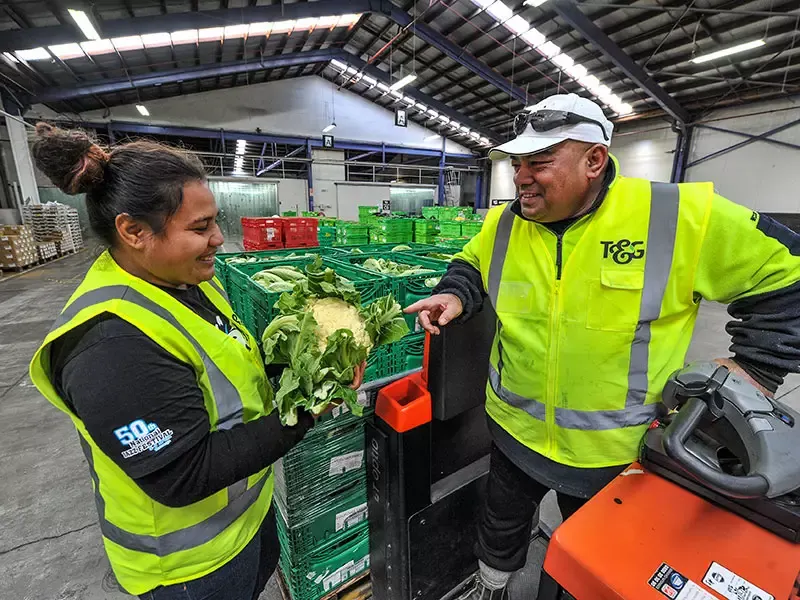
Here's a number that stopped me: New Zealand had about 7,000 commercial fruit and vegetable growers 20 years ago. It has 4,300 now. That's the Commerce Commission's own figure, footnoted to a Horticulture NZ release, and it's still roughly right today: HortNZ's own website currently puts the number at "4,300+ growers" for the year to March 2026.
Over the same 20 years, the number of "full service" wholesalers, the companies that run the big trading floors where growers sell and supermarkets buy, went from four to three. That happened when Turners & Growers merged with Freshmax in 2020.
Now it might go from three to two. J&P Turner Limited (JPT), which owns the wholesaler Fresh Direct, wants to buy Turners & Growers Fresh Limited (T&G Fresh), the other big national wholesaler. On 10 September the Commerce Commission published a Statement of Issues saying it isn't yet satisfied the deal wouldn't substantially lessen competition. That's regulator-speak for: this might not get approved as proposed.
I went and read the full 46-page Statement of Issues, because the press release version leaves out the interesting parts.
Three wholesalers, soon maybe two
Only three companies in New Zealand run full national "full service" produce markets: JPT (via Fresh Direct), T&G Fresh, and MG Group, formerly Market Gardeners Limited. The Commission's document is blunt about what these three actually do. They're not just middlemen taking a cut. They aggregate produce from hundreds of growers of wildly different sizes, absorb the risk of a bad batch or a washed-out crop, warehouse and transport it, and sell it on to supermarkets, greengrocers and food service companies who mostly don't want to deal with individual farms directly.
If JPT buys T&G Fresh, that's down to two.
JPT argues in its own application that this wouldn't matter much: the merged company's combined market share would be "modest," barriers to entry are low, and rivals like MG Group and various smaller wholesale distributors would keep it honest. The Commission isn't convinced yet. Its preliminary view is that the two companies "compete closely" for at least some growers and wholesale customers, and that MG Group and the smaller players might not be enough to replace the competitive tension that disappears when JPT and T&G Fresh stop bidding against each other.
One detail from the document stuck with me: some growers reported "multi-homing", selling to both JPT and T&G Fresh at once, specifically so they can play the two off against each other in price negotiations. One grower told the Commission it does this "frequently." That tactic goes away if there's only one wholesaler left to sell to.
Who actually has a problem here
The Commission's document makes a point I hadn't expected: it thinks growers are more exposed to this than supermarkets are. Supermarkets can see retail prices, can shop around, and can pass price rises on to customers. A lot of growers, especially smaller ones, don't have that visibility and don't have anywhere else to go, particularly if their crop is perishable and has to move fast.
Some growers submitted anonymously to the Commission (their names are withheld in the public version) worried about exactly this: fewer options, lower prices, worse contract terms, and the loss of the ability to shop their crop around at the last minute. Others surveyed by the Commission, via Horticulture NZ's newsletter, said they weren't concerned. Forty-nine growers responded to that survey. The Commission says it isn't treating that as a representative sample of the whole industry, just as a lead for who to talk to next.
The part that makes this more than a straight merger
T&G Fresh doesn't just wholesale produce. It also grows some of it, specifically tomatoes, cucumbers, citrus, berries, cherries and other stone fruit. JPT, through Fresh Direct, grows nothing except a small cherry export line.
That matters because the Commission is separately investigating whether a merged JPT/T&G Fresh would have the ability and the incentive to favour its own tomatoes and cucumbers over the same crops grown by independent growers, selling its own stock first, at better prices, while independent growers' produce "sits on the floor" longer and sells for less. That's the Commission's language, drawn from a grower submission, not mine.
To be clear, this is a live question the Commission is still investigating, not a finding. It says so itself, repeatedly, in the document.
The twist: this isn't the usual story
Every other piece I've written in this series has followed the same shape: an overseas fund or multinational buys a New Zealand food category, and a NZ family name is what survives once the foreign capital eventually leaves (Gladfield in malt, Talley's in frozen vegetables). This one runs the same pattern, but the exit and re-entry are happening in the same transaction.
T&G Fresh's history: the Turner family founded Turners & Growers in New Zealand more than a century ago, then sold their majority shareholding in the 1990s to UK investment company Guinness Peat Group, which later sold it on to Germany's BayWa AG. I'm flagging that ownership chain as reported by trade outlet Inside Retail; I haven't found it independently confirmed in a Commission or company document, so treat it as solid but single-sourced for now.
T&G Global, the BayWa-linked parent, isn't selling because domestic fresh produce is unprofitable. Its own announcement is explicit about why: it wants to put its money into "Apples and VentureFruit," its branded export platforms, chasing what it describes as a global premium fresh fruit category worth US$89 billion, with the premium apples segment alone worth US$13 billion and growing at 8% a year out to 2030. Chair Benedikt Mangold's own words: divesting T&G Fresh "allows us to concentrate our focus and capital" on those export businesses.
Meanwhile J&P Turner, the Turner family's company, is buying the domestic wholesale business their own family sold out of thirty years ago. The law firm that advised JPT on the deal called it a business "returning... to family ownership" and "under the stewardship of the family whose name has been synonymous with the produce industry for generations." Which is a nice line for a law firm insights page. It's also, functionally, the same movement I keep finding in this series: global capital chases the export-scale, IP-protected, high-margin category, and steps back from the lower-margin, domestically-facing one, leaving room for the New Zealand name that was there to begin with.
What happens next
The Commission has until 5 November 2026 to decide whether to clear the deal, though that date can be pushed out further. Submissions close 23 September. If you're a grower or a wholesale customer with a view, that's the window.
Whatever the Commission decides, the maths at the start of this piece doesn't move. Fewer growers, fewer wholesalers, same country, same amount of tomatoes to sell.
Before you go: Sign up free | Leave a tip