Before You Buy Organic Baby Food, Turn the Pouch Over
For a lot of people, a new baby is the reason they start buying organic. Only Organic says it was the first certified organic baby food here. Who's behind it, what the pouch actually tells you, and what the research says about why it might matter.
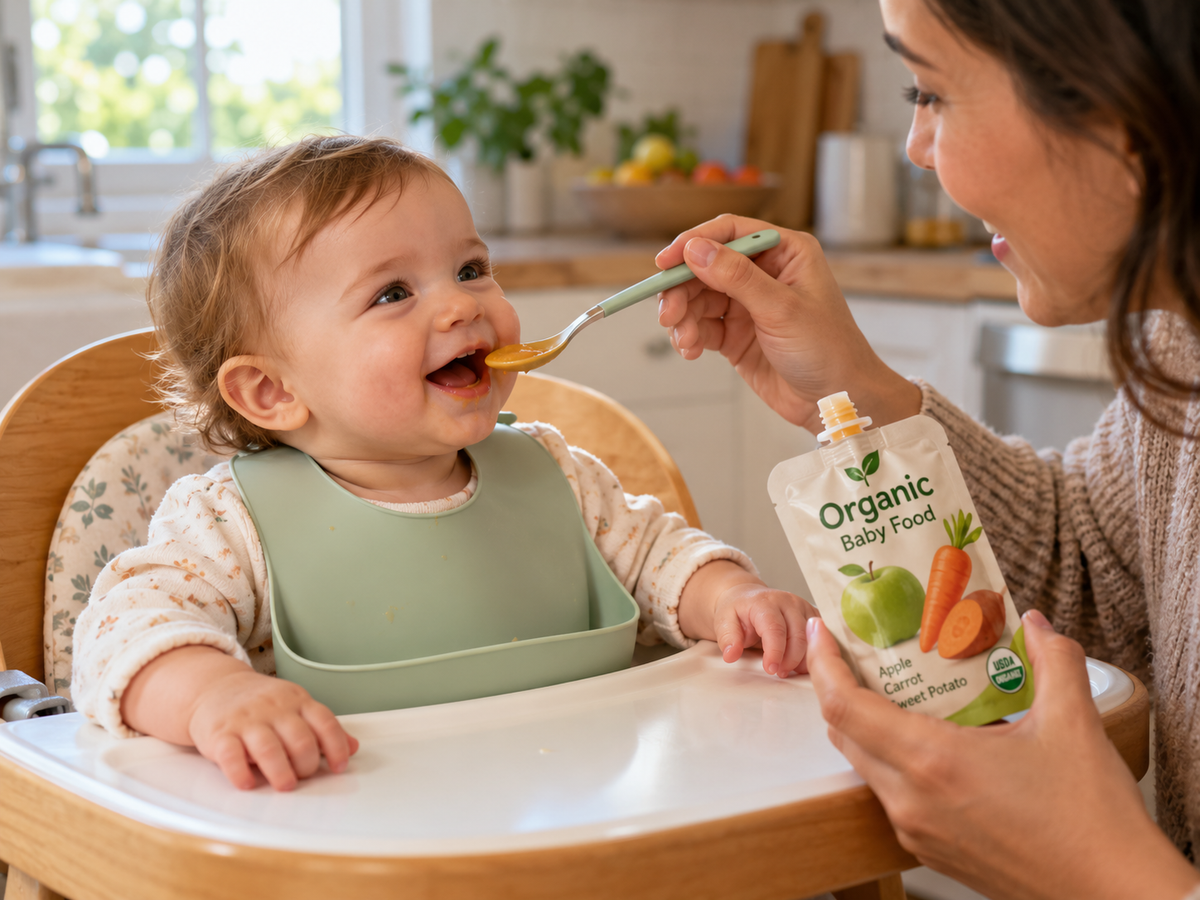
Nothing sharpens label-reading like handing a spoon to someone who can't read yet.
I wrote that line in It Usually Starts With One Fact, a list of the twelve things that tend to tip people into buying organic. A baby at home was number one. The pattern is old enough to have a name. A 2006 US report called baby food a "gateway food", one of the first organic things most people ever buy.
New Zealand fits the pattern. In the year to November 2020, baby products made up 2.7% of everything sold in New Zealand supermarkets, according to OANZ's market report. They made up 8.1% of organic sales. By my sums, that's three times their share. Put another way, roughly 7% of baby product sales were organic, against 2.3% across the whole shop. That's my estimate, not OANZ's. The report doesn't say whether that includes formula. OANZ hasn't published a newer breakdown.
The same report says many millennials start choosing organic when their children start solids. "There is a strong linkage between organics and parenting," it says.
So if you're standing in the baby aisle wondering whether organic is worth it, you're in a long queue. I went and looked at the brand that filled most of the organic baby shelf at the supermarket I checked.
The first one
Only Organic says it was the first certified organic baby food brand in New Zealand and Australia. It said so in a sponsored piece on Stuff on 1 October, paid for by its owner, McCallum Industries.
Muir McCallum started the brand in 1994, according to Supermarket News, and it has been made in Henderson ever since. Only Organic's terms and conditions show it as a division of McCallum Industries, a West Auckland family company. You may know its other famous product. It's PALM corned beef.
McCallum makes a second baby food too. Natureland is its range that isn't sold as organic. A 2020 trade piece called Only Organic Natureland's "big sister brand", and Natureland's pouch carries the same street address as McCallum. The sponsored piece doesn't mention it.
None of that is a problem. It's useful to know, though. On the shelf, the organic pouch and the one next to it that isn't can come from the same family firm. The brand isn't what makes the difference. The certification is.
In that sponsored piece, McCallum's general manager, Jessica Tran, says consumers "want to know where their food comes from".
Fair enough. So I turned the pouches over.
What the pouch tells you
Most of what you need is on the back.
There's an organic certification mark from AsureQuality, the certifier, with a certificate number. That number is the point. It means someone other than the brand checks the claim.
Each organic ingredient carries an asterisk, explained underneath as a certified organic ingredient. If an ingredient has no asterisk, it isn't one.
Then there's a small box that says "Made in New Zealand". Under it, one line answers Tran's question honestly, if not precisely. The food was produced using "imported and local" certified organic ingredients.
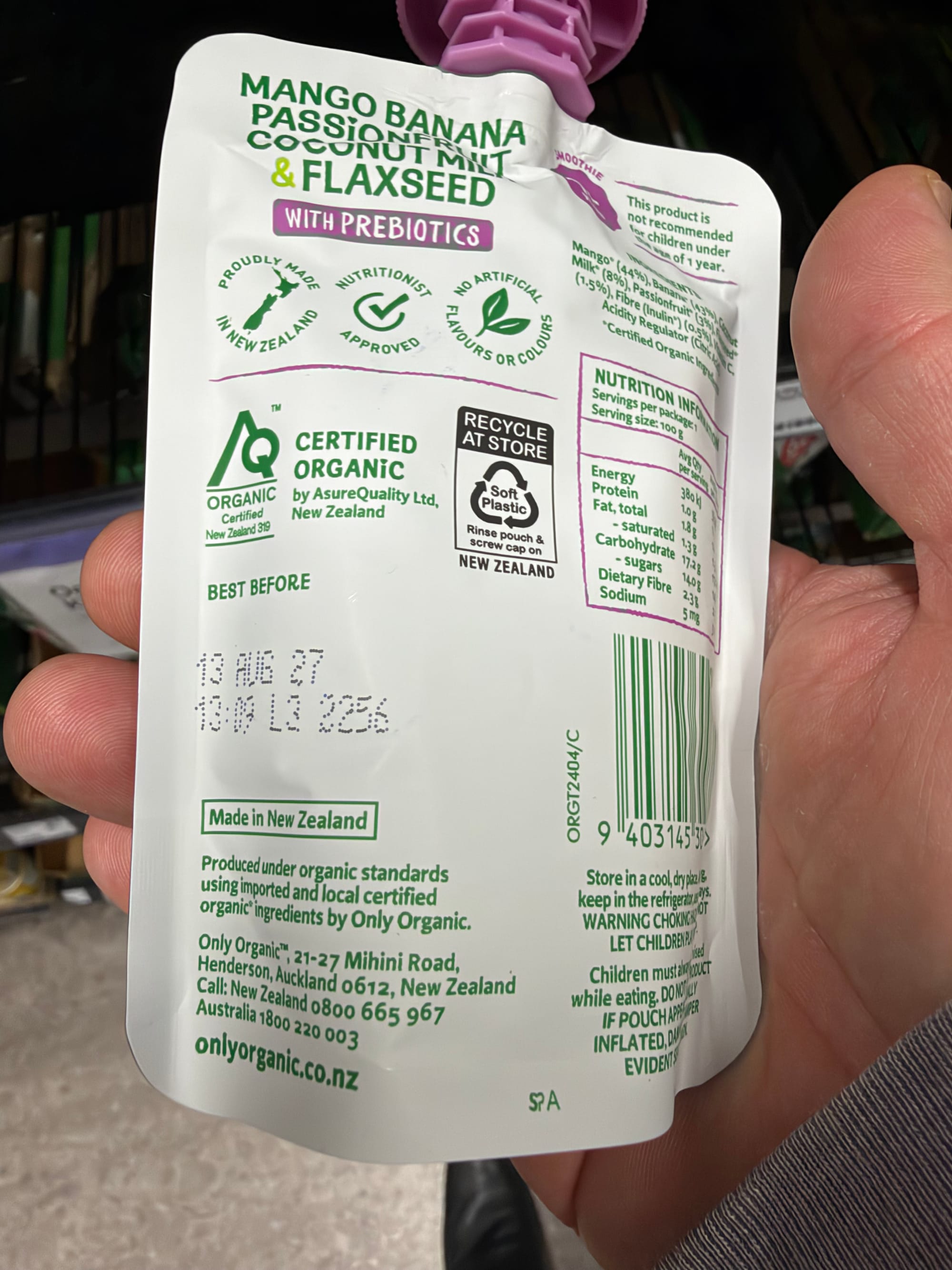
Which is which, the pack doesn't say. Neither does the FernMark licence page, the government's country-of-origin mark. Its 40 Only Organic products are all ticked as made in New Zealand, and none as grown here. Under the FernMark rules, made here is enough. You can sometimes work it out from the ingredients. The mango, banana and passionfruit smoothie is 44% mango and 43% banana. The Kindy beef bolognese says its beef is New Zealand grass-fed.
Some Only Organic products aren't made here at all. The rice cakes I picked up were made in Belgium and the Netherlands, the oat bars in Switzerland, each made "for" Only Organic. The packs say so plainly, in that same little box. The sponsored piece doesn't.
The other brands are worth turning over too. A Wattie's beef bolognese pouch I picked up says "Made in Australia". The Wattie's organic vegetable pouch carries ACO certification, one of the organic marks recognised in Australia.
Why it might matter
The bigger question is whether any of this changes what ends up in your baby.
Between 2015 and 2017, a Massey University team tested urine from 501 New Zealand children. I've written it up in full. They carried two to seven times more of one pesticide marker than children in the US, Spain and Thailand. The researchers' best guess for the main source was food.
When a Seattle study swapped much of the children's food for organic, markers for two insecticides dropped to undetectable within days. They came back when the normal food did.
Now the caveats, because they matter. Every level in the New Zealand study sat below health guidance values. In the same study, children who ate more organic fruit didn't show lower levels, though few of them ate much organic. And nobody has shown that the amounts found in food harm children. Nobody has shown they're harmless, either.
What that leaves you with is a choice, not a verdict. Change what your baby eats, and what passes through them changes too, quickly.
What to look for
The word organic on the front is a promise. The certifier's mark on the back is what makes it checkable.
The "Made in" box is the most straightforward line on the pack. Read it.
Organic doesn't always cost more. At PAK'nSAVE Whakatane on 3 October, most Only Organic pouches were cheaper than most Wattie's pouches that weren't organic. Prices move between stores, so check yours.
You can't taste whether it was sprayed. You can turn the pouch over.
Before you go
If this was useful, you can sign up free to get new posts by email. If you'd like to support the work, there's a one-off tip jar.