Europe Rejected Four Indian Organic Certifiers. Is New Zealand Checking Its Imports?
In 2022 Europe stopped accepting four organic certifiers for Indian products. New Zealand's 2023 law gives MPI the same power. It just doesn't switch on until 31 March 2028.

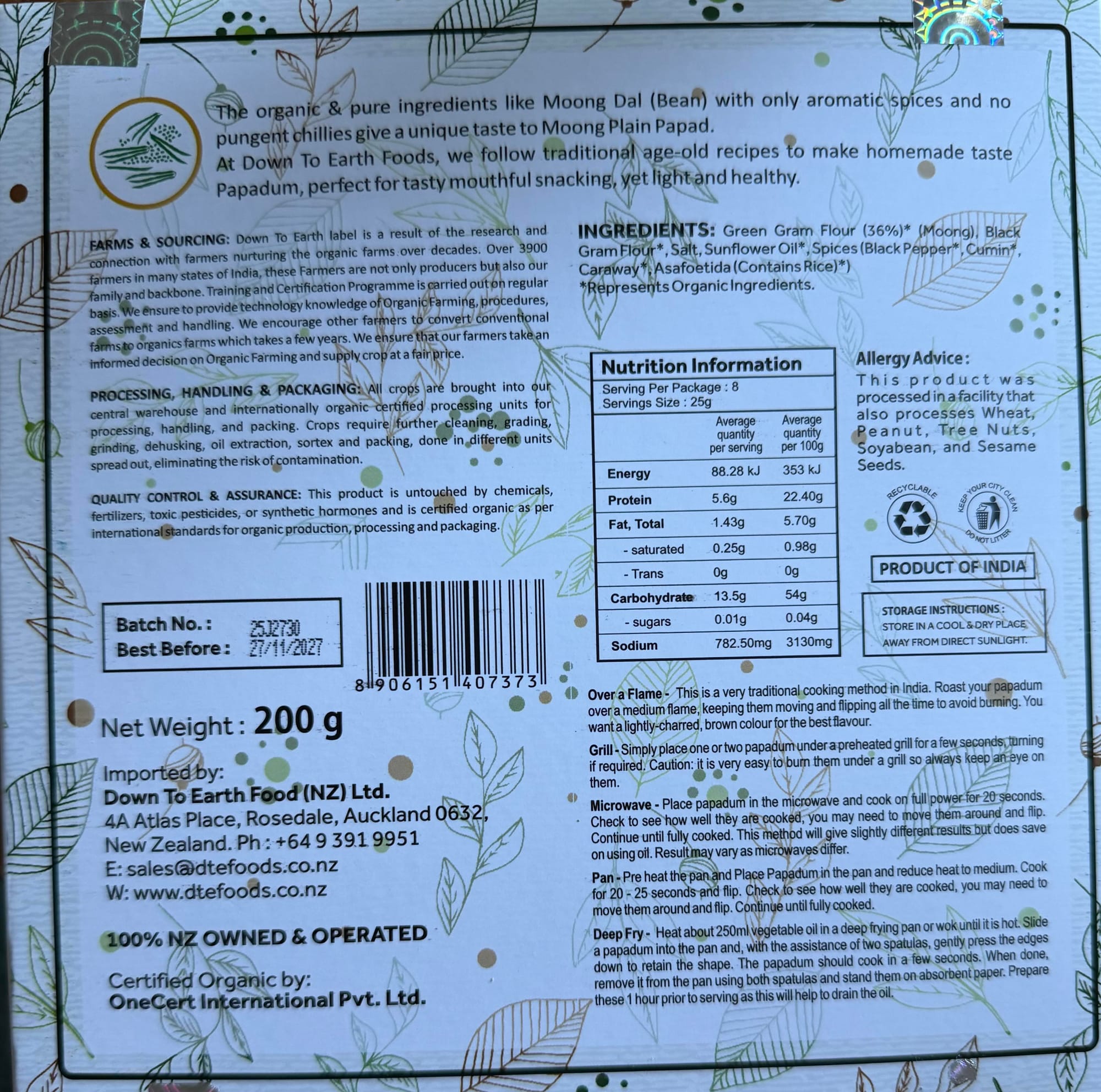
There's a box of moong dal papadums at the back of my pantry. Product of India, imported by a company in Auckland. On the back, in bold type: "Certified Organic by: OneCert International Pvt. Ltd."
I bought it without a second look. Then I read the European regulations behind this piece, and that name was in them.
The spice shelf
Organic turmeric. Organic cumin. Organic coriander. Organic ginger. Organic cinnamon.
Search New Zealand's online spice shops and you'll find plenty of them, a good share grown in India and packed here. Some listings say exactly who certified the spice. Some say "certified organic" and stop there.
That doesn't mean those spices aren't organic. A retailer can hold a perfectly good certificate without publishing it. It does leave a shopper with no way to check, which is an odd position for a product whose whole premium rests on having been checked.
So I went looking for who checks it. The trail started in Brussels.
Europe acted twice
In December 2021 the European Commission removed five India-based certifiers from the list India's own regulator supervises. OneCert was one of them. The reason was sesame seed. Thousands of tonnes of supposedly organic sesame had arrived from India contaminated with ethylene oxide, a fumigant the Commission describes as carcinogenic for humans. It produced about 90 alerts. The Commission said contamination levels usually far exceeded the legal maximum, and that the certifiers had not dealt with the root cause.
Ten months later, on 24 October 2022, it went further. Four certification bodies lost EU recognition for products from India: Control Union Certifications, Ecocert, Lacon and OneCert. Only OneCert is based in India. The other three are Dutch, French and German.
The 2022 regulation cites contamination of a large number of Indian consignments with substances not allowed in organic or conventional production, often far above EU residue limits, ethylene oxide among them. It says the four bodies failed to show the products met equivalent organic rules, and failed to take corrective action.
OneCert's European recognition in India had covered processed food. A papadum is processed food. My box is good until November 2027.
It was a narrow decision. It didn't ban Indian organic food, and it didn't cancel these certifiers' work elsewhere in the world.
OneCert hasn't gone anywhere at home
India's organic regulator, APEDA, still lists OneCert as an accredited certifier under India's national organic standard, with accreditation valid until 26 October 2027. The same list notes that OneCert has not been eligible for some EU product categories since January 2022.
In February 2026 APEDA published a penalty of 250,000 rupees against OneCert. It was one of six certifiers fined after a meeting in December 2025. The circular doesn't say why.
So the papadums in my pantry may well be properly certified. To its credit, the box names its certifier, which is more than some online listings do. What it doesn't say is which standard. The label says only that the product is certified organic "as per international standards".
Neither EU regulation mentions spices or papadums. The question for New Zealand is about the certifiers, not the crop. If Europe stopped trusting them for India, did anyone here look at what they had certified for us?
What New Zealand asks of imported organic food today
Not much that's specific to organic. MPI's importing organics page says organic imports must meet the same rules as any other imported food, and that use of the word "organic" is managed by the Commerce Commission under the Fair Trading Act 1986. MPI describes its own role as helping make sure imports are correctly sourced and labelled, safe to eat, and free from pests.
MPI's guidance for sellers adds that if you claim a product is certified organic, you must be able to back that up with a certificate. That puts the burden on the business to hold the evidence. Nothing in MPI's import guidance describes anyone looking at that evidence before the product reaches a shelf.
And the evidence has to be the right evidence. A certificate covers a particular operator, a particular product and particular steps in the chain. A certified farm in India doesn't automatically cover the packet on your bench if the spice was shipped in bulk, repacked here, or blended with other spices along the way. Each of those is a step where organic and non-organic product can meet. In MPI's own export programme, every operator involved in producing, processing and exporting an organic product has to be certified, from grower to exporter. A generic organic logo on a product page tells you none of that.
Going the other way is a different story. A New Zealand business exporting organic product to Europe, the US, Japan or China under MPI's Official Organic Assurance Programme needs an organic management plan verified by AsureQuality or BioGro, the only two agencies that can certify it. It must register with MPI and get an official assurance for each consignment. For Europe, that assurance has to be issued before the goods leave New Zealand.
To be fair to MPI, those rules are set by the countries buying from us. Each export market has its own published requirements, and the exporter has to meet them. And it isn't only imports that get the light touch. A New Zealand grower selling only at home doesn't currently have to be certified at all. MPI's guidance says you can choose to be.
Still, the gap is real. Other countries demand that paperwork of our exporters. We don't yet demand the equivalent of theirs.
Testing isn't the same as checking
MPI does test imported food. Its Food Residues Survey Programme samples New Zealand-grown and imported plant foods from shops and distributors, and most samples are tested for more than 400 agricultural chemicals. When a result is over the legal limit, MPI traces it back to the grower or importer. MPI has also surveyed chemical contaminants in imported dried spices, although that work was published more than a decade ago.
A residue test answers a food safety question: is this under the limit for ordinary food? It doesn't tell you whether a farm was inspected, what went on the soil, or whether the paperwork follows the spice from field to packet. A spice can pass every residue limit and still not be organic. A trace of pesticide in an organic spice doesn't prove fraud either, because drift happens. Certification is the check on the system, and nothing else does that job.
Which raises a practical question. When MPI's testing does find a residue in a spice sold as organic, does anyone then look at whether it should still be sold as organic? Or does the file close once the result is under the limit for ordinary food? MPI's published description of the programme doesn't say.
The law already has Europe's tools
Here's the part I didn't expect. The Organic Products and Production Act 2023 contains almost exactly what Europe used.
Section 62 lets MPI approve a foreign organic system only if it has equivalent or similar outcomes to ours, and lets MPI withdraw that approval when it stops being satisfied. Section 61 says an imported product can't be described as organic unless it meets the New Zealand standard or comes through an approved system. Selling one that doesn't is an offence carrying a fine of up to $250,000 for a company. Anyone importing organic products to sell must be approved by MPI, and an importer who retails what they import gets no exemption. Section 54 requires a free public register of every approved operator.
That's the register I mentioned in The $10,000 Line. A shop selling someone else's prepackaged organic goods, with the packaging intact, doesn't need approval itself.
None of it applies yet. These sections only bite once a product is covered by an organic standard, and the Organic Standards Regulations come into force on 31 March 2028. MPI's consultation on penalties for the new system closed on 22 September.
MPI's own page on selling organic products, last reviewed in July 2026, still describes the Act as a Bill that will help "if accepted". It was accepted in April 2023.
Then a trade deal arrived
New Zealand's free trade agreement with India came into force on 20 October 2026. Attached to it is a side letter on organics, signed by both countries' trade ministers in April.
The letter sets up an interim arrangement for trade in organic food and agricultural products, starting the day the agreement took effect. For now, the yardstick is a third country's standard that both sides accept: Australia's. The two governments then say they will try to finish a full assessment of whether their organic systems are equivalent within 12 months.
India's government expects organic basmati rice, flax seeds, psyllium husk and black tea to be among the products that gain traction.
The letter doesn't name any certifiers. It doesn't say how the interim arrangement works for Indian products coming here, either.
So the question in this piece now has a rough deadline. Within about a year, New Zealand is meant to decide whether India's organic system measures up. OneCert is an accredited part of that system today. Europe looked at the same certifiers in 2021 and 2022 and drew its conclusion.
What happens next
New Zealand has the law to do what Europe did, and a trade deal that puts India's organic system in front of it. The question is what it looks at, and what happens in the meantime.
Four things I couldn't find answered anywhere on the public record:
- Before 31 March 2028, does anyone other than the seller check the overseas certificate behind an imported product sold here as organic?
- Does anyone in New Zealand keep track of overseas certifiers that a major regulator has suspended or dropped?
- After Europe's 2021 and 2022 decisions, did MPI or the Commerce Commission look at whether products certified by those bodies were being sold here as organic?
- When New Zealand assesses India's organic system under the trade deal, or approves foreign systems under section 62, will it look at certifiers another major regulator has stopped trusting?
I haven't found any New Zealand retailer selling Indian food under invalid certification, or any sign that the consignments Europe flagged came here.
Plenty of Indian growers and New Zealand importers do this properly, and they have the most to lose from a loose system. An importer who pays for genuinely certified spice, and keeps the paperwork that follows it from farm to packet, is competing on price with anyone willing to print the same word without that cost behind it. Better checking is what makes their certificate worth paying for.
Until 2028, the best tool a shopper has is the one from the farmers' market. Ask who certified it, and to which standard. My papadum box answers the first question and not the second.
Europe made its call four years ago. New Zealand has given itself a year to make its own.
Before you go
If you found this useful, you can get new posts free by email.
If you'd like to support the work, you can leave a one-off tip.