New Zealand’s Only Certified Organic Chicken
In New Zealand there’s only one nationally available certified organic chicken producer: Bostock’s. Started by the Bostock family on their Hawke’s Bay organic orchard, they raised organic free-range birds with organic grain, no antibiotics or GMOs, and premium air-chilled processing.
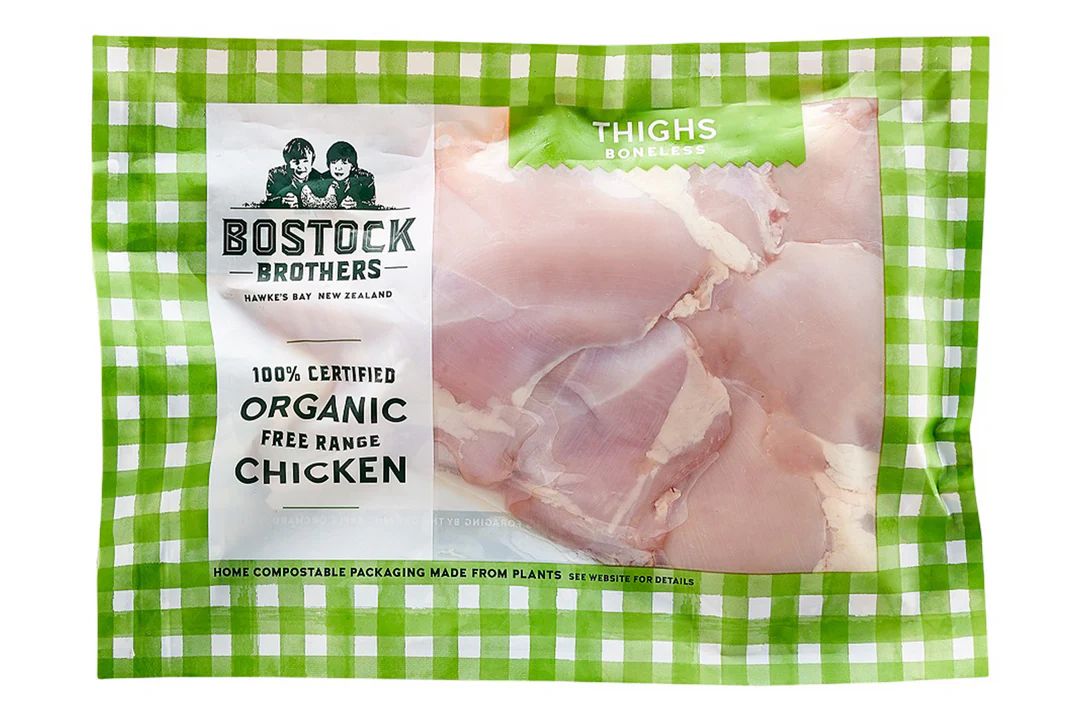
If you are buying certified organic chicken in New Zealand, you are buying Bostock’s. There is currently no other nationally available, certified organic chicken producer in the country.
That matters.
It means the organic poultry category here is not competitive. It is singular.
Who Started Bostock’s?
Bostock Brothers Organic Free Range Chicken was founded in 2014 by brothers Ben and George Bostock in Hawke’s Bay.
The Bostock family were already long-time organic apple growers through Bostock New Zealand, operating organically since the 1990s. The chicken business grew out of that existing organic orchard system.
The idea was vertical integration:
- Grow organic grain
- Raise organic chickens
- Control the supply chain
- Sell nationally
From the start, they positioned themselves as:
- Certified organic (feed + land)
- Free range
- No antibiotics
- No GMOs
- Air-chilled processing
That last point is important. Air-chilling is slower and more expensive than water immersion chilling. It avoids water absorption and chlorine use, and produces a firmer texture. It’s a premium process.
Why They Feel Older Than 2014
The chicken brand itself started in 2014.
But the Bostock family organic farming story goes back decades. That legacy makes the brand feel established and embedded.
They expanded steadily into:
- New World
- Pak’nSave
- Countdown
- Farro
- Costco
- Direct online delivery
Within roughly a decade, they became synonymous with “organic chicken” in New Zealand.
Because they are the only certified organic chicken producer, they effectively own the category.
Why It Costs So Much More
Organic poultry is expensive to produce. The main cost drivers:
- Certified organic grain (significantly higher cost than conventional feed)
- Slower growing birds
- Lower stocking densities
- Outdoor access requirements
- Organic compliance auditing
- Air-chilled processing
You are paying for feed standards and system compliance, not just marketing.
Whether that premium aligns with your values is personal. But the cost difference is structural, not random.
The 2024 Sale to Inghams
In 2024, the chicken business was sold to:
Inghams Enterprises
The reported sale price was approximately NZD $35 million.
The brand continues to operate as “Bostock’s Organic,” but ownership now sits under a large corporate poultry group.
This is where context matters.
Who Owns Inghams?
Inghams Enterprises is one of Australasia’s largest poultry producers, operating across Australia and New Zealand.
Inghams is owned by:
TPG Capital
(a US-based private equity firm)
TPG Capital acquired Inghams in 2013 and later relisted it publicly before regaining full control. Inghams operates large-scale conventional and free-range poultry operations across both countries.
This means Bostock’s now sits within a vertically integrated, multinational poultry system rather than as a standalone family-owned business.
What This Means
- Bostock’s remains New Zealand’s only certified organic chicken.
- The brand was built by an organic orchard family.
- It is now owned by a large poultry corporation backed by global private equity.
- Organic certification standards still apply regardless of ownership.
- The supply chain is now likely more scalable and nationally secure.
For some buyers, corporate ownership changes perception.
For others, certification standards are what matter most.
Both views are valid.
The Bigger Picture
There are plenty of free-range chickens in New Zealand.
There is currently only one certified organic chicken.
That’s Bostock’s.
If more farmers stepped into certified organic poultry, the category would be more competitive and likely more affordable.
Until then, the organic chicken shelf in New Zealand is effectively a single-brand space.
Ownership note:
Inghams Enterprises is owned by TPG Inc. (formerly TPG Capital), a publicly listed US-based private equity firm. Major shareholders in TPG include large institutional investors such as The Vanguard Group, BlackRock, Capital Research and Management Company, and Temasek Holdings, alongside significant shareholdings held by TPG’s founders and senior executives. Ownership is widely distributed across institutional investors rather than controlled by a single individual or government entity.