Farmer Brown: New Zealand’s Biggest Egg Brand — and the System Behind the Golden Yolk
Farmer Brown is New Zealand’s biggest egg brand, backed by a vertically integrated agribusiness producing roughly a third of the nation’s eggs. From colony cages to free-range, golden yolks are driven by feed formulation, not farming romance. This is the system behind the carton.
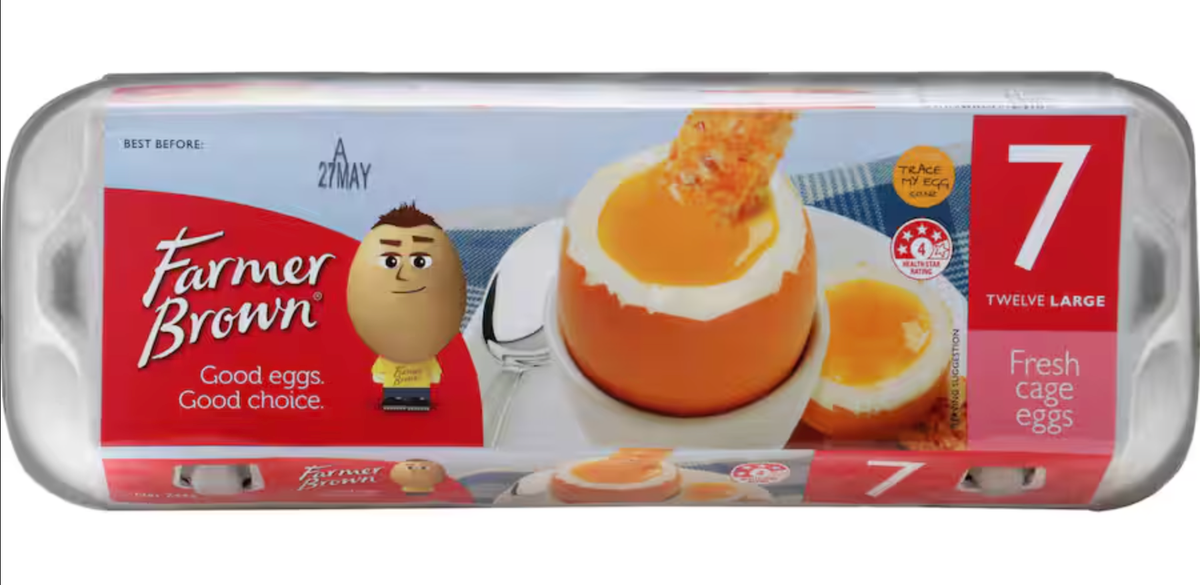
If you’ve stood in a New Zealand supermarket egg aisle in the last 20 years, you’ve seen Farmer Brown.
Red cartons. “Golden yolks.” Affordable. Familiar.
It’s the default egg for a large percentage of Kiwi households.
Which makes it worth understanding properly.
This isn’t a hit piece. It’s a system breakdown.
What Farmer Brown Actually Is
Farmer Brown is a retail brand owned by Zeagold Foods, the trading identity of Mainland Poultry, widely reported as New Zealand’s largest egg producer.
In 2017, Malaysia-based private equity firm Navis Capital Partners acquired approximately 75% of Mainland Poultry. Navis is headquartered in Kuala Lumpur and invests across Southeast Asia, Australia and New Zealand.
This is not a small farm brand.
It’s a vertically integrated agribusiness:
- Feed milling
- Chick rearing
- Layer farms
- Grading and packing
- Processed egg products
- National distribution
Scale is the advantage. Efficiency is the engine.
How Big Is the NZ Egg Market?
New Zealand produces roughly 1.1–1.2 billion eggs per year.
Per capita consumption sits around 229 eggs per person annually (EPF estimate, June 2025).
Eggs remain one of the cheapest sources of animal protein in the country.
Zeagold/Mainland is widely reported to produce around one-third of national supply — roughly 33–35%.
That makes Farmer Brown one of the most structurally important food brands in the country.
Supermarket retail egg sales have previously been reported around $285–286 million annually. Updated public retail breakdowns are limited, though pricing has shifted with inflation.
The Three Production Systems That Matter in NZ
Since the 2023 ban on conventional battery cages, NZ operates under three primary systems:
1. Colony (Enriched Cage)
Minimum 750 cm² per hen.
Perches. Nest boxes. Scratch areas.
A regulatory improvement over old battery cages.
Still cages. Still indoors.
This is where affordability largely sits.
2. Barn (Cage-Free Indoor)
No cages. Large indoor sheds. More freedom of movement.
Still fully indoor systems.
Mid-tier pricing.
3. Free-Range
Outdoor access.
Higher land requirement. Higher production cost. Greater biosecurity complexity.
Ethically preferred by many consumers.
Not financially accessible to everyone.
Quick Comparison: Colony vs Barn vs Free-Range
| Feature | Colony | Barn | Free-Range |
|---|---|---|---|
| Housing | Enriched cages | Indoor, no cages | Indoor + outdoor access |
| Space per hen | Minimum regulated (750 cm²) | More than colony | Highest (indoor + outdoor) |
| Outdoor access | No | No | Yes |
| Stocking density | High | Moderate | Lower |
| Land requirement | Low | Low | High |
| Production cost | Lowest | Mid | Highest |
| Retail price | Cheapest | Mid-range | Most expensive |
| Welfare perception | Contested | Improved | Highest (consumer perception) |
| Yolk colour | Feed-driven | Feed-driven | Feed + pasture |
The Colony Labelling Debate
In 2025–2026, RNZ and welfare groups renewed criticism that “colony laid” packaging does not explicitly say “caged.”
The concern: consumers may interpret colony as cage-free.
No regulatory change has occurred yet. Colony remains legal and widely used.
However, pressure is building.
Major supermarket chains have signalled longer-term moves toward cage-free sourcing around 2027.
If that proceeds, it will reshape the economics of the egg aisle again.
The Golden Yolk: Designed, Not Accidental
Farmer Brown markets “deep golden yolks” as a signature feature.
Yolk colour is driven by carotenoids in the hen’s diet:
- Maize (yellow base)
- Marigold extract (lutein)
- Sometimes alfalfa or paprika in broader industry practice
Hens deposit pigment from feed directly into the yolk.
Change the feed → change the colour.
A colony hen indoors can produce a yolk as deep as a free-range hen if the ration is formulated accordingly.
Important distinctions:
- Colour does not indicate housing system.
- Colour does not automatically indicate superior welfare.
- Colour does not automatically indicate higher omega-3.
- Colour reflects feed formulation.
It is chemistry, not pasture mythology.
What’s Actually in Commercial Layer Feed?
A typical large-scale NZ layer ration includes:
Energy base:
- Maize and/or wheat
Protein:
- Soybean meal
- Sometimes sunflower meal
Fats:
- Vegetable oils
Minerals:
- Limestone (calcium)
- Dicalcium phosphate
- Salt
Amino acids:
- Methionine
- Lysine
Vitamin/mineral premix:
- A, D, E, B-complex
- Selenium, zinc, manganese
Pigment inputs:
- Marigold
- Maize
This is performance nutrition. Precisely formulated for output, shell strength and feed conversion efficiency.
Cheap eggs are not achieved by stripping nutrition.
They are achieved by system efficiency.
Why Farmer Brown Eggs Are Cheap
Key cost levers:
- Bulk grain purchasing and in-house milling
- High stocking density in colony systems
- Automation in egg collection and grading
- Standardised high-output layer genetics
- Vertical integration removing margin stacking
Colony systems require less land than free-range.
Less land lowers capital cost.
Lower capital cost lowers retail price.
That’s the structural advantage.
Trace My Egg: The Practical Tool
Each egg carries a stamped 5-digit code.
On Trace My Egg, you can enter that code to see:
- Farm location
- Production system (CL, BN, FR, OR)
If welfare matters to you, that code is more reliable than yolk colour.
Colour can be engineered.
Housing system cannot.
What Farmer Brown Represents
Farmer Brown represents:
- Affordable, scalable protein access
- Industrialised food production
- The tension between cost and welfare
- The centre of the colony labelling debate
It is neither villain nor hero.
It is infrastructure.
Without brands like Farmer Brown, egg prices in NZ would likely be significantly higher.
The real question isn’t whether the yolk is golden.
It’s which production system you choose to support.